Many factory delays do not happen because a company forgot one obvious licence. They happen because the applicable approval requirements were never mapped correctly in the first place, or because the capacity, process and layout details in different applications did not match each other.
By the time this is discovered — often during construction, commissioning or a statutory inspection — fixing it costs time, money, and sometimes a re-application. Factory compliance in India means checking whether a facility has the approvals, licences, safety arrangements, environmental consents, workplace controls and ongoing records that are applicable to its specific industry, location and operations.
The exact checklist is never identical for two factories. This article is built around the factory compliance checklist in India that project teams actually need: how to identify what applies to your facility, what to verify before operations, and what to prepare before an inspection.
1. What Does Factory Compliance Mean in India?
In practical terms, factory compliance is not one event. It runs across the life of a project in stages, and each stage carries a different set of checks.
- Initial approvals/licences: registrations and permissions needed before or during setup, based on sector, location and scale.
- Construction/establishment permissions: building plan approval, land use, and site-related clearances.
- Pre-operation requirements: consents, inspections or certifications that must be in place before commissioning or production start-up.
- Safety and environmental compliance: fire safety, machine safety, pollution-control systems and hazardous-material controls suited to the actual process.
- Ongoing operational compliance: routine records, monitoring, reporting and statutory registers maintained through the year.
- Renewal/amendment requirements: keeping approvals current, and revisiting them when capacity, process, materials or layout change.
Treating these as one checklist, ticked once at project start, is where most gaps begin. Compliance status needs to be revisited whenever the facility itself changes.
2. How to Identify Which Factory Approvals Apply to Your Project
There is no single national list of “factory licences” that applies uniformly to every plant. What is applicable depends on a combination of project-specific factors, and applicability should be assessed early — ideally before construction begins, not after a query is raised
A reasonably reliable applicability assessment considers:
- Sector — chemicals, food processing, pharmaceuticals, engineering, textiles and other sectors carry different licensing frameworks.
- Location — approvals and procedures differ by state, industrial area authority and local body.
- Process — the specific manufacturing process determines hazard classification, emissions and effluent character.
- Capacity — installed and operating capacity can shift which category of approval or consent applies.
- Raw materials and hazardous materials — certain materials bring in additional storage, handling and safety obligations.
- Storage quantities — volumes stored on-site can cross thresholds that change the applicable approval category.
- Utilities — boilers, pressure vessels, power load and fuel systems often need separate, equipment-specific approvals.
- Environmental impact and product category — scale of emissions/effluent, and whether the product needs standards-based certification.
Using the National Single Window System (NSWS)
The Government of India’s National Single Window System, run by DPIIT, includes a Know Your Approvals (KYA) module — an online questionnaire that generates an indicative list of central and state approvals based on the details a user enters about the business.
KYA is a useful starting point for orientation, but it is explicitly an advisory and guidance tool. It does not replace a project-specific verification of applicability against the actual process, site, capacity and materials involved — this verification should still be done for the specific facility before relying on any indicative list.
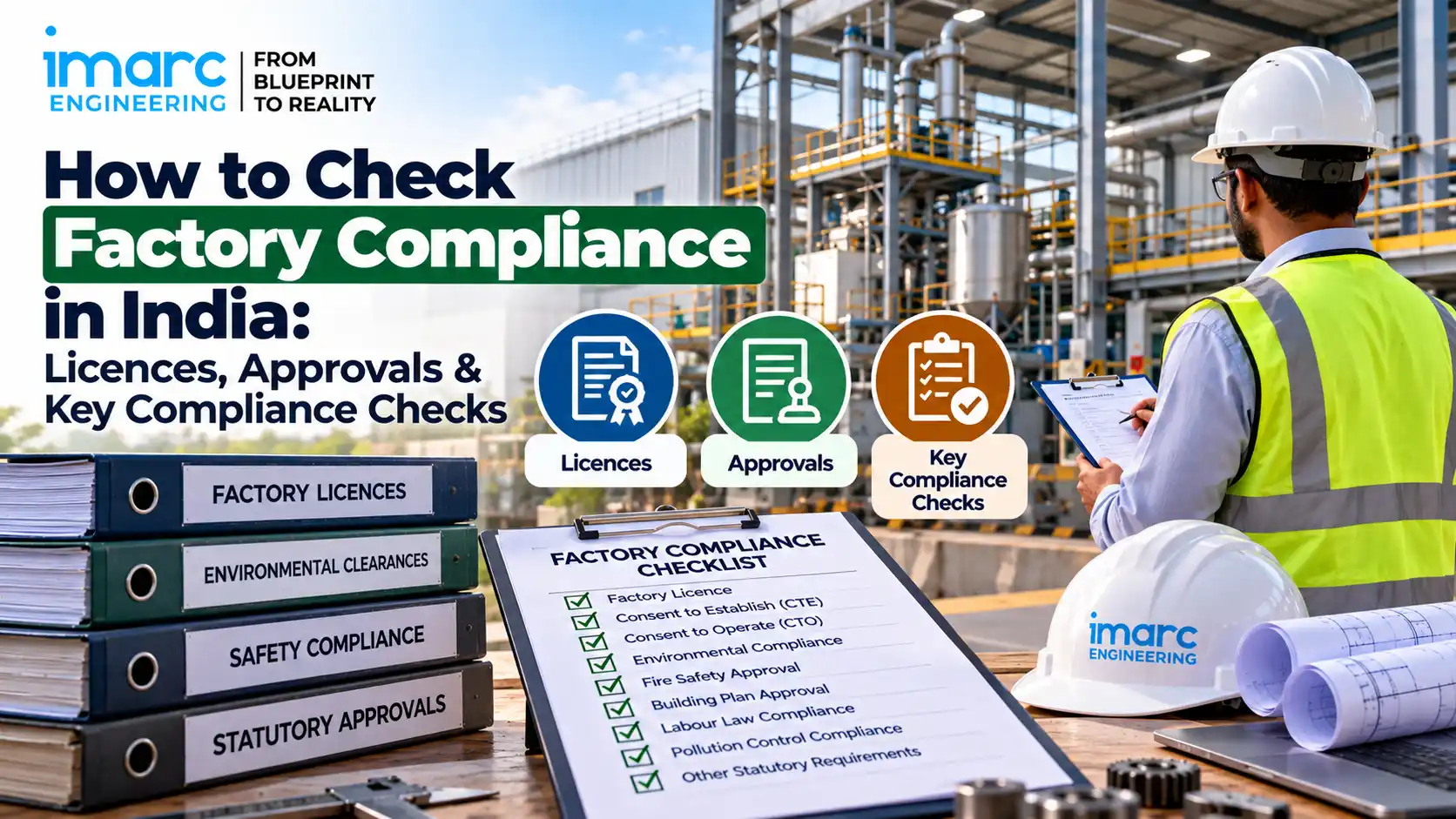
3. Factory Compliance Checklist in India
The sections below outline what to check across ten practical areas. Not every item applies to every factory — applicability depends on the factors covered in Section 2 and the Applicability Matrix in Section 4.
1. Factory approval, registration and licensing
Check whether the facility’s factory approval/registration is current, matches the actual site, and is held for the correct entity and location. A common gap: the licence exists, but the registered capacity, premises boundary or activity description no longer matches what is actually operating.
2. Land and building compliance
Confirm land use permission, building plan sanction and completion/occupancy-related approvals are in place and match the constructed layout. Buildings constructed with deviations from the sanctioned plan are a frequent and avoidable source of compliance notices.
3. Environmental compliance
Depending on the category and scale of the project, this can include Environmental Clearance, Consent to Establish and Consent to Operate from the relevant State Pollution Control Board, along with pollution-control systems appropriate to the actual process (see Section 5).
4. Fire and safety compliance
Verify the fire NOC and fire-safety systems are sized for the current building use and occupancy, not just the use approved at the design stage. Layout changes after approval are a common reason fire systems fall out of alignment.
5. Machinery and workplace safety
Check machine guarding, electrical safety certification, load testing of lifting equipment, and whether workplace safety measures match the machinery actually installed — not only what was listed at the approval stage.
6. Hazardous material and storage compliance
Where hazardous chemicals are stored or handled, check whether storage quantities, handling procedures and on-site emergency arrangements are consistent with applicable thresholds and with what is actually kept on site.
7. Utility and equipment-related approvals
Boilers, pressure vessels, DG sets, transformers and similar utilities are typically regulated separately from the general factory licence and need their own registration, periodic inspection or certification.
8. Labour and worker welfare compliance
The Occupational Safety, Health and Working Conditions Code, 2020 forms part of India’s current occupational safety and working-conditions framework. Because applicable requirements depend on the rules and implementation status in the relevant jurisdiction, factories should verify current registration, working-hour, worker-welfare and record-keeping requirements applicable to their state rather than relying on an older Factories Act checklist alone.
9. Sector or product-specific approvals
Certain products need standards-based certification (for example, under the Bureau of Indian Standards regime) before sale, and certain activities — such as handling of specified petroleum products or explosives — fall under the Petroleum and Explosives Safety Organisation (PESO). Check whether these apply based on the actual product and materials.
10. Ongoing compliance, renewals and amendments
Confirm renewal timelines for every approval held, and whether any recent change in the plant should have triggered an amendment application. An approval that was correct on the day it was issued can become non-compliant simply because the plant changed around it.
4. Factory Compliance Applicability Matrix
This matrix is a guide to the project factors that drive applicability — it is not a substitute for a facility-specific assessment.
| Project Factor | Why It Matters for Compliance | What Should Be Checked |
|---|---|---|
| Industry / sector | Different sectors (chemicals, food, pharma, engineering, textiles) carry different licensing and product-approval regimes. | Sector-specific licences, product certifications, and any dedicated regulator for that industry. |
| State / location | Factories law, fire rules, building bye-laws and pollution categorisation are administered at state and local level and vary in procedure. | Applicable state Factories/Labour Rules, local municipal or industrial-area authority requirements, zoning. |
| Manufacturing process | The process determines emissions, effluent, noise, hazard classification and machinery risk. | Process flow against environmental and safety categorisation; whether the process is listed as hazardous. |
| Production capacity | Capacity thresholds often decide whether an approval, a higher category of consent, or added safety provisions apply. | Installed/approved capacity in the licence versus actual or planned capacity. |
| Raw materials | Certain raw materials trigger storage, handling, labelling or import-related compliance. | Material Safety Data Sheets and whether materials fall under any regulated or hazardous list. |
| Hazardous materials | Handling of hazardous chemicals may bring in additional safety, storage and reporting obligations. | Applicability of hazardous-chemical rules and site emergency planning requirements. |
| Storage quantity | Storage above certain thresholds can change the applicable approval category or require additional safety clearance. | Quantities stored on-site against applicable threshold limits. |
| Water consumption | Source of water, consumption volume, abstraction permissions where applicable, and discharge point/method. | Source of water, consumption volume, and discharge point/method. |
| Emissions / effluent | Type and volume of emissions or effluent decide the pollution-control category and monitoring frequency. | Stack emissions, effluent characteristics, and whether treatment systems match actual load. |
| Boiler / pressure equipment | Boilers and pressure vessels are regulated separately from general factory approvals. | Boiler registration, periodic inspection certificates, and operator competency requirements. |
| Product category | Some product categories require standards-based certification before sale or use. | Whether the product needs BIS or other product-specific certification before commercial dispatch. |
5. Environmental and Pollution Compliance Checks
Environmental requirements are assessed project by project, based on the category of activity, scale, location and pollution potential — not every factory requires every environmental approval.
- Environmental Clearance (EC) — applicable to specified categories/scales of projects under the EIA framework, processed through the MoEFCC’s PARIVESH portal.
- Consent to Establish (CTE) and Consent to Operate (CTO) — issued by the relevant State Pollution Control Board, based on pollution category and scale.
- Pollution-control systems — effluent treatment, air-pollution control and solid/hazardous-waste management systems sized for actual, not assumed, discharge and emission loads.
- Waste management — segregation, storage, manifest-based disposal and record-keeping for hazardous and non-hazardous waste.
- Monitoring and records — periodic stack/effluent monitoring, log books and reports as required by consent conditions.
Where a claim is specific to your project — for example, whether EC applies, or which CPCB/SPCB category your unit falls under — it should be verified directly with the concerned State Pollution Control Board or through the PARIVESH/CPCB portals rather than assumed from a general checklist.
6. Safety, Fire and Workplace Compliance
Beyond formal approvals, day-to-day plant readiness is judged on physical conditions. Practical items to check:
- Emergency exits — unobstructed, correctly marked, and sufficient for the current occupancy.
- Fire protection — extinguishers, hydrants, alarm and detection systems tested and within validity.
- Machine guarding — physical guards in place and matched to the machinery actually running.
- Electrical safety — earthing, load capacity and periodic testing certificates available.
- PPE — appropriate personal protective equipment issued and used for the actual hazards on the floor.
- Emergency preparedness — a current on-site emergency/disaster plan and evidence of mock drills.
- Workplace safety — walkways, material storage, ventilation and noise levels within acceptable limits.
- Worker welfare facilities — canteen, restrooms, drinking water and first-aid provisions as applicable.
- Inspection and maintenance records — logs for fire equipment, lifting gear, electrical systems and pressure equipment kept up to date.
7. Common Factory Compliance Gaps
Most compliance problems trace back to a small set of recurring issues:
- Wrong approvals identified — applying for the wrong category or missing an approval because applicability was assumed rather than assessed.
- Applicability assessed too late — identified only after construction has started, leading to rework or redesign.
- Inconsistent documents — capacity, process or layout figures differ across applications, drawings and technical reports.
- Layout changed after approval — construction or equipment placement deviates from what was sanctioned.
- Capacity increased without review — production scaled up without checking whether it changes the applicable approval category.
- New raw materials introduced without review — a material change that alters hazard classification or storage rules.
- Pollution-control systems not aligned with actual operations — treatment capacity designed for a different load than what is actually generated.
- Expired or overdue permissions — renewal dates missed due to no tracking system.
- Missing inspection records — statutory tests done but not logged, or not done at all.
- Licence conditions not followed — the approval exists, but day-to-day operations don’t match its stated conditions.
- Compliance treated as one-time — no process to revisit approvals when the plant changes.
Each of these can independently stall a project timeline, trigger a show-cause notice, or complicate an inspection — even when the factory holds every licence it was originally issued.
Read Our Related Insight: How to Get a Factory License in India: Complete 2026 Guide for Manufacturers
8. How to Prepare for a Factory Compliance Inspection
Before an inspection — statutory or otherwise — a structured review reduces the chance of surprises:
- Verify approval validity — confirm every licence and consent held is within its renewal date.
- Review approval conditions — re-read the conditions attached to each approval, not just its existence.
- Check technical documents — ensure capacity, process description and layout are consistent across all files.
- Check actual layout against approved layout — walk the floor with the sanctioned drawing in hand.
- Verify capacity and process information — confirm what is running matches what was approved.
- Check safety systems — fire, electrical and machine-safety systems tested and certificates current.
- Check environmental records — consent conditions, monitoring reports and waste-disposal records in order.
- Check monitoring and maintenance records — boiler, pressure-equipment and lifting-gear logs available.
- Organise statutory documents — registers, licences and certificates accessible in one place, not scattered across departments.
- Assign responsibility — a named person ready to respond to authority queries during the visit.
9. Factory Compliance Self-Assessment Checklist
Use this as a quick internal readiness check, not a formal certification:
- Applicable approvals identified for this specific facility
- State/location-specific requirements checked
- Factory approval/licence status verified and current
- Environmental permissions checked against actual scale and category
- Fire and safety requirements checked against current layout
- Hazardous-material requirements reviewed against actual materials on site
- Utility/equipment approvals (boiler, pressure vessels, DG sets) reviewed
- Documents (capacity, process, layout) consistent with actual plant
- Approval conditions being actively followed, not just held
- Renewal/amendment requirements tracked on a calendar
- Inspection and maintenance records maintained and accessible
- Ongoing compliance responsibilities assigned to a named person or team
If several of these remain unresolved, the facility may benefit from a structured compliance review before operations, an inspection, or an expansion — rather than addressing gaps one at a time as they surface.
10. How IMARC Engineering Can Help
IMARC Engineering works alongside industrial clients on the engineering and technical side of compliance readiness — helping ensure that plant design, documentation and approvals are aligned rather than treated as separate workstreams. This includes:
- Project compliance-readiness inputs during planning and design stages
- Identification of process, layout or system gaps that could affect approval applicability
- Coordination between engineering teams and compliance/regulatory requirements
- Support for greenfield and brownfield project planning
- Regulatory approval planning support, aligned with project timelines
- Technical documentation and readiness support ahead of applications or inspections
IMARC Engineering is not a statutory or licensing authority and does not guarantee approval outcomes. Support is limited to technical, engineering and documentation readiness: https://www.imarcengineering.com/contact-us
If you are unsure which approvals apply to your factory, or want to identify compliance gaps before construction, commissioning, inspection or expansion, speak with IMARC Engineering’s team at https://www.imarcengineering.com/contact-us.
Conclusion
Factory compliance in India is not simply collecting a set of licences. It is about identifying the approvals that actually apply to a specific facility, keeping technical documents and site conditions consistent, meeting the conditions attached to each approval, and maintaining compliance continuously — not just at the point of setup. A facility that treats compliance this way is far better placed for smooth inspections, expansions and long-term operations.
Contact Us:
IMARC Engineering
Phone: +91-120-433-0800
Email: sales@imarcengineering.com
India: C-130, Sector 2, Noida, Uttar Pradesh 201301
LinkedIn: https://www.linkedin.com/showcase/imarc-engineering/
About the Author