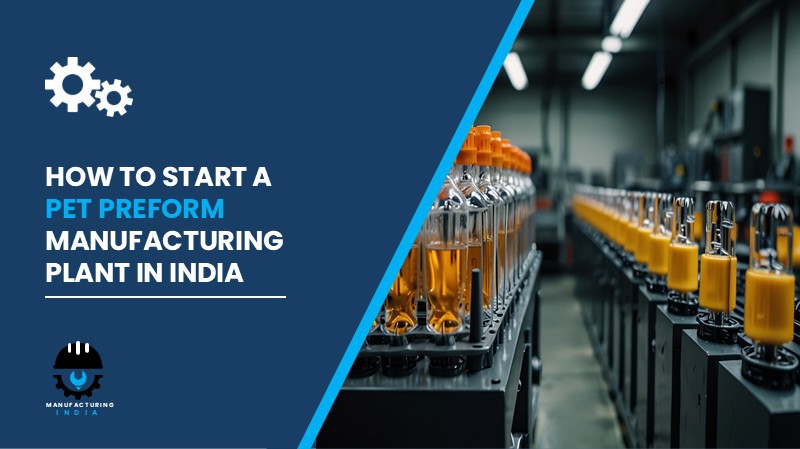
Setting up a PET preform manufacturing plant in India presents a compelling investment case driven by the country’s surging demand for lightweight, food-safe, and cost-effective packaging solutions across the food and beverage, personal care, and pharmaceutical industries. PET preforms — the injection-moulded intermediate components made from Polyethylene Terephthalate that are subsequently blow-moulded into plastic bottles and containers — serve as the foundational packaging input for some of India’s fastest-growing consumer categories, including carbonated soft drinks, bottled water, edible oils, sauces, dairy products, personal care products, detergents, and pharmaceutical liquids. As India’s FMCG sector deepens its penetration into tier-2 and tier-3 cities, and as organised food processing and beverage manufacturing continues its structural expansion, the domestic requirement for reliable, precision-engineered PET preforms is growing at a pace that makes new production capacity both commercially necessary and financially attractive.
India’s structural positioning makes it one of the Asia-Pacific region’s most strategic locations for PET preform production investment. The country is identified as a key growth market for the global PET preform industry, with expanding domestic manufacturing capacities supporting the region’s continued leadership. The Make in India and Production-Linked Incentive (PLI) programmes for food processing and FMCG indirectly strengthen demand for standardised, locally produced PET preforms, while bottle converters and FMCG brands are increasingly preferring nearby, dependable suppliers to reduce logistics costs, minimise inventory risk, and ensure just-in-time delivery. Industrial estates and packaging clusters in Gujarat, Maharashtra, Rajasthan, and Uttar Pradesh offer the PET resin supply chain access, utilities infrastructure, and proximity to major beverage and FMCG manufacturing hubs that a PET preform plant requires to operate efficiently and competitively.
Investing in a PET preform manufacturing plant in India today aligns robust and multi-sector demand from food and beverage, personal care, and pharmaceutical packaging with cost-competitive injection moulding operations, a strengthening domestic PET resin supply chain, and clear policy momentum under Make in India. With gross profit margins of 20–30% and net profit margins of 8–12%, the unit economics support a commercially sound investment, and the facility’s scalable injection moulding model enables viable break-even outcomes across annual capacities of 50,000 to 100,000 MT.
What is a PET Preform?
PET preforms are materials that serve as the direct intermediate input for producing plastic bottles and containers. These materials are created from Polyethylene Terephthalate — a high-clarity, lightweight, and strong engineering polymer — and are shaped into precise tube-like forms through injection moulding before being subjected to a stretch blow-moulding process to form finished bottles or containers of the required size and shape. PET material is recognised for its exceptional clarity, strength, and lightness, making it particularly suited to food-contact and beverage packaging applications where product visibility, hygiene, and transport efficiency are all commercially important.
Preforms are primarily utilised to package drinks, cosmetics, food products, pharmaceuticals, and household care items. The formation of PET preforms is based on injection mould technology, with the quality of the finished preform — including intrinsic viscosity (IV), weight consistency, and neck finish tolerances — determining the performance and reliability of the blow-moulded bottle produced downstream. The production process covers injection moulding and thermal conditioning as the primary manufacturing method. End-use industries served include food and beverage, personal care, and pharmaceuticals. Applications span carbonated drink bottles, food jars and tubs, detergent and cleaner containers, pharmaceutical bottles, cosmetic packaging, and lightweight single-serve containers.
Cost of Setting Up a PET Preform Manufacturing Plant in India
The cost of establishing a PET preform manufacturing plant in India depends on plant capacity, injection moulding technology selection, mould configuration, geographic location, degree of automation, and the food-grade and pharmaceutical-grade regulatory compliance requirements applicable to the production facility.
1. Capital Expenditure (CapEx)
Land and Site Development is a foundational component of total capital investment, covering land registration charges, boundary development, drainage infrastructure, and site utilities. Investors may explore Special Economic Zones (SEZs) or established industrial and packaging estates in Gujarat, Maharashtra, or Uttar Pradesh, where proximity to PET resin suppliers and FMCG customer clusters reduces both procurement freight costs and finished goods distribution expenses, improving the overall landed cost competitiveness of production.
Civil Works and Construction cover the main production hall housing injection moulding lines — which require controlled temperature and humidity conditions for consistent preform quality — raw material storage for PET resin in silo or bag-in-box format, a quality control laboratory equipped for IV measurement, weight consistency, and visual defect inspection, finished goods warehousing, an administrative block, and utilities infrastructure including chilled water systems for mould cooling.
Machinery and Equipment represent the largest single component of total CapEx for a PET preform manufacturing plant. Key machinery required includes:
- Resin dryers
- Injection moulding machines with high-precision moulds
- Cooling and conveying systems
- Quality inspection stations
- Automated packaging units
Other Capital Costs include an effluent treatment plant (ETP) for process water management, pre-operative expenses, commissioning and trial run charges, food-grade facility certification costs, and import duties applicable to high-cavitation injection moulding machines and precision moulds not available through domestic machinery suppliers.
Request a Sample Report for In-Depth Market Insights: https://www.imarcgroup.com/pet-preform-manufacturing-plant-project-report/requestsample
2. Operational Expenditure (OpEx)
Raw Material Cost is by far the dominant operational expense, accounting for approximately 75–85% of total OpEx. The primary raw materials are PET resin and colour masterbatch. PET resin — a petrochemical derivative whose price moves in correlation with paraxylene and MEG (monoethylene glycol) feedstock markets — is consumed in the largest volumes and drives the overwhelming majority of input cost. Long-term procurement contracts with reliable PET resin suppliers are essential to stabilise input costs and protect margins against petrochemical commodity price cycles. Selecting plant locations with proximity to domestic PET resin producers or port-accessible import routes reduces the freight burden on this highest-volume input.
Utility Cost is the second-largest OpEx component, representing 10–15% of total operating expenses, covering electricity for injection moulding machine hydraulics and heating systems, chilled water circulation for mould cooling, resin drying operations, conveying and packaging systems, and general plant climate control and lighting requirements.
Other Operating Costs include transportation and distribution to beverage, food processing, pharmaceutical, and personal care customers, packaging materials for preform protection and bulk handling, salaries and wages for injection moulding operators and quality control technicians, routine machinery maintenance and mould servicing including hot runner system upkeep, depreciation on injection moulding machines and precision moulds, and applicable taxes. By the fifth year of operations, total operational costs are projected to increase substantially due to inflation, market fluctuations, potential rises in PET resin prices, supply chain disruptions, rising consumer demand, and shifts in the global petrochemical economy — all variables requiring careful incorporation into the five-year financial model.
3. Plant Capacity
The proposed manufacturing facility for a PET preform plant is designed with an annual production capacity ranging between 50,000 and 100,000 metric tonnes, enabling economies of scale while maintaining the operational flexibility to serve a diversified customer base across beverage, food, pharmaceutical, and personal and home care packaging segments. Plant capacity can be customised per investor requirements and phased through the addition of injection moulding machines and mould sets as customer volumes and market demand grow. As with all high-volume injection moulding operations, profitability improves meaningfully with higher capacity utilisation, making long-term supply agreements with anchor customers from the beverage and FMCG sectors a strategic commercial priority from the outset.
4. Profit Margins and Financial Projections
The financial projections for a PET preform manufacturing plant demonstrate commercially sound profitability potential under normal operating conditions. Gross profit margins typically range between 20–30%, supported by stable demand across multiple FMCG and pharmaceutical packaging segments and the product’s established role as an essential, high-volume consumable in the packaging supply chain. Net profit margins are projected at 8–12%. A comprehensive financial analysis covering NPV (net present value), IRR (internal rate of return), payback period, gross margin progression, and net margin development across a five-year horizon is essential before committing capital. The project’s ROI profile and long-term financial sustainability are assessed against realistic assumptions on capital investment, production capacity utilisation, PET resin pricing trends, and demand outlook from the food and beverage, personal care, and pharmaceutical end-use sectors.
Why Set Up a PET Preform Plant in India?
Crucial Packaging Infrastructure Role in High-Growth FMCG Sectors. PET preforms serve as the foundational input for blow-moulded plastic bottles and containers, positioning them as an essential consumable for high-volume FMCG and industrial packaging ecosystems. India’s food and beverage, personal care, and pharmaceutical sectors are all on strong growth trajectories driven by rising disposable incomes, urbanisation, and the expansion of modern retail — each trend generating incremental demand for PET-packaged products and, by extension, for domestically produced preforms.
Rising Consumption of Bottled Beverages, Packaged Foods, and Personal Care Products. Rising consumption of bottled beverages, packaged foods, pharmaceuticals, and personal care products — driven by urbanisation, convenience lifestyles, and emerging-market growth — is generating steady, volume-led demand for PET preforms. The water, carbonated soft drink, and edible oil segments specifically continue to expand at healthy growth rates, providing a high-volume, recurring demand base for preform producers with established customer relationships.
Asia-Pacific Leadership and India’s Strategic Role. The Asia-Pacific region is expected to maintain its leadership in the global PET preform market due to growing manufacturing capacities in countries including India. India’s large and fast-growing domestic packaging consumption base, combined with competitive manufacturing costs and an established PET resin supply chain, positions the country as a priority investment location for both domestic market supply and potential export to regional markets.
Active Industry Investment in India-Linked PET Recycling Infrastructure. In September 2024, Indorama Ventures Public Company Limited — through its subsidiary IVL Dhunseri Petrochem Industries Limited — and Dhunseri Ventures Limited formed a joint venture with Varun Beverages Limited to establish several greenfield state-of-the-art PET recycling facilities in India. This strategic alliance marks a substantial move towards meeting the increasing demand for recycled content throughout India and signals the growing maturity of the country’s PET packaging ecosystem, creating both upstream recycled resin supply and downstream circular economy credibility for new preform producers.
Policy and Packaging Ecosystem Support. Government focus on food safety, pharmaceutical compliance, organised retail, and domestic manufacturing under Make in India and PLI schemes for food processing and FMCG indirectly strengthens demand for standardised, locally produced PET preforms. Additionally, recyclability mandates are accelerating the shift toward PET over alternative packaging materials, further expanding the addressable market for the product.
Localisation and Supply Reliability Preference Among FMCG Brands. Bottle converters and FMCG brands increasingly prefer nearby, dependable PET preform suppliers to reduce logistics costs, minimise inventory risk, ensure just-in-time delivery, and respond quickly to design or weight-lightweighting changes. This preference for regional, reliable sourcing creates strong commercial opportunities for new Indian producers with efficient operations and disciplined resin sourcing strategies.
Manufacturing Process — Step by Step
The PET preform manufacturing process uses injection moulding and thermal conditioning as the primary production method. Each stage requires precise process control, hygiene compliance, and quality assurance to deliver preforms that consistently meet the IV, weight, neck finish, and visual quality specifications required by beverage, food, pharmaceutical, and personal care blow-moulding customers.
- PET Resin Drying: PET resin pellets are fed into resin dryers where moisture content is reduced to the very low levels required for injection moulding — typically below 50 parts per million — to prevent hydrolytic degradation of the polymer during processing and ensure consistent intrinsic viscosity in the finished preform.
- Injection Moulding: Dried PET resin and colour masterbatch are fed into injection moulding machines where the material is melted, homogenised, and injected under high pressure into high-precision multi-cavity moulds to form preforms of the specified weight, neck finish, and wall thickness geometry.
- Thermal Conditioning: Moulded preforms undergo controlled cooling within the mould cavities — supported by chilled water circulation through the mould cooling circuit — to solidify the preform structure, lock in dimensional accuracy, and prevent crystallisation that would impair the subsequent blow-moulding step.
- Cooling and Conveying: Ejected preforms are transferred via cooling and conveying systems that maintain product temperature control during transit from moulding machines to quality inspection and packaging stations.
- Quality Inspection: Preforms are evaluated at quality inspection stations for weight consistency, dimensional accuracy, neck finish geometry, wall thickness distribution, colour uniformity, and visual surface defects including black specks, sink marks, and haze, ensuring only specification-compliant product is released for packaging.
- Automated Packaging: Inspected preforms are counted, oriented, and packed into bulk bags or boxes using automated packaging units for dispatch to food and beverage, personal care, pharmaceutical, and personal and home care bottle-manufacturing customers.
Key Applications
PET preforms manufactured in India serve a broad and commercially high-value range of packaging applications across multiple consumer and industrial sectors:
- Beverage Packaging: Carbonated soft drink, water, and juice bottle preforms for the domestic and export beverage industry.
- Food Packaging: Edible oil, sauces, dairy, and condiment bottle preforms for the organised food processing and FMCG sector.
- Pharmaceuticals: Medicine, syrup, and healthcare container preforms requiring food-grade and pharmaceutical-grade material compliance.
- Personal and Home Care: Cosmetics, toiletries, detergents, and household cleaner bottle preforms for the personal care and home care FMCG sector.
Leading Manufacturers
The global PET preform industry is served by a concentrated group of multinational corporations with extensive production capacities and diversified application portfolios across beverage, food, pharmaceutical, and personal care packaging segments. Key players in the global market include:
- Indorama Ventures Public Company Limited
- SABIC
- Plastipak Packaging
- Amcor
- M&G Chemicals
Timeline to Start the Plant
Establishing a PET preform manufacturing plant in India involves a structured multi-phase development sequence. Investors should plan for the following phases:
- Feasibility study and project report preparation
- Land acquisition and site development
- Regulatory approvals and environmental clearances
- Factory licence and fire safety compliance
- Machinery procurement and installation
- Raw material supplier agreements and supply chain setup
- Trial production and quality testing
- Commercial production launch
Licences and Regulatory Requirements
Starting a PET preform manufacturing unit in India requires several approvals spanning business registration, food-grade compliance, environmental, and industrial safety domains:
- Business registration (Proprietorship, LLP, or Pvt Ltd)
- Factory Licence under the Factories Act
- Environmental Clearance from the State Pollution Control Board
- GST Registration
- Fire Safety NOC
- Food-grade material compliance certification applicable to preforms used in direct food and beverage contact packaging
- Effluent Treatment Plant (ETP) operational clearance
- Occupational Health and Safety compliance
Key Challenges to Consider
Extreme Raw Material Cost Concentration. PET resin and colour masterbatch account for 75–85% of total OpEx, making this one of the highest raw material cost-concentration profiles among polymer processing investments. PET resin pricing is directly tied to paraxylene and MEG feedstock markets and global petrochemical supply conditions, creating significant margin exposure to commodity price volatility that can only be managed through long-term supplier contracts and disciplined procurement strategies.
Precision Engineering and Quality Compliance Requirements. PET preform manufacturing demands tight control over intrinsic viscosity, weight consistency, and neck finish tolerances, along with food-grade compliance and long OEM validation cycles with beverage and FMCG customers. Achieving and maintaining specification compliance across high-cavitation, high-speed injection moulding operations requires experienced process engineers, calibrated inspection systems, and a rigorous quality management framework.
Capital Investment in High-Cavitation Moulding Equipment. Achieving the 50,000 to 100,000 MT annual production capacity needed for competitive unit economics requires significant investment in injection moulding machines with high-precision, multi-cavity moulds — the most technically demanding and expensive capital items in the plant. Mould tooling costs, in particular, represent a substantial capital commitment that must be planned alongside the core machinery investment.
Competition from Established Global and Domestic Players. The competitive landscape includes Indorama Ventures Public Company Limited, Plastipak Packaging, Amcor, SABIC, and M&G Chemicals globally, alongside well-established Indian preform producers serving the domestic beverage and FMCG markets. New entrants must compete on price, delivery reliability, product consistency, and just-in-time supply capability to win and retain accounts with demanding FMCG brand customers.
PET Resin Sustainability and Recyclability Demands. Recyclability mandates and increasing brand owner commitments to recycled PET (rPET) content — as evidenced by the September 2024 joint venture between Indorama Ventures, Dhunseri Ventures, and Varun Beverages for greenfield PET recycling facilities in India — are creating pressure on preform producers to adapt their material specifications and supply chains to incorporate rPET. Producers who build rPET sourcing capability early will be better positioned as regulatory and customer requirements tighten.
Skilled Manpower for Injection Moulding Operations. Maintaining consistent preform quality across multi-cavity, high-speed injection moulding operations requires trained process technicians, mould maintenance specialists, and quality control personnel — a technical workforce requiring ongoing investment in training, certification, and competitive retention programmes.
Frequently Asked Questions
1. How much does it cost to set up a PET preform manufacturing plant in India?
The total setup cost depends on plant capacity, injection moulding technology, mould configuration, location, and automation level. CapEx covers land and site development, food-grade production facilities, core machinery including resin dryers, injection moulding machines with high-precision moulds, cooling and conveying systems, quality inspection stations, and automated packaging units. A detailed project report with full CapEx and OpEx breakdowns is available on request.
2. Is PET preform manufacturing profitable in India in 2026?
Yes. The project demonstrates gross profit margins of 20–30% and net profit margins of 8–12% under normal operating conditions, supported by stable and growing demand from the food and beverage, personal care, and pharmaceutical packaging sectors that collectively constitute one of India’s most consistently expanding industrial markets.
3. What machinery is required for a PET preform plant in India?
Key machinery includes resin dryers, injection moulding machines with high-precision moulds, cooling and conveying systems, quality inspection stations, and automated packaging units. The number of injection moulding machines and mould cavitation levels determine the total production capacity and machinery investment.
4. What licences and approvals are required to start a PET preform plant in India?
Required approvals include business registration, a Factory Licence under the Factories Act, Environmental Clearance from the State Pollution Control Board, GST registration, a Fire Safety NOC, food-grade material compliance certification for food and beverage contact applications, ETP operational clearance, and Occupational Health and Safety compliance.
5. What raw materials are needed for PET preform manufacturing?
The primary raw materials are PET resin and colour masterbatch. PET resin accounts for approximately 75–85% of total operating expenses, making resin procurement discipline and supplier contract strategy the single most critical operational cost management lever for the investment.
6. What are the environmental compliance requirements for a PET preform plant in India?
The unit must obtain Environmental Clearance from the State Pollution Control Board, operate a certified ETP for process water and cooling water management, and maintain monitoring systems for wastewater discharge and air emissions in line with state pollution control board standards applicable to plastic processing facilities.
7. What is the best location to set up a PET preform plant in India?
Optimal locations offer proximity to PET resin supply chains, access to major beverage and FMCG manufacturing clusters, reliable utilities including stable electricity supply and chilled water infrastructure, and strong logistics connectivity. Industrial and packaging estates in Gujarat, Maharashtra, Rajasthan, and Uttar Pradesh are among the most strategically relevant options for this investment.
8. What is the break-even period for this type of plant in India?
The break-even period depends on plant capacity, capacity utilisation rate, PET resin pricing trends, and demand conditions. A detailed financial analysis including payback period, NPV, and IRR projections is included in the full project report, available via the sample request link.
9. What government incentives are available for manufacturers in India?
The Make in India initiative, PLI schemes for food processing and FMCG-related manufacturing, and state-level industrial promotion policies provide financial and regulatory support for polymer processing and packaging manufacturing investments. State investment promotion boards may offer capital subsidy, power tariff concessions, and land cost benefits depending on the chosen plant location and production scale.
Key Takeaways for Investors
A PET preform manufacturing plant in India represents a commercially well-grounded investment opportunity underpinned by essential and structurally growing demand from the food and beverage, personal care, and pharmaceutical packaging sectors that together constitute India’s largest and most volume-consistent consumers of injection-moulded polymer packaging components. The project demonstrates financial viability across annual production capacities of 50,000 to 100,000 MT, with gross profit margins of 20–30% and net profit margins of 8–12% confirming sound unit economics under normal operating conditions. The global PET preform market, valued at USD 17.50 Billion in 2025, is projected to reach USD 25.78 Billion by 2034, growing at a CAGR of 4.4% from 2026 to 2034, with India’s positioning as a key Asia-Pacific growth market placing domestically produced preforms at the centre of the country’s expanding packaging supply chain. With FMCG consumption rising, PET recyclability mandates strengthening the material’s long-term competitive position, and brand owners increasingly preferring local, reliable preform suppliers for just-in-time delivery, demand sustainability for India-based PET preform production is structurally robust across the full investment horizon.
About the Author