Setting up an extruded polystyrene (XPS) manufacturing plant in India presents a compelling investment case, driven by accelerating demand across residential construction, commercial construction, infrastructure and civil engineering, cold chain and refrigeration, and industrial insulation. XPS rigid foam boards have become indispensable to India’s built environment providing thermal resistance, compressive strength, and moisture resistance in below-grade foundations, roofs, cavity walls, and cold-storage installations. As construction activity intensifies and energy performance standards tighten, the strategic case for domestic XPS production has never been stronger.
India’s growing urbanisation, large-scale infrastructure expansion, and policy momentum under the Make in India initiative together create ideal conditions for establishing a high-throughput XPS manufacturing facility. States such as Gujarat and Maharashtra offer well-developed industrial estates, strong logistics connectivity, and access to chemical raw material supply chains all of which are critical to cost-competitive XPS production. Investors who move early in this space stand to capture significant market share in a segment where local manufacturing capacity currently lags behind demand.
Setting up an XPS manufacturing plant in India combines policy tailwinds, cost-competitive land and labour, and robust demand from five distinct end-use sectors. With gross profit margins ranging between 30–40% and net margins of 15–22%, the investment profile is financially sound across a range of production capacities, making break-even a realistic near-term milestone.
What is Extruded Polystyrene (XPS)?
Extruded Polystyrene (XPS) is a rigid cellular plastic insulation material manufactured by the extrusion of polystyrene into closed-cell foam boards, used primarily for thermal insulation. According to ASTM C578, which covers cellular polystyrene boards made by moulding (EPS) or extrusion (XPS) for thermal insulation applications, XPS is produced by melting polystyrene and mixing it with blowing agents under pressure. When the material exits the extruder, it expands into a closed-cell structure that delivers exceptional thermal resistance, compressive strength, and moisture resistance.
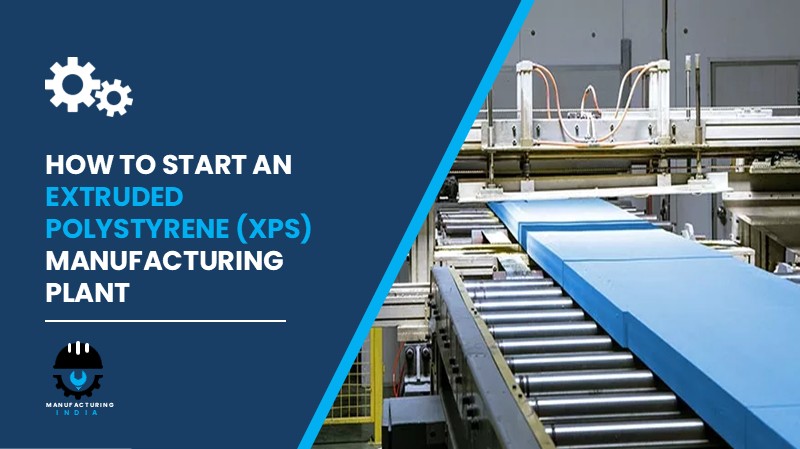
These properties make XPS widely suitable for below-grade insulation, floors, foundations, roofs, cavity walls, and industrial installations where durability and resistance to water exposure are primary requirements. The manufacturing route raw material dosing and blending, melt extrusion of polystyrene with additives and blowing agent, foaming and board formation, calibration and shaping, cutting, edge profiling, and finishing — is a well-established multi-step process that can be scaled across a range of production capacities.
The product serves five principal end-use industries: residential construction, commercial construction, infrastructure and civil engineering, cold chain and refrigeration, and industrial insulation.
Cost of Setting Up an Extruded Polystyrene (XPS) Manufacturing Plant in India
The total cost of establishing an XPS manufacturing plant in India depends on several variables, including production capacity, technology selection, plant location, degree of automation, and regulatory compliance requirements. A thorough feasibility study covering CapEx, OpEx, and financial projections is essential before committing capital.
1. Capital Expenditure (CapEx)
Capital investment in an XPS manufacturing facility covers multiple cost heads. Land and site development including land registration, boundary development, and related site preparation forms a substantial component of the upfront investment. Investors should evaluate options within Special Economic Zones (SEZs) or designated industrial estates to benefit from concessional land rates and streamlined approvals.
Civil works encompass construction of the production shed, laboratory, raw material storage, finished goods warehouse, and administrative block. These are typically sized in line with annual production targets.
The machinery and equipment component represents the single largest portion of total capital expenditure. Key machinery required includes:
- High-intensity mixers
- Foam extruders
- Blowing-agent injection systems
- Calibration equipment
- Board cutters
Other capital costs include effluent treatment plant (ETP) installation, pre-operative expenses, commissioning charges, and any applicable import duties on specialised equipment components.
Request a Sample Report for In-Depth Market Insights: https://www.imarcgroup.com/extruded-polystyrene-manufacturing-plant-project-report/requestsample
2. Operational Expenditure (OpEx)
Raw material cost is the dominant operating expense in any XPS plant, accounting for 65–75% of total OpEx. Core inputs include polystyrene resin, blowing agent (CO₂), flame retardants, and pigments. Securing long-term supply agreements with reliable domestic and international suppliers is essential to stabilise procurement costs and manage price volatility inherent in petrochemical-linked inputs.
Utility cost covering electricity, water, and steam represents 15–20% of total operating expenditure. Energy-intensive extrusion and foaming stages make power cost a key variable to manage through efficient equipment selection and load scheduling.
Other operating costs include transportation and outbound logistics, packaging materials, salaries and wages, equipment maintenance, depreciation, taxes, and miscellaneous overheads. By the fifth year of operations, total operational expenditure is projected to increase substantially due to inflation, market fluctuations, and potential rises in the cost of key materials, with supply chain dynamics and global economic shifts also contributing to this trajectory.
3. Plant Capacity
The proposed XPS manufacturing facility is designed with an annual production capacity ranging between 50,000–150,000 cu.m., enabling economies of scale while maintaining operational flexibility. Capacity can be customized to match investor requirements, site constraints, and target market size. It is well established that profitability improves as capacity utilisation increases, and plants operating at higher throughput rates achieve stronger returns on the fixed cost base.
4. Profit Margins and Financial Projections
The financial profile of an XPS manufacturing plant in India is robust. Gross profit margins typically range between 30–40%, supported by stable demand and value-added applications across multiple construction and industrial segments. Net profit margins average 15–22% over a five-year operating horizon. The full financial report covers NPV, IRR, payback period, income and expenditure projections, fixed versus variable cost structures, and a detailed profit and loss account – all developed on realistic assumptions related to capital investment, pricing trends, and demand outlook.
Why Set Up an Extruded Polystyrene (XPS) Plant in India?
Strong Building-Efficiency Demand: The XPS market benefits from ongoing demand for thermal insulation in new constructions and renovations, driven by government and building owner efforts to reduce operating energy costs. As India’s urban building stock expands rapidly, the need for high-performance insulation in residential and commercial structures continues to grow.
Suitability for Moisture-Prone Applications: XPS’s closed-cell structure makes it particularly well-positioned for below-grade, foundation, and roof applications where moisture resistance is a primary requirement – conditions that are common across India’s diverse climatic zones, from humid coastal regions to waterlogged monsoon-affected construction sites.
Broad Construction Utility: XPS serves multiple applications – foundation and perimeter insulation, floor and slab insulation, inverted and flat roof insulation, cavity wall and exterior wall insulation – providing a diversified end-use demand profile that insulates the business from single-sector volatility.
Performance-Oriented Product Positioning: The combination of thermal resistance, compressive strength, and durability allows XPS to command premium positioning in applications that require both insulation performance and structural toughness, supporting healthier margins compared to commodity insulation alternatives.
Scope for Product Upgradation: The growing industry trend towards reduced global warming potential (GWP) blowing agents and enhanced sustainability credentials opens meaningful opportunities for innovation in the manufacturing process, allowing forward-looking investors to differentiate on environmental performance.
Active Industry Investment: Global manufacturers are actively reshaping the XPS landscape. In March 2025, Kingspan Group Plc announced the acquisition of Hao Wei to strengthen its insulation business including XPS, establishing its first regional XPS production site in Asia to shift from importing XPS products into Malaysia and Singapore to local manufacturing. In July 2025, BASF announced the completion of the sale of its Styrodur XPS insulation business to Karl Bachl Kunststoffverarbeitung GmbH and Co. KG (BACHL), with BACHL having expanded its commercial reach in January 2025 by taking over the sales and distribution of Styrodur products. These moves signal intensifying strategic importance of XPS as a product category globally.
Manufacturing Process – Step by Step
The XPS manufacturing process uses melt extrusion as the primary production method. The operation is a multi-step sequence involving material handling, reaction chemistry, and downstream finishing.
- Raw Material Dosing and Blending: Polystyrene resin, blowing agent (CO₂), flame retardants, and pigments are accurately dosed and blended in high-intensity mixers to achieve a homogeneous feed composition.
- Melt Extrusion with Additives and Blowing Agent: The blended material is fed into foam extruders where it is melted under controlled temperature and pressure. The blowing agent is injected via blowing-agent injection systems and thoroughly mixed into the molten polymer.
- Foaming and Board Formation: As the melt exits the extruder die, pressure drops rapidly, causing the blowing agent to expand and create the characteristic closed-cell foam structure that gives XPS its thermal and moisture-resistant properties.
- Calibration and Shaping: The expanding foam board passes through calibration equipment that controls dimensions, density, and surface quality to meet specification tolerances.
- Cutting: Board cutters trim the continuous foam board to standard lengths and widths suitable for the target application.
- Edge Profiling and Finishing: Boards are edge-profiled to specification — tongue-and-groove or square edge – and surface-finished as required.
- Packaging and Dispatch: Finished boards are packaged and dispatched to end-use industries including residential and commercial construction sites, infrastructure projects, cold chain operators, and industrial insulation contractors.
Key Applications
XPS produced at an India-based facility serves a broad range of construction and industrial markets:
- Residential Construction: Used in basement walls, foundation slabs, underfloor systems, pitched roofs, and exterior wall assemblies in housing projects.
- Commercial Construction: Applied in flat roofs, inverted roofs, cavity walls, podium decks, and façade systems in office, retail, and hospitality buildings.
- Infrastructure and Civil Engineering: Used in road, rail, parking deck, bridge-adjacent, and foundation-related insulation systems in large public and private infrastructure projects.
- Cold Chain and Refrigeration: Used in walk-in coolers, cold rooms, freezer panels, and refrigerated logistics facilities, providing insulation efficiency and resistance to moisture exposure.
- Industrial Insulation: Applied in thermal insulation systems, prefabricated elements, and building equipment applications at industrial and utility installations.
Leading Manufacturers
The global XPS market is served by several multinational companies with extensive production capacities and diverse application portfolios. Key players include:
- Owens Corning
- DuPont de Nemours, Inc.
- Kingspan Group
- BASF SE
- Carlisle Construction Materials (CCM)
- Knauf Insulation
Timeline to Start the Plant
- Feasibility study and project report preparation
- Land acquisition and site development
- Regulatory approvals and environmental clearances
- Factory licence and fire safety compliance
- Machinery procurement and installation
- Raw material supplier agreements and supply chain setup
- Trial production and quality testing
- Commercial production launch
Licences and Regulatory Requirements
Starting an XPS manufacturing unit in India requires several approvals:
- Business registration (Proprietorship, LLP, or Pvt Ltd)
- Factory Licence under the Factories Act
- Environmental Clearance from State Pollution Control Board
- GST Registration
- Fire Safety NOC
- Hazardous and Chemical compliance (applicable given use of blowing agents and flame retardants)
- Effluent Treatment Plant (ETP) operational clearance
- Occupational Health and Safety compliance
Key Challenges to Consider
High Capital Requirements: Establishing an XPS plant involves significant upfront investment across land, civil works, and machinery – including foam extruders and blowing-agent injection systems – making careful financial planning and funding strategy essential.
Raw Material Price Volatility: The dominant cost input – polystyrene resin – is a petrochemical-linked material subject to global crude price cycles. Blowing agents (CO₂), flame retardants, and pigments also exhibit price variability, and investors should negotiate long-term contracts to mitigate exposure.
Regulatory Compliance: Chemical handling, effluent management, emission standards, and fire safety requirements impose ongoing compliance obligations. Environmental clearance from the State Pollution Control Board is a critical path item that can affect project timelines.
Technology and Innovation Pressure: The industry trend towards reduced GWP blowing agents and sustainable manufacturing processes requires ongoing investment in process upgrades, and investors must factor technology refresh costs into long-range planning.
Competition: The global XPS market includes well-capitalised players such as Owens Corning, Kingspan Group, BASF SE, DuPont de Nemours, Carlisle Construction Materials, and Knauf Insulation, and domestic entrants must position on service responsiveness, customisation, and supply reliability.
Skilled Manpower: Foam extrusion operations require trained process technicians and quality control personnel, and building a capable workforce in the early ramp-up phase is a key operational challenge.
Frequently Asked Questions
How much does it cost to set up an Extruded Polystyrene (XPS) manufacturing plant in India?
Total capital investment depends on plant capacity, technology, and location, covering land, civil works, machinery (including foam extruders, high-intensity mixers, blowing-agent injection systems, calibration equipment, and board cutters), and other capital costs. A detailed CapEx breakdown is available in the full project report.
Is Extruded Polystyrene (XPS) manufacturing profitable in India in 2026?
Yes. The project demonstrates healthy profitability potential under normal operating conditions, with gross profit margins of 30–40% and net profit margins of 15–22%.
What machinery is required for an XPS plant in India?
Key machinery includes high-intensity mixers, foam extruders, blowing-agent injection systems, calibration equipment, and board cutters.
What licences and approvals are required to start an XPS plant in India?
Requirements include business registration, Factory Licence, Environmental Clearance, GST Registration, Fire Safety NOC, chemical compliance certifications, ETP clearance, and Occupational Health and Safety compliance.
What raw materials are needed for XPS manufacturing?
Core raw materials are polystyrene resin, blowing agent (CO₂), flame retardants, and pigments.
What are the environmental compliance requirements for an XPS plant in India?
Plants must obtain Environmental Clearance from the State Pollution Control Board, operate a compliant Effluent Treatment Plant, and adhere to emission standards, particularly for chemical blowing agents and flame-retardant handling.
What is the best location to set up an XPS plant in India?
Locations offering access to polystyrene resin suppliers, reliable power and water utilities, strong logistics connectivity, and industrial zoning – such as established industrial estates in Gujarat or Maharashtra – are strategically advantageous.
What is the break-even period for this type of plant in India?
The break-even period is covered in the full financial analysis, which includes payback period, NPV, and IRR projections based on realistic capacity utilisation and pricing assumptions.
What government incentives are available for manufacturers in India?
Incentives under Make in India, state-level industrial policies, SEZ benefits, and schemes promoting energy-efficient construction materials may be applicable depending on location and product category. Investors should consult state industrial development agencies for current scheme details.
Key Takeaways for Investors
An XPS manufacturing plant in India represents a strategically well-timed investment, with demand anchored across five resilient sectors – residential construction, commercial construction, infrastructure and civil engineering, cold chain and refrigeration, and industrial insulation. The financial model is viable across the proposed capacity range of 50,000–150,000 cu.m. per annum, delivering gross margins of 30–40% and net margins of 15–22% under normal operating conditions. The global XPS market was valued at USD 7.10 Billion in 2025 and is projected to reach USD 11.40 Billion by 2034 at a CAGR of 5.4%, underpinning long-run demand sustainability for domestic producers. With India’s construction output continuing to expand, the forward demand trajectory for high-performance thermal insulation firmly supports the long-term commercial logic of this investment.
About the Author