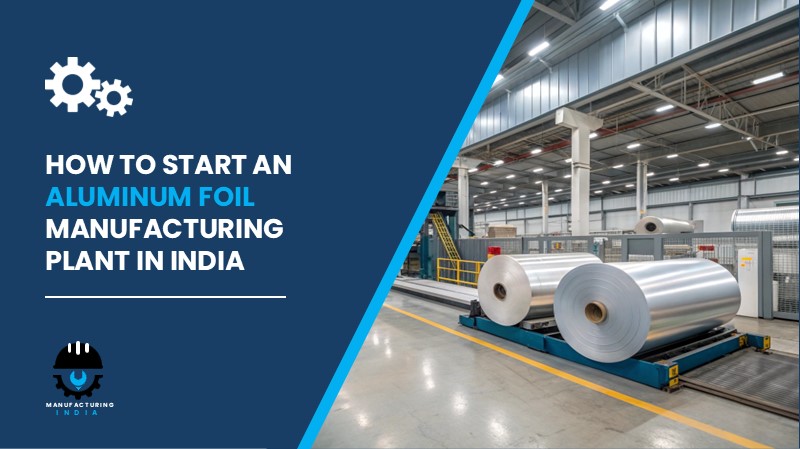
Setting up an aluminum foil manufacturing plant in India presents a compelling investment case as the country rapidly emerges as one of the most cost-competitive and high-demand destinations for packaging materials and aluminum-based product manufacturing. Driven by booming demand from the food and beverage packaging industry, pharmaceutical sector, construction and insulation industry, and household and consumer goods segment, aluminum foil has become an indispensable part of India’s rapidly expanding packaging and industrial materials economy.
“With over 1.4 billion consumers, a rapidly urbanising population, Make in India policy support, and a booming food processing and pharmaceutical sector, India offers one of the most financially attractive environments for aluminum foil manufacturing — with gross margins of 20–30% and a break-even window of 3–5 years.”
What is Aluminum Foil?
Aluminum foil is a versatile, thin sheet of aluminum produced through rolling processes and widely used in packaging, insulation, and industrial applications. It provides an effective barrier against moisture, light, oxygen, and contaminants, ensuring food preservation, pharmaceutical protection, and extended product shelf life. Available in multiple thicknesses and formats — including household foil, container foil, blister foil, and industrial-grade foil — it caters to diverse end-use requirements. Aluminum foil is lightweight, flexible, and thermally resistant, allowing for easy handling, cooking, and heat transfer applications. Its recyclability and eco-friendly profile further enhance its appeal, making it a preferred material across food and beverage, healthcare, electronics, and industrial sectors where durability, hygiene, and performance are critical.
Cost of Setting Up an Aluminum Foil Manufacturing Plant in India
The aluminum foil manufacturing plant cost in India depends on several parameters including production capacity, technology used, plant location, level of automation, and regulatory compliance requirements. Here is a structured breakdown of all major cost components:
1. Capital Expenditure (CapEx)
The total capital investment in an aluminum foil manufacturing plant typically covers the following:
Land and Site Development
This includes land acquisition, boundary development, land registration charges, and basic site preparation. Cost varies significantly depending on whether the land is in an industrial estate, Special Economic Zone (SEZ), or a privately purchased plot. Proximity to aluminum slab suppliers, established metal processing clusters such as those in Gujarat, Odisha, and Jharkhand, and proximity to key packaging industry customers can reduce both input logistics and distribution costs substantially.
Civil Works and Construction
Building costs cover the main rolling and finishing shed, raw material and aluminum slab storage, quality control laboratory, annealing furnace bay, finishing and slitting area, administrative block, and worker amenities. Construction specifications depend on plant scale, heavy machinery foundation requirements for rolling mills, and local regulatory compliance norms. Adequate structural reinforcement for large rolling mill equipment is an important civil works consideration.
Machinery and Equipment
This is the single largest component of CapEx. Key machinery required for an aluminum foil manufacturing plant includes:
- Aluminum Ingot and Slab Preparation Equipment
- Hot Rolling Mills
- Cold Rolling Mills
- Foil Rolling Mills (for final gauge reduction)
- Annealing Furnaces
- Foil Separators
- Slitting Machines
- Rewinding Machines
- Surface Finishing Units
- Coating and Lamination Lines (for specialty foil grades)
- Automated Quality Inspection Systems
- Thickness Gauges and Flatness Measurement Equipment
- Automated Packaging Machines
- Material Handling and Conveying Equipment
Machinery costs represent the largest share of overall capital expenditure, reflecting the high precision engineering and specialised rolling technology involved in aluminum foil production. Rolling mills for foil-gauge aluminum represent a significant portion of the total machinery investment.
Other Capital Costs
These include pre-operative expenses, commissioning charges, import duties on specialised rolling mill equipment sourced internationally, utilities installation, fire safety systems, and Effluent Treatment Plant (ETP) setup. Lubrication oil management systems, mill coolant handling, and spent lubricant disposal infrastructure also form part of the initial capital outlay for a foil rolling facility.
2. Operational Expenditure (OpEx)
Once the plant is commissioned, the ongoing cost structure is dominated by a few key components:
Raw Material Cost (Aluminum Slabs): 70–80% of Total OpEx
Aluminum slabs are the primary raw material and account for the majority of operating expenses. The cost of aluminum is directly linked to the London Metal Exchange (LME) price of aluminum, making raw material cost management and hedging strategy a critical operational priority. Additional materials include rolling lubricants, coolants, annealing atmospheres, and packaging materials. Long-term contracts with domestic aluminum producers such as Hindalco Industries and NALCO can provide more stable input pricing.
Utility Cost: 10–15% of Total OpEx
Utilities include electricity (heavily consumed by rolling mills, annealing furnaces, and slitting lines), cooling water, compressed air, and fuel for annealing operations. Given the energy-intensive nature of aluminum rolling and annealing, electricity tariff optimisation and energy recovery systems are important cost management levers for a foil manufacturing plant.
Other Operating Costs
The remaining budget covers transportation and logistics, secondary packaging, salaries and wages for rolling mill operators and quality engineers, maintenance of precision rolling equipment, rolling lubricant replenishment, depreciation, taxes, quality certification audits, and miscellaneous overhead.
3. Plant Capacity
The proposed manufacturing facility is designed with an annual production capacity ranging between 20,000 to 50,000 MT. This range allows the plant to achieve economies of scale while maintaining flexibility to serve multiple end-use segments including food and beverage packaging manufacturers, pharmaceutical blister packaging converters, construction insulation product makers, and household foil distributors. Smaller setups may start at lower capacity, but profitability and machine utilisation improve significantly with higher throughput and longer production runs across consistent product grades.
4. Profit Margins and Financial Projections
- Gross Profit Margin: 20–30%, supported by stable demand across food packaging, pharmaceutical, and construction end-use sectors
- Net Profit Margin: 8–12%, improving with higher capacity utilisation and efficient aluminum sourcing and hedging strategies
- Break-Even Period: 3 to 5 years, depending on production scale, aluminum price management, product mix, and sales channel efficiency
Financial projections must account for capital investment, operating costs, capacity utilisation rates, LME aluminum price trends, and demand outlook. A thorough analysis should also include sensitivity analysis, Net Present Value (NPV), Internal Rate of Return (IRR), and Payback Period, with particular attention to aluminum commodity price scenarios.
Request a Sample Report for In-Depth Market Insights: https://www.imarcgroup.com/aluminum-foil-manufacturing-plant-project-report/requestsample
Why Set Up an Aluminum Foil Plant in India?
India presents a uniquely favourable environment for establishing an aluminum foil manufacturing plant:
Surging Domestic Demand from Packaging and Pharma Sectors
India’s packaged food and beverage, pharmaceutical blister packaging, and FMCG industries are growing rapidly. Rising consumer preference for hygienic, tamper-evident, and sustainable packaging is driving significant growth in flexible packaging adoption. The Indian pharmaceutical industry’s expansion and food processing sector growth are creating sustained high-volume demand for aluminum foil across blister packs, strip packaging, lidding foils, and flexible laminate applications.
Policy and Regulatory Tailwinds
The Government of India’s emphasis on food safety, domestic manufacturing under the Make in India initiative, PLI schemes for food processing and packaging, and growing environmental awareness around recyclable packaging materials is creating a policy-friendly environment for aluminum foil manufacturers. India’s large domestic aluminum production base provides a strategic raw material advantage for foil manufacturers located near smelter sites.
Cost-Competitive Manufacturing
India offers competitive land costs, a large pool of trained engineering and technical talent, and direct access to domestic aluminum production from Hindalco Industries and NALCO — two of India’s largest primary aluminum producers. Proximity to domestic aluminum supply reduces raw material logistics costs significantly compared to import-dependent manufacturers in other markets, providing Indian foil producers a structural cost advantage.
Export Opportunities
India-based manufacturers can tap into growing export demand from Southeast Asia, the Middle East, Africa, and South Asia, where food packaging and pharmaceutical packaging industries are expanding rapidly and local aluminum foil production capacity remains limited. India’s established metals export infrastructure and competitive freight rates support international market entry across household, industrial, and pharmaceutical foil grades.
Sustainability and Recyclability Advantage
Aluminum foil is one of the most recyclable packaging materials available, capable of being recycled indefinitely without loss of quality. Growing consumer and regulatory pressure on sustainable packaging across India and export markets is reinforcing aluminum foil’s competitive position versus non-recyclable alternatives. An industry report notes that 90% of consumers prefer brands with sustainable packaging and 43% are willing to pay a premium for eco-friendly packaging, directly supporting premium pricing for high-quality aluminum foil products.
Manufacturing Process Overview
The aluminum foil manufacturing process primarily uses aluminum ingot or coil preparation, hot rolling, cold rolling, annealing, slitting, and rewinding technologies. The complete process flow involves:
- Aluminum Ingot and Slab Procurement — sourcing and incoming quality inspection of primary aluminum slabs or pre-rolled coils
- Hot Rolling — reduction of aluminum slabs to intermediate gauge coils using hot rolling mills
- Cold Rolling — further gauge reduction of intermediate coils to achieve the desired foil thickness using cold rolling mills
- Foil Rolling — final gauge reduction to achieve foil-thickness product, typically below 200 microns, using precision foil rolling mills
- Annealing — controlled heat treatment in annealing furnaces to achieve the desired mechanical properties, softness, and formability of the finished foil
- Foil Separation — separation of double-rolled foil layers produced during thin-gauge foil rolling
- Slitting — precision cutting of master coils to customer-specified widths using slitting machines
- Rewinding — rewinding of slit coils to specified lengths and roll dimensions
- Surface Finishing — application of coatings, lacquers, or surface treatments for specialty foil grades
- Quality Inspection — measurement of thickness, flatness, tensile strength, pinhole count, and surface quality against product specifications
- Packaging and Dispatch — protective wrapping and palletising of finished foil rolls for safe storage and transport to customers
Key Applications of Aluminum Foil
Aluminum foil manufactured in India serves a wide variety of end-use industries and applications:
- Food and Beverage Packaging: Food wrapping, ready-to-eat meal containers, flexible laminate packaging, lidding foil for dairy products, and aseptic packaging for juices and beverages
- Pharmaceutical Packaging: Blister packs and strip packaging for tablets and capsules, where aluminum foil’s barrier properties protect product integrity and extend shelf life
- Construction and Insulation: Thermal insulation facings, reflective barriers for roofing and wall insulation, HVAC duct insulation, and building envelope applications
- Household and Retail: Consumer kitchen foil rolls, disposable baking trays, catering containers, and barbecue foil products for retail and foodservice
- Industrial and Electronics: Capacitor foil, electromagnetic shielding, cable wrapping, and specialty industrial packaging requiring barrier and conductivity properties
Global Market Outlook
The global aluminum foil market was valued at USD 30.03 Billion in 2025 and is projected to reach USD 47.40 Billion by 2034, growing at a CAGR of 5.2% from 2026 to 2034. This sustained growth is driven by rising demand for flexible packaging in food and beverage, pharmaceutical expansion, construction and insulation applications, and increasing consumer preference for recyclable and sustainable packaging formats globally.
Leading global players in the aluminum foil industry include:
- Hindalco Industries Limited
- Amcor Plc
- ACM Carcano
- Assan Aluminyum
- Eurofoil
- Ess Dee Aluminium
- Huawei Aluminium
- Laminazione Sottile
- Shanghai Metal Corporation
- UACJ Foil Corporation
Timeline to Start an Aluminum Foil Plant
Setting up an aluminum foil manufacturing plant from ideation to commissioning typically requires 12 to 18 months. This covers:
- Feasibility study and detailed project report (DPR) preparation
- Land acquisition and site development
- Regulatory approvals and environmental clearances
- Factory licence and fire safety compliance
- Rolling mill and machinery procurement, installation, and commissioning
- Utility infrastructure and lubrication system setup
- Trial production, quality testing, and product grade qualification
- Commercial production launch and customer supply commencement
Licenses and Regulatory Requirements
Starting an aluminum foil manufacturing unit in India requires several approvals, including:
- Business registration (Proprietorship, LLP, or Private Limited Company)
- Factory Licence under the Factories Act
- Environmental Clearance from the State Pollution Control Board
- Consent to Establish and Consent to Operate under pollution control regulations
- GST Registration
- Fire Safety NOC
- BIS Certification for food-grade aluminum foil under IS 15392 (where applicable for food contact applications)
- FSSAI compliance documentation for food-contact grade foil supplied to food manufacturers
- Bureau of Indian Standards (BIS) hallmark for pharmaceutical-grade blister foil grades
- Udyam Registration (for MSME benefits and government scheme eligibility)
Key Challenges to Consider
Before investing, entrepreneurs should be aware of the common challenges in this business:
- High Capital Requirements: Initial CapEx for precision foil rolling mills, annealing furnaces, and slitting equipment is significant, particularly for mid to large-scale plants targeting pharmaceutical and food packaging grade specifications.
- Aluminum Price Volatility: Aluminum slab costs are directly linked to LME aluminum prices and can fluctuate significantly, impacting margins. Effective hedging strategies and long-term supply contracts with domestic producers are essential risk management tools.
- Precision Manufacturing Requirements: Achieving consistent foil thickness down to 6–12 microns with minimal pinhole counts requires highly precise rolling mill equipment, skilled operators, and rigorous process control — a significant technical barrier for new entrants.
- Energy Intensity: Rolling mills and annealing furnaces are major electricity consumers. Energy cost management and power tariff negotiation are critical to maintaining cost competitiveness, particularly against established large-scale players.
- Competition from Established Players: The market includes large integrated producers with captive aluminum supply and established customer relationships, requiring new entrants to differentiate through specialty grades, customer service responsiveness, or niche application focus.
- Skilled Manpower: Operating precision foil rolling mills, annealing furnaces, and quality inspection systems requires trained metallurgical engineers, rolling mill operators, and quality control technicians who are in growing demand across India’s expanding metals processing sector.
Frequently Asked Questions
The following questions are answered in the report:
- How much does it cost to set up an aluminum foil manufacturing plant in India?
- Is aluminum foil manufacturing profitable in India in 2026?
- What machinery is required for an aluminum foil plant in India?
- What raw materials are required for aluminum foil production?
- What licences and approvals are required to start an aluminum foil plant in India?
- How long does it take to commission an aluminum foil manufacturing plant in India?
- What is the best state or location to set up an aluminum foil plant in India?
- What government incentives are available for aluminum foil manufacturers in India?
- What is the break-even period for an aluminum foil plant in India?
- What are the BIS and FSSAI compliance requirements for food-grade aluminum foil manufacturing in India?
Key Takeaways for Investors
The aluminum foil manufacturing industry in India represents a strong and scalable investment opportunity backed by growing domestic demand from food packaging, pharmaceutical, and construction sectors, India’s large primary aluminum production base, and supportive government manufacturing policies. With gross margins of 20–30%, a well-planned aluminum foil manufacturing plant cost in India remains competitive and financially viable across plant capacities. Investors who combine precision rolling capability, efficient aluminum sourcing from domestic producers, and a clear product focus across food-grade, pharmaceutical, or industrial foil segments stand to benefit significantly from one of India’s fastest-growing segments of the packaging and materials manufacturing industry.
About the Author