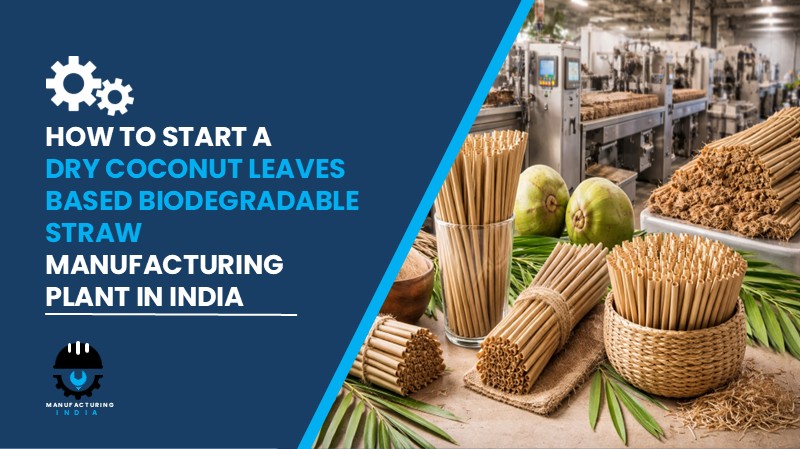
Setting up a dry coconut leaves based biodegradable straw manufacturing plant in India presents a compelling investment case driven by the accelerating shift away from single-use plastics across the food and beverage industry, hospitality sector, and broader environmental markets. As governments worldwide enact legislation banning conventional plastic straws, demand for sustainable, compostable alternatives is surging and India, with its exceptional coconut cultivation base, stands uniquely positioned to lead this transition. The Ministry of Agriculture & Farmers Welfare has declared that India’s annual coconut production stands at 2,437.80 crore coconuts, with productivity reaching 11,616 coconuts per hectare, establishing a robust and cost-effective domestic raw material foundation.
India’s advantages extend well beyond raw material abundance. The country’s growing urbanisation, expansion of quick-service restaurants (QSR), rising eco-consciousness among consumers, and the central government’s sustained push under Make in India collectively create a fertile environment for green manufacturing. States with strong agri-processing infrastructure and coconut cultivation, particularly those in South India and coastal belts, offer ideal conditions for this unit in terms of proximity to raw material supply chains, lower logistics costs, and access to skilled agro-processing labour. Aligning this investment with India’s plastic waste reduction policy agenda further enhances its long-term regulatory tailwinds.
A dry coconut leaves based biodegradable straw manufacturing plant in India combines world-class policy support, unmatched raw material proximity, and strong demand across the food service and hospitality sectors. With gross margins ranging between 45-55% and net margins of 15-20%, the plant offers compelling returns, competitive entry barriers, and a break-even profile suited to mid-scale investors seeking sustainable, future-ready manufacturing.
What is Dry Coconut Leaves Based Biodegradable Straw?
A dry coconut leaves based biodegradable straw is an eco-friendly alternative to conventional plastic straws, produced using dried coconut leaves — specifically the midribs and rachis — which are abundant, sustainable, and completely biodegradable. Unlike synthetic straws, these products decompose naturally after use, contributing directly to the reduction of plastic waste in landfills and waterways. The production process involves collecting, drying, and processing coconut leaves, followed by cutting and shaping them into straws. These biodegradable straws provide a sustainable, natural solution that offers similar functionality to traditional plastic straws while generating zero toxic residue.
The manufacturing method is classified as a cutting, shaping, drying, and processing technique, involving multiple unit operations that are relatively accessible from a technology adoption standpoint. End-use industries served include the food and beverage industry, hospitality and catering, retail and consumer goods, and event management and institutional use. Applications span cold beverages, smoothies, milkshakes, cocktails, juice bars, quick-service restaurants, packaged drink kits, weddings, festivals, schools, offices, and public institutions.
Cost of Setting Up a Dry Coconut Leaves Based Biodegradable Straw Manufacturing Plant in India
The total investment required for this production facility depends on plant capacity, technology selection, degree of automation, geographic location, and regulatory compliance requirements. Both capital expenditure and operational expenditure must be carefully evaluated before committing to this venture.
1. Capital Expenditure (CapEx)
The capital investment for a dry coconut leaves based biodegradable straw plant spans several cost heads. Land and site development form a substantial component of total CapEx, covering land registration charges, boundary development, drainage, and site levelling. Investors may explore Special Economic Zones (SEZs) or state-designated industrial estates to benefit from subsidised land rates and faster regulatory approvals. Civil works costs include the construction of the production shed, raw material storage area, quality control laboratory, administrative block, and finished goods warehouse — each designed to support safe and efficient plant operations.
Machinery and equipment costs represent the largest single component of total capital expenditure. Key machinery required includes:
- Shredders
- Pulping units
- Molding and compression presses
- Drying tunnels
- Trimming and cutting machines
- Sanitization systems
- Packaging line
Other capital costs include effluent treatment plant (ETP) installation, pre-operative expenses such as feasibility studies and project report preparation, regulatory fees, trial production costs, and any applicable import duties on specialised equipment.
Request a Sample Report for In-Depth Market Insights: https://www.imarcgroup.com/dry-coconut-leaves-based-biodegradable-straw-manufacturing-plant-project-report/requestsample
2. Operational Expenditure (OpEx)
Raw material cost is the dominant driver of operating expenditure, accounting for approximately 30–40% of total OpEx. The primary raw materials required are dry coconut leaves (midribs/rachis) and water. Binding agents include natural starches such as tapioca or corn starch, and food-grade glycerin (used optionally for flexibility enhancement). Sanitization inputs include food-grade hydrogen peroxide or ozone, while packaging materials comprise compostable pouches and boxes. Long-term supplier agreements are strongly recommended to stabilise pricing and ensure uninterrupted supply, especially given the seasonal nature of coconut harvesting cycles.
Utility costs covering electricity, water, and steam account for 25-30% of total OpEx, reflecting the energy requirements of drying tunnels and processing equipment. Additional operating costs include transportation and distribution, compostable packaging procurement, employee salaries and wages, routine machinery maintenance, depreciation on fixed assets, and applicable taxes. By the fifth year of operations, total operational costs are projected to increase substantially, driven by inflation, market fluctuations, potential rises in the cost of key materials, supply chain disruptions, rising consumer demand, and broader global economic shifts.
3. Plant Capacity
The proposed manufacturing facility is designed with an annual production capacity ranging between 200 million and 500 million straws, enabling economies of scale while maintaining operational flexibility. This capacity range can be customised to suit investor requirements, from smaller pilot-scale units to full commercial-scale operations. Profitability improves meaningfully with higher capacity utilisation, as fixed costs are spread across a larger output volume.
4. Profit Margins and Financial Projections
The project demonstrates strong profitability potential under normal operating conditions. Gross profit margins typically range between 45–55%, supported by stable end-market demand and value-added applications across food service and hospitality. Net profit margins are projected at 15–20% on average across a five-year financial model. A comprehensive financial analysis, including net present value (NPV), internal rate of return (IRR), payback period assessment, income and expenditure projections, liquidity analysis, sensitivity analysis, and uncertainty analysis, is available in the detailed project report. These metrics provide investors with a full view of financial viability and long-term sustainability.
Why Set Up a Dry Coconut Leaves Based Biodegradable Straw Plant in India?
Surging Demand for Plastic Alternatives. The growing global emphasis on reducing plastic waste and the demand for biodegradable alternatives position dry coconut leaves based biodegradable straws as a crucial product in the fight against pollution. Several countries, particularly in Europe and North America, have already implemented legislation banning plastic straw usage, creating export opportunities for Indian manufacturers.
India’s Unmatched Coconut Resource Base. The Asia Pacific region, and India in particular, is expected to contribute significantly to the biodegradable straws sector due to the presence of extensive coconut cultivation. With annual coconut production at 2,437.80 crore and productivity of 11,616 coconuts per hectare, India offers an unmatched domestic supply of the core raw material, minimising import dependency and input cost volatility.
Megatrend Alignment and Consumer Shift. Global initiatives to ban plastic straws and the increasing consumer preference for sustainable products are driving demand for biodegradable alternatives. This megatrend alignment ensures that demand is structural and long-term rather than cyclical, providing investors with reliable revenue visibility.
Policy and Infrastructure Support. Government initiatives and policies focused on environmental sustainability and reducing single-use plastic waste are key demand catalysts. India’s own single-use plastic restrictions, combined with Make in India incentives for green manufacturing, provide regulatory tailwinds and potential access to capital subsidies for eligible units.
Moderate Entry Barriers and Scalability. While initial capital investment in machinery and technology is required, the production of biodegradable straws from coconut leaves involves relatively straightforward processing techniques. This provides investors with a scalable entry point and the ability to expand output incrementally as market demand grows.
Active Industry Investment and Upstream Expansion. In June 2025, the Philippine Coconut Authority (PCA) announced plans to plant 50 million coconut trees by 2026 doubling its original target as part of a five-year initiative to plant 100 million trees by 2028. This upstream investment signals expanding global raw material availability and validates long-term sector confidence in coconut-based products.
Manufacturing Process Step by Step
The dry coconut leaves based biodegradable straw manufacturing process uses cutting, shaping, drying, and processing of dry coconut leaves as its primary production method. Each stage involves precise unit operations designed to ensure product quality, food safety, and dimensional consistency.
- Raw Material Collection and Sourcing: Dry coconut leaves, specifically the midribs and rachis, are collected and procured from coconut farms or agro-processing hubs. Water, natural starches, and food-grade glycerin are also sourced at this stage.
- Cleaning and Sanitization: The dry coconut leaf midribs undergo cleaning and sanitization using food-grade hydrogen peroxide or ozone to eliminate surface contaminants and meet food-contact safety standards.
- Shredding and Pulping: Material is fed into shredders and pulping units to break down the fibrous structure into a workable input form suitable for compression and moulding.
- Binding and Mixing: Natural starches (tapioca or corn) and optional food-grade glycerin are introduced as binding agents to enhance structural integrity and flexibility of the straw.
- Moulding and Compression: The prepared material is passed through molding and compression presses to form uniform straw shapes with consistent wall thickness and diameter.
- Drying: Moulded straws are transported through drying tunnels to remove residual moisture, cure the binding agents, and achieve the final dimensional stability required for commercial use.
- Trimming and Cutting: Drying tunnels discharge semi-finished straws into trimming and cutting machines, which achieve precise length and finish quality.
- Quality Control and Testing: Finished straws undergo analytical quality checks for concentration, purity, dimensional accuracy, and stability compliance.
- Packaging and Dispatch: Approved straws are packed in compostable pouches and boxes using the automated packaging line, then dispatched to the food and beverage industry, hospitality, retail, and event management end-use sectors.
Key Applications
Dry coconut leaves based biodegradable straws serve a wide range of industries requiring sustainable single-use product alternatives:
- Food & Beverage: Eco-friendly drinking straws for restaurants, cafés, juice bars, quick-service restaurants, and takeaway services, including use with cold beverages, smoothies, milkshakes, and cocktails.
- Hospitality & Catering: Single-use biodegradable straws for hotels, resorts, airlines, and catering services requiring certified compostable tableware.
- Retail & Consumer Goods: Sustainable straw packaging for supermarkets, e-commerce stores, and eco-product brands supplying packaged drink kits.
- Event Management & Institutional Use: Compostable straws for weddings, festivals, offices, schools, and public institutions seeking to comply with plastic-free event guidelines.
Leading Manufacturers
The global dry coconut leaves based biodegradable straw industry comprises several active players serving the food and beverage, hospitality, and environmental sectors. Key players include:
- CocoStraw
- BioStraws
- ECOStix
- GreenStraw
Timeline to Start the Plant
Investors should plan for a structured project execution timeline across the following phases:
- Feasibility study and project report preparation
- Land acquisition and site development
- Regulatory approvals and environmental clearances
- Factory licence and fire safety compliance
- Machinery procurement and installation
- Raw material supplier agreements and supply chain setup
- Trial production and quality testing
- Commercial production launch
Licences and Regulatory Requirements
Starting a dry coconut leaves based biodegradable straw manufacturing unit in India requires several approvals:
- Business registration (Proprietorship, LLP, or Pvt Ltd)
- Factory Licence under the Factories Act
- Environmental Clearance from State Pollution Control Board
- GST Registration
- Fire Safety NOC
- Effluent Treatment Plant (ETP) operational clearance
- Occupational Health and Safety compliance
Key Challenges to Consider
High Capital Requirements. Initial investment in shredders, pulping units, molding and compression presses, drying tunnels, and the full packaging line represents a significant upfront commitment that requires careful financial planning and access to project funding.
Raw Material Price Volatility. The cost of key inputs including dry coconut leaves (midribs/rachis), natural starches such as tapioca or corn starch, food-grade glycerin, and compostable packaging can fluctuate seasonally and with global supply chain disruptions. Long-term supplier contracts help mitigate this risk.
Regulatory Compliance. Meeting environmental clearance conditions, ETP operational requirements, food-contact material safety standards, and state-level factory regulations requires dedicated compliance resources and ongoing monitoring.
Technology and Innovation Pressure. The biodegradable straw market is evolving rapidly, with consumer expectations around product performance, water resistance, and shelf life continuously rising, requiring manufacturers to invest in process refinement and quality assurance systems.
Competition from Key Industry Players. Established manufacturers including CocoStraw, BioStraws, ECOStix, and GreenStraw operate across global markets with existing customer relationships, requiring Indian entrants to differentiate on price, quality, and supply chain reliability.
Skilled Manpower. Operating shredding, compression, drying, and quality testing equipment requires trained technicians and production supervisors, and retaining skilled agro-processing workforce in competitive labour markets can be challenging.
Frequently Asked Questions
1. How much does it cost to set up a dry coconut leaves based biodegradable straw manufacturing plant in India? The total cost depends on plant capacity, location, technology, and automation level. The investment covers land, civil works, machinery including shredders, pulping units, and drying tunnels, utilities, and pre-operative costs. A detailed project report provides exact CapEx and OpEx figures tailored to your capacity requirements.
2. Is dry coconut leaves based biodegradable straw manufacturing profitable in India in 2026? Yes. The project demonstrates gross profit margins of 45-55% and net profit margins of 15-20% under normal operating conditions, supported by strong demand across the food and beverage and hospitality sectors and growing regulatory pressure on single-use plastics.
3. What machinery is required for a dry coconut leaves based biodegradable straw plant in India? Key equipment includes shredders, pulping units, molding and compression presses, drying tunnels, trimming and cutting machines, sanitization systems, and a packaging line.
4. What licences and approvals are required to start a dry coconut leaves based biodegradable straw plant in India? Required approvals include business registration, Factory Licence under the Factories Act, Environmental Clearance from the State Pollution Control Board, GST registration, Fire Safety NOC, ETP operational clearance, and Occupational Health and Safety compliance.
5. What raw materials are needed for dry coconut leaves based biodegradable straw manufacturing? Primary materials include dry coconut leaves (midribs/rachis) and water. Binding agents comprise natural starches (tapioca/corn) and optional food-grade glycerin. Sanitization uses food-grade hydrogen peroxide or ozone, and packaging requires compostable pouches and boxes.
6. What are the environmental compliance requirements for a dry coconut leaves based biodegradable straw plant in India? The unit must obtain Environmental Clearance from the State Pollution Control Board, operate a functional Effluent Treatment Plant (ETP), maintain emission compliance, and follow Occupational Health and Safety norms throughout the manufacturing process.
7. What is the best location to set up a dry coconut leaves based biodegradable straw plant in India? Locations with proximity to coconut-growing regions, well-developed agro-processing infrastructure, and access to reliable transportation networks are strategically advantageous. Industrial estates and SEZs in coconut-abundant states offer additional benefits in terms of land cost and regulatory support.
8. What is the break-even period for this type of plant in India? The break-even period depends on plant capacity, production utilisation rates, pricing strategy, and local cost structures. The detailed financial analysis in the project report covers payback period, NPV, and IRR projections to guide investor decision-making.
9. What government incentives are available for manufacturers in India? Manufacturers may access benefits under the Make in India initiative, state-level industrial promotion schemes, capital subsidy programmes for green manufacturing units, and GST input tax credit provisions. Specific incentives vary by state and unit classification.
Key Takeaways for Investors
A dry coconut leaves based biodegradable straw manufacturing plant in India presents a well-rounded investment opportunity anchored by growing demand across the food and beverage industry, hospitality and catering, retail, and event management sectors all of which are actively transitioning away from plastic tableware. The project demonstrates strong financial viability, with gross margins of 45-55% and net margins of 15-20%, achievable across a production capacity range of 200-500 million straws annually. India’s annual coconut production of 2,437.80 crore, combined with North America’s leading 34.7% share of the current global market, underscores the scale of opportunity for producers who can serve both domestic demand and export channels. As plastic bans continue expanding globally and consumer preference for sustainable alternatives becomes entrenched, demand for this production is structurally positioned for durable, long-term growth.
About the Author