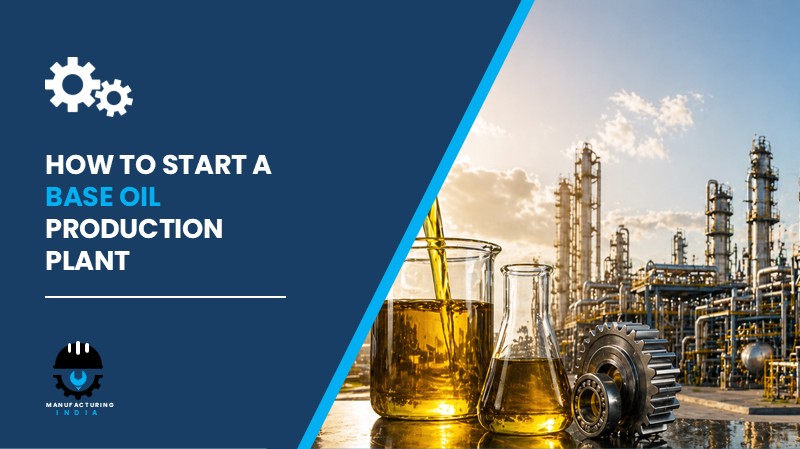
Setting up a base oil production plant in India presents a compelling investment case driven by robust demand from the automotive, industrial manufacturing, marine, power generation, aerospace, and metalworking sectors. Base oils are the primary, major component used to manufacture lubricants, including motor oils, greases, and metalworking fluids – products that are indispensable to the efficient and continuous operation of nearly every engine and machine in India’s rapidly expanding economy. As vehicle ownership rises, industrial automation deepens, and infrastructure construction accelerates, the domestic requirement for high-quality lubricants places base oil at the centre of India’s industrial supply chain.
India’s strategic advantages for establishing a base oil production unit are substantial. The country’s accelerating urbanisation, large-scale infrastructure development, and the Government of India’s Make in India initiative create a policy-aligned, demand-rich environment for lubricant feedstock producers. States such as Gujarat and Maharashtra, with their established petrochemical corridors, port connectivity, and industrial estate ecosystems, provide strong location choices for greenfield plants. Proximity to refineries, access to skilled technical labour, and relatively cost-competitive land and utilities further reinforce the case for domestic production over import dependency.
Setting up a base oil production plant in India aligns directly with policy tailwinds, a cost-competitive manufacturing environment, and sustained demand from automotive and industrial sectors. With gross profit margins typically ranging between 20-30% and a break-even window of 3 to 7 years, the investment offers financially viable returns across a range of production capacities.
What is Base Oil?
Base oil is the primary, major component used to manufacture lubricants, including motor oils, greases, and metalworking fluids, produced by blending with additives. It is manufactured either by refining crude oil (mineral base oil) or through chemical synthesis (synthetic base oil). The fundamental function of base oil is to provide the essential lubricating film between moving surfaces – reducing friction, managing heat, and extending the operational life of machinery and engines.
Base oils are classified by the American Petroleum Institute (API) into five groups – Group I through Group V – based on saturation levels, sulfur content, and viscosity index. Higher group numbers represent higher refining severity and superior performance characteristics. Key technical properties include viscosity, oxidation stability, and pour point. Base oils are not fuels but rather high-viscosity materials extracted through distillation and further processing.
The primary production process involves solvent extraction, hydrotreating, and blending. End-use industries served include automotive, industrial manufacturing, marine, power generation, aerospace, and metalworking, with applications spanning engine oils, hydraulic fluids, gear oils, turbine oils, compressor lubricants, metalworking fluids, and greases.
Cost of Setting Up a Base Oil Production Plant in India
The total cost of establishing a base oil production plant in India depends on a combination of capacity, technology selection, plant location, level of automation, and regulatory compliance requirements. A thorough feasibility study covering CapEx, OpEx, and financial projections is essential before committing capital.
1. Capital Expenditure (CapEx)
The capital investment for a base oil production plant in India covers several major cost heads. Land and site development – including land registration charges, boundary development, and site preparation – forms a substantial portion of the total investment and must be carefully planned, with consideration for industrial estates or Special Economic Zones (SEZs) that may offer concessional land rates and infrastructure support.
Civil works encompass construction of the production shed, quality control laboratory, raw material and finished goods storage, and the administrative block. These costs vary by location but represent a fixed and essential outlay for any production-scale facility.
Machinery and equipment account for the largest single portion of total capital expenditure. Key machinery required includes:
- Atmospheric and vacuum distillation units
- Solvent extractors
- Hydrotreaters
- Catalytic dewaxing units
- Hydrocrackers
- Refining columns
- Packaging systems
- Heat exchangers
- Filtration systems
- Storage tanks
- Quality testing labs
Other capital costs include effluent treatment plant (ETP) installation, pre-operative expenses, commissioning charges, and import duties on specialised refining equipment not manufactured domestically.
Request a Sample Report for In-Depth Market Insights: https://www.imarcgroup.com/base-oil-manufacturing-plant-project-report/requestsample
2. Operational Expenditure (OpEx)
The operating cost structure of a base oil production plant is dominated by raw material consumption. Raw materials – specifically crude oil/vacuum gas oil, hydrogen, and catalyst – account for approximately 75-85% of total operating expenses. Given this concentration, securing long-term supplier contracts and managing feedstock procurement strategically is critical to cost control and margin protection. Reliable suppliers must be identified early, and supply chain risks assessed to ensure consistent production quality.
Utility costs, covering electricity, water, and steam, represent a further 10-15% of OpEx and must be factored into location selection and plant design. Other ongoing operational costs include transportation, packaging, salaries and wages, maintenance, depreciation, and applicable taxes. By the fifth year of operations, total operational costs are projected to increase substantially due to inflation, market fluctuations, and potential rises in the cost of key materials – making a five-year OpEx projection an essential part of the feasibility study.
3. Plant Capacity
The proposed production facility is designed with an annual production capacity ranging between 50,000 and 200,000 tons, enabling economies of scale while maintaining operational flexibility. Capacity can be customized based on investor requirements, market access strategy, and available capital. Profitability improves meaningfully with higher capacity utilisation, making a phased ramp-up plan an important component of the investment strategy.
4. Profit Margins and Financial Projections
The base oil production plant in India demonstrates healthy profitability potential under normal operating conditions. Gross profit margins typically range between 20-30%, supported by stable demand and value-added applications across industrial and automotive end-users. Net profit margins range between 8-15%. A full financial analysis covering Net Present Value (NPV), Internal Rate of Return (IRR), payback period, liquidity analysis, and sensitivity analysis is required to assess project viability across scenarios. The break-even period for a base oil production business typically ranges from 3 to 7 years, with efficient operations and strategic sourcing capable of shortening this window.
Why Set Up a Base Oil Production Plant in India?
Crucial Industrial Input Across Sectors: Base oils are the essential raw material for lubricants, greases, and specialty fluids used across automotive, industrial machinery, power generation, and marine sectors. Their role in ensuring equipment efficiency, longevity, and smooth operation makes them indispensable inputs across the economy – a structural demand characteristic that insulates the sector from cyclical volatility.
Rising Vehicle Ownership and EV Growth: The global automotive market continues to expand, and even as electric vehicles gain share, the need for high-quality lubricants remains strong. Global sales of electric cars are on track to surpass 20 million in 2025, accounting for over a quarter of cars sold worldwide, according to the IEA’s Global EV Outlook. This sustained and evolving automotive demand directly supports base oil consumption at scale.
Policy and Infrastructure Push: Government focus on manufacturing, transportation infrastructure, mining, and energy development – alongside initiatives like Make in India and industrial corridor development – indirectly boosts lubricant demand, thereby strengthening the base oil market. India’s industrial policy environment is actively supportive of domestic chemical and petrochemical production.
Cost-Competitive Manufacturing Environment: India offers cost-competitive land, a large technical labour pool, and proximity to established petrochemical supply chains. Locating a plant near refinery clusters or port-connected industrial estates reduces feedstock logistics costs and improves overall operating efficiency.
Active Industry Investment and Domestic Circular Economy: In January 2026, Hindustan Petroleum Corporation Limited (HPCL) and Castrol India signed a Memorandum of Understanding to explore the development of a Re-Refined Base Oil (RRBO) ecosystem in India. The two companies will work together to evaluate a model for collecting used lubricating oil and having it re-refined for lubricant production – signalling growing institutional interest in domestic base oil production and circular economy models.
Local Supply Chain Preference: With increasing emphasis on supply chain resilience, lubricant manufacturers prefer local base oil suppliers to reduce dependency on imports, manage price volatility linked to crude oil, and ensure consistent quality and timely availability – creating direct commercial opportunities for domestic producers with efficient operations.
Production Process – Step by Step
The base oil production process uses solvent extraction, hydrotreating, and blending as the primary production methods. The process is a multi-step operation involving several unit operations, material handling, and quality checks.
- Sourcing of raw materials: Procurement of crude oil/vacuum gas oil, hydrogen, and catalyst from reliable suppliers under long-term contracts
- Atmospheric distillation: Initial separation of crude oil fractions at atmospheric pressure using distillation units
- Vacuum distillation: Further separation of heavier fractions at reduced pressure using vacuum distillation columns
- Solvent extraction or hydrocracking: Removal of aromatic compounds and impurities using solvent extractors or hydrocrackers to improve base oil quality
- Catalytic dewaxing: Reduction of pour point and improvement of low-temperature performance using catalytic dewaxing units
- Hydrofinishing: Final treatment using hydrotreaters to improve oxidation stability, colour, and overall product quality
- Separation and purification: Separation of base oil fractions through refining columns to meet API group classification requirements
- Blending: Combining base oil fractions with performance additives using blending systems to achieve target product specifications
- Quality testing: Laboratory analysis to verify viscosity, oxidation stability, pour point, and API classification compliance
- Packaging and dispatch: Filling into storage tanks or packaged formats for dispatch to automotive, industrial, marine, and power generation end-users
Key Applications
Base oil serves a wide range of end-use industries, making it one of the most broadly demanded specialty petroleum products in the market.
- Automotive: Engine oils, transmission fluids, and hydraulic oils for vehicles across passenger, commercial, and two-wheeler segments
- Industrial: Lubricants for machinery, compressors, turbines, and hydraulic systems in manufacturing facilities
- Marine: Specialty lubricants and fluids for marine engines and offshore equipment
- Power & Telecommunication: Insulating oils for transformers, cooling fluids, and specialty oils for high-performance systems
- Aerospace: High-specification lubricants for aircraft engines and precision machinery
- Metalworking: Metalworking fluids and cutting oils for machining, forming, and surface treatment operations
- Construction: Greases, heavy-duty lubricants, and fluids for construction equipment
Leading Manufacturers
The global base oil industry is served by several large multinational companies with extensive production capacities and diverse application portfolios. Key players in the global market include:
- ExxonMobil
- Chevron
- Shell
- Saudi Aramco
- SK Enmove
Timeline to Start the Plant
- Feasibility study and project report preparation
- Land acquisition and site development
- Regulatory approvals and environmental clearances
- Factory licence and fire safety compliance
- Machinery procurement and installation
- Raw material supplier agreements and supply chain setup
- Trial production and quality testing
- Commercial production launch
Licences and Regulatory Requirements
Starting a base oil production unit in India requires several approvals:
- Business registration (Proprietorship, LLP, or Private Limited Company)
- Factory Licence under the Factories Act
- Environmental Clearance from the State Pollution Control Board
- GST Registration
- Fire Safety NOC
- Hazardous and chemical storage compliance under applicable regulations
- Effluent Treatment Plant (ETP) operational clearance
- Occupational Health and Safety compliance
Key Challenges to Consider
High Capital Requirements: Establishing a base oil production plant in India demands significant upfront investment in refining technology, machinery, and infrastructure. While not as capital-intensive as full-scale crude refining, the financial threshold remains substantial and requires careful project funding strategy.
Raw Material Price Volatility: The primary raw materials – crude oil/vacuum gas oil, hydrogen, and catalyst – are subject to global commodity price fluctuations. Since raw materials account for 75-85% of OpEx, price volatility directly impacts margins and necessitates active procurement risk management.
Regulatory Compliance: Meeting environmental clearance requirements, ETP operational standards, and occupational health norms adds both time and cost to project execution. Stringent quality control under API classification standards further demands investment in laboratory infrastructure and skilled quality personnel.
Technology and Innovation Pressure: Stringent environmental regulations and the demand for energy-efficient solutions are encouraging innovations in the production of advanced base oils, including Group II and Group III oils. Investors must plan for technology upgrades to remain competitive in a market shifting toward higher-performance lubricants.
Competition from Global Players: The market is served by well-capitalised global producers including ExxonMobil, Chevron, Shell, Saudi Aramco, and SK Enmove, all of which benefit from scale, established supply chains, and brand equity. Domestic producers must differentiate through cost efficiency, supply reliability, and product quality.
Skilled Manpower: Operating distillation units, hydrotreaters, and quality testing laboratories requires technically trained engineers and process operators. Recruiting, training, and retaining skilled manpower in a competitive labour market is a recurring operational challenge.
Frequently Asked Questions
1. How much does it cost to set up a base oil production plant in India?
The total capital investment depends on plant capacity, technology selection, and location, covering land acquisition, civil works, machinery, and pre-operative expenses. Request a sample report from IMARC Group for detailed CapEx figures.
2. Is base oil production profitable in India in 2026?
Yes. Gross profit margins typically range between 20-30% and net margins between 8-15%, supported by stable demand across automotive, industrial, and power generation sectors.
3. What machinery is required for a base oil production plant in India?
Key equipment includes atmospheric and vacuum distillation units, solvent extractors, hydrotreaters, catalytic dewaxing units, hydrocrackers, refining columns, heat exchangers, filtration systems, storage tanks, and quality testing labs.
4. What licences and approvals are required to start a base oil production plant in India?
Requirements include business registration, Factory Licence, Environmental Clearance, GST Registration, Fire Safety NOC, ETP clearance, hazardous chemical compliance, and occupational health and safety certification.
5. What raw materials are needed for base oil production?
The primary raw materials are crude oil/vacuum gas oil, hydrogen, and catalyst. For re-refined base oil, used lubricating oil serves as the key feedstock.
6. What are the environmental compliance requirements for a base oil production plant in India?
Plants must obtain Environmental Clearance from the State Pollution Control Board, operate a compliant Effluent Treatment Plant, and meet emission standards for petrochemical processing facilities.
7. What is the best location to set up a base oil production plant in India?
Locations near refinery clusters, petrochemical industrial estates, or port-connected zones in states such as Gujarat or Maharashtra offer optimal access to feedstock, infrastructure, and target markets.
8. What is the break-even period for this type of plant in India?
The break-even period typically ranges from 3 to 7 years, depending on initial investment, operating costs, market demand, and pricing stability. Efficient operations and strategic sourcing can shorten this period.
9. What government incentives are available for manufacturers in India?
Governments may offer incentives such as capital subsidies, tax exemptions, reduced utility tariffs, export benefits, or interest subsidies to promote manufacturing under various national or regional industrial policies, including Make in India-aligned schemes.
Key Takeaways for Investors
A base oil production plant in India represents a strategically sound investment, anchored by sustained demand from automotive, industrial manufacturing, marine, power generation, aerospace, and metalworking sectors. The project demonstrates financial viability across a range of plant capacities – from 50,000 to 200,000 tons annually – with gross margins of 20-30% and net margins of 8-15% achievable under normal operating conditions. The global base oil market was volume at 34.5 million tons in 2025 and is projected to reach 40.7 million tons by 2034, exhibiting a CAGR of 1.8% from 2026 to 2034. With megatrends including rising vehicle ownership, industrial automation, and infrastructure expansion continuing to drive lubricant demand – and domestic circular economy initiatives such as the HPCL-Castrol India RRBO partnership signalling growing institutional commitment – the long-term demand outlook for base oil production in India remains well-supported.
About the Author