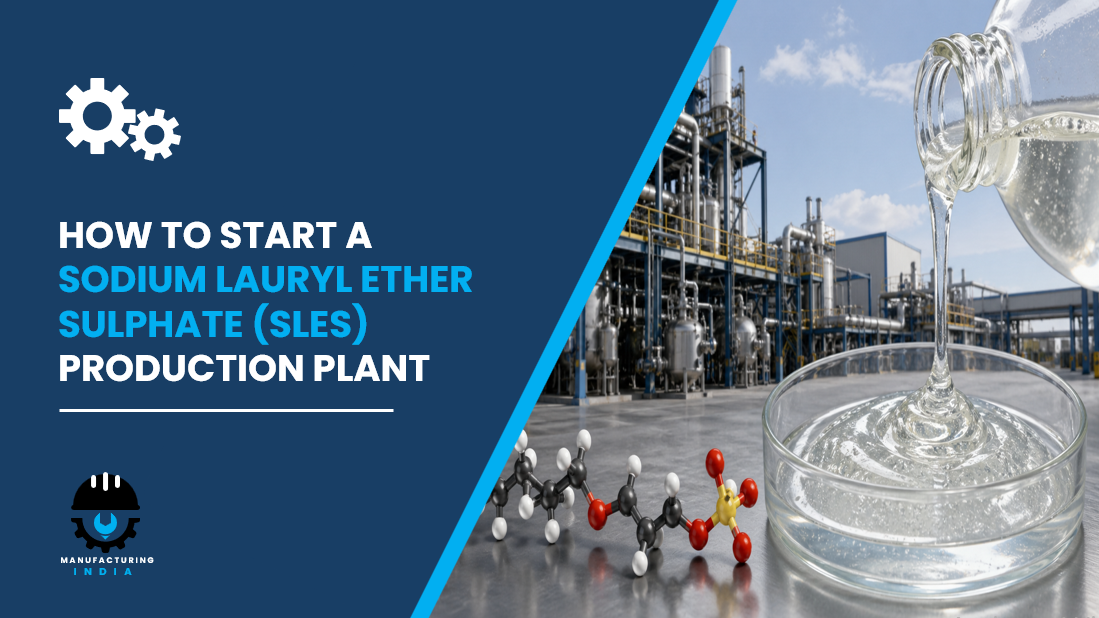
Setting up a sodium lauryl ether sulphate (SLES) production plant in India presents a compelling investment case anchored in the country’s rapidly expanding personal care and household cleaning industries, a growing urban middle class with rising hygiene awareness, accelerating demand for cost-effective and high-performance surfactants, and a strong Asia-Pacific market position that makes India one of the most strategically attractive locations globally for SLES production. Sodium lauryl ether sulphate — a synthetic detergent and surfactant derived from natural sources like coconut oil or palm kernel oil — delivers excellent foaming, cleansing, and emulsifying properties that make it a non-substitutable active ingredient in shampoos, body washes, hand soaps, facial cleansers, dishwashing liquids, laundry detergents, and industrial cleaners. Its balance of cost-efficiency and performance has established SLES as one of the most widely used surfactants in the world, and as India’s personal care and household cleaning markets continue their rapid expansion, the demand for domestically produced SLES is growing at a structural and sustained pace.
India’s strategic advantages for this investment are well established. The country’s household cleaners market — valued at USD 10.35 trillion in 2024 and projected to reach USD 36.31 trillion by 2033 at a 15% CAGR as per industrial reports — represents one of the world’s most significant growth opportunities for surfactant producers. The shift toward more eco-friendly and biodegradable surfactant formulations is further driving the development of SLES products with improved sustainability profiles, as SLES derived from renewable plant-based sources gains traction with both consumers and formulators. Chemical and surfactant manufacturing ecosystems in Gujarat, Maharashtra, Andhra Pradesh, and Tamil Nadu offer established infrastructure, skilled chemical processing workforces, and strong logistics connectivity to personal care and cleaning product manufacturers who represent the primary institutional buyer base. Government initiatives in the Asia-Pacific region supporting local chemical production further enhance market potential for India-based SLES producers.
A sodium lauryl ether sulphate (SLES) manufacturing plant in India combines one of the world’s fastest-growing household cleaners markets — projected at a 15% CAGR through 2033 — with a globally proven surfactant production process delivering gross margins of 20–30% and net margins of 10–18%. With the global SLES market projected to reach 3.47 million tons by 2034 at a CAGR of 4.3%, this investment offers stable financial returns and structurally secured demand from India’s expanding personal care, household cleaning, and industrial sectors.
What is Sodium Lauryl Ether Sulphate (SLES)?
Sodium lauryl ether sulphate (SLES) is a synthetic detergent and surfactant commonly used in personal care and cleaning products. It is derived from natural sources like coconut oil or palm kernel oil, with its chemical structure allowing for effective cleansing, foaming, and emulsifying properties. SLES is a key ingredient in a variety of products — including shampoos, body washes, hand soaps, facial cleansers, and household cleaners — due to its ability to lower surface tension and remove dirt and oils effectively. SLES offers a balance of cost-efficiency and performance, making it one of the most popular surfactants used worldwide.
Its ability to generate rich foam, solubilise oils and sebum, and perform consistently across a wide pH range makes it technically superior and commercially preferred over many alternative surfactants in high-volume formulation applications. The primary production method spans etherification, sulfonation, and neutralisation. The product serves end-use industries including personal care, household cleaning, and industrial and institutional cleaning, with applications in shampoos, body washes, facial cleansers, dishwashing liquids, laundry detergents, industrial cleaners, textile processing, and emulsion formulations.
Cost of Setting Up a Sodium Lauryl Ether Sulphate (SLES) Manufacturing Plant in India
The total cost of establishing a sodium lauryl ether sulphate (SLES) manufacturing plant in India depends on production capacity, sulfonation technology, plant location, degree of automation, and regulatory compliance requirements.
1. Capital Expenditure (CapEx)
The capital investment required to set up this facility covers several major cost heads. Land and site development — including land registration, boundary development, chemical-resistant site infrastructure, and related site works — forms a substantial portion of total CapEx. Investors should consider locating the unit within chemical or specialty chemical industrial estates in Gujarat (Ankleshwar, Dahej, Bharuch), Maharashtra (Tarapur, Pune), or Andhra Pradesh, where proximity to lauryl alcohol and ethylene oxide supply chains, established chemical processing infrastructure, and state investment incentives create a commercially favourable operating environment. The highly reactive nature of ethylene oxide and sulfur trioxide — both used in the SLES production process — requires site selection that complies with hazardous chemical storage siting norms and has access to reliable utility supply.
Civil works and construction costs cover the raw material receiving and storage area for lauryl alcohol, ethylene oxide, and sulfur trioxide/oleum, the ethoxylation unit building with pressure vessel provisions, sulfonation reactor hall, neutralisation and finishing section, vacuum stripping and bleaching area, pH adjustment and dilution zone, storage and drumming section, quality control laboratory, effluent treatment area, and administrative block. All process areas handling ethylene oxide and sulfur trioxide must be constructed with corrosion-resistant materials, explosion-proof electrical installations, and dedicated emergency response infrastructure throughout.
Machinery and equipment represent the largest component of total capital expenditure for this SLES manufacturing plant. Key machinery required includes:
- Sulfonation reactors
- Ethoxylation units
- Neutralisation tanks
- Vacuum stripping columns
- Bleaching vessels
- pH adjustment systems
- Dilution control units
- Storage and drumming stations
Other capital costs include effluent treatment plant (ETP) installation for sulfonation and neutralisation process wastewater, pre-operative and commissioning expenses, safety and hazard monitoring systems throughout ethylene oxide and sulfur trioxide handling areas, and any applicable import duties on specialised sulfonation reactor and ethoxylation equipment not manufactured domestically.
Request a Sample Report for In-Depth Market Insights: https://www.imarcgroup.com/sodium-lauryl-ether-sulphate-manufacturing-plant-project-report/requestsample
2. Operational Expenditure (OpEx)
The operating cost structure of an SLES manufacturing plant is overwhelmingly dominated by raw material procurement. Raw material cost — covering lauryl alcohol as the primary and most costly feedstock input, along with ethylene oxide used in the etherification stage and sulfur trioxide or oleum used in the sulfonation stage — accounts for approximately 70–75% of total OpEx, making lauryl alcohol procurement the single most critical cost management lever for plant-level profitability. Lauryl alcohol prices are linked to coconut oil and palm kernel oil commodity markets, requiring investors to establish long-term supply agreements with fatty alcohol producers and authorised chemical distributors to stabilise input costs across production cycles.
Utility costs, covering electricity, water, steam, and cooling water required for ethoxylation, sulfonation, neutralisation, and stripping operations, account for 15–20% of OpEx — a moderately high share reflecting the thermal and pressure management demands of the multi-stage chemical synthesis process. Other operating costs include transportation and logistics for raw material procurement and finished SLES dispatch to personal care formulators, household cleaning product manufacturers, and industrial cleaning compound producers, packaging materials (drums, IBCs, and tankers), salaries and wages, maintenance and calibration of reactor and processing equipment, depreciation of fixed assets, and applicable taxes. By the fifth year of operations, total operational costs are projected to increase substantially due to inflation, lauryl alcohol and ethylene oxide price escalation, market fluctuations, supply chain disruptions, and rising consumer demand dynamics.
3. Plant Capacity
The proposed production facility is designed with an annual production capacity of 30,000 MT, enabling economies of scale while maintaining operational flexibility. Capacity can be customised based on specific investor requirements, target market segment mix across personal care, household cleaning, and industrial buyers, and available capital. Profitability and unit economics improve meaningfully with higher capacity utilisation given the significant fixed cost base of sulfonation and ethoxylation reactor infrastructure.
4. Profit Margins and Financial Projections
The SLES manufacturing plant demonstrates healthy profitability potential under normal operating conditions. Gross profit margins typically range between 20–30%, supported by stable and growing demand from personal care and household cleaning formulators, the performance premium of high-purity SLES grades, and India’s household cleaners market growing at a 15% CAGR. Net profit margins are projected in the range of 10–18%. Key financial indicators including NPV, IRR, payback period, liquidity analysis, and sensitivity analysis are covered comprehensively in the full project report.
Why Set Up a Sodium Lauryl Ether Sulphate (SLES) Manufacturing Plant in India?
Strong and Expanding Market Demand from Personal Care and Household Cleaning. The ongoing expansion of the personal care and household cleaning industries globally is driving significant demand for SLES, as consumers continue to prefer cost-effective and efficient cleansing products. India’s household cleaners market — valued at USD 10.35 trillion in 2024 and projected to reach USD 36.31 trillion by 2033 at a 15% CAGR as per industrial reports — represents the domestic scale of this opportunity and confirms India as one of the highest-growth surfactant consumption markets in the world.
Asia-Pacific Leading Global SLES Production and Consumption. The Asia-Pacific region is expected to remain the largest and fastest-growing market for SLES, owing to high production capacities and strong demand in countries like China and India. India-based producers are ideally positioned to serve both the domestic market and export demand across Southeast Asia, the Middle East, and Africa — markets where personal care and household cleaning product manufacturing is expanding rapidly alongside rising incomes and urbanisation.
Sustainability and Plant-Based Raw Material Sourcing Driving Premium Demand. With rising consumer preferences for natural and sustainable ingredients, SLES derived from renewable plant-based sources — particularly coconut oil and palm kernel oil — is gaining significant traction with personal care formulators targeting clean-label and eco-conscious consumer segments. Regulatory frameworks promoting the use of biodegradable and eco-friendly ingredients in cleaning and personal care products are actively supporting the growth of plant-derived SLES manufacturing globally and in India specifically.
Low Entry Barriers Relative to Production Value. The production process for SLES is relatively straightforward with moderate investment requirements for equipment and raw materials — opening opportunities for both established chemical players and new market entrants. The well-established nature of the etherification, sulfonation, and neutralisation process steps means that proven technology is commercially available, reducing technology risk for first-time producers.
Stable US Market Pricing Supporting Export Viability. In December 2025, SLES prices in the US market remained stable following modest gains earlier in November, as downstream demand from personal care and household cleaners supported market activity — confirming steady international pricing conditions that support export economics for Indian SLES producers targeting North American distribution channels.
Industrial and Institutional Cleaning Demand Diversifying Revenue Base. Beyond personal care and household cleaning, SLES is widely used in industrial and institutional cleaning formulations — including degreasers, car wash formulations, and industrial detergents — and in textile and emulsion processing as a wetting agent, emulsifier, and foaming agent. This multi-sector demand base provides revenue diversification and reduces concentration risk for SLES producers targeting broad industrial buyer portfolios.
Manufacturing Process — Step by Step
The SLES manufacturing process uses etherification, sulfonation, and neutralisation as the primary production method. The process involves multiple chemical unit operations, material handling stages, and quality verification checkpoints throughout.
- Raw Material Receipt and Inspection: Lauryl alcohol, ethylene oxide, and sulfur trioxide or oleum are received from suppliers, inspected for purity and specification compliance, and stored in designated hazardous chemical storage areas with appropriate containment and monitoring systems.
- Etherification (Ethoxylation): Lauryl alcohol is reacted with ethylene oxide under controlled temperature and pressure conditions in ethoxylation units in the presence of a catalyst to produce laureth — the ethoxylated intermediate. The degree of ethoxylation (typically 2–3 moles of ethylene oxide per mole of lauryl alcohol) is precisely controlled to achieve the target product specification.
- Sulfonation: The laureth intermediate undergoes sulfonation with sulfur trioxide or oleum in sulfonation reactors to produce lauryl ether sulphate acid. Sulfonation is a fast, exothermic reaction requiring precise temperature control and falling film or air-SO₃ reactor technology to prevent over-sulfonation and product degradation.
- Neutralisation: The crude lauryl ether sulphate acid is neutralised with sodium hydroxide (caustic soda) in neutralisation tanks to produce the sodium salt of lauryl ether sulphate — the finished SLES active. Neutralisation parameters — caustic addition rate, temperature, and mixing intensity — are carefully controlled to achieve the target pH and active content.
- Vacuum Stripping: The neutralised SLES paste is processed through vacuum stripping columns to remove residual 1,4-dioxane — a trace by-product of the ethoxylation stage — to below regulatory limits applicable to personal care product ingredients in key export markets including the US and EU.
- Bleaching: SLES is treated in bleaching vessels with hydrogen peroxide or sodium hypochlorite to achieve the required colour specification — typically a clear to slightly yellowish paste — for personal care grade product supply.
- pH Adjustment and Dilution: Bleached SLES is adjusted to the final pH specification using pH adjustment systems and diluted to the required active content — typically 70% active for paste grade or 25–28% active for liquid grade — using dilution control units.
- Quality Control and Testing: Finished SLES is tested for active matter content, pH, colour, viscosity, sodium chloride content, dioxane levels, and heavy metal parameters against applicable IS, personal care grade, and export quality specifications.
- Storage and Drumming: Approved SLES is transferred to storage and drumming stations, packaged in drums, IBCs, or dispatched as bulk tanker loads, and shipped to personal care formulators, household cleaning product manufacturers, textile processors, and industrial cleaning compound producers.
Key Applications
The SLES manufacturing plant serves multiple high-volume industries with consistent and growing demand for a reliable, high-purity surfactant active:
- Personal Care: Used in shampoos, body washes, liquid hand soaps, and facial cleansers as the primary foaming and cleansing surfactant active — the largest volume application segment for SLES globally.
- Household Cleaning: Applied in laundry detergents, dishwashing liquids, and surface cleaners for its superior degreasing, foaming, and soil removal performance across formulation types.
- Industrial and Institutional Cleaning: Used in degreasers, car wash formulations, and industrial detergents where high foaming and effective cleaning across varied soil types are required.
- Textile and Emulsion Processing: Functions as a wetting agent, emulsifier, and foaming agent in textile processing and chemical formulations requiring stable foam, controlled wetting, and emulsification performance.
Leading Manufacturers
The global SLES industry is served by several major multinational chemical companies with extensive production capacities and diverse application portfolios. Key players include:
- BASF SE
- Clariant AG
- Huntsman Corporation
- Stepan Company
- Galaxy Surfactants Ltd.
Timeline to Start the Plant
- Feasibility study and project report preparation
- Land acquisition and site development
- Regulatory approvals and environmental clearances
- Factory licence and fire safety compliance
- Machinery procurement and installation
- Raw material supplier agreements and supply chain setup
- Trial production and quality testing
- Commercial production launch
Licences and Regulatory Requirements
Starting a sodium lauryl ether sulphate (SLES) manufacturing unit in India requires several approvals:
- Business registration (Proprietorship, LLP, or Pvt Ltd)
- Factory Licence under the Factories Act
- Environmental Clearance from State Pollution Control Board
- GST Registration
- Fire Safety NOC
- Hazardous chemical compliance for ethylene oxide and sulfur trioxide storage and handling under the Manufacture, Storage, and Import of Hazardous Chemical (MSIHC) Rules
- Consent to Establish and Consent to Operate from State Pollution Control Board covering sulfonation reactor emissions and effluent discharge
- Effluent Treatment Plant (ETP) operational clearance for sulfonation and neutralisation process wastewater
- Occupational Health and Safety compliance
Key Challenges to Consider
High Capital Requirements for Hazardous Chemical Processing. Ethoxylation units, sulfonation reactors, vacuum stripping columns, and associated safety and containment infrastructure for ethylene oxide and sulfur trioxide handling constitute significant CapEx commitments. Explosion-proof electrical installations and dedicated emergency response systems throughout the plant add substantially to the upfront investment requirement.
Raw Material Price Volatility. Lauryl alcohol — accounting for 70–75% of total OpEx — is priced in relation to coconut oil and palm kernel oil commodity markets, creating input cost exposure to vegetable oil price cycles. Ethylene oxide and sulfur trioxide prices are linked to petrochemical and sulfur market dynamics. Long-term supply agreements with fatty alcohol and specialty chemical producers are essential cost risk management tools.
Regulatory Compliance for Hazardous Chemical Handling. Meeting MSIHC Rules requirements for ethylene oxide and sulfur trioxide storage and handling, State Pollution Control Board emission and effluent standards for sulfonation operations, and 1,4-dioxane content compliance requirements for personal care grade SLES export involves multi-layered compliance obligations requiring dedicated management and ongoing environmental monitoring investment.
Technology and Innovation Pressure. Growing consumer preference for milder, low-irritation surfactant systems — including SLES with higher degrees of ethoxylation for reduced skin irritation — and increasing demand for palm-free and certified sustainable lauryl alcohol inputs require producers to invest in product development and supply chain sustainability credentials to serve premium personal care formulator accounts.
Competition. Global players such as BASF SE, Clariant AG, Huntsman Corporation, and Stepan Company, along with Indian producer Galaxy Surfactants Ltd., maintain strong market positions with established quality certifications and supply relationships across personal care and household cleaning formulators. New entrants must achieve personal care grade quality certification, 1,4-dioxane compliance, and consistent active content specifications to win institutional buyer accounts.
Skilled Manpower for Hazardous Chemical Operations. Operating ethylene oxide ethoxylation units, falling film sulfonation reactors, and vacuum stripping columns to personal care industry quality standards requires chemical engineers with specialised surfactant synthesis experience — a workforce category requiring targeted recruitment from petrochemical or oleochemical processing backgrounds.
Frequently Asked Questions
1. How much does it cost to set up a sodium lauryl ether sulphate (SLES) manufacturing plant in India? Total investment depends on production capacity (30,000 MT annually), sulfonation technology, location, and automation level. Key cost components include land and hazardous chemical-compliant site infrastructure, civil construction, machinery (sulfonation reactors, ethoxylation units, neutralisation tanks, vacuum stripping columns, bleaching vessels, pH adjustment systems, dilution control units, storage and drumming stations), ETP, safety systems, and working capital for lauryl alcohol procurement. A detailed project report provides capacity-specific CapEx and OpEx estimates.
2. Is sodium lauryl ether sulphate (SLES) manufacturing profitable in India in 2026? Yes. The facility demonstrates gross profit margins of 20–30% and net profit margins of 10–18% under normal operating conditions. Profitability is supported by India’s household cleaners market growing at a 15% CAGR and stable export pricing conditions as evidenced by the US market in December 2025. Profitability improves with higher capacity utilisation and effective lauryl alcohol procurement cost management.
3. What machinery is required for a sodium lauryl ether sulphate (SLES) manufacturing plant in India? Key equipment includes sulfonation reactors, ethoxylation units, neutralisation tanks, vacuum stripping columns, bleaching vessels, pH adjustment systems, dilution control units, and storage and drumming stations.
4. What licences and approvals are required to start an SLES manufacturing plant in India? Required approvals include business registration, Factory Licence under the Factories Act, Environmental Clearance from the State Pollution Control Board, GST registration, Fire Safety NOC, hazardous chemical compliance under MSIHC Rules for ethylene oxide and sulfur trioxide, Consent to Establish and Operate from the State Pollution Control Board, ETP operational clearance, and Occupational Health and Safety certification.
5. What raw materials are needed for SLES manufacturing? Key raw materials are lauryl alcohol as the primary and dominant cost feedstock, ethylene oxide used in the etherification (ethoxylation) stage to produce the laureth intermediate, and sulfur trioxide or oleum used in the sulfonation stage to produce lauryl ether sulphate acid before neutralisation.
6. What are the environmental compliance requirements for an SLES manufacturing plant in India? Operators must obtain Environmental Clearance, maintain an operational ETP for sulfonation and neutralisation process wastewater, comply with State Pollution Control Board guidelines on effluent quality and hazardous chemical stack emission standards for sulfonation reactor operations, and meet 1,4-dioxane reduction requirements through vacuum stripping for personal care grade product compliance with IS and export market specifications.
7. What is the best location to set up an SLES manufacturing plant in India? Ideal locations offer proximity to lauryl alcohol and ethylene oxide supply chains, established specialty chemical processing infrastructure, compliance with MSIHC Rules siting requirements for hazardous chemical storage, and access to personal care and household cleaning product manufacturer buyer clusters. Gujarat (Ankleshwar, Dahej, Bharuch), Maharashtra (Tarapur, Pune), and Andhra Pradesh are strong location options combining chemical industry infrastructure, state investment incentives, and proximity to FMCG and personal care formulator hubs.
8. What is the break-even period for this type of plant in India? Break-even depends on production scale, lauryl alcohol procurement costs, capacity utilisation, and prevailing SLES market pricing across personal care, household cleaning, and industrial grades. The gross margin profile of 20–30% and the 30,000 MT annual capacity scale support a commercially competitive payback timeline. A detailed feasibility study provides project-specific break-even, NPV, and IRR projections.
9. What government incentives are available for manufacturers in India? SLES manufacturers in India can benefit from capital subsidies under state-level specialty chemical and surfactant manufacturing investment schemes in Gujarat and Maharashtra, tax exemptions under state industrial promotion policies, concessional land and utility rates in chemical industrial estates, and export-linked benefits for personal care grade SLES supplied to international formulators. Make in India and Asia-Pacific chemical industry support initiatives may provide additional investment facilitation.
Key Takeaways for Investors
The sodium lauryl ether sulphate (SLES) manufacturing plant opportunity in India is underpinned by structural, multi-sector demand growth from personal care, household cleaning, industrial cleaning, and textile processing industries — all of which are expanding rapidly within India’s consumer economy and industrial base. The financial profile is commercially sound at 30,000 MT annual capacity, with gross margins of 20–30% and net margins of 10–18%, supported by India’s household cleaners market growing at a 15% CAGR toward USD 36.31 trillion by 2033 and stable international pricing conditions as confirmed by the US market in December 2025. The global SLES market, volumed at 2.38 million tons in 2025, is projected to reach 3.47 million tons by 2034 at a CAGR of 4.3%, confirming a sustained and growing demand runway. As Asia-Pacific — with India as a key growth engine — continues to lead global SLES production and consumption, and as consumer preference for plant-derived, biodegradable surfactant formulations strengthens the commercial positioning of coconut oil-derived SLES, India-based manufacturers who achieve personal care grade quality certification and consistent supply reliability are positioned for durable, multi-decade demand growth across every tier of the country’s and region’s expanding formulation industry.
About the Author