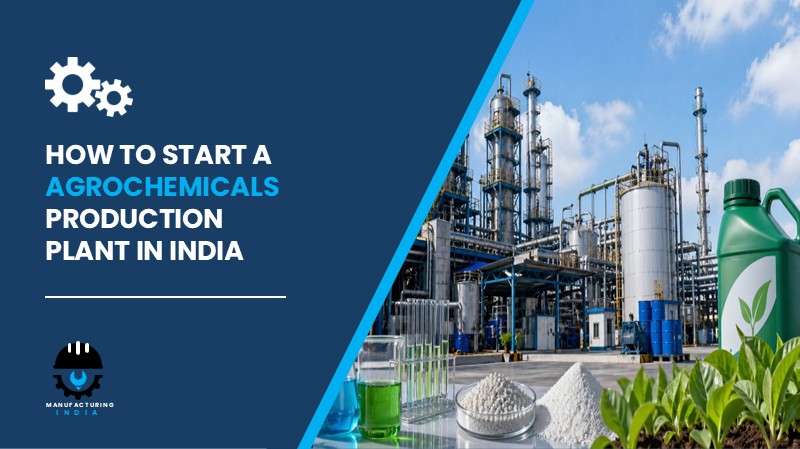
Setting up an agrochemicals production plant in India presents a compelling investment case at a time when the country’s vast agricultural sector — the backbone of the livelihoods of more than half its population — is undergoing its most significant productivity transformation in decades. Driven by rising global food demand, increasing pressure on arable land, the urgent need for higher crop productivity, and growing adoption of modern farming practices, agrochemicals are the essential inputs that enable Indian farmers to protect their crops, optimise soil fertility, and consistently deliver yields that meet both domestic food security requirements and the country’s growing agricultural export ambitions. Agrochemicals — encompassing fertilisers, pesticides, herbicides, fungicides, insecticides, plant growth regulators, and micronutrients — serve as essential components of contemporary farming, enabling farmers to produce crops effectively while reducing the impact of weeds, insects, pathogens, and nutrient shortages across India’s diverse agro-climatic zones.
India’s structural advantages for agrochemicals production are exceptional and policy-reinforced at every level. According to the Government of India’s Outcome-Outcome Monitoring Framework for 2025–26, 250,000 farmers received on-farm demonstrations of new agricultural technologies, 1.2 million farmers and rural youth were trained under ATMA, and 280,000 beneficiaries participated in farm schools — each programme boosting the adoption of modern farming practices and driving agrochemical demand at the grassroots level. India is already one of the world’s largest producers and exporters of generic agrochemical active ingredients, with a well-developed chemical manufacturing base in Gujarat, Maharashtra, Andhra Pradesh, and Telangana that provides raw material access, chemical handling expertise, and export logistics. The Make in India initiative and targeted agricultural productivity programmes provide policy tailwinds, while a domestic market of over 140 million farm households ensures stable, recurring, and seasonally predictable demand that few other manufacturing investments can match.
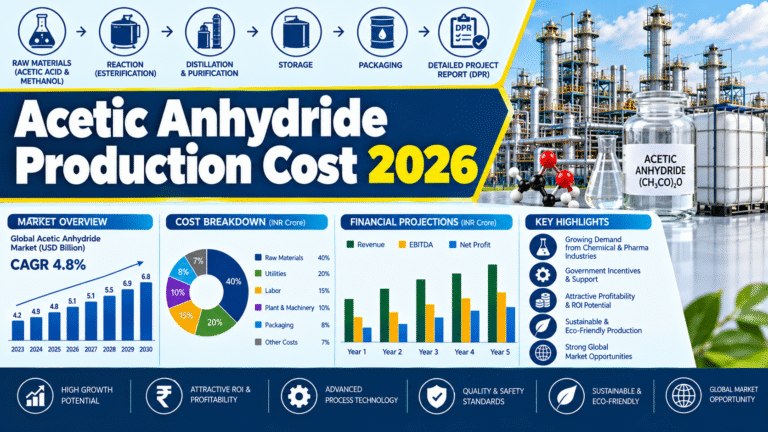
Investing in an agrochemicals production plant in India today aligns rising global food demand, India’s modern farming technology adoption programmes, and a global agrochemicals market growing from USD 307.23 Billion in 2025 to USD 407.92 Billion by 2034 at a 3.2% CAGR with cost-competitive production economics and a scalable, diversified product portfolio. With gross profit margins of 25–40% and net profit margins of 12–20%, the unit economics are commercially attractive at the proposed 10,000 MT annual capacity, and the investment’s diversified agrochemical product range supports long-term revenue resilience across India’s agricultural cycle.
What are Agrochemicals?
Agrochemicals refer to chemical and biological materials that agricultural enterprises use to boost crop productivity and defend against insect and disease threats, and to enhance soil fertility. The category comprises various substances including fertilisers, pesticides, herbicides, fungicides, insecticides, plant growth regulators, and micronutrients. These agricultural products function as essential components of contemporary farming because they enable farmers to produce crops effectively while reducing the impact of weeds, insects, pathogens, and nutrient shortages across all crop categories and climatic conditions.
Agrochemicals exist in multiple formulations — including liquids, granules, powders, and emulsifiable concentrates — to meet the needs of various crops and climatic conditions. Farmers achieve maximum crop yield through targeted application methods that deliver specific results for their farming operations while maintaining uniform crop standards. Environmental sustainability mandates that manufacturers create new product formulations that deliver enhanced performance and create less environmental damage while protecting user safety and ecosystem health — an innovation imperative that is reshaping product development across the global agrochemicals industry and creating new premium market segments for bio-based and precision-formulated crop protection products.
The primary production process covers raw material handling and formulation, chemical synthesis or blending, reaction control and neutralisation, filtration and drying, quality inspection, filling, packaging, and labelling. End-use industries served include the agriculture and farming sector, commercial crop production, horticulture and plantations, and seed and crop protection companies. Applications span crop protection, weed control, pest and disease management, soil fertility enhancement, and yield improvement across cereals, fruits, vegetables, oilseeds, and cash crops.
Cost of Setting Up an Agrochemicals Production Plant in India
The cost of establishing an agrochemicals production plant in India depends on plant capacity, the product range across pesticides, herbicides, fungicides, insecticides, and plant growth regulators, chemical synthesis technology selection, geographic location, degree of automation, and the comprehensive environmental, safety, and quality compliance requirements applicable to agrochemical manufacturing facilities supplying the Indian and export agricultural markets.
1. Capital Expenditure (CapEx)
Land and Site Development forms a foundational component of total capital investment, covering land acquisition charges, site registration, boundary development, chemical containment and bund wall infrastructure, drainage, and site utilities. Given the hazardous nature of agrochemical active ingredients and intermediates, site safety infrastructure — including toxic gas detection, chemical spill containment, and emergency response systems — adds capital requirements beyond conventional chemical plant standards. Investors may explore established agrochemical manufacturing clusters or Special Economic Zones (SEZs) in Ankleshwar and Dahej in Gujarat, Navi Mumbai and Nagpur in Maharashtra, and Hyderabad in Telangana, where chemical handling infrastructure, regulatory expertise, raw material supply chains, and established agrochemical industry ecosystems create the most commercially advantaged operating environments for new producers.
Civil Works and Construction cover the main synthesis and formulation production building housing corrosion-resistant reactor systems, filtration and drying areas, formulation blending units, filling lines, and quality control laboratory, raw material storage facilities for glycine, phosphorous trichloride, formaldehyde, and purification solvents with appropriate chemical containment, finished goods warehousing with segregated storage for different formulation types, packaging areas, an administrative block, and utilities infrastructure including steam generation and cooling water systems.
Machinery and Equipment represent the largest single component of total CapEx for an agrochemicals production plant. Key machinery required includes:
- Corrosion-resistant reactors
- Mixers
- Filtration systems
- Drying units
- Filling lines
- Automated packaging equipment
Other Capital Costs include an effluent treatment plant (ETP) for managing agrochemical synthesis effluents and formulation washdown water, fume scrubbing systems for synthesis reactor off-gases, pre-operative expenses, Central Insecticides Board (CIB) registration costs, commissioning charges, and import duties on specialised automated packaging or analytical quality control equipment not available domestically at the required specification.
Request a Sample Report for In-Depth Market Insights: https://www.imarcgroup.com/agrochemicals-manufacturing-plant-project-report/requestsample
2. Operational Expenditure (OpEx)
Raw Material Cost is the dominant operational expense, accounting for approximately 55–65% of total OpEx. The primary raw materials are glycine, phosphorous trichloride, formaldehyde, and solvents for purification. Glycine — as the primary amino acid feedstock for glyphosate-based herbicide synthesis — drives the majority of raw material cost for herbicide-focused production configurations. Phosphorous trichloride and formaldehyde are critical intermediates for phosphonate-based active ingredient synthesis. Purification solvents are consumed across multiple product lines for active ingredient isolation and quality standardisation. Long-term procurement contracts with reliable suppliers for all major raw materials are strongly advisable to stabilise production economics and ensure supply continuity across agricultural seasons.
Utility Cost is the second-largest OpEx component, representing 20–25% of total operating expenses — a relatively high utility proportion reflecting the energy intensity of chemical synthesis reactor heating, distillation for purification, solvent recovery operations, and drying unit operations that together constitute the most energy-demanding stages of agrochemical active ingredient manufacturing.
Other Operating Costs include transportation and distribution to agricultural input dealers, distributor networks, seed and crop protection companies, and direct farm sales channels, packaging materials for liquid, granular, and powder agrochemical formulations in retail and bulk formats, salaries and wages for chemical engineers and formulation technicians, routine machinery maintenance including reactor lining inspection and filtration system servicing, CIB registration renewal and regulatory compliance costs, depreciation on production equipment, and applicable taxes. By the fifth year of operations, total operational costs are projected to increase substantially due to inflation, market fluctuations, potential rises in glycine and other raw material prices, supply chain disruptions, rising consumer demand, and shifts in the global economy.
3. Plant Capacity
The proposed production facility for agrochemicals is designed with an annual production capacity of 10,000 metric tonnes, enabling economies of scale while maintaining the operational flexibility to serve a diversified portfolio across herbicides, fungicides, insecticides, plant growth regulators, and micronutrient formulations suited to India’s diverse cropping systems. Plant capacity can be customised per investor requirements and expanded through additional reactor and formulation line configurations as market demand and customer relationships grow. Profitability improves with higher capacity utilisation and product portfolio diversification, making established distribution relationships with agri-input dealers and commercial farm customers a strategic commercial foundation from the outset.
4. Profit Margins and Financial Projections
The financial projections for an agrochemicals production plant demonstrate healthy profitability potential under normal operating conditions. Gross profit margins typically range between 25–40%, supported by stable and recurring demand driven by the annual agricultural cycle and the growing adoption of modern crop protection practices across India’s farming community. Net profit margins are projected at 12–20%. A comprehensive financial analysis covering NPV (net present value), IRR (internal rate of return), payback period, gross margin progression, and net margin development across a five-year horizon is essential before committing capital. The project’s ROI profile and long-term sustainability are assessed against realistic assumptions on capital investment, production capacity utilisation, raw material pricing trends, and demand outlook from the agriculture and farming sector, commercial crop production, horticulture and plantations, and seed and crop protection company customers.
Why Set Up an Agrochemicals Production Plant in India?
Rising Global Food Demand and Agricultural Productivity Imperative. Population growth and shrinking arable land are increasing dependence on agrochemicals to maximise crop productivity per hectare — the fundamental demand driver for the entire agrochemicals industry globally. With global population continuing to grow and urbanisation reducing available agricultural land, the pressure on farmers to increase yields per unit area makes high-performance crop protection and soil fertility products more essential with each passing agricultural cycle. India, as one of the world’s largest agricultural producers with over 140 million farm households, sits at the centre of this productivity imperative.
Government Investment in Farmer Technology Adoption. According to the Government of India’s Outcome-Outcome Monitoring Framework for 2025–26, 250,000 farmers received on-farm demonstrations of new agricultural technologies, 1.2 million farmers and rural youth were trained under ATMA, and 280,000 beneficiaries participated in farm schools — programmes that are systematically expanding the farmer base actively using modern agrochemical inputs and driving structured demand growth for crop protection and soil fertility products across previously underserved agricultural geographies.
Technological Advancements Creating Premium Product Opportunities. Formulation and application technique innovations are producing less environmental damage while improving agrochemical efficiency — a trend that is creating premium market segments for bio-based and precision-formulated crop protection products alongside conventional agrochemicals. In December 2025, Syngenta released a new insecticide mode of action, strengthening agrochemical portfolios after 12 years of research across 30 crops and more than 3,200 trials, with Vertento targeting cotton, soybeans, and peanuts and Opello for corn following Plinazolin technology trials. In November 2025, Corteva highlighted two crop protection solutions of natural and nature-inspired origin — Goltrevo bioinsecticide targeting sap-feeding and chewing insects including whiteflies, aphids, and corn leafhopper linked to corn stunt disease with yield losses up to 70%, and Varpelgo for chewing pests across fruits, vegetables, row crops, and rice — signalling the active innovation frontier that Indian producers can participate in.
Stable and Recurrent Annual Demand. The annual agricultural cycle creates predictable requirements for crop protection products and nutrient solutions that repeat every season, providing a revenue visibility and demand reliability that most manufacturing categories cannot offer. This seasonal recurrence of agrochemical procurement — aligned with Kharif and Rabi planting cycles — enables reliable production planning, inventory management, and financial forecasting that support sound project economics.
Scalable and Diversified Product Portfolio Opportunity. Fertiliser, bio-based products, and specialty crop solutions offer manufacturers various options to build revenue centres through business expansion — a product portfolio diversification advantage that allows an Indian agrochemicals producer to serve multiple crop categories and farming systems while reducing single-product commercial risk. The ability to expand from herbicides into fungicides, insecticides, and plant growth regulators within the same production infrastructure provides organic revenue growth pathways without proportional capital reinvestment.
Export Market Access and India’s Global Agrochemicals Position. Developing economies are experiencing increased agrochemical usage as farmers gain better access to agricultural inputs through government-backed productivity programmes, while developed markets focus on innovations enabling precision agriculture and environmentally friendly formulations. India’s established global reputation as a producer of generic agrochemical active ingredients — built on decades of chemical manufacturing expertise in Gujarat and Andhra Pradesh — provides new domestic producers with credibility and channel access for export market development across Southeast Asia, Africa, and Latin America.
Manufacturing Process — Step by Step
The agrochemicals production process uses raw material handling and formulation, chemical synthesis or blending, reaction control and neutralisation, filtration and drying, quality inspection, filling, packaging, and labelling as the primary production method. Each stage requires precisely controlled reaction temperatures, pH levels, reagent ratios, and purification parameters to deliver agrochemical active ingredients and formulations meeting the regulatory purity, concentration, and stability specifications required by Central Insecticides Board registration requirements and customer quality standards.
- Raw Material Receipt and Handling: Glycine, phosphorous trichloride, formaldehyde, purification solvents, and other chemical inputs are received from certified suppliers, quality-inspected for purity and specification compliance, and transferred to segregated chemical storage under appropriate containment conditions with incompatible chemical separation maintained at all times.
- Chemical Synthesis in Corrosion-Resistant Reactors: Primary agrochemical active ingredients are synthesised through controlled chemical reactions in corrosion-resistant reactors, with precise control of reagent addition rates, temperature, pressure, and reaction time to achieve target product yield and selectivity while minimising by-product formation.
- Reaction Control and Neutralisation: Synthesised reaction mixtures undergo pH adjustment and neutralisation using appropriate reagents to quench the reaction, stabilise the product, and prepare the crude active ingredient mixture for subsequent purification processing.
- Filtration: Neutralised reaction product is processed through filtration systems to remove insoluble by-products, catalyst residues, and particulate impurities, producing a clarified solution suitable for solvent-based purification or direct concentration.
- Drying and Concentration: Filtered product streams are processed through drying units or evaporators to remove solvent and water content, concentrating the active ingredient to the specification required for the target formulation type — technical grade solid or liquid depending on the product.
- Formulation Blending: Technical grade active ingredients are blended with appropriate co-formulants — surfactants, carriers, solvents, stabilisers, and colourants — in mixers to produce the final agrochemical formulation in the specified form: emulsifiable concentrate, wettable powder, granule, suspension concentrate, or soluble liquid.
- Quality Inspection: Finished agrochemical formulations undergo comprehensive quality testing covering active ingredient concentration, physical stability, pH, viscosity, particle size for granular and powder products, emulsification characteristics, and storage stability against Central Insecticides Board and customer specification parameters before release for filling and packaging.
- Filling, Packaging, and Labelling: Specification-compliant agrochemical formulations are filled into bottles, cans, bags, or drums using filling lines, sealed, and labelled with regulatory-compliant labels including crop and pest claims, active ingredient declaration, safety instructions, and CIB registration number using automated packaging equipment before dispatch to agricultural input dealers, distributor networks, and direct farm customers.
Key Applications
Agrochemicals produced in India serve the complete spectrum of crop management and farm productivity applications across India’s diverse agricultural systems:
- Cereal and Grain Farming: Agrochemicals improve crop resistance and nutrient availability, leading to better crop yields and uniform grain quality throughout extensive farming regions covering wheat, rice, maize, and pulses.
- Horticulture and Plantation Crops: Specialised formulations provide support to control pests while boosting the growth of fruits and vegetables, tea, coffee, and plantation crops — high-value agriculture segments where agrochemical investment per hectare is significantly higher than field crop averages.
- Commercial Agriculture: Large farms use agrochemicals to boost output while managing weeds and protecting crops from different types of weather-related and biotic stress across oilseeds, sugarcane, and cotton production systems.
- Seed and Crop Protection Industry: Integrated crop management programmes use agrochemicals to maintain seed quality, boost seed germination rates, and support the systemic crop protection programmes that modern farm management systems deploy across the full growing season.
Leading Producers
The global agrochemicals industry is served by a group of large multinational companies with extensive production capacities and diverse application portfolios across crop protection, fertilisers, and specialty agrochemical segments. Key players in the global market include:
- BASF SE
- Bayer AG
- Corteva Inc.
- Dow Inc.
- FMC Corporation
Timeline to Start the Plant
Establishing an agrochemicals production plant in India involves a structured multi-phase development sequence. Investors should plan for the following phases:
- Feasibility study and project report preparation
- Land acquisition and site development
- Regulatory approvals and environmental clearances
- Factory licence and fire safety compliance
- Machinery procurement and installation
- Raw material supplier agreements and supply chain setup
- Trial production and quality testing
- Commercial production launch
Licences and Regulatory Requirements
Starting an agrochemicals production unit in India requires several approvals spanning business registration, pesticide regulation, environmental, chemical safety, and agricultural compliance domains:
- Business registration (Proprietorship, LLP, or Pvt Ltd)
- Factory Licence under the Factories Act
- Environmental Clearance from the State Pollution Control Board
- GST Registration
- Fire Safety NOC
- Central Insecticides Board (CIB) registration under the Insecticides Act 1968 for each pesticide, herbicide, fungicide, and insecticide product, mandatory before commercial manufacture and sale
- Hazardous/Chemical compliance under the Manufacture, Storage and Import of Hazardous Chemical (MSIHC) Rules applicable to agrochemical synthesis intermediates
- Effluent Treatment Plant (ETP) operational clearance for managing chemical synthesis effluents and formulation washdown water
- Occupational Health and Safety compliance including hazardous chemical handling training and medical surveillance for production workers
Key Challenges to Consider
CIB Registration and Regulatory Complexity. Each agrochemical product — every active ingredient, every formulation type, and every crop-pest combination — requires separate Central Insecticides Board registration before commercial manufacture and sale in India. The CIB registration process is technically demanding, time-consuming, and requires dossiers of efficacy, residue, toxicology, and environmental fate data. New product registrations can take several years, making the registration pipeline management a critical strategic function that must begin well before plant commissioning.
Raw Material Price Volatility and Supply Concentration. Glycine, phosphorous trichloride, and formaldehyde account for 55–65% of total OpEx, with glycine pricing particularly subject to global supply concentration and production economics in China, where significant volumes of the global glycine supply originate. Supply chain disruptions — such as Chinese environmental enforcement actions affecting chemical production — can cause rapid glycine price spikes that directly compress agrochemical production margins. Dual-source procurement strategies and strategic inventory positions are essential for cost stability.
Hazardous Chemical Safety and Environmental Compliance. Agrochemical synthesis involves multiple hazardous chemical intermediates — phosphorous trichloride, formaldehyde, and various solvents — that require comprehensive chemical safety management systems, advanced monitoring equipment, and rigorous environmental compliance across synthesis effluent treatment and air emission control. Managing these requirements demands dedicated safety engineering expertise and ongoing regulatory engagement with state pollution control authorities.
Competition from Established Multinational and Indian Players. The competitive landscape includes global giants BASF SE, Bayer AG, Corteva Inc., and FMC Corporation with proprietary molecules, global distribution, and massive R&D investment advantages, alongside well-established Indian generic producers in Gujarat and Andhra Pradesh with decades of CIB registrations, regulatory experience, and distribution network depth. New entrants must focus on generic active ingredient cost competitiveness, niche crop-specific formulations, bio-based products, or private label supply to carve defensible commercial positions.
Technological and Formulation Innovation Pressure. Active development of bio-based and precision-formulated crop protection products — as evidenced by Corteva’s November 2025 Goltrevo bioinsecticide and Varpelgo launches, and Syngenta’s December 2025 Plinazolin technology commercialisation — is accelerating the pace of product innovation in the global agrochemicals industry. Indian producers must invest in formulation development capability and stay current with emerging active ingredient technologies to remain competitive across the premium market segments that command the strongest margins.
Skilled Technical Workforce for Chemical Synthesis Operations. Maintaining consistent active ingredient synthesis quality, formulation stability, and analytical quality control across multiple agrochemical product lines requires trained synthetic chemists, formulation technologists, and regulatory affairs specialists — a technically demanding, multi-disciplinary workforce that requires ongoing investment in recruitment, advanced training, and retention programmes.
Frequently Asked Questions
1. How much does it cost to set up an agrochemicals production plant in India?
The total setup cost depends on plant capacity, product range, synthesis technology, location, and automation level. CapEx covers land and site development with chemical safety infrastructure, production facility civil construction, core machinery including corrosion-resistant reactors, mixers, filtration systems, drying units, filling lines, and automated packaging equipment, along with CIB registration costs, ETP, fume scrubbing systems, and other capital costs. A detailed project report with full CapEx and OpEx breakdowns is available on request.
2. Is agrochemicals production profitable in India in 2026?
Yes. The project demonstrates gross profit margins of 25–40% and net profit margins of 12–20% under normal operating conditions, supported by stable and recurring demand from the annual agricultural cycle across India’s 140 million farm household market, expanding government farmer technology adoption programmes, and a global agrochemicals market growing from USD 307.23 Billion in 2025 to USD 407.92 Billion by 2034.
3. What machinery is required for an agrochemicals production plant in India?
Key machinery includes corrosion-resistant reactors, mixers, filtration systems, drying units, filling lines, and automated packaging equipment. All equipment must be fabricated from materials compatible with the agrochemical active ingredients and solvents processed — typically glass-lined, stainless steel, or HDPE-lined reactor and storage systems — with automated control systems for precise reaction parameter management.
4. What licences and approvals are required to start an agrochemicals production plant in India?
Required approvals include business registration, a Factory Licence under the Factories Act, Environmental Clearance from the State Pollution Control Board, GST registration, a Fire Safety NOC, Central Insecticides Board (CIB) registration under the Insecticides Act 1968 for each product, MSIHC Rules compliance for hazardous chemical handling, ETP operational clearance, and Occupational Health and Safety compliance.
5. What raw materials are needed for agrochemicals production?
The primary raw materials are glycine, phosphorous trichloride, formaldehyde, and solvents for purification. Glycine accounts for approximately 55–65% of total operating expenses as the primary feedstock for herbicide active ingredient synthesis, making glycine procurement strategy, supplier diversification, and price risk management the most critical cost management levers for the investment.
6. What are the environmental compliance requirements for an agrochemicals production plant in India? The unit must obtain Environmental Clearance from the State Pollution Control Board, operate a certified ETP for managing chemical synthesis effluents and formulation washdown water, install fume scrubbing systems for synthesis reactor off-gases, comply with MSIHC Rules for hazardous chemical storage and handling, and maintain continuous monitoring systems for air emissions and wastewater discharge in line with applicable state pollution control standards.
7. What is the best location to set up an agrochemicals production plant in India?
Optimal locations offer proximity to key raw material supply chains for glycine, phosphorous trichloride, and formaldehyde, established chemical handling infrastructure and regulatory expertise, logistics connectivity to agricultural market distribution networks, and access to skilled chemical engineering workforce. Established agrochemical manufacturing clusters in Ankleshwar and Dahej in Gujarat, Navi Mumbai in Maharashtra, and Hyderabad in Telangana are among the most strategically relevant options.
8. What is the break-even period for this type of plant in India?
The break-even period depends on plant capacity, product registration timelines with the CIB, capacity utilisation rate, raw material pricing trends, and demand conditions across crop protection and soil fertility market segments. A detailed financial analysis including payback period, NPV, and IRR projections is included in the full project report, available via the sample request link.
9. What government incentives are available for manufacturers in India?
The Make in India initiative, agricultural productivity programmes supporting agrochemical adoption, state-level chemical industry promotion policies in Gujarat and Telangana, and export promotion schemes for agrochemical active ingredients and formulations provide financial and regulatory support for agrochemicals production investments. Capital subsidies, power tariff concessions, land cost benefits, and duty drawback schemes for exported agrochemical products may be applicable depending on the chosen plant location and production profile.
Key Takeaways for Investors
An agrochemicals production plant in India represents a commercially well-grounded investment opportunity anchored by stable and structurally growing demand from the agriculture and farming sector, commercial crop production, horticulture and plantations, and seed and crop protection companies — customer segments that collectively constitute India’s largest and most recurring industrial procurement market. The project demonstrates financial viability at an annual production capacity of 10,000 MT, with gross profit margins of 25–40% and net profit margins of 12–20% confirming commercially attractive unit economics supported by the annual agricultural cycle’s predictable demand recurrence. The global agrochemicals market, valued at USD 307.23 Billion in 2025, is projected to reach USD 407.92 Billion by 2034, growing at a CAGR of 3.2%, with India’s own agricultural productivity programmes — training 1.2 million farmers under ATMA and delivering on-farm technology demonstrations to 250,000 farmers in 2025–26 alone — driving domestic demand expansion that a well-positioned domestic producer can capture with supply chain advantages over imported alternatives. With active product innovation from Syngenta and Corteva expanding the premium crop protection segment, India’s agricultural sector’s systematic technology adoption continuing, and the diversified product portfolio across herbicides, fungicides, insecticides, and plant growth regulators distributing commercial risk across multiple crop and market segments, demand sustainability for India-based agrochemicals production is structurally robust and commercially compelling across the full investment horizon.
About the Author