Setting up an ice manufacturing plant in India presents a highly compelling investment opportunity, driven by accelerating demand for safe, purified commercial ice across the food processing, fisheries, hospitality, healthcare, concrete cooling, and cold chain logistics sectors; the rapid expansion of organized food service and quick-service restaurant networks; rising consumer preference for hygienic and packaged ice; intensifying cold storage and temperature-controlled supply chain infrastructure; and the increasing penetration of commercial ice across retail, industrial, and institutional end-use markets. As one of the most strategically significant segments of the global refrigeration and food safety industry, ice manufacturing combines water purification and treatment, refrigeration-cycle freezing, ice formation and harvesting, cutting and shaping, quality inspection, cold storage, and packaging operations to serve a broad range of food processing, fisheries, healthcare, hospitality, concrete, and industrial cooling applications.
The global ice market size was valued at USD 6.35 Billion in 2025. According to IMARC Group estimates, the market is expected to reach USD 11.39 Billion by 2034, exhibiting a CAGR of 6.7% from 2026 to 2034. Driven by sustained growth in organized food service and hospitality, accelerating urbanisation and rising disposable incomes across emerging economies, the expanding cold chain logistics and food processing sectors, and growing consumer demand for hygienic, packaged, and commercially produced ice. Asia-Pacific accounts for the largest regional share, supported by India’s deep-rooted ice consumption base across fisheries, food processing, hospitality, healthcare, and retail sectors, along with the country’s active expansion of cold storage capacity, industrial parks, and organised food service infrastructure.
Expanding adoption of packaged and hygienic ice products, growing demand for specialised ice formats across the food processing, fisheries, concrete, and healthcare sectors, and the increasing use of commercial ice across quick-service restaurants, institutional catering, and cold chain logistics are driving sustained demand growth. The shift from unorganised and unhygienic ice supply to purity-certified, food-grade commercial ice production integrates ice manufacturing as a core operation in modern food safety, hospitality, healthcare, and industrial supply chains.
Ice manufacturing sits at the intersection of food safety, industrial cooling, refrigeration engineering, and downstream food processing, fisheries, and cold chain value chains, supported by a structurally growing global commercial cooling and food safety industry. With gross profit margins typically ranging between 30 to 40% and a well-defined break-even trajectory at scale, a dedicated ice manufacturing plant represents both a financially sound and strategically well-timed investment for refrigeration companies, food processing groups, cold chain logistics operators, and institutional investors targeting the evolving global commercial cooling, food safety, and hospitality markets.
What is Ice Manufacturing?
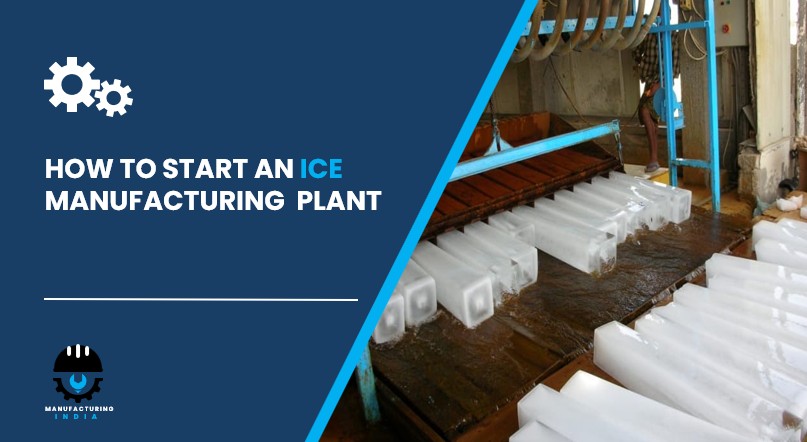
Ice manufacturing is the industrial process of freezing purified water under controlled conditions to produce ice in various commercial forms — including block ice, cube ice, flake ice, tube ice, and crushed ice — each designed to meet the specific temperature maintenance, handling, and application requirements of food processing, fisheries, hospitality, healthcare, concrete cooling, and industrial end-use markets. Commercial ice is distinct from domestic household ice in terms of purity standards, production volume, consistent size and shape, food-grade certification, and hygienic handling throughout the manufacturing, storage, and distribution chain.
Water is the primary raw material for ice manufacturing. Source water undergoes multi-stage purification including filtration, softening, ultraviolet sterilisation, and reverse osmosis treatment to achieve the purity levels required for food-grade ice production, with turbidity, microbial counts, total dissolved solids (TDS), and chemical contaminant levels all subject to strict food safety standards. The quality of input water directly influences the clarity, purity, taste neutrality, and food-safety compliance of the finished ice product across all commercial formats.
Standard commercial ice product types include block ice (large rectangular blocks for fisheries, concrete cooling, and industrial applications), cube ice (regular cubes for beverages and food service), flake ice (thin flat flakes for food display, fish processing, and healthcare), tube ice (hollow cylindrical pieces for beverages and food processing), and crushed ice (fine-grained ice for specialised cooling and beverage applications). Packaging formats range from small retail pouches (typically 1 kg to 10 kg) to bulk industrial deliveries for fisheries, construction, and food processing customers.
The ice manufacturing sequence broadly involves source water reception and quality testing, multi-stage water purification and treatment, chilling and refrigeration-cycle processing, ice formation on evaporator surfaces or in moulds, ice harvesting and demoulding, cutting or shaping to specification, quality inspection and purity verification, cold storage, and retail or bulk packaging and distribution. End-use segments served include food and beverage processing, fisheries and seafood cold chains, hospitality and food service, healthcare and pharmaceutical cooling, concrete and construction cooling, retail and quick-commerce, and industrial and chemical process cooling.
Cost of Setting Up an Ice Manufacturing Plant
The total cost of establishing an ice manufacturing plant depends on several variables including plant capacity, chosen ice product mix (block, cube, flake, tube, or crushed ice), level of automation and refrigeration technology (ammonia-based versus HFC/HFO systems or natural refrigerant platforms), geographic location and source water quality, cold storage requirements, distribution logistics infrastructure, and applicable food safety and regulatory compliance requirements. A thorough feasibility assessment covering all CapEx and OpEx components is essential before committing capital, given the energy-intensive, food-grade, and cold-chain-dependent nature of commercial ice manufacturing.
1. Capital Expenditure (CapEx)
Capital investment for an ice manufacturing plant covers several broad cost heads. Land and site development forms a meaningful part of the overall investment, encompassing land registration charges, boundary development, drainage, site grading, and related civil infrastructure expenses. A typical ice manufacturing facility requires a land parcel sized to accommodate the water treatment plant, refrigeration machinery hall, ice production floor, cold storage chambers, loading and dispatch bay, quality control laboratory, and on-site utility installations. Investors may consider locating the facility in proximity to fisheries and seafood processing clusters, food and beverage industrial parks, hospital and healthcare complexes, construction material supply hubs, or port-connected logistics centres for distribution-optimised strategies.
Civil works and construction costs cover the water treatment building, refrigeration machinery room, ice production floor and harvesting area, cold storage chambers and insulated rooms, loading and dispatch bay, packaging and labelling zone, quality control laboratory, and the administrative block. Machinery and equipment costs represent the largest single portion of total capital expenditure. Key machinery and equipment required includes:
- Water supply and purification systems (borewell or municipal water intake systems, multi-stage filtration units including sand filters, activated carbon filters, and cartridge filters, water softening and ion-exchange units, reverse osmosis systems for TDS reduction, ultraviolet sterilisation units, ozone treatment systems for microbial elimination, storage tanks for treated water, and automated dosing systems for residual treatment chemicals)
- Refrigeration plant and compressor systems (industrial-grade ammonia or HFO/HFC refrigeration compressors, condensing units and cooling towers, evaporator coils and refrigerant circuit piping, expansion valves and pressure regulation systems, variable-frequency-drive motor systems for energy-efficient compressor operation, refrigerant monitoring and leak-detection systems, and standby compressor units for production continuity assurance)
- Ice making and forming equipment (block ice can systems with vertical freeze chambers and brine tank immersion, cube ice makers with grid evaporator and harvesting mechanisms, flake ice machines with rotating drum evaporators and scraper assemblies, tube ice plants with vertical evaporator tubes, ice harvesting conveyors, and demoulding systems using water or hot gas defrost cycles)
- Ice cutting and shaping equipment (band saws or hydraulic ice block cutters for block ice sizing, automatic cube-ice classifiers and graders, flake-ice sizing and distribution conveyors, tube ice length cutters, vibratory classifiers for chip and fine separation, and shape-setting forms for specialty product variants)
- Cold storage and refrigerated holding systems (insulated cold storage chambers with individual temperature zone control, rapid-cooling blast freezers for initial product hardening, refrigerated dispatch holding rooms, insulated loading bays for temperature-controlled lorry loading, temperature and humidity monitoring systems, and cold-room door air curtains for thermal efficiency)
- Water quality testing and process control laboratory equipment (TDS meters, turbidity analysers, pH meters, residual chlorine testers, microbial plate count incubators, Salmonella absence testing kits, water hardness testing kits, spectrophotometers for chemical contaminant analysis, and standard analytical balances and sampling equipment)
- Packaging lines (automatic bagging and heat-sealing machines for retail pouches, inline weighers for fill control, bulk bag filling stations for industrial deliveries, date-code and batch-number printing systems, carton erectors and sealers, shrink-wrapping units, and automated palletising equipment)
- Utility systems (electrical substations and transformers, cooling towers and condenser water circulation pumps, compressed air compressors and dryers, water recycling and recirculation systems, drainage and effluent collection infrastructure, standby diesel generator sets for refrigeration continuity, and energy metering systems for consumption tracking)
- Material handling and dispatch equipment (ice conveying belts and bucket elevators, insulated transport bins and totes for ice transfer to packaging, forklifts and pallet trucks, refrigerated delivery vehicles for last-mile cold chain distribution, and loading dock levellers and lorry restraints)
Other capital costs include utility connections (electricity, water, and refrigerant supply), pre-operative expenses, plant commissioning costs, cold-room insulation panel procurement, ice production trial runs, and applicable import duties on specialised refrigeration compressors, flake-ice machines, and automated packaging equipment not manufactured domestically.
Request a Sample Report for In-Depth Market Insights: https://www.imarcgroup.com/ice-manufacturing-plant-project-report/requestsample
2. Operational Expenditure (OpEx)
The operating cost structure of an ice manufacturing plant is heavily weighted toward electricity. Electricity costs for refrigeration compressors, cooling towers, pumps, cold storage, and packaging lines account for approximately 40 to 55% of total OpEx, making ice manufacturing one of the most energy-intensive food-grade production operations. Water procurement and treatment chemical costs represent an additional 10 to 15% of OpEx. Entering long-term electricity supply agreements at favourable industrial tariffs, investing in energy-efficient compressors, heat-recovery systems, and variable-frequency-drive motor controls, and optimising refrigerant system design are critical commercial priorities for managing operating cost competitiveness.
Additional operating costs include packaging materials (laminated pouches, bulk bags, and palletisation materials), cold chain transportation and last-mile delivery logistics, salaries and wages for refrigeration plant operators, water treatment technicians, quality control staff, and delivery personnel, periodic compressor and evaporator maintenance, refrigerant top-up and leak-management costs, cold-room insulation maintenance, water treatment chemical replenishment, microbiological testing consumables, and applicable FSSAI, AGMARK, and ISO food safety certification and renewal costs.
3. Plant Capacity
The proposed ice manufacturing facility is designed with an annual production capacity ranging between 15,000 to 30,000 metric tonnes, enabling meaningful economies of scale while preserving operational flexibility across the full product range, from standard commodity-grade block and flake ice to premium cube, tube, and food-grade packaged ice for hospitality, retail, and healthcare channels. Plant capacity can be customised based on the investor’s specific capital availability, target market scale, and chosen product mix across end-use segments such as fisheries and seafood processing, food and beverage service, healthcare cooling, construction, industrial process cooling, and retail packaged ice.
Profitability improves considerably at higher capacity utilisation levels, given the significant fixed-cost component of refrigeration plant, cold storage infrastructure, and water treatment systems, making early off-take agreements with fisheries cooperatives, seafood exporters, food processing companies, hospital networks, quick-service restaurant chains, modern retail chains, and construction companies strategically important.
4. Profit Margins and Financial Projections
An ice manufacturing plant demonstrates healthy profitability potential under normal operating conditions. Gross profit margins typically range between 30 to 40%, supported by stable and growing demand across fisheries, food processing, hospitality, healthcare, and retail markets; the structural shift toward certified hygienic and packaged ice; rising food safety compliance requirements across organised food service; and differentiation opportunities through premium food-grade, purified, and branded ice products for modern retail and quick-commerce channels. Net profit margins range between 12 to 20%. Financial projections incorporate NPV analysis, IRR calculations, payback period modelling, and sensitivity analysis across plant capacity utilisation, electricity tariff scenarios, and end-market demand conditions, providing investors with a comprehensive view of long-term financial viability.
Why Set Up an Ice Manufacturing Plant?
- Essential Food-Safety and Cooling Staple: Commercial ice is an indispensable input across virtually every segment of the food processing, fisheries, hospitality, healthcare, and industrial cooling supply chain, making it a high-volume, daily-consumption industrial product with sustained replacement and replenishment cycles across the global food safety, refrigeration, and cold chain ecosystem.
- Food Safety and Cold Chain Megatrend: Rising consumer awareness of food-borne illness, expanding FSSAI food safety enforcement across organised food service and retail, growing seafood and perishable food export volumes, and the rapid scaling of India’s cold chain infrastructure are driving sustained demand for certified hygienic commercial ice across emerging and developed economies.
- Fisheries and Seafood Export Growth: India’s seafood exports reached USD 7.38 Billion in 2023-24, making it one of the world’s largest seafood exporters. The fisheries sector is structurally the single largest domestic consumer of commercial ice, as flake ice and block ice are essential inputs for maintaining seafood freshness from harvest through processing, cold storage, and export logistics, directly creating high-volume and structurally growing demand for proximate ice manufacturing capacity.
- Hospitality, Food Service, and QSR Expansion: India’s rapidly expanding quick-service restaurant, organised food service, hotels, and event catering sectors create escalating demand for cube ice, packaged ice, and hygienic commercial ice supply. The hospitality sector’s shift toward certified and branded ice over unorganised supply is creating attractive branded and institutional ice market opportunities for well-positioned manufacturers.
- Healthcare and Pharmaceutical Cooling: Growing hospital infrastructure, expanding pharmaceutical cold chain requirements, and rising demand for sterile and certified ice for patient care, organ and specimen transport, and pharmaceutical product cooling are creating a structurally growing premium-grade ice segment with strong unit-value economics and high quality-compliance entry barriers.
- Concrete and Construction Industry Demand: Large-scale infrastructure and construction projects use substantial quantities of block and chilled ice for concrete cooling, ensuring proper curing, structural integrity, and compliance with construction temperature standards. Continued infrastructure investment across urban development, metro rail, road, and port construction projects directly sustains large-volume block-ice demand in proximity to active construction zones.
- Retail Packaged Ice and Modern Trade Channel: The expansion of supermarkets, hypermarkets, convenience stores, and quick-commerce platforms is creating a growing branded retail packaged ice segment, where food-grade certification, consistent purity, and hygienic sealed packaging differentiate established commercial ice producers from unorganised supply and create structurally improving unit realisations for branded products.
- Energy Technology and Refrigeration Innovation: Growing adoption of energy-efficient natural refrigerant systems (CO₂, ammonia, propane), variable-frequency-drive compressors, heat-recovery installations, and solar-assisted refrigeration platforms are reducing the dominant electricity cost component of ice manufacturing, improving margins, and enabling competitive pricing in markets with high electricity costs.
- Government Infrastructure and Food Safety Initiatives: The Pradhan Mantri Matsya Sampada Yojana (PMMSY) fisheries infrastructure programme, the National Fisheries Policy’s cold chain development priority, FSSAI’s strengthening food safety enforcement across food service and retail, and India’s Sagarmala port-logistics and cold chain development schemes directly support sustained commercial ice demand growth and provide favourable policy frameworks for new domestic capacity.
- Import Substitution and Cold Chain Export Potential: Many emerging regional markets continue to rely on unorganised, unhygienic, and inconsistent ice supply, creating attractive formalisation and import-substitution opportunities for food-grade commercial ice manufacturers with certified product quality, modern packaged formats, and scalable cold chain logistics capabilities.
How Ice is Manufactured
The ice manufacturing sequence encompasses source water reception and quality testing, multi-stage purification and treatment, pre-chilling and refrigeration-cycle processing, ice formation and harvesting, cutting and shaping, quality inspection and purity verification, cold storage, and retail or bulk packaging and dispatch as the core stages of production. Each stage involves specific unit operations, quality assurance checkpoints, and process control protocols aligned to food safety standards (FSSAI, BIS, ISO 22000, HACCP, and FSSC 22000).
- Source Water Reception and Quality Testing: Source water (borewell, municipal supply, or treated surface water) is received, sampled, and tested for TDS, turbidity, pH, hardness, microbial load (total plate count, coliforms, E. coli, and Salmonella absence), residual chlorine, heavy metals, and chemical contaminants before being directed to the treatment plant. Only water meeting FSSAI and BIS food-grade standards is approved for ice production.
- Multi-Stage Water Purification and Treatment: Approved source water is passed through sequential treatment stages including coarse filtration for suspended solids removal, activated carbon filtration for chlorine and organic compound removal, water softening through ion-exchange resin units to reduce hardness and scale formation, reverse osmosis treatment for TDS and dissolved solids reduction to food-grade levels, ultraviolet sterilisation for microbial inactivation, and ozone treatment for residual disinfection and improved product clarity. Treated water is stored in dedicated food-grade holding tanks before entering the refrigeration and ice production system.
- Pre-Chilling and Refrigeration Cycle Processing: Purified water is pre-chilled to near-zero temperatures before entering the ice formation stage. Industrial refrigeration systems using ammonia, HFO, or natural refrigerant compressors generate the low-temperature conditions required for ice formation by driving a refrigerant compression-condensation-expansion-evaporation cycle. Refrigerant circuit pressures, temperatures, and flow rates are continuously monitored by automated process control systems to ensure stable and efficient ice formation conditions.
- Ice Formation and Harvesting: The ice formation method varies by product type. Block ice is produced by freezing water in large vertical aluminium moulds submerged in chilled brine tanks, with continuous freeze times of 24 to 48 hours depending on block size. Cube ice is produced on grid evaporators where water is continuously circulated and incrementally frozen to specified cube dimensions. Flake ice is produced by spraying water onto a rotating drum evaporator surface, where a thin ice layer forms and is scraped off as flakes. Tube ice is formed inside vertical refrigerated tubes through which water flows and freezes, creating hollow cylindrical pieces. Harvesting is achieved through hot-gas or water defrost cycles that release ice from evaporator surfaces or moulds, with automated harvesting conveyors transferring product to the downstream processing section.
- Cutting and Shaping: Block ice is transported by crane or conveyor to band-saw cutting stations where it is cut to specified commercial dimensions for fisheries, construction, and industrial customers. Cube ice passes through automated graders to ensure dimensional consistency, while flake ice is conveyed directly to cold storage or packaging. Tube ice is cut to specified lengths and classified by vibratory sieves. Off-specification pieces are segregated for rework or downgraded to industrial-grade applications.
- Quality Inspection and Purity Verification: All finished ice is subjected to visual inspection for clarity, colour, and absence of foreign matter, along with purity testing for TDS, pH, and microbial counts. Samples from each production batch are tested against FSSAI, BIS IS 4303, and applicable food-safety standards. Ice failing inspection is rejected and not released to cold storage or dispatch.
- Cold Storage and Holding: Inspected ice is transferred to insulated cold storage chambers maintained at minus 10°C to minus 18°C for product preservation, inventory management, and demand-based dispatch scheduling. Cold storage capacity is sized to buffer production against demand variability, support seasonal peak demand periods, and enable efficient load-and-dispatch logistics for both local delivery and long-haul cold-chain shipment.
- Packaging and Dispatch: Cube ice and food-grade ice are packed in automated bagging machines into sealed laminated retail pouches (1 kg, 2 kg, 5 kg, and 10 kg) with date-code and batch-number printing. Bulk industrial and fisheries-grade ice is loaded directly into insulated lorries, refrigerated containers, or bulk isothermal bins for dispatch. Retail-packed ice is palletised, stretch-wrapped, and dispatched to modern retail chains, quick-commerce fulfilment hubs, hospitality customers, and institutional buyers. Block ice is loaded by forklift or crane into delivery lorries for fisheries, concrete, and industrial customers.
- Final Quality Audit: Production samples from each lot undergo purity and microbial testing, clarity and dimensional verification, and packaging integrity inspection. Each batch is released only upon passing all specified quality parameters under FSSAI, BIS IS 4303, and applicable export certification standards.
Key Applications
Ice manufactured at a dedicated commercial facility serves a broad range of end-use channels, each with specific ice type, purity, size, and packaging requirements.
- Fisheries and Seafood Processing: Flake ice and block ice are extensively used across fish landing centres, seafood processing plants, fish markets, aquaculture farms, and seafood cold chain logistics for maintaining product freshness from harvest through processing and export. Ice is the single largest non-water raw material in seafood value chains and represents the dominant commercial ice consumption segment in India.
- Food and Beverage Processing: Food processing companies use flake ice and cube ice for maintaining product temperature during processing, chilling meat and poultry, cooling baked goods, and temperature-controlled ingredient preparation in modern food manufacturing operations.
- Hospitality and Food Service: Hotels, restaurants, bars, quick-service chains, catering services, and event management companies use cube ice and packaged ice extensively for beverage cooling, food display, and buffet service, with growing preference for certified hygienic and branded commercial ice over unorganised supply.
- Healthcare and Pharmaceutical Cooling: Hospitals and clinics use sterile-grade ice for patient care, fever management, physical therapy, and specimen transport. Pharmaceutical companies use certified ice for temperature-sensitive product cooling and cold chain compliance. These segments command premium unit realisations and strict quality certification requirements.
- Concrete and Construction Cooling: Large infrastructure and building construction projects use block ice and chilled water for concrete mix cooling during hot-weather concreting, ensuring proper hydration, reduced cracking, and structural integrity. Dam, bridge, metro, and airport projects represent consistent high-volume block-ice demand centres.
- Retail Packaged Ice: Supermarkets, hypermarkets, convenience stores, and quick-commerce platforms sell branded retail-packaged ice to household consumers for food cooling, beverage chilling, outdoor use, and emergency applications, creating a growing modern-trade channel for food-grade certified commercial ice.
- Cold Chain Logistics and Temperature-Controlled Transport: Ice is used in insulated cold-chain packaging for transporting perishable foods, seafood, pharmaceuticals, and temperature-sensitive products across road, rail, and air logistics networks where active refrigeration is unavailable or uneconomical.
- Industrial Process Cooling: Chemical plants, textile processing units, data centres, and other industrial facilities use commercial ice as a supplementary or emergency process cooling medium for heat exchangers, reactor cooling, and equipment temperature management.
Leading Ice Manufacturers
The commercial ice manufacturing industry is served by regional, national, and multinational companies with significant production capacities across block, flake, cube, tube, and packaged ice formats. Key players include:
- Ice Make Refrigeration Limited (India)
- Snowman Logistics Limited (India)
- Kool-ex Cold Chain Limited (India)
- Manitowoc Ice (USA)
- Hoshizaki Corporation (Japan)
- Scotsman Ice Systems (USA / Europe)
- Ice-O-Matic (USA)
- Brema Group (Italy)
- North Star Ice Equipment (USA)
- GEA Group (Germany)
- Focusun Refrigeration Corporation (China)
- Sindeice (Spain)
Recent Industry Developments
- January 2026: Hoshizaki Corporation announced an expansion of its natural refrigerant ice maker product range, transitioning its full portfolio of cube and flake ice machines to CO₂ and propane-based refrigerant systems to comply with global HFC phase-down regulations and meet growing demand from environmentally regulated hospitality and food service markets across Europe and North America.
- October 2025: Ice Make Refrigeration Limited (India) announced capacity addition at its Gujarat manufacturing facility, increasing its commercial ice plant and refrigeration equipment production capacity to meet growing domestic and export demand from fisheries, food processing, and cold chain logistics sectors across South Asia, the Middle East, and Africa.
- June 2025: Manitowoc Ice launched a new series of high-efficiency modular cube ice machines with integrated smart monitoring, remote diagnostics, and real-time production data analytics, targeting the growing demand for IoT-enabled commercial refrigeration equipment in organised food service and quick-service restaurant chains globally.
Timeline to Start the Plant
Investors planning an ice manufacturing plant should anticipate the following phased development timeline, typically ranging from 8 to 12 months depending on site development requirements, regulatory approval timelines, and the lead time for refrigeration compressors, ice making machines, cold-room panels, and automated packaging lines:
- Feasibility study and detailed project report preparation
- Land acquisition, site assessment, and source water quality evaluation
- Regulatory approvals, FSSAI licence, factory licence, environmental clearances, and utility connections
- Civil construction: water treatment building, refrigeration machinery room, ice production floor, cold storage chambers, packaging area, loading bay, quality laboratory, and administrative block
- Specialised machinery procurement, refrigeration plant installation, ice making machine commissioning, cold-room panel installation, and utility infrastructure setup
- Source water supply agreements and electricity, water, and refrigerant supply contracts
- Plant commissioning, refrigeration system leak testing, and trial production runs
- Product qualification, FSSAI food-grade ice certification, BIS IS 4303 compliance verification, and institutional buyer technical qualification
- Distribution channel development, fisheries and food service key account relationships, and commercial production ramp-up to design capacity
Licences and Regulatory Requirements
Starting an ice manufacturing unit requires several approvals, which vary by country and jurisdiction:
- Business registration (Proprietorship, LLP, or Private Limited Company)
- FSSAI Central Licence under the Food Safety and Standards Act (mandatory for food-grade commercial ice manufacturing in India)
- Factory Licence under applicable factories legislation
- Industrial Entrepreneur Memorandum (IEM) filing with the Department for Promotion of Industry and Internal Trade (India)
- Environmental Clearance from the relevant national authority (where applicable based on project scale)
- Consent to Establish and Consent to Operate from the relevant State Pollution Control Board
- Refrigerant handling and storage approvals (for ammonia and other regulated refrigerants)
- Bureau of Indian Standards (BIS) certification under BIS IS 4303 (Ice — Specification) for commercial ice
- Water quality and discharge compliance permits from state water regulation authorities
- ISO 22000 / FSSC 22000 Food Safety Management System certification
- HACCP (Hazard Analysis and Critical Control Points) certification
- GST Registration
- Fire Safety NOC (mandatory for refrigeration plants and cold storage facilities)
- Electricity Board approval and grid connectivity permits (critical given high electricity demand of refrigeration operations)
- ISO 9001 Quality Management System certification (recommended for institutional, export, and retail supply)
- ISO 14001 Environmental Management System certification
- ISO 45001 Occupational Health and Safety Management System certification
- Refrigerant pressure system certification from the Boiler Inspection authority (for ammonia refrigeration systems)
- MSME registration (where applicable, for access to government subsidy and incentive schemes in India)
- APEDA registration (for export of ice and cold chain services supporting agricultural and food product exports from India)
- Import or export code (IEC) for international trade in ice and refrigeration equipment
- EPR (Extended Producer Responsibility) registration for plastic packaging compliance
Key Challenges to Consider
- Electricity Cost Volatility and Energy Intensity: Refrigeration compressors, cooling towers, cold storage chambers, and water treatment systems make ice manufacturing one of the most electricity-intensive food-grade production operations, with electricity typically accounting for 40 to 55% of total operating costs. Rising industrial electricity tariffs, grid reliability issues in remote locations, and regulatory pressure on refrigerant systems require ongoing investment in energy-efficient compressors, variable-frequency-drive motors, heat-recovery systems, and renewable energy installations to maintain operating cost competitiveness.
- Refrigerant Regulatory Transition: The global phase-down of hydrofluorocarbon (HFC) refrigerants under the Kigali Amendment to the Montreal Protocol is requiring ice manufacturers to transition refrigeration systems from HFC platforms to natural refrigerant alternatives (CO₂, ammonia, and propane) or low-GWP HFO systems. Managing this transition requires capital investment in equipment upgrades, refrigerant handling safety infrastructure, and technician certification, creating both a compliance cost and a competitive differentiator for early adopters.
- Source Water Availability and Quality Variability: Water scarcity, groundwater quality deterioration, and seasonal variability in source water TDS and microbial load directly impact ice production economics, purification costs, and product quality consistency. Conducting thorough hydrogeological and water quality assessments, investing in robust multi-stage treatment infrastructure, and securing diverse and reliable water supply sources are critical site selection and operational priorities.
- Competition from Unorganised and Unhygienic Supply: A significant portion of commercial ice supply in India and many emerging markets continues to come from unorganised manufacturers operating without FSSAI licences, food-grade certifications, or adequate water treatment and hygiene protocols, competing on price through inferior quality and regulatory non-compliance. Investing in brand building, FSSAI certification visibility, quality assurance, and institutional and modern retail channel partnerships is critical to defending market share and consumer trust.
- Cold Chain Logistics and Last-Mile Distribution: Commercial ice is a perishable, low-value-density product with strict cold chain requirements from production to end-use, making last-mile delivery logistics a major cost and operational challenge. Melting losses during transport, short delivery windows, and the capital cost of refrigerated delivery vehicles require careful route planning, insulated packaging solutions, and proximity-to-market plant location strategy to maintain product quality and delivery economics.
- Seasonal Demand Variability: Commercial ice demand is strongly seasonal in most Indian markets, with peak demand during summer months (April to June) creating production and cold storage capacity constraints, while winter demand slowdowns put pressure on plant capacity utilisation and revenue. Managing seasonal inventory, building diversified off-take channel portfolios across fisheries (year-round), healthcare (year-round), and hospitality (peak-season), and maintaining flexible capacity are important strategies for revenue stability.
- Food Safety and Microbiological Compliance: Commercial ice is a food-grade product subject to FSSAI, BIS IS 4303, and WHO food safety standards requiring absence of pathogens, strict TDS and turbidity limits, and documented quality management systems. Increasingly stringent enforcement across organised food service, modern retail, and export channels requires ongoing investment in water treatment upgrades, microbiological laboratory infrastructure, HACCP compliance, and food-safety certification maintenance.
- Skilled Workforce Availability: Refrigeration plant operation, water treatment management, ice machine maintenance, and cold-room management require skilled refrigeration technicians and food safety managers with formal training and technical certifications. Building and retaining a capable workforce through partnerships with refrigeration engineering institutes, structured training programmes, and competitive compensation is essential in markets with limited skilled industrial refrigeration labour.
Project Economics
Capital Expenditure (CapEx) and Operational Expenditure (OpEx) Analysis
Capital Investment (CapEx)
Refrigeration plant and machinery costs account for the largest portion of total capital expenditure, with industrial refrigeration compressors, ice making machines (flake, cube, block, and tube systems), cold storage chambers, water treatment plant, and supporting utility infrastructure (cooling towers, compressed air, electrical substations, and standby generators) together representing the most significant equipment investments. The cost of land and site development, including civil construction of the refrigeration machinery room, water treatment building, ice production floor, insulated cold storage chambers, loading bay, and administrative block, forms a substantial part of the overall investment, ensuring a solid foundation for safe, hygienic, and energy-efficient plant operations across the multi-year asset depreciation cycle.
Operating Expenditure (OpEx)
In the first year of operations, the operating cost for the ice manufacturing plant is projected to be significant, covering electricity (accounting for approximately 40 to 55% of total OpEx for refrigeration compressors, cooling towers, water treatment, cold storage, and packaging operations), water procurement and treatment chemicals (10 to 15% of OpEx), packaging materials, transportation and last-mile delivery logistics, salaries and wages for refrigeration plant operators, water treatment technicians, quality control staff, and delivery personnel, depreciation, taxes, refrigerant and maintenance costs, and applicable food safety certification costs. By the fifth year, the total operational cost is expected to increase due to electricity tariff escalation, refrigerant regulatory compliance costs, labour cost growth, and logistics cost inflation.
Frequently Asked Questions
1. How much does it cost to set up an ice manufacturing plant?
Total setup cost depends on plant capacity, ice product mix, refrigeration technology platform (ammonia, HFO, or natural refrigerant systems), level of automation, cold storage capacity, geographic location, and applicable regulatory requirements. Capital investment covers land, civil works, water treatment plant, refrigeration compressor systems, ice making machines, cold storage chambers, cutting and shaping equipment, packaging lines, utility infrastructure, quality control laboratory equipment, and pre-operative costs. A detailed project report provides capacity-specific cost estimates.
2. Is ice manufacturing profitable?
Yes. Gross profit margins typically range between 30 to 40% and net margins between 12 to 20%, supported by growing demand across fisheries, food processing, hospitality, healthcare, construction, and retail markets; the structural shift toward food-grade certified and hygienic commercial ice; rising FSSAI food safety enforcement across organised food service; and product differentiation opportunities through premium branded, purified, and packaged ice formats for modern retail and quick-commerce channels.
3. What machinery is required for an ice manufacturing plant?
Essential machinery and equipment includes source water intake and storage systems, multi-stage water purification units (sand filter, activated carbon filter, water softener, reverse osmosis system, UV sterilisation, and ozone treatment), industrial refrigeration compressors and refrigerant circuit, block ice can systems with brine tank immersion, cube ice makers with grid evaporators, flake ice machines with rotating drum evaporators, tube ice plants, ice harvesting conveyors, block ice cutting saws, flake and cube classifiers, insulated cold storage chambers, automated bagging and sealing machines, multi-head weighers, date-code printers, forklift handling equipment, refrigerated delivery vehicles, and quality control laboratory instruments.
4. What licences and approvals are required to start an ice manufacturing plant?
Required approvals include business registration, FSSAI Central Licence (mandatory for food-grade commercial ice in India), Factory Licence, Industrial Entrepreneur Memorandum filing (India), Environmental Clearance where applicable, Consent to Establish and Operate from the State Pollution Control Board, BIS IS 4303 certification for commercial ice, refrigerant handling and pressure system approvals (particularly for ammonia systems), fire safety NOC, GST registration, ISO 22000 / FSSC 22000 food safety management certification, HACCP certification, ISO 9001 quality management certification, and electricity board approval for high-load industrial connections.
5. What raw materials are needed for ice manufacturing?
The primary raw material is purified water (food-grade, meeting FSSAI and BIS IS 4303 purity standards), produced through multi-stage treatment of source water (borewell or municipal supply). Supporting inputs include water treatment chemicals (coagulants, activated carbon, resin for softener, UV lamps, ozone generators), refrigerants (ammonia, CO₂, HFO, or other refrigerant gases), packaging materials (laminated pouches, cartons, bulk bags, and palletisation materials), and cleaning and sanitisation chemicals. Raw materials including water and energy collectively account for approximately 50 to 65% of total operating costs.
6. What are the environmental compliance requirements?
Operators must obtain Consent to Operate, comply with refrigerant handling and leak-prevention regulations (particularly for ammonia systems), treat and manage wastewater from equipment washing and water treatment backwash through dedicated effluent treatment, manage solid waste (spent filter media, packaging waste, and laboratory chemical waste), and adhere to applicable water-discharge norms. Transition to natural refrigerant systems, solar-assisted refrigeration, and water-recycling infrastructure supports compliance with increasingly stringent environmental and refrigerant phase-down regulations.
7. What is the best location to set up an ice manufacturing plant?
Ideal locations offer proximity to key demand centres including fisheries landing centres and seafood processing clusters, food processing industrial parks, hospital and healthcare complexes, construction activity zones, and organised food service and hospitality hubs; access to reliable and competitively priced electricity (the dominant operating cost); availability of high-quality source water at adequate volume; compliance with industrial zoning and food-safety regulations; cold chain logistics infrastructure for last-mile ice distribution; and availability of skilled refrigeration and food processing workforce.
8. How long does it take to start an ice manufacturing plant?
The timeline typically ranges from 8 to 12 months, depending on site development requirements, regulatory approval timelines (particularly FSSAI Central Licence, Environmental Clearance, and refrigerant approval), refrigeration compressor and ice machine procurement lead times, civil works completion, equipment installation and commissioning, refrigeration system leak testing and charge verification, trial production runs, and product certification under BIS IS 4303, FSSAI, and applicable food-safety standards.
9. What government incentives are available for ice manufacturers?
In India, the Pradhan Mantri Matsya Sampada Yojana (PMMSY) cold chain and ice plant infrastructure grant scheme directly supports ice manufacturing and fisheries cold chain investments with capital subsidies. The MSME capital subsidy programmes, state-level industrial promotion policies, food-processing park infrastructure incentives, and PLI scheme for food processing provide additional support. State-level concessions on power tariffs, stamp duty, and GST reimbursement, along with priority allocation of land in food-processing parks and fisheries infrastructure development zones, offer further financial benefits. The National Programme for Cold Chain, Value Addition and Preservation Infrastructure (NPCVAP) also supports cold chain and ice manufacturing capacity.
10. What is the break-even period for an ice manufacturing plant?
Break-even typically ranges from 3 to 5 years, depending on scale, refrigeration technology efficiency, electricity tariff structure, product mix between commodity-grade bulk ice and premium food-grade packaged and branded ice, and customer off-take contract flow. Securing early supply agreements with fisheries cooperatives, seafood exporters, hospital networks, food processing companies, quick-service restaurant chains, and modern retail ice buyers can significantly support a smoother ramp-up and faster break-even achievement.
Key Takeaways for Investors
The ice manufacturing plant opportunity is underpinned by sustained demand growth across fisheries and seafood processing, food and beverage processing, hospitality and food service, healthcare and pharmaceutical cooling, concrete and construction, retail packaged ice, cold chain logistics, and industrial process cooling — all aligned with global food safety, cold chain infrastructure expansion, urbanisation, and industrial development megatrends.
The structural shift toward certified food-grade, hygienic, and packaged commercial ice, the growing fisheries and seafood export cold chain, rising FSSAI food safety enforcement across organised food service and retail, the expanding healthcare and pharmaceutical cooling market, and the long-term scaling of India’s cold chain infrastructure create a robust and diversified demand base for well-positioned commercial ice manufacturers.
With a well-defined market demand base across multiple end-use segments, strong product differentiation opportunities through certified purity grades, branded packaged formats, and premium healthcare and pharmaceutical-grade variants, capital-efficient processing economics once refrigeration assets are fully depreciated, and the fundamental role of commercial ice in delivering food safety, temperature control, and cold chain integrity demanded by fisheries, food processing, hospitality, healthcare, and industrial applications, ice manufacturing offers both medium-term commercial viability and long-term demand sustainability for well-positioned producers operating at scale with strong brand, distribution, food-safety, and cold chain logistics foundations.
About the Author