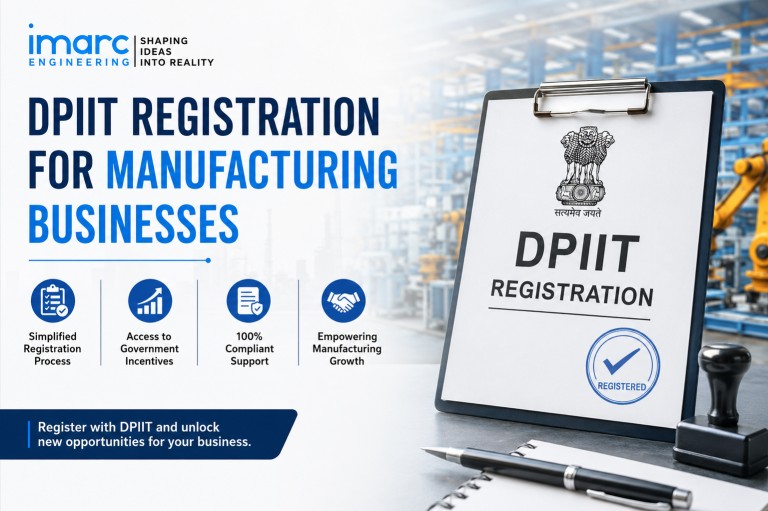
DPIIT Registration for Manufacturing Businesses
Setting up a manufacturing unit in India today means competing for capital, land, and market share in one of the world’s fastest-scaling industrial economies. Yet many first-time founders and even established MSMEs leave a straightforward government advantage on the table simply because they never formalize it: recognition under the Department for Promotion of Industry and Internal Trade (DPIIT).
DPIIT registration is the certification that converts a legally incorporated manufacturing business into a recognized startup eligible for tax holidays, funding access, procurement preference, and regulatory relief. Under the 2026 Startup India notification, eligible entity types include private limited companies, LLPs, registered partnership firms, cooperative societies, and multi-state cooperatives, with sole proprietorships excluded. A February 2026 update also opened recognition to one-person companies. For manufacturing founders navigating plant setup, licensing, and capital planning simultaneously, DPIIT recognition is one of the few compliance steps that pays for itself many times over.
This guide walks through why DPIIT registration services for manufacturing businesses matters, the common mistakes that derail applications, the step-by-step process, and how the recognition connects to larger incentive programs like the Production Linked Incentive (PLI) scheme.
Why DPIIT Registration Matters for Manufacturing Businesses
1. It Is the Gateway to Startup India’s Financial Benefits
Without DPIIT recognition, a company may be legally incorporated and fully operational but still cannot claim the Section 80-IAC income tax holiday, cannot access the Fund of Funds for Startups, cannot avail the 80% rebate on patent filing fees, and does not qualify for angel tax exemption under Section 56(2)(viib) of the Income Tax Act. For capital-intensive manufacturing setups, these exemptions materially change project economics.
2. It Signals Credibility to Investors and Lenders
DPIIT recognition acts as a third-party validation layer. Investors, venture funds, and financial institutions increasingly treat the certificate as a shorthand for regulatory seriousness when evaluating early-stage manufacturing ventures, particularly in pharma, EV, chemicals, and food processing where compliance risk runs high.
3. It Reduces Regulatory Drag During the Build-Out Phase
DPIIT-recognized startups may self-certify compliance under 9 labour laws and 3 environmental laws for a period of 3 to 5 years from incorporation, and eligible startups may be wound up within 90 days under the Insolvency and Bankruptcy Code if the venture does not succeed. For manufacturing founders managing plant commissioning, hiring, and multi-state operations at once, this self-certification window frees up bandwidth that would otherwise go into routine labour and environmental filings.
4. It Opens the Door to Sector-Specific Manufacturing Incentives
DPIIT recognition alone does not unlock PLI benefits, but it positions a manufacturing entity to plug into the broader industrial incentive architecture. Make in India builds the overall manufacturing environment, PLI provides financial incentives to boost production, and Startup India supports innovation and entrepreneurship, with a manufacturing startup able to leverage all three simultaneously for growth.
Challenges Businesses Face When Applying for DPIIT Recognition
1. Misjudging Eligibility Thresholds
A business is eligible for Startup India registration if it is incorporated as a Private Limited Company, LLP, Partnership Firm, Cooperative Society, or Multi-State Cooperative Society, is less than 10 years old (20 years for Deep Tech), has annual turnover below ₹200 crore (₹300 crore for Deep Tech), works on innovation or scalable models, and is not formed by splitting or restructuring an existing business.
This framework follows notification G.S.R. 108(E) issued on February 4, 2026, which doubled the annual turnover ceiling for regular startups from ₹100 crore to ₹200 crore and, for the first time, extended recognition to Cooperative Societies. Founders working off older thresholds frequently under- or over-estimate whether their unit qualifies.
2. Weak or Generic Innovation Narratives
A vague or generic innovation description that does not clearly articulate what is new or different about the product or service is the single most frequent cause of rejection, and a business model that resembles a conventional trading, manufacturing, or services business without a demonstrable technology or innovation component will not qualify.
This is the single biggest pitfall for manufacturing applicants: a plant that simply replicates an existing production process, without a differentiated technology, process innovation, or scalable model, struggles to clear DPIIT’s review.
3. Confusing Startup India Registration with DPIIT Recognition
Founders often assume portal sign-up is the same as certification. Registering on the Startup India web portal is free and requires no qualifications, but DPIIT recognition itself is a separate certificate issued only after the department reviews the application against its eligibility guidelines.
4. Missing the Downstream 80-IAC Application
DPIIT recognition and the Section 80-IAC tax exemption are handled as two distinct steps by two different reviewing bodies, and many recognized startups never file the second application, leaving the income tax holiday unclaimed.
5. Underestimating Documentation for Foreign-Backed or JV Entities
Foreign investors and joint venture partners setting up manufacturing in India often need additional structuring around entity type and shareholding before DPIIT recognition can be pursued, which extends timelines if not planned early.
Steps to Consider While Registering Under DPIIT
1. Step 1: Confirm entity structure and eligibility
- Incorporate as a Private Limited Company, LLP, Registered Partnership Firm, One Person Company, or Cooperative Society
- Verify the entity is within 10 years of incorporation (20 years if pursuing the Deep Tech category)
- Confirm annual turnover has stayed below ₹200 crore in every financial year since incorporation
- Confirm the business was not formed by splitting or restructuring an existing entity
2. Step 2: Register on the Startup India portal
- Create a profile on the Startup India website with entity and founder details
- Apply through the National Single Window System (NSWS) at no cost
3. Step 3: Build the innovation narrative
- Articulate specifically what is new, improved, or differentiated about the product, process, or manufacturing model
- Avoid generic descriptions that read as a standard trading or production business
- Include supporting evidence: pilot data, process specifications, or technical differentiation
4. Step 4: Submit the DPIIT recognition application
- Upload incorporation certificate, PAN, and founder/director details
- Attach the innovation write-up and any supporting documents (patents, pilot results, letters of support)
- Applications with complete documentation are often processed within a few business days, although timelines may vary depending on DPIIT review requirements.
5. Step 5: Apply separately for Section 80-IAC tax exemption
- File through the Inter-Ministerial Board process once DPIIT recognition is granted
- This step is independent and is frequently missed by newly recognized startups
6. Step 6: Layer in sector-specific manufacturing incentives
- Evaluate PLI eligibility directly, or explore indirect participation as a component or raw material supplier to a larger PLI applicant
- Align state-level manufacturing subsidies, GeM procurement advantages, and IPR fast-tracking with the DPIIT certificate
IMARC Engineering’s DPIIT and Incentive Alignment Framework
For manufacturing founders and EPC/EPCM teams managing plant setup alongside regulatory filings, DPIIT registration works best when it is sequenced into the broader project plan rather than treated as a standalone compliance task. IMARC Engineering’s advisory approach follows six stages:
- Eligibility & Entity Review – Assessing entity type, turnover history, and incorporation age against current DPIIT thresholds
- Innovation Positioning – Structuring the technical narrative around the manufacturing process, technology, or product differentiation
- Application Preparation & Filing – Coordinating portal registration, documentation, and DPIIT submission
- Tax & Incentive Mapping – Identifying eligibility for Section 80-IAC, PLI participation (direct or supply-chain), and state-level subsidies
- Compliance Structuring – Setting up self-certification schedules under applicable labour and environmental laws
- Ongoing Incentive Tracking – Monitoring renewal, reporting, and scheme deadlines tied to the recognition
Consult With An Expert: https://www.imarcengineering.com/contact?service=company-incorporation
DPIIT Registration Lifecycle
| Stage | Key Activities | IMARC’s Role | Business Outcome |
| Eligibility Assessment | Entity type, turnover, and age verification against 2026 thresholds | Structuring guidance and gap identification | Clarity on qualification before filing |
| Innovation Documentation | Drafting the technical differentiation narrative | Technical writing support aligned to DPIIT criteria | Reduced rejection risk |
| Application & Filing | Portal registration and DPIIT submission via NSWS | End-to-end filing coordination | Recognition certificate issued |
| Tax Exemption Filing | Section 80-IAC application to the Inter-Ministerial Board | Application preparation and follow-up | Access to income tax holiday |
| Incentive Alignment | PLI, state subsidy, and GeM procurement mapping | Feasibility and eligibility analysis | Expanded funding and market access |
| Compliance Management | Labour/environmental self-certification setup | Compliance calendar and documentation support | Reduced regulatory overhead |
Industry-Specific Considerations for Manufacturing Sectors
1. Pharmaceuticals and Pharma Intermediates
Applicants should pair DPIIT recognition with alignment to CDSCO and WHO-GMP compliance timelines, since regulatory approvals often run in parallel with the DPIIT process.
2. Food Processing
Food processing units with the right product focus can typically expect to receive PLI incentive disbursement within 18-24 months of qualifying production, making early DPIIT and PLI sequencing important for cash flow planning.
3. Electric Vehicles and EV Components
EV component manufacturers should evaluate DPIIT recognition alongside battery and auto-sector PLI categories, where investment thresholds and incremental sales benchmarks differ from other sectors.
4. Electronics and Chemicals
Electronics and pharmaceutical industries currently receive roughly 70% of all PLI incentive payments disbursed, making these among the most mature sectors for combining DPIIT recognition with production-linked incentives.
5. Drones and Deep Tech Manufacturing
The drone PLI scheme offers an incentive payment of up to 20% of value added, a structure suited to smaller, technology-driven manufacturers, which aligns naturally with DPIIT’s expanded Deep Tech recognition category.
Business Outcomes of Getting DPIIT Registration Right
- Direct access to tax relief through Section 80-IAC once both DPIIT and Inter-Ministerial Board approvals are secured
- Lower cost of capital as angel tax exemption and Fund of Funds access reduce friction for early investors
- Faster market entry via self-certification under labour and environmental laws during the critical build-out phase
- Stronger procurement position through GeM eligibility without prior turnover or experience requirements
- Structured pathway into PLI-linked manufacturing incentives, either as a direct applicant or as a qualified supplier in a larger scheme
DPIIT and Manufacturing Incentive Trends in 2026
- The February 2026 notification doubled the turnover ceiling for regular startups to ₹200 crore and extended recognition to Cooperative Societies for the first time, widening the pool of eligible manufacturing entities
- A dedicated Deep Tech category now offers a longer runway, up to 20 years of incorporation age and a ₹300 crore turnover ceiling, benefiting hard-tech and advanced manufacturing founders
- PLI schemes had secured actual investment of ₹2.40 lakh crore and created over 14.15 lakh direct and indirect jobs as of March 2026, with a growing ecosystem of component suppliers, ancillary manufacturers, and contract processors forming around larger PLI beneficiaries
- MSMEs are increasingly using PLI eligibility as suppliers to major applicants rather than as direct beneficiaries, since direct PLI eligibility requires minimum investment thresholds most early-stage manufacturers cannot meet
- One government programme is increasingly used to finance participation in another, with manufacturers combining MUDRA loans and CGTMSE-backed credit guarantees to meet minimum investment requirements before drawing PLI incentives on production
Conclusion
DPIIT registration is not a bureaucratic formality bolted onto manufacturing setup; it is a strategic filing that determines whether a business can access tax holidays, funding, and procurement advantages that its competitors are already using. The eligibility rules changed meaningfully in February 2026, widening the door for manufacturing startups, MSMEs, and even cooperative structures that previously fell outside the framework. Founders, EPCM firms, and investors who sequence DPIIT recognition alongside plant planning, rather than treating it as a parallel compliance track, position their projects for both regulatory relief and downstream incentive access under PLI and related schemes.
Frequently Asked Questions
1. Is DPIIT registration mandatory for setting up a manufacturing unit in India?
No. DPIIT recognition is not mandatory for incorporation or operation, but without it a business cannot access Startup India’s tax exemptions, funding schemes, or procurement benefits.
2. Can a sole proprietorship apply for DPIIT recognition?
No, sole proprietorships are not eligible; the business must first be converted to an eligible entity type such as a private limited company or LLP.
3. How long does DPIIT recognition take to process?
A recognized application is typically approved within 72 hours once submitted with complete documentation, though incomplete innovation narratives can extend this timeline.
4. Does DPIIT recognition automatically qualify a business for PLI incentives?
No. DPIIT recognition and PLI eligibility are separate. PLI has its own sector-specific investment and production thresholds, though DPIIT-recognized status strengthens a manufacturing entity’s overall incentive positioning.
5. What is the turnover limit for DPIIT eligibility in 2026?
Annual turnover must remain below ₹200 crore in any financial year since incorporation, or ₹300 crore for entities qualifying under the Deep Tech category.
Contact Us:
IMARC Engineering
Phone: +91-120-433-0800
Email: sales@imarcengineering.com
India: C-130, Sector 2, Noida, Uttar Pradesh 201301
LinkedIn: https://www.linkedin.com/showcase/imarc-engineering/
About the Author