
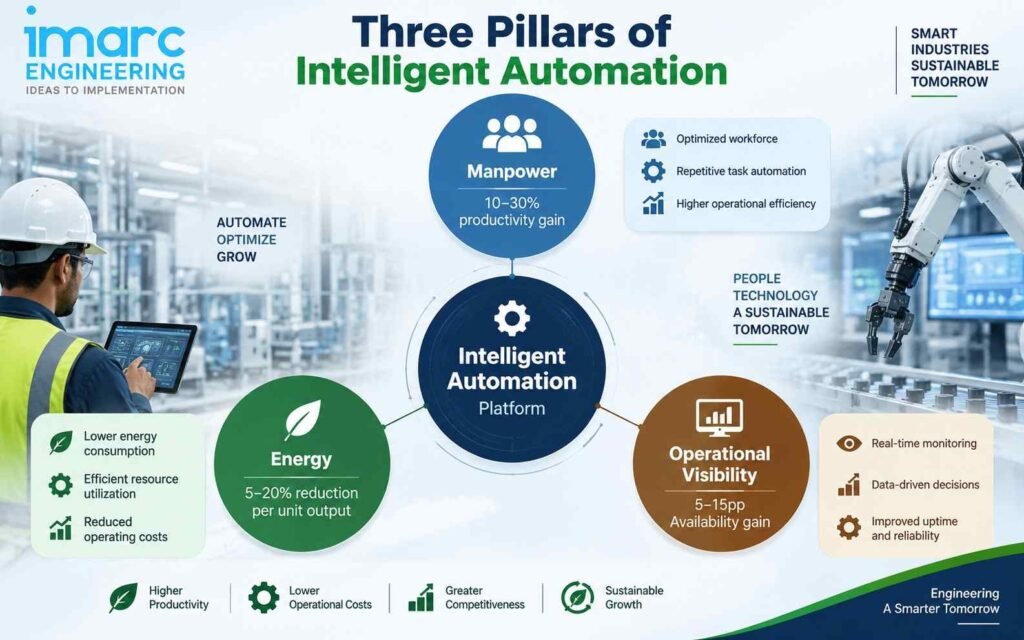
Intelligent automation in Indian manufacturing now centres on three measurable outcomes rather than technology for its own sake: getting more output per worker, cutting energy consumption per unit produced, and giving plant leaders real-time visibility into what is actually happening on the shop floor. Together these three pillars, manpower, energy, and operational visibility, define how automation investment decisions are being made in 2026.
The scale of the shift shows up in the numbers. Manufacturing employment rose 5.92% to 1.96 crore persons in 2023-24, while manufacturing GVA increased 11.89% in current prices, according to the latest Annual Survey of Industries (ASI) released by MoSPI in August 2025. A larger, costlier workforce producing more output is exactly the condition under which automation stops being optional.
For plant leaders evaluating where to start, a structured automation service in indian manufacturing typically begins by mapping these three pillars against a specific facility’s baseline before recommending any technology. This article walks through why 2026 is an inflection point, what each pillar delivers in measurable terms, and where implementations commonly go wrong.
Why 2026 Is an Inflection Point for Indian Manufacturers
Four data points explain why automation investment is accelerating rather than plateauing.
- India installed 9,120 industrial robots in 2024, a 7% increase over the previous year, moving the country into sixth position globally for annual robot installations, behind Germany, Korea, the United States, Japan, and China, per the International Federation of Robotics’ 2025 World Robotics report
- The PLI scheme covers 14 strategic sectors with an approved financial outlay of ₹1.91 lakh crore. As of 31 March 2026, the schemes had attracted more than ₹2.40 lakh crore in investment and generated over 14.15 lakh jobs.
- Industrial output grew 5.80% in 2023-24 against invested capital of INR 68,01,329 crore, a combination that rewards facilities extracting more from existing assets over those simply adding capacity
- Revised Schedule M, effective for large pharmaceutical manufacturers since 1 July 2024, mandates Computerised System Validation and data integrity aligned with ALCOA+ principles, pushing digital monitoring from a productivity tool into a compliance requirement
Pillar One: Optimizing Manpower
Skilled manufacturing labour is scarcer and costlier than it was five years ago, and automation’s role here is redeployment rather than pure headcount reduction.
- Automation-supported operations typically show 10-30% labour productivity improvement, shifting workers from repetitive manual tasks into supervisory, exception-handling, and technical roles
- India’s manufacturing robot density remains well below regional peers, which means most facilities are automating from a low base rather than approaching saturation, leaving substantial room to scale without proportional workforce cuts
- Institutional knowledge capture through automation reduces the operational risk created when experienced operators retire or transition, a growing concern given how quickly skilled manufacturing talent is being absorbed across expanding capacity
- Structured automation rollouts pair technology deployment with reskilling, since facilities that automate without workforce transition planning routinely see slower adoption and higher resistance on the shop floor
Pillar Two: Optimizing Energy
Energy is typically the second-largest controllable cost in a manufacturing plant after labour, and automation addresses it at the equipment level rather than through blanket conservation measures.
- Variable Frequency Drive control and load optimisation typically deliver 5-20% energy reduction per unit of output, achieved by matching motor and pump speed to actual process demand instead of running at fixed speed
- Energy consumption per unit produced is now a standard live metric on production dashboards, alongside throughput and quality, allowing plant teams to catch energy drift in the same shift it occurs rather than in a monthly utility bill
- Condition monitoring on rotating equipment, including vibration and thermography-based sensing, catches inefficiency signatures such as bearing wear and motor degradation before they compound into higher specific energy consumption
- Facilities integrating energy metrics into existing SCADA and Historian systems avoid a separate monitoring layer, keeping energy visibility inside the same operational dashboard used for availability and quality tracking
Pillar Three: Operational Visibility
Traditional manufacturing operations rely on end-of-shift reports. Intelligent automation replaces that lag with continuous, live data.
- Live dashboards tracking Overall Equipment Effectiveness, throughput against plan, and downtime reason codes support decisions within the shift they occur, not after it closes
- Facilities implementing structured real-time monitoring typically see 5-15 percentage point Availability improvement over 12-24 months, a direct consequence of catching downtime causes as they happen rather than reconstructing them afterward
- Predictive maintenance programmes built on this visibility layer typically cut unplanned downtime by 20-40% for monitored assets, with maintenance cost reductions of 10-25% following from fewer emergency interventions
- Remote experts and corporate quality teams gain the same live view as plant floor operators, reducing dependence on physical travel for routine oversight and enabling faster escalation when a quality or safety metric breaches threshold
Sector Priorities Across the Three Pillars
Which pillar a manufacturer prioritises first typically depends on sector economics rather than a universal sequence.
- Automotive Tier-1 suppliers lean hardest on operational visibility, since OEM contracts increasingly require connected production data and real-time quality tracking as a condition of continued sourcing
- Pharmaceutical manufacturers weight manpower and visibility together, because Revised Schedule M compliance requires both trained personnel oversight and electronic batch records with full audit trails
- Energy-intensive sectors such as cement, chemicals, and metals prioritise the energy pillar first, given that power and fuel typically represent a larger share of operating cost than in discrete manufacturing
- Electronics and FMCG contract manufacturers, where margins are thin and labour cost pressure is acute, generally start with the manpower pillar through machine vision and task automation before layering in energy and visibility systems
Where Intelligent Automation Programmes Commonly Stall
Most underperforming automation investments trace back to a small set of avoidable patterns.
- Technology selected before the baseline is quantified, so there is no way to verify whether the manpower, energy, or visibility gain claimed by a vendor actually materialised on that specific line
- Energy monitoring built as a standalone system disconnected from existing SCADA and Historian data, creating a second dashboard that plant teams eventually stop checking
- Workforce transition treated as an afterthought, producing resistance to real-time monitoring that employees perceive as surveillance rather than a tool that protects their institutional knowledge
- Predictive maintenance rolled out across all assets simultaneously instead of prioritising the 20-40% of critical assets that typically justify sensor investment in the first 12-18 months
How IMARC Engineering’s Expertise Can Help in Intelligent Automation
- Baseline assessment across manpower, energy, and visibility metrics before any technology is recommended
- SCADA, DCS, and MES integration that keeps energy and availability data inside one operational dashboard
- Predictive maintenance programme design, starting with critical-asset prioritisation rather than blanket sensor deployment
- Workforce transition planning that pairs automation deployment with reskilling and change management
- Post-implementation verification of actual manpower, energy, and downtime gains against the original business case
Get in Touch With Our Team: https://www.imarcengineering.com/contact?service=automation-digital-monitoring-setup
Conclusion
Intelligent automation in Indian manufacturing has moved past pilot projects into a measurable operating discipline built around three pillars. Manufacturers who quantify their manpower, energy, and visibility baseline before selecting technology consistently outperform those who lead with vendor enthusiasm. The facilities winning in 2026 are the ones treating automation as a verified business outcome, not a one-time capital purchase.
Explore More Factory Insights: https://imarcengineering.com/blog/how-to-get-a-factory-license-in-india
Contact Us:
IMARC Engineering
Phone: +91-120-433-0800
Email: sales@imarcengineering.com
India: C-130, Sector 2, Noida, Uttar Pradesh 201301
LinkedIn: https://www.linkedin.com/showcase/imarc-engineering/
About the Author