Setting up a camphor oil processing plant setup cost in india represents an attractive investment proposition underpinned by growing demand for natural aromatic ingredients, essential oils, fragrances, topical formulations, and household products. Camphor oil is used across pharmaceutical, personal care, cosmetics, fragrance, aromatherapy, and household applications due to its characteristic aroma and functional properties, and growing interest in plant-derived ingredients continues to support the development of natural formulations containing camphor oil. Demand is further supported by applications in topical products, massage preparations, vapor products, and fragrance compositions, with Asia-Pacific holding the largest share of the global market at approximately 45.0%. This growth trajectory, combined with expanding availability of aromatic raw materials, creates a favourable processing environment for new entrants with efficient distillation, purification, and quality control systems.
What is Camphor Oil?
Camphor oil is an aromatic essential oil obtained primarily from Cinnamomum camphora and related aromatic plants through steam distillation or other extraction methods. Its composition can vary according to the plant source, geographical conditions, extraction technique, and processing conditions, with the oil containing volatile compounds that contribute to its characteristic fragrance and functional properties. Depending on its composition and intended application, camphor oil is used in fragrances, cosmetics, personal-care products, household formulations, topical preparations, and other specialty products.
Manufacturing generally involves raw-material selection, cleaning, size reduction, distillation or extraction, condensation, oil-water separation, filtration, purification, quality testing, and packaging. Manufacturers may further process the oil to achieve specific composition and purity requirements, and proper storage in sealed, light-resistant containers is important to maintain its quality and stability.
Minimum Cost Required to Set Up a Camphor Oil Processing Plant:
Industry cost benchmarking for camphor oil processing points to a minimum entry investment of roughly USD 0.5-1.2 million for a smaller-scale facility near the lower end of the benchmarked capacity band (around 100-200 MT per annum), reflecting the cost of raw-material handling and chipping equipment, steam distillation or extraction vessels, condensers and oil-water separators, and filtration and storage infrastructure. Capital requirements scale from there, running into the USD 2-4 million range for mid-sized plants (around 250-400 MT per annum), and exceeding USD 5-6 million for larger facilities at the upper end of the capacity range (500 MT per annum and above), where additional distillation lines, expanded purification and quality testing capacity, and larger raw material and finished-product storage push total investment above smaller single-line operations of comparable output.
Camphor Oil Processing Plant Setup Cost
The total capital investment required to establish a camphor oil processing plant is shaped by several key parameters: annual production capacity (typically ranging from 100 to 500 MT per annum), the extraction technology adopted (steam distillation, solvent extraction, or a combination), the level of automation across cleaning, distillation, and purification sections, facility specification, raw material sourcing strategy, and applicable regulatory and safety compliance requirements. Below is a structured breakdown of the major cost components.
1. Capital Expenditure (CapEx)
Total capital investment in a camphor oil processing plant covers the following major heads:
Land and Site Development
This encompasses land acquisition or lease, site preparation, boundary development, and utilities connectivity. Site selection should prioritise proximity to camphor tree wood/bark chip sources, to ensure competitive and consistent raw material supply, which is the single largest driver of camphor oil processing economics. Access to a reliable supply of process water and steam, strong road logistics for inbound raw material and outbound finished oil, proximity to fragrance, pharmaceutical, or personal care manufacturing clusters, and availability of a trained technical workforce are critical site selection criteria. Compliance with industrial zoning regulations, food and pharmaceutical safety norms where applicable, effluent discharge standards, and environmental clearance frameworks must be assessed from project initiation.
Civil Works and Construction
Building costs cover the main processing facility including the raw material receiving and cleaning section, size-reduction and chipping area, distillation/extraction hall, condensation and separation section, filtration and purification area, quality control laboratory, packaging line, administrative block, and utility infrastructure including boilers, cooling water systems, and effluent treatment plant. Construction must comply with applicable factory act requirements, boiler and pressure vessel safety codes, and environmental clearance conditions.
Machinery and Equipment
Machinery represents the single largest CapEx component. Key equipment required for a camphor oil processing plant includes:
- Raw Material Cleaning and Sorting Machines: Cleaning and sorting units that remove dirt, debris, and non-usable material from camphor tree wood/bark chips ahead of processing
- Chippers, Shredders, and Grinders: Size-reduction equipment that prepares raw wood/bark chips into the particle size required for efficient steam distillation or extraction
- Feed Hoppers and Material Handling Systems: Hoppers and conveying equipment that feed prepared raw material into the distillation or extraction vessels at a controlled rate
- Steam Generators or Boilers: Boiler systems that supply the steam required to drive the distillation process, forming a core utility for the plant
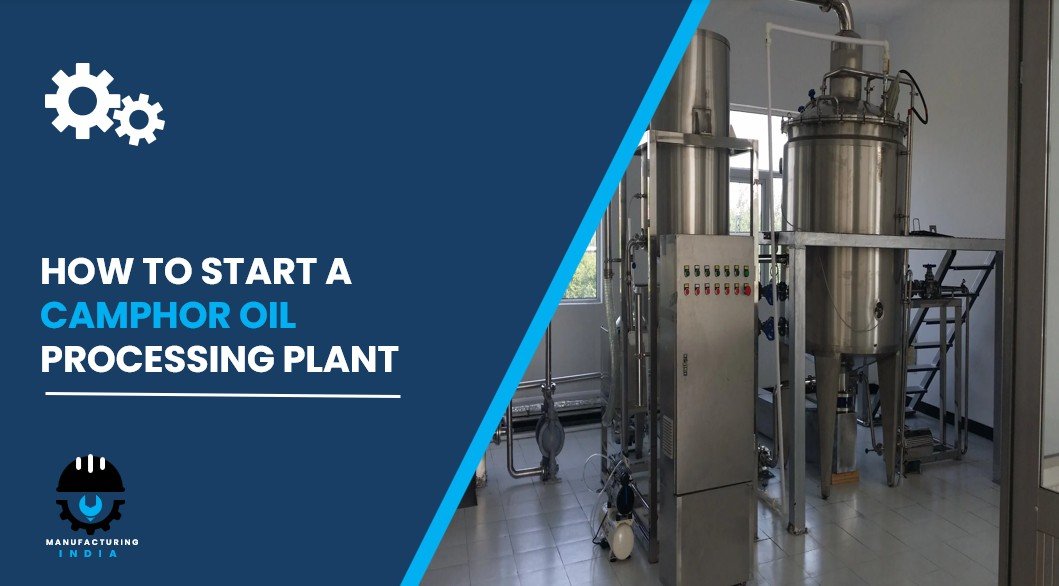
- Steam Distillation and Extraction Vessels: Distillation or extraction vessels that separate volatile camphor oil compounds from the raw plant material, forming the core production technology of the plant
- Condensers and Oil-Water Separators: Condensation and separation equipment that recovers camphor oil vapor and separates it from the accompanying water phase
- Decantation Tanks and Filtration Units: Decantation and filtration equipment that removes residual moisture and particulate matter from the crude camphor oil
- Centrifuges and Vacuum Distillation Systems: Centrifugal separation and vacuum distillation equipment used to further refine and concentrate the oil for higher-purity applications
- Purification Units and Quality Testing Equipment: Analytical instrumentation and purification systems that verify and refine oil composition, purity, and stability to meet offtake specifications
- Storage Tanks and Transfer Pumps: Sealed, light-resistant storage tanks and transfer pumps designed to preserve oil quality and stability ahead of packaging
- Weighing, Filling, Capping, and Labeling Machines: Automated weighing, filling, capping, and labeling equipment for finished camphor oil packaging and dispatch
Other Capital Costs
These include pre-operative expenses, commissioning charges, import duties on specialised distillation and purification equipment, staff training and competency development, initial working capital for production commissioning, regulatory compliance setup, and ISO 9001 / GMP quality management system establishment costs.
Request a Sample Report for In-Depth Market Insights: https://www.imarcgroup.com/camphor-oil-processing-plant-project-report/requestsample
2. Operational Expenditure (OpEx)
Raw materials, principally camphor tree wood/bark chips, constitute the dominant operating cost, typically representing 65-75% of total OpEx. Utility costs, driven primarily by steam generation for distillation and process energy consumption, account for 15-20% of OpEx. Labour, maintenance, quality control, depreciation, taxes, packaging, transportation, and overhead costs constitute the remainder of the operating cost base.
3. Plant Capacity
The proposed camphor oil processing facility is designed with an annual production capacity ranging between 100-500 MT, enabling economies of scale while maintaining operational flexibility. This capacity range supports a diversified offtake portfolio spanning pharmaceutical and topical products, personal care and cosmetics, fragrance and perfumery, aromatherapy, household products, and specialty formulations, serving domestic industrial customers, export-oriented essential oil buyers, and long-term offtake agreements.
4. Profit Margins and Financial Projections
The project demonstrates healthy profitability potential under normal operating conditions. Financial projections encompass capital investment, operating costs, capacity utilisation ramp-up schedule, raw material sourcing strategy, and forward demand outlook underpinned by rising interest in natural and plant-derived ingredients. A comprehensive feasibility analysis includes sensitivity analysis, Net Present Value (NPV), Internal Rate of Return (IRR), and Payback Period calculations. Gross profit margins for camphor oil processing typically range from 35-45%, supported by stable demand and value-added, application-specific formulations. Net profit margins of 18-25% are achievable with disciplined cost management, optimal capacity utilisation, and effective raw material procurement.
Why Set Up a Camphor Oil Processing Plant?
Natural Ingredient Demand
Growing interest in plant-derived aromatic ingredients supports expanding opportunities for essential oils and botanical extracts, positioning new processing capacity to capture rising demand from natural and clean-label formulations.
Diverse Applications
Camphor oil can serve pharmaceutical, personal-care, fragrance, household, and specialty formulation markets, allowing producers to diversify offtake across multiple demand channels and reduce dependence on any single end-use segment.
Value-Added Processing
Distillation, purification, blending, and standardized formulations can create opportunities for differentiated, higher-margin products relative to unprocessed raw material.
Fragrance Demand
Camphor oil’s distinctive aromatic characteristics support ongoing applications in fragrance, personal care, and household products, providing a stable base of structural demand for the category.
Research and Processing Innovation
Ongoing research into camphor oil’s chemical composition and biological properties, combined with improvements in extraction, separation, purification, and analytical testing technologies, is expected to support development of specialized, application-specific products and improve production consistency over time.
Latest Industry Development
- March 2026: A research study published in BioResources investigated the effect of ozonation on camphor oil, examining changes in its chemical composition and biological activity. Using GC-MS analysis, researchers identified compounds in both crude and ozonized camphor oil and reported that ozonation altered the oil’s chemical profile and increased antifungal activity against several Candida species in laboratory testing. The study also evaluated cytotoxic effects against ovarian cancer cells and reported differences between crude and ozonized oil, indicating potential for modifying camphor oil through controlled processing to investigate application-specific properties. The researchers noted that these in-vitro findings should not be interpreted as evidence of clinical efficacy.
Camphor Oil Industry Outlook 2026
The camphor oil industry is expected to benefit from continued demand for botanical ingredients across fragrance, personal care, pharmaceutical, household, and specialty applications. Manufacturers are likely to focus on high-purity oils, standardized compositions, improved extraction efficiency, sustainable raw-material sourcing, and application-specific formulations. According to the Government of India, production of aromatic and medicinal plants is expected to increase from 9.01 lakh tonnes in 2024-25 to 9.76 lakh tonnes in 2025-26, indicating expanding availability of raw materials for the broader aromatic-ingredient industry. This growth is expected to create additional opportunities for essential-oil processing and value-added products, including camphor oil, with manufacturers likely to emphasise traceability, quality control, optimized extraction yields, and customized oil profiles to serve growing demand for natural and plant-derived ingredients.
Manufacturing Process Overview
The camphor oil processing operation transforms raw camphor tree wood/bark chips into purified aromatic oil through a sequence of preparation, distillation, separation, and purification operations. The key process stages are:
- Raw Material Selection and Cleaning: Camphor tree wood/bark chips are received, sorted, and cleaned to remove dirt, debris, and non-usable material ahead of processing.
- Size Reduction: Cleaned raw material is chipped, shredded, or ground to the particle size required for efficient steam distillation or extraction.
- Steam Distillation or Extraction: Prepared raw material is fed into distillation or extraction vessels, where volatile camphor oil compounds are separated from the plant matrix using steam or solvent-based extraction.
- Condensation: Vapor carrying the volatile oil compounds is passed through condensers, converting it back into liquid form ahead of separation.
- Oil-Water Separation: Condensed liquid is separated into crude camphor oil and an aqueous by-product stream using oil-water separators and decantation tanks.
- Filtration and Purification: Crude oil undergoes filtration, centrifugation, and, where required, vacuum distillation to remove residual moisture and impurities and achieve the desired purity and composition.
- Quality Testing: Oil composition, purity, and stability are tested against offtake specifications and applicable industry standards before release for packaging.
- Packaging and Dispatch: Finished camphor oil is weighed, filled, capped, labeled, and packaged in sealed, light-resistant containers before dispatch to pharmaceutical, cosmetics, fragrance, or household product customers.
Key Applications of Camphor Oil
- Pharmaceutical and Topical Products: Camphor oil is used in selected topical formulations, ointments, balms, and other external-use products.
- Personal Care and Cosmetics: Because of its distinctive cooling and fragrant qualities, it is used in some creams, lotions, massage treatments, and personal-care formulas.
- Fragrance and Perfumery: Camphor oil can be used in fragrance compositions and related goods given its unique olfactory signature.
- Aromatherapy: The oil is used in aromatic formulations and essential-oil blends designed for fragrance and sensory applications.
- Household Products: Camphor-derived aromatic ingredients are used in selected cleaners, air-freshening products, and other household formulations.
- Specialty Formulations: Its volatile chemical constituents make camphor oil a potential ingredient in research and development of antimicrobial, antifungal, and other specialty formulations.
Global Camphor Oil Market Outlook
The camphor oil market is being driven by increasing demand for natural aromatic ingredients, essential oils, fragrances, topical formulations, and household products, with Asia-Pacific holding the largest share of the global market at approximately 45.0%. The camphor oil market benefits from multiple structural demand drivers:
- Growing interest in plant-derived aromatic ingredients supporting demand for essential oils and botanical extracts
- Diverse end-use applications spanning pharmaceutical, personal-care, fragrance, household, and specialty formulation markets
- Increasing consumer preference for natural, plant-derived formulations across cosmetics and personal care
- Expanding availability of aromatic and medicinal plant raw material, supported by government production initiatives in key sourcing regions
- Ongoing research into camphor oil’s chemical composition and biological properties, supporting development of specialised applications
- Improvements in extraction, separation, purification, analytical testing, and storage technologies improving oil quality and production consistency
Leading processors in the global camphor oil market include Apt Exim, Bulk Apothecary, BZMP OJSC, Clensta International Pvt Ltd., Ernesto Ventos SA, and Givaudan SA, serving end-use sectors including pharmaceutical, personal care, cosmetics, fragrance, aromatherapy, household products, and specialty chemical industries.
Licenses and Regulatory Requirements
Establishing a camphor oil processing unit requires a range of approvals and certifications, which may vary by country and jurisdiction, including:
- Business registration and company incorporation under applicable company law
- Factory License under applicable state Factories Act provisions for processing operations
- Environmental Clearance from the applicable State or Central Pollution Control Board for effluent and emission generation from distillation operations
- Pollution Control Board Clearances – Consent to Establish (CTE) and Consent to Operate (CTO) for processing operations
- Food Safety and Standards Authority (or equivalent national food/cosmetic safety authority) registration, where the oil is intended for food, pharmaceutical, or cosmetic use
- ISO 9001:2015 Quality Management System Certification for quality management infrastructure compliance
- Good Manufacturing Practice (GMP) certification, particularly for pharmaceutical- and cosmetic-grade camphor oil
- Boiler and pressure vessel safety approvals from the applicable inspectorate for steam distillation equipment
- Export-Import Code (IEC) for international market access
- Fire Safety Certification from the applicable authority for processing and storage infrastructure
Key Challenges to Consider
Raw Material Availability and Seasonality
Camphor oil production depends on a consistent supply of camphor tree wood/bark chips, which can be subject to seasonal availability and regional sourcing constraints, making raw material availability and long-term supplier contracts critical project development priorities.
Composition Variability
Camphor oil composition can vary significantly according to plant source, geographical conditions, extraction technique, and processing conditions, requiring robust quality control and testing systems to deliver consistent, specification-compliant product to customers.
Regulatory and Safety Compliance
Camphor oil intended for pharmaceutical, cosmetic, or food-adjacent use is subject to regulatory requirements around purity, safety, and labelling, requiring investment in quality systems and certification, particularly for export-oriented processors.
Competition from Synthetic and Alternative Sources
Camphor oil competes with synthetic camphor and other aromatic ingredients in certain applications, requiring producers to emphasise the natural, plant-derived positioning and differentiated quality of their product to maintain premium pricing.
Capital Intensity and Financing
While less capital-intensive than many large-scale chemical processing plants, camphor oil processing still requires meaningful upfront investment in distillation, purification, and quality testing infrastructure. New entrants must carefully evaluate financing structures to manage capital deployment while working toward long-term project profitability.
Frequently Asked Questions (FAQs)
How much does it cost to set up a camphor oil processing plant?
The total investment depends on plant capacity (100-500 MT per annum), extraction technology adopted (steam distillation, solvent extraction, or a combination), automation level, facility specification, and location. Costs cover land, civil construction (distillation hall, purification and quality testing section, packaging facility, utilities), machinery (distillation vessels, condensers, separators, purification units), regulatory compliance, and working capital. A comprehensive feasibility study from IMARC Group provides detailed, capacity-specific cost estimates covering all CapEx and OpEx components.
Is camphor oil processing a profitable business in 2026?
Yes. Sustained demand driven by growing interest in natural aromatic ingredients and diverse applications across pharmaceutical, personal care, fragrance, and household products, combined with gross margins of 35-45% and net profit margins of 18-25%, make camphor oil processing financially attractive, particularly for projects that secure reliable raw material sourcing and diversified offtake.
What machinery and equipment are required for a camphor oil processing plant?
Key equipment includes raw-material cleaning machines, sorting units, chippers or shredders, grinders, feed hoppers, steam generators or boilers, steam distillation vessels, extraction vessels, condensers, oil-water separators, decantation tanks, filtration units, centrifuges, vacuum distillation systems, purification units, storage tanks, transfer pumps, weighing systems, and filling, capping, labeling, and packaging equipment.
What licenses and approvals are required?
Required approvals include company registration, Factory License, Environmental Clearance, Pollution Control Board clearances, food/cosmetic safety authority registration where applicable, ISO 9001 certification, GMP certification for pharmaceutical or cosmetic grade product, and boiler and pressure vessel safety approvals.
How long does it take to commission a camphor oil processing plant?
Typically, 9-15 months from project initiation to commercial production launch, depending on project scale, equipment procurement lead times, regulatory approvals, and quality certification timelines.
What are the key raw materials for camphor oil processing?
The primary input is camphor tree wood/bark chips, sourced from Cinnamomum camphora and related aromatic plants. Consistent quality and traceable sourcing of this raw material are important considerations for supply chain and procurement planning.
What is the break-even period for a camphor oil processing plant?
The break-even period generally ranges from 3 to 5 years, depending on plant size, capital investment, raw material costs, and the pace of offtake market development. Securing long-term supply and offtake arrangements significantly improves revenue predictability and supports faster break-even achievement.
Which regions offer the strongest demand for camphor oil?
Asia-Pacific holds the largest share of the global camphor oil market at approximately 45.0%, supported by strong raw material availability and established fragrance, personal care, and pharmaceutical industries. Demand is also growing steadily across North America and Europe, driven by rising interest in natural and plant-derived ingredients.
What certifications are important for camphor oil processors targeting export markets?
Export-oriented processors typically require ISO 9001 certification, GMP certification for pharmaceutical- or cosmetic-grade product, food/cosmetic safety authority registration, and compliance with the quality and labelling standards of target export markets.
How does camphor oil processing compare to other essential oil processing operations in terms of setup?
Camphor oil processing follows a broadly similar steam distillation and purification workflow to other essential oil operations, though camphor tree wood/bark chip sourcing, composition variability by plant source, and application-specific purification requirements introduce distinct quality control and supply chain considerations relative to leaf- or flower-based essential oils.
Key Takeaways for Investors
The camphor oil processing industry represents a resilient and financially attractive investment opportunity positioned at the intersection of growing demand for natural aromatic ingredients, diverse end-use applications, and continued innovation in extraction and purification technology. Strong structural demand from pharmaceutical, personal care, fragrance, aromatherapy, household, and specialty formulation markets, combined with Asia-Pacific’s leading position in both raw material availability and market demand, provides a favourable investment environment for new entrants.
The scalable nature of the camphor oil value chain, from single-line distillation operations to fully integrated, multi-grade processing spanning pharmaceutical, cosmetic, and fragrance applications, allows investors to phase capital deployment according to risk appetite and target market positioning, while ongoing research into camphor oil’s composition and biological properties continues to open new specialty application opportunities for the category.
Contact Us:
IMARC Group
134 N 4th St. Brooklyn, NY 11249, USA
Email: sales@imarcgroup.com
Tel No: (D) +91 120 433 0800
United States: (+1-201-971-6302)
About the Author