Most industrial feasibility studies focus on land cost, utility access, market proximity, and project economics. Environmental risk is often treated as a compliance step to be handled later, once the site is already committed and the project is already committed on paper.
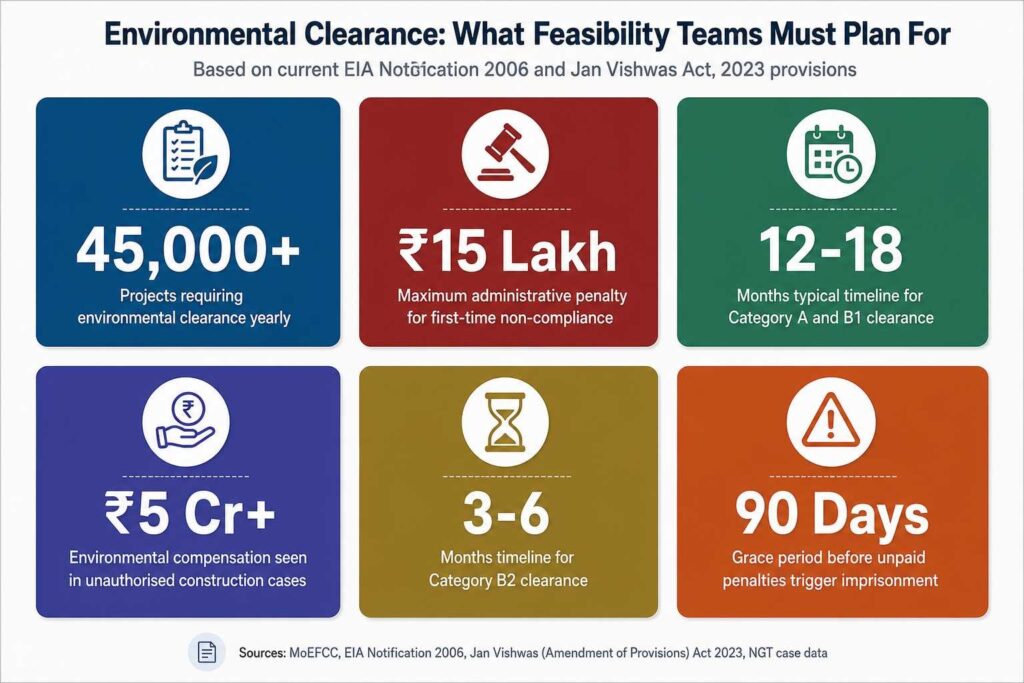
That sequencing is where many projects run into trouble. Over 45,000 projects across India require environmental clearances every year, and a site that looks financially sound on a feasibility report can turn out to be legally unviable once its environmental constraints surface. By that point, land may already be purchased, and design work may already be underway.
Building an Environmental Impact Assessment (EIA) in India into the feasibility stage, rather than after it, is what prevents this outcome. When environmental screening runs alongside the financial and technical evaluation, promoters find out early whether a site is eligible for clearance at all, and under what conditions.
What Goes Wrong When EIA Is an Afterthought
The Environment (Protection) Act, 1986 and the EIA Notification 2006 make clearance a legal prerequisite for a wide range of sectors, including mining, chemicals, thermal power, and large-scale manufacturing. No project listed under Schedule 1 can legally begin construction without prior Environmental Clearance.
Feasibility teams often assume this is a downstream compliance task, similar to a factory license or a fire NOC, something that can be applied for once the site, layout, and financing are locked in. Environmental Clearance does not work that way. It is a threshold approval, and a site that fails screening cannot be substituted late in the process without reopening the entire feasibility exercise, including land cost assumptions, utility routing, and construction sequencing that were built around the original site.
Projects that skip this step, or assume it can be managed after site selection, face real consequences. Following the Jan Vishwas (Amendment of Provisions) Act, 2023, which came into effect on 1 April 2024, first-time violations under Section 15 of the EP Act now attract administrative penalties ranging from ₹10,000 to ₹15 lakh, with imprisonment of up to three years if the penalty remains unpaid for 90 days. In cases involving large construction projects, environmental compensation for unauthorised work has exceeded ₹5 crore, alongside demolition orders from the National Green Tribunal.
Beyond the direct penalties, an EC-less project also runs into secondary blocks. Occupancy certificates cannot be issued, institutional lenders and buyers treat the asset as unsaleable, and RERA registration for real estate components gets invalidated. A feasibility study that does not account for this risk is, in effect, incomplete, regardless of how accurate its cost and revenue projections otherwise are.
The Cost of Redesigning Around Environmental Constraints Later
When environmental risk surfaces after a feasibility study is already approved, the fix is rarely simple. A site found to fall within a protected buffer zone or an ecologically sensitive area may need to be relocated, which restarts land acquisition, utility connection applications, and layout design from scratch. A project that assumed the wrong clearance category may find its actual timeline is six to twelve months longer than what was budgeted, which affects loan drawdown schedules and construction contractor commitments already signed.
These are not hypothetical risks. Feasibility reports built without environmental input have historically underestimated project timelines, understated compliance costs, and in some cases recommended sites that were never eligible for clearance under Schedule 1 at all. Correcting these issues after commercial commitments are in place is far more expensive, in both time and capital, than screening for them upfront.
Clearance Categories and Timelines
The scale of environmental review a project requires depends on its category under the EIA Notification 2006. This directly determines the appraisal timeline that a feasibility study needs to plan around.
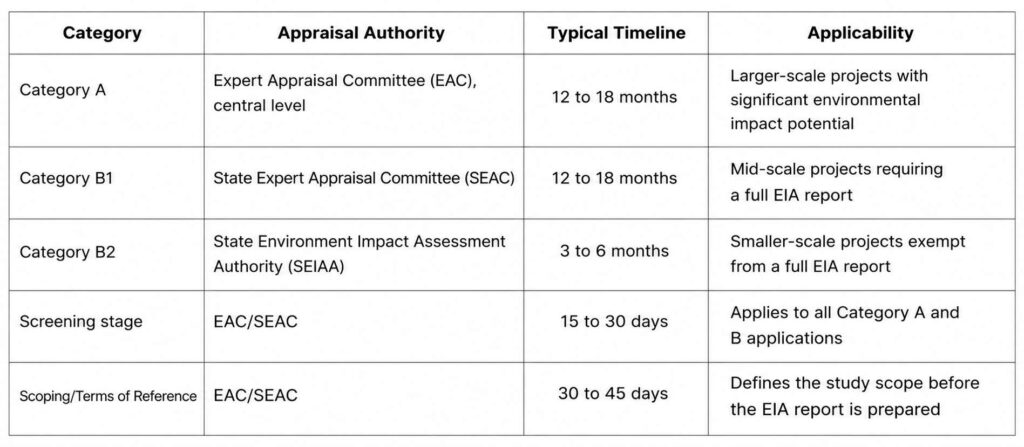
A feasibility study that ignores this classification risks understating the project timeline by close to a year, which directly affects financing assumptions, construction scheduling, and revenue projections built into the same report.
Why Integration Changes the Outcome
An integrated feasibility and environmental study looks materially different from a standalone feasibility report. It typically covers:
- Baseline air, water, noise, and soil quality assessment for the proposed site
- Identification of ecologically sensitive zones, forest land, or protected areas within the project’s influence area
- Preliminary screening against Schedule 1 of the EIA Notification to confirm category and applicable authority
- Water and effluent discharge norms under the Water Act, 1974, and air emission norms under the Air Act, 1981
- An early estimate of the Consent to Establish and Consent to Operate requirements from the State Pollution Control Board
Running this alongside the technical feasibility work means site selection, layout planning, and utility sizing are all informed by environmental constraints from day one, instead of being redesigned later to accommodate them.
This is particularly relevant for projects near rivers, forest boundaries, or designated industrial clusters, where environmental sensitivity can vary significantly within a few kilometres. A feasibility study that treats the entire district as equally viable, without this level of site-specific screening, is working from an incomplete picture regardless of how detailed its cost modelling is.
Get in touch with IMARC Engineering for Environmental Impact Assessment: https://www.imarcengineering.com/contact?service=environmental-impact-sustainability-studies
How IMARC Engineering’s Expertise Can Help in Environmental Feasibility Planning
Assessing environmental risk at the same stage as financial and technical feasibility requires people who understand both sides of that equation. IMARC Engineering works with industrial promoters across pharmaceuticals, chemicals, food processing, FMCG, and infrastructure to run these assessments together rather than in sequence.
Support at this stage typically includes:
- Screening candidate sites against Schedule 1 of the EIA Notification before land is finalised
- Estimating the likely clearance category, authority, and timeline for a given project configuration
- Coordinating baseline environmental data collection alongside technical feasibility surveys
- Preparing documentation aligned with NABET/QCI-accredited EIA/EMP requirements
- Advising on Consent to Establish and Consent to Operate requirements from the relevant State Pollution Control Board
This integrated approach reduces the chance of discovering a site-blocking environmental constraint after capital has already been committed to the project.
Watch our short video explaining how manufacturing feasibility studies are applied in real industrial projects:
Conclusion
Treating environmental review as a step that follows feasibility, rather than one built into it, leaves projects exposed to delays, penalties, and sites that were never viable to begin with. Feasibility studies that incorporate environmental screening from the outset give promoters a realistic view of timeline, cost, and clearance risk before any capital commitment is made, protecting the project’s financing, schedule, and site selection long before construction ever begins.
Contact Us:
IMARC Engineering
Phone: +91-120-433-0800
Email: sales@imarcengineering.com
India: C-130, Sector 2, Noida, Uttar Pradesh 201301
LinkedIn: https://www.linkedin.com/showcase/imarc-engineering/
About the Author