Introduction
Setting up a new factory is one of the highest-stakes investment decisions a business can make — and one of the easiest to get wrong when process design is treated as an afterthought rather than a core engineering activity.
Once land is acquired, buildings are designed, and equipment orders are placed, the hidden problems surface: inefficient material flow, oversized or undersized utilities, excessive handling, poor space utilisation, compliance gaps, and production rates that never reach the business plan. These issues are rarely visible in a basic layout drawing or a machinery quotation. They become clear only through structured manufacturing process design before major commitments are locked.
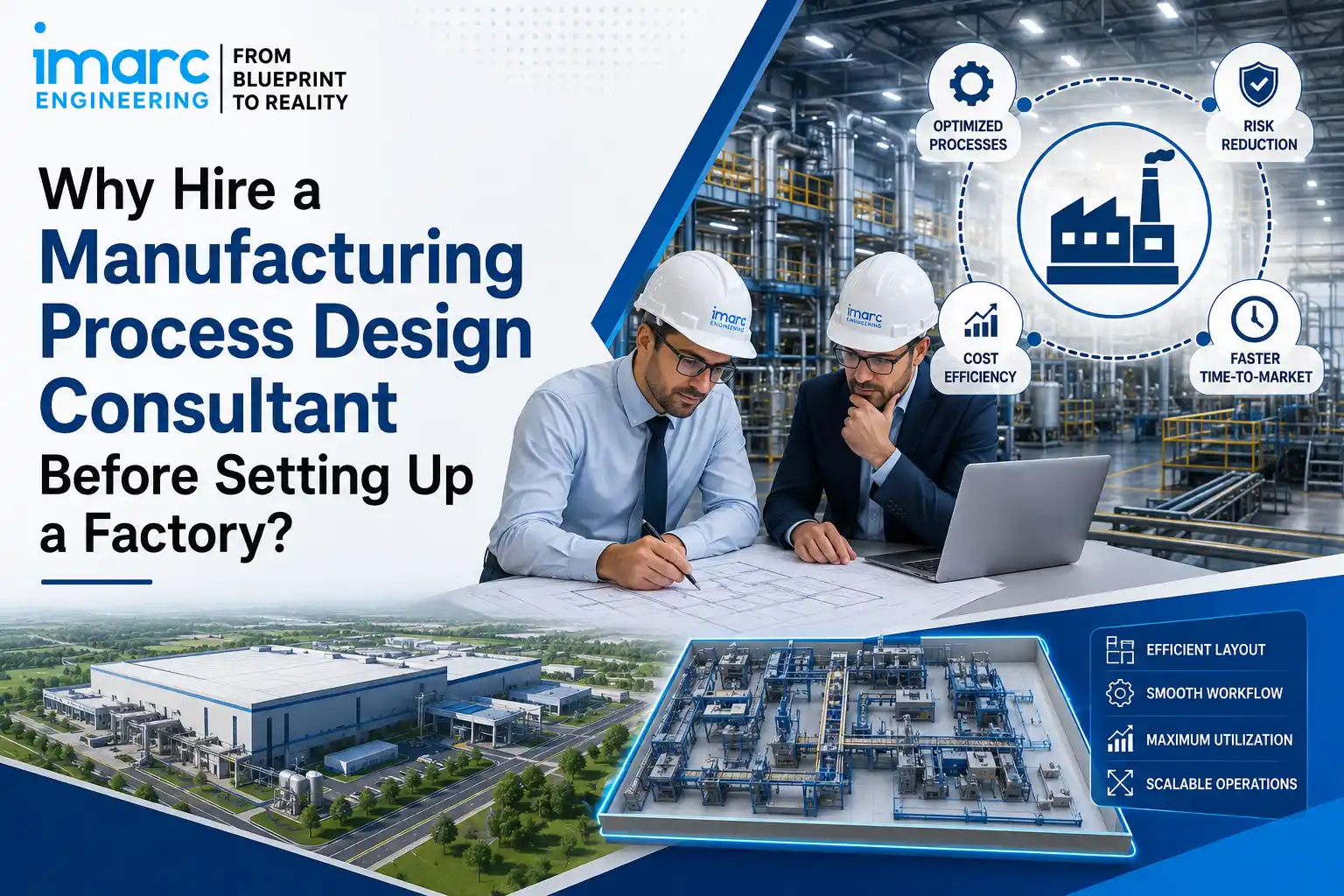
IMARC Engineering provides manufacturing process design consultancy for companies setting up new factories or expanding existing ones across India. This article explains why businesses should hire a Manufacturing Process Design Consultant early, what risks can be avoided, and how professional process design improves both capital efficiency and long-term operational performance.
Why Process Design Matters Before Factory Setup in India
India’s manufacturing sector continues to expand under strong policy support and rising investment.
Manufacturing is estimated to grow around 7% at constant prices in FY 2025-26, according to MoSPI’s First Advance Estimates. FDI into manufacturing rose 18% in FY 2024-25 to US$19.04 billion, as reported by the Ministry of Commerce and Industry and DPIIT. Cumulative FDI inflows since April 2000 stand at approximately US$1.16 trillion. The Production Linked Incentive (PLI) scheme has attracted cumulative investment exceeding ₹2.16 lakh crore, with cumulative production and sales surpassing ₹20.41 lakh crore as of December 2025, per PIB.
As more companies set up new plants to capture this growth, the quality of process design has become a decisive factor. Logistics costs have improved to an estimated 7.97% of GDP (DPIIT-NCAER study), yet plant-level efficiency still depends on how well material flow, equipment placement, utilities, and compliance requirements are designed from the start.
Hiring a manufacturing process design consultant before finalising layout, equipment, and civil design helps convert investment into a factory that is efficient, compliant, and scalable.
Why Setting Up a Factory Without Process Design Expertise Creates Risk
Most underperforming new factories follow a familiar pattern: process design left to equipment vendors or civil architects, limited attention to material flow and waste, and late discovery of capacity, compliance, or cost problems.
Common risks include:
- Inefficient material flow: Excessive movement, backtracking, and handling that permanently raise labour and cycle time.
- Wrong equipment capacity or sequence: Machines that create bottlenecks or remain underutilised because process logic was not validated.
- Utility mismatches: Power, water, steam, compressed air, or HVAC systems that are oversized, undersized, or poorly distributed.
- Space wastage or congestion: Layouts that look neat on paper but create chronic congestion or unused areas once production starts.
- Compliance and safety gaps: Designs that struggle to meet factory licence, environmental, fire, or sector-specific regulatory requirements.
- High future modification cost: Expensive redesigns and retrofits after the building and foundations are already complete.
Structured manufacturing process design surfaces these issues early and builds efficiency and compliance into the factory before capital is locked.
Key Reasons to Hire a Manufacturing Process Design Consultant Early
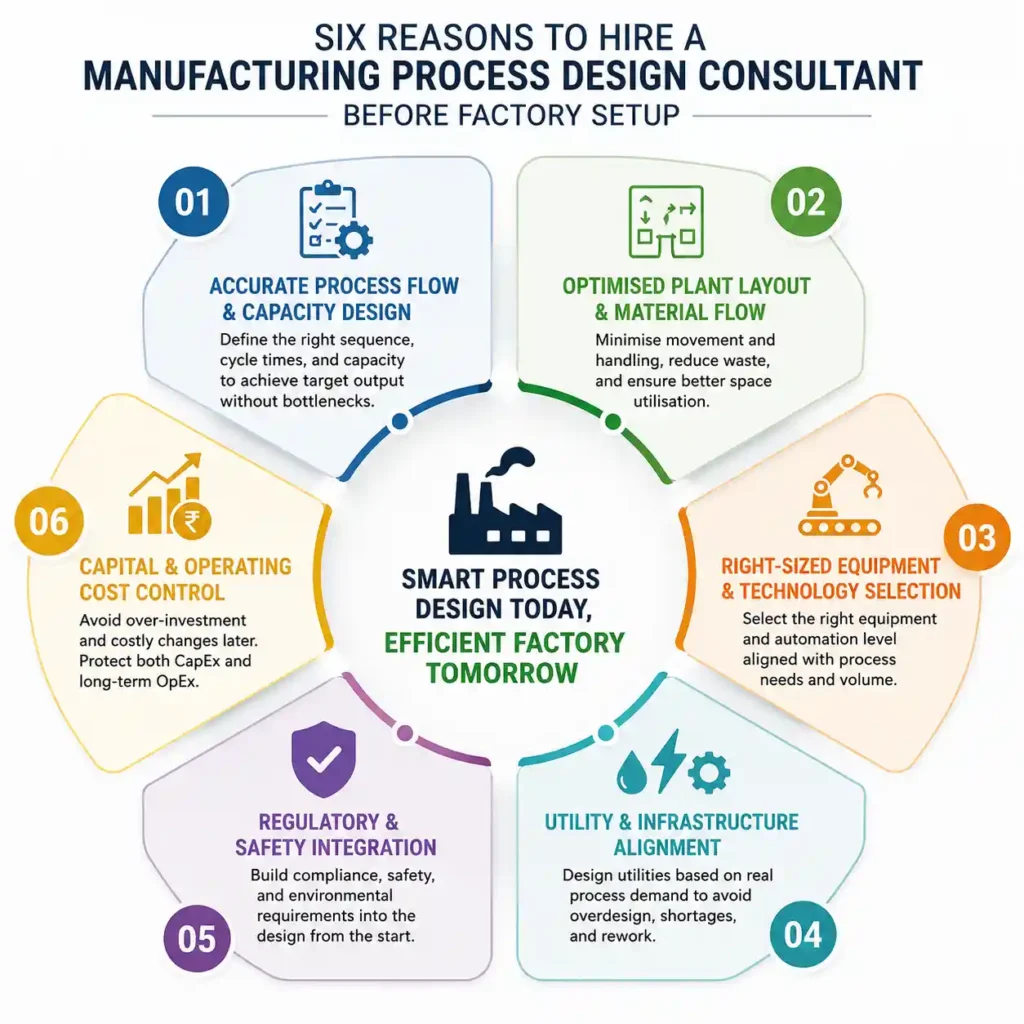
A professional process design consultant adds value in six critical areas before factory setup begins.
Step 1. Accurate Process Flow and Capacity Design
Defining the correct sequence of operations, cycle times, and capacity balances so that the factory can achieve target output without chronic bottlenecks.
Step 2. Optimised Plant Layout and Material Flow
Designing layouts that minimise unnecessary movement, reduce handling, improve visibility, and support lean material flow from raw material to finished goods.
Step 3. Right-Sized Equipment and Technology Selection
Matching equipment capability and automation level to actual process needs and volume projections instead of relying only on vendor recommendations.
Step 4. Utility and Infrastructure Alignment
Ensuring power, water, steam, compressed air, HVAC, and effluent systems are designed for real process demand rather than rough estimates.
Step 5. Regulatory and Safety Integration
Building factory licence, environmental, fire safety, and sector-specific compliance requirements into the process and layout design from the beginning.
Step 6. Capital and Operating Cost Control
Avoiding over-investment in space and equipment while preventing under-design that forces expensive changes later. Early process design typically protects both CapEx and long-term OpEx.
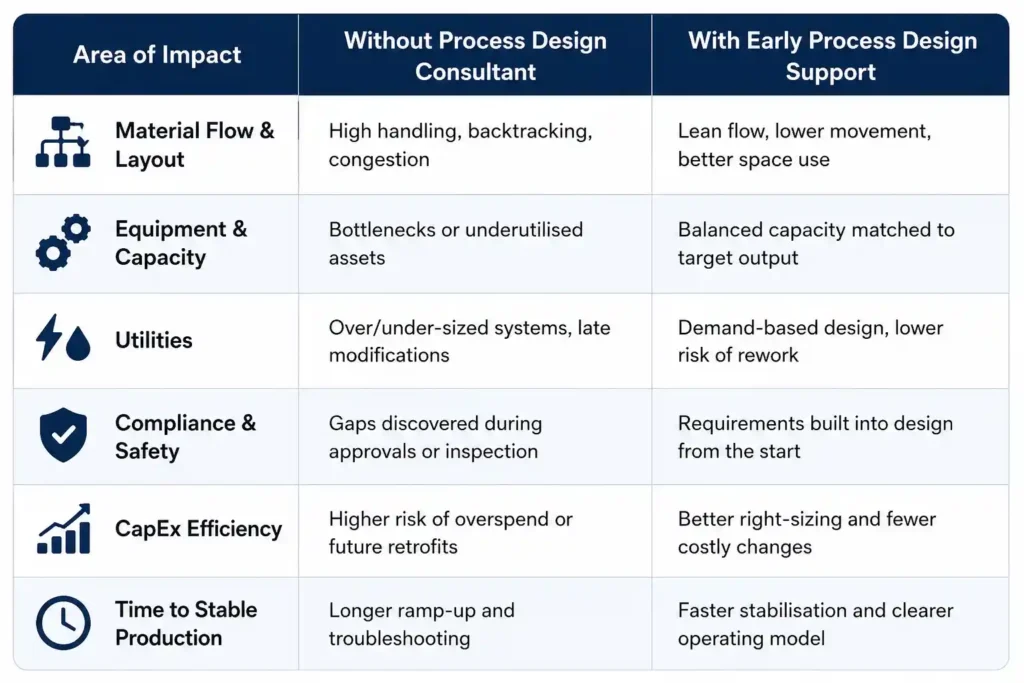
How a Manufacturing Process Design Consultant Supports Factory Setup
IMARC Engineering’s process design approach is built around verified operational and cost evidence at every stage — replacing assumption-driven layouts with structured manufacturing design.
- Process mapping and capacity definition: Establishing the correct operation sequence, cycle times, and output targets before layout or equipment decisions.
- Layout and material flow design: Developing plant layouts that support efficient movement, clear zones, and future scalability.
- Equipment and technology advisory: Supporting selection and sizing of machines aligned with process requirements and volume plans.
- Utility and infrastructure planning: Defining realistic demand for power, water, steam, air, HVAC, and effluent systems.
- Compliance and safety integration: Embedding regulatory and safety requirements into process and layout design.
- Cost and risk review: Highlighting CapEx and OpEx implications of design choices so that decisions remain commercially sound.
IMARC Engineering works with companies setting up factories across pharmaceuticals, food and beverage, chemicals, auto components, electronics, FMCG, and discrete industrial manufacturing.
Contact IMARC Engineering’s team for manufacturing process design support before you finalise your factory setup plans in India: https://www.imarcengineering.com/contact?service=plant-layout-and-process-flow-design
Common Mistakes When Setting Up a Factory Without Process Design Support
- Finalising building design and civil drawings before process flow and equipment layout are validated
- Accepting equipment vendor layouts without independent review of material flow and capacity balance
- Underestimating utility demand and discovering shortfalls only during commissioning
- Ignoring future volume growth and creating a layout that cannot scale without major disruption
- Treating compliance requirements as a documentation exercise rather than a design input
- Focusing only on CapEx minimisation and creating a factory that is expensive to operate
Conclusion
India’s manufacturing growth, supported by PLI investments, rising FDI, and improving logistics creates strong opportunities for new factory setup. However, the long-term performance of any plant depends heavily on the quality of process design decisions made before construction and equipment commitments.
Hiring a manufacturing process design consultant early reduces the risk of inefficient layouts, capacity imbalances, utility mismatches, compliance gaps, and expensive future modifications. It helps convert capital investment into a factory that is efficient, compliant, and ready to deliver target output with lower operational friction.
Through process mapping, layout optimisation, equipment advisory, utility planning, and compliance integration, IMARC Engineering helps manufacturers design factories that perform well from the first day of production and remain competitive over the long term.
Contact Us:
IMARC Engineering
Phone: +91-120-433-0800
|Email: sales@imarcengineering.com
India: C-130, Sector 2, Noida, Uttar Pradesh 201301
LinkedIn: https://www.linkedin.com/showcase/imarc-engineering/
About the Author