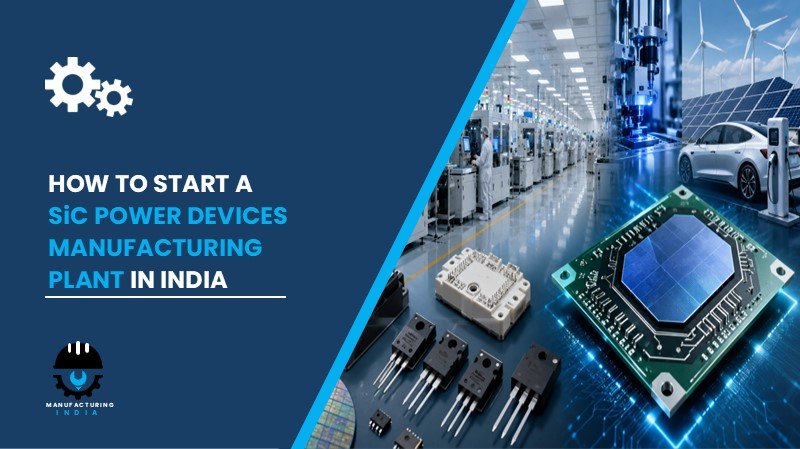
Setting up a SiC power devices manufacturing plant in India presents a compelling investment case, driven by rising adoption of 800V EV architectures, expansion of renewable power installations, AI-driven data centers, and smart grid modernization. SiC power devices are advanced semiconductor components used to control and convert electrical power, made from a durable compound of silicon and carbon that allows them to operate at much higher voltages, temperatures, and frequencies than conventional silicon alternatives.
India’s push toward semiconductor self-reliance, electric mobility, and domestic electronics manufacturing under Make in India and PLI schemes is strengthening demand for locally produced power semiconductors. Automotive OEMs, industrial equipment manufacturers, and power electronics companies are increasingly seeking localized semiconductor supply chains, creating a strategically sound opening for regional manufacturers.
This investment benefits from strong policy support under Make in India and PLI schemes, cost-competitive manufacturing economics, and steady demand from EV, renewable energy, and industrial automation sectors. With gross margins of 30–42% and net margins of 10–20%, it offers a credible path to break-even viability.
What are SiC Power Devices?
SiC power devices are advanced semiconductor components used to control and convert electrical power. Made from a durable compound of silicon and carbon, SiC belongs to the “wide-bandgap” family of materials, allowing devices to operate at much higher voltages, temperatures, and frequencies than conventional silicon alternatives. By minimizing energy waste and reducing power conversion losses, SiC technology enables dramatic improvements in energy efficiency, translating to smaller, lighter, and more compact electronic designs.
The SiC power devices manufacturing process uses epitaxial growth, photolithography, ion implantation, etching, thin-film deposition, metallization, wafer thinning, dicing, packaging, and electrical testing as its core stages. End-use industries served include electric vehicles, renewable energy, industrial automation, power transmission & distribution, consumer electronics, aerospace & defense, railways, and telecommunications.
Cost of Setting Up a SiC Power Devices Manufacturing Plant in India
Cost depends on capacity, technology, location, automation, and regulatory compliance.
1. Capital Expenditure (CapEx)
Total capital investment for the plant depends on capacity, technology, and location, covering land acquisition, site preparation, and necessary infrastructure. Land and site development — including registration, boundary development, and related charges — forms a substantial part of the investment, and investors can evaluate industrial estates or designated zones offering robust infrastructure, transportation, and utilities, while ensuring compliance with local zoning and environmental regulations.
Machinery costs account for the largest portion of capital expenditure, with scale of manufacturing and automation level determining the total cost.
Key machinery required includes:
- Epitaxial reactors (CVD systems)
- Photolithography systems
- Ion implantation equipment
- Oxidation furnaces
- Plasma etching systems
- Thin-film deposition equipment (PVD/CVD)
- Metallization systems
- Chemical mechanical polishing (CMP) tools
- Wafer probing systems
- Wafer dicing machines
- Die bonders
- Wire bonders
- Molding and packaging systems
- Electrical testing equipment
- Cleanroom facilities
Other capital costs cover infrastructure and utility setup.
Request a Sample Report for In-Depth Market Insights: https://www.imarcgroup.com/sic-power-devices-manufacturing-plant-project-report/requestsample
2. Operational Expenditure (OpEx)
Raw material cost is the largest component of operating expenses. SiC wafers, epitaxial precursor gases (silane SiH4, propane C3H8), dopant gases (nitrogen, aluminum), photoresist, and etch gases together account for approximately 40–50% of total OpEx, making long-term supplier contracts essential to mitigate price volatility.
Utility cost accounts for approximately 20–28% of OpEx. Other operating costs include transportation, packaging, salaries and wages, depreciation, taxes, and maintenance.
By the fifth year, total operational cost is expected to rise substantially due to inflation, market fluctuations, rising raw material costs, supply chain disruptions, and shifts in the global economy.
3. Plant Capacity
The proposed facility is designed with an annual manufacturing capacity ranging between 10,000–50,000 wafers, enabling economies of scale while maintaining flexibility. Capacity can be customized based on investor requirements, and profitability generally improves with higher capacity utilisation.
4. Profit Margins and Financial Projections
Financial projections cover ROI, profitability, and long-term sustainability, based on capital investment, operating costs, capacity utilization, pricing trends, and demand outlook. Gross profit margins typically range between 30–42%, while net profit margins range between 10–20%. Payback period, liquidity, and net present value (NPV) figures form part of the full financial analysis.
Why Set Up a SiC Power Devices Plant in India?
Critical Enabler of Next-Generation Power Electronics. SiC power devices are essential for high-efficiency power conversion across electric vehicles, renewable energy systems, industrial automation, data centers, rail traction, aerospace, and smart grid infrastructure.
High but Defensible Entry Barriers. Manufacturing requires significant capital investment, advanced semiconductor fabrication capabilities, high-purity wafers, precision processing technologies, and lengthy customer qualification cycles, favoring experienced manufacturers.
Megatrend Alignment. The rapid adoption of electric vehicles, fast-charging infrastructure, renewable energy, energy storage systems, AI-driven data centers, and industrial electrification is driving robust, double-digit demand growth.
Policy and Regulatory Tailwinds. Government initiatives supporting semiconductor self-reliance, electric mobility, and domestic electronics manufacturing — including semiconductor incentive programs, Make in India, and PLI schemes — are accelerating investments and strengthening the industry’s growth outlook.
Active Industry Investment. In March 2026, SK keyfoundry announced completion of its SiC Planar MOSFET process platform and secured an order for a 1200V SiC MOSFET product, while in February 2026, NoMIS Power Corporation released two medium-voltage SiC MOSFETs on its next-generation planar platform.
Supply Chain Localization. Automotive OEMs, industrial equipment manufacturers, and power electronics companies are increasingly seeking localized, reliable semiconductor supply chains to reduce geopolitical risks and shorten lead times.
Manufacturing Process – Step by Step
The SiC power devices manufacturing process uses epitaxial growth and precision semiconductor fabrication as its primary method.
- Epitaxial growth: Epitaxial reactors (CVD systems) grow high-purity crystalline layers on SiC wafers.
- Photolithography: Photolithography systems pattern the wafer surface using photoresist to define device structures.
- Ion implantation: Ion implantation equipment introduces dopant gases such as nitrogen and aluminum to modify electrical properties.
- Oxidation and etching: Oxidation furnaces and plasma etching systems shape and refine device layers.
- Thin-film deposition: Thin-film deposition equipment (PVD/CVD) applies functional layers to the wafer.
- Metallization: Metallization systems and CMP tools form electrical contacts and planarize the surface.
- Wafer testing: Wafer probing systems verify device performance before dicing.
- Dicing and packaging: Wafer dicing machines, die bonders, wire bonders, and molding and packaging systems prepare finished devices, verified with electrical testing equipment before dispatch to end-use industries such as electric vehicles and renewable energy.
Key Applications
- Electric Vehicles: Traction inverters, onboard chargers, DC-DC converters, and fast-charging systems.
- Renewable Energy: Solar inverters, wind power converters, and energy storage systems.
- Industrial: Motor drives, power supplies, industrial automation, and high-voltage equipment.
- Telecommunication & Data Centers: 5G power infrastructure, server power supplies, and UPS systems.
Leading Manufacturers
Leading manufacturers in the global industry include:
- Infineon Technologies AG
- STMicroelectronics N.V.
- Wolfspeed Inc.
- onsemi Corporation
- ROHM Co., Ltd.
Timeline to Start the Plant
- Feasibility study and project report preparation
- Land acquisition and site development
- Regulatory approvals and environmental clearances
- Factory licence and fire safety compliance
- Machinery procurement and installation
- Raw material supplier agreements and supply chain setup
- Trial production and quality testing
- Commercial production launch
Licences and Regulatory Requirements
Starting a SiC power devices manufacturing unit in India requires several approvals:
- Business registration (Proprietorship, LLP, or Pvt Ltd)
- Factory Licence under the Factories Act
- Environmental Clearance from State Pollution Control Board
- GST Registration
- Fire Safety NOC
- Hazardous/chemical compliance for precursor gases and etch chemicals
- Effluent Treatment Plant (ETP) operational clearance
- Occupational Health and Safety compliance
Key Challenges to Consider
High Capital Requirements. Machinery costs, including epitaxial reactors, photolithography systems, and ion implantation equipment, account for the largest share of capital expenditure.
Raw Material Price Volatility. SiC wafers, epitaxial precursor gases, dopant gases, photoresist, and etch gases together make up 40–50% of OpEx, so reliable long-term supplier contracts are essential.
Regulatory Compliance. Safety protocols, monitoring systems, and effluent treatment requirements must be implemented throughout production to minimize environmental impact.
Technology and Qualification Pressure. High-purity wafers, precision processing, stringent quality standards, and lengthy customer qualification cycles create barriers requiring continuous technology investment.
Competition from Established Players. Global producers such as Infineon Technologies AG, STMicroelectronics N.V., Wolfspeed Inc., onsemi Corporation, and ROHM Co., Ltd. set a high bar for new entrants.
Skilled Manpower. Operating epitaxial reactors, photolithography systems, and electrical testing equipment requires trained, well-supervised personnel.
Frequently Asked Questions
1. How much does it cost to set up this facility in India?
Cost depends on capacity, technology, location, automation, and regulatory compliance, covering land, civil works, machinery, and other capital costs.
2. Is SiC power devices manufacturing profitable in India in 2026?
Gross margins of 30–42% and net margins of 10–20% indicate healthy profitability potential under normal operating conditions.
3. What machinery is required for a SiC power devices plant in India?
Epitaxial reactors, photolithography systems, ion implantation equipment, oxidation furnaces, plasma etching systems, thin-film deposition equipment, metallization systems, CMP tools, wafer probing systems, wafer dicing machines, die bonders, wire bonders, and molding and packaging systems.
4. What licences and approvals are required to start the unit in India?
Business registration, a Factory Licence, Environmental Clearance, GST Registration, Fire Safety NOC, hazardous/chemical compliance, ETP clearance, and occupational health and safety compliance.
5. What raw materials are needed for SiC power devices manufacturing?
SiC wafers, epitaxial precursor gases (silane SiH4, propane C3H8), dopant gases (nitrogen, aluminum), photoresist, and etch gases.
6. What are the environmental compliance requirements for this facility in India?
Environmental Clearance from the State Pollution Control Board, an operational ETP, and safety/monitoring systems.
7. What is the best location to set up a SiC power devices plant in India?
The location must offer easy access to SiC substrates and precursor gases, along with proximity to target markets and robust transportation and utility infrastructure.
8. What is the break-even period for this type of plant in India?
It depends on capacity utilisation, pricing trends, and cost structure, detailed through payback period and NPV analysis in the full financial projections.
9. What government incentives are available for manufacturers in India?
Semiconductor incentive programs, Make in India, and PLI schemes for electronics and automotive support domestic power semiconductor manufacturing.
Key Takeaways for Investors
A SiC power devices manufacturing plant in India taps into steady, diversified demand from electric vehicles, renewable energy, industrial automation, power transmission & distribution, consumer electronics, aerospace & defense, railways, and telecommunications sectors, underpinned by policy support under Make in India and PLI schemes. The project shows healthy financial viability across its proposed 10,000–50,000 wafer annual capacity range, with gross margins of 30–42% and net margins of 10–20%. With Asia-Pacific already accounting for about 43.4% of the global market and the global semiconductor market expected to exceed USD 1.5 Trillion by 2035 as per NITI Aayog, demand fundamentals for domestically produced SiC power devices appear well-positioned for long-term investor interest.
About the Author