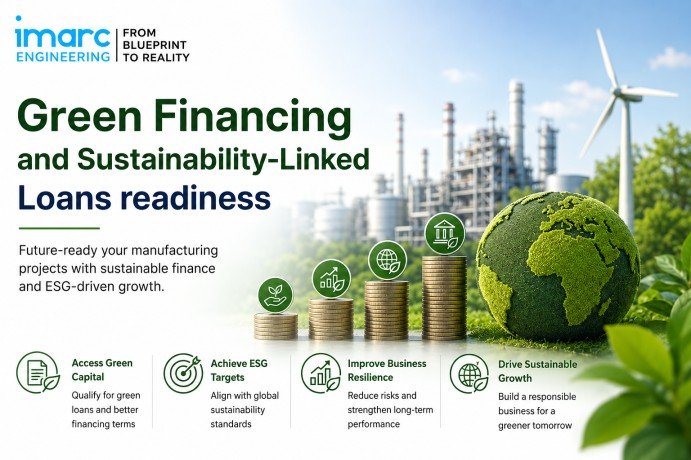
Green Financing and Sustainability-Linked Loans readiness
India’s manufacturing sector is entering a phase where access to capital is increasingly tied to environmental performance, not just financial ratios. Banks, development finance institutions, and bond investors are now pricing sustainability into the cost of capital itself, rewarding manufacturers that can demonstrate measurable emissions reduction, energy efficiency, and resource stewardship with lower borrowing costs. India’s sustainable debt market has already crossed USD 55.9 billion, spanning green, social, sustainability, and sustainability-linked instruments, and continues to expand rapidly as regulatory frameworks mature (Source: Climate Bonds Initiative, 2024). The scale of the gap is significant: the finance ministry estimates India needs close to USD 2.5 trillion of climate-aligned investment by 2030, and current sources cover only around two-thirds of the broader USD 10 trillion transition need through 2070.
For manufacturing companies planning capacity expansion, modernization, or greenfield projects, this shift means Green Financing and Sustainability-Linked Loans readiness is no longer optional. Getting financing-ready requires structured groundwork long before a term sheet is signed. This guide walks through what readiness actually involves and how manufacturing project teams can prepare systematically.
Why Green Financing Readiness Has Become a Priority
Four forces are converging to push sustainability-linked capital into the mainstream of industrial project finance.
- Regulatory reporting: First, regulatory reporting is tightening. SEBI’s enhanced BRSR Core requirements now demand assurance-level disclosure for large listed companies, and this discipline is cascading down supply chains as lenders ask manufacturing vendors for the same data
- Green deposit framework: Second, the RBI’s Framework for Acceptance of Green Deposits, effective since June 1, 2023, formalized how banks and NBFCs channel depositor funds into green finance, creating a capital pipeline regulated lenders are under pressure to deploy
- Climate Finance Taxonomy: Third, a formal classification system is close to arriving. The finance ministry released a draft Climate Finance Taxonomy in 2025, with formal notification expected through 2026, a step CareEdge-ESG has called as significant as the 2023 sovereign green bond launch (Source: Business Today, 2026).
- Market adoption: Fourth, real transactions prove the model works. IFC sanctioned a USD 100 million SLL to JK Tyre in January 2025 for energy-efficient tyre manufacturing capacity, while JSW Cement raised Rs 400 crore from MUFG Bank India as its first SLL to fund capacity expansion to 25 million tonnes per annum
For plant heads, ESG leaders, and CFOs, the message is consistent: sustainability performance is becoming a direct input into the cost and availability of project capital.
Green Financing vs. Sustainability-Linked Loans: Knowing the Difference
Manufacturing companies preparing a financing strategy need to understand that these are two distinct instruments with different structuring requirements.
- Green financing (green loans, green bonds, green deposits) is use-of-proceeds based: funds must be ring-fenced for a specific eligible activity, such as a solar captive power plant or wastewater recycling system, with reporting on fund allocation and impact. Sovereign green bonds illustrate the scale: for H1 FY27, the government plans to issue Rs 15,000 crore in sovereign green bonds through RBI Retail Direct auctions .
- Sustainability-Linked Loans, by contrast, are performance based. Funds can be used for general corporate purposes, but the interest margin steps up or down depending on whether the company meets pre-agreed Sustainability Performance Targets, tracked through KPIs such as emissions intensity or water recycling rates. Tata Communications’ USD 250 million SLL links its margin to progress on carbon emission reduction targets aligned with its 2035 net-zero ambition
Both routes are increasingly used together in phased manufacturing projects: green loans for capital-intensive green assets, and SLLs for working capital or expansion financing where sustainability performance improvement across the whole facility is the target.
The Cost-of-Capital Advantage: Understanding the “Greenium”
A well-structured transaction can lower borrowing costs, though the pricing benefit in India is still modest by global standards. India’s sovereign green bonds have traded at a “greenium” of roughly 2 to 6 basis points below comparable conventional bonds, narrower than the 7 to 8 basis point global average but still measurable.
Cumulative sovereign green bond issuance has crossed Rs 44,000 crore since January 2024 alone, ahead of financial institution, corporate, and municipal green issuances combined, signalling deep investor appetite . For manufacturers, the benefit typically shows up less in headline rate cuts and more in wider lender access, as DFIs and green-deposit-funded bank pools actively seek eligible borrowers.
Step-by-Step: Building Financing Readiness
Step 1: Establish a Baseline Sustainability Performance Profile
Before approaching any lender, manufacturers need verified baseline data on energy consumption, Scope 1 and 2 GHG emissions, water usage, and waste generation. Without a credible baseline, KPI negotiation becomes guesswork, and verifiers will flag data gaps during due diligence.
Step 2: Map the Project Against an Eligible Activity Taxonomy
Green financing proceeds must align with an accepted green activity list, generally covering renewable energy, energy efficiency, clean transportation, sustainable water management, and pollution prevention. With India’s Climate Finance Taxonomy still in draft form pending 2026 notification, most lenders currently reference RBI’s green deposit framework categories,
ICMA-aligned bond frameworks, or sector-specific standards such as the Green Steel Taxonomy for hard-to-abate segments . Mapping the project against these categories early avoids late-stage disqualification.
Step 3: Define Financially Material, Ambitious KPIs
For SLLs specifically, KPIs must be material to the borrower’s core business and genuinely ambitious relative to a business-as-usual trajectory, not targets that would be met regardless. Common manufacturing KPIs include:
- Energy intensity per tonne of output
- Renewable energy share in total power consumption
- Scope 1 and 2 emissions reduction against a baseline year
- Water recycling or freshwater withdrawal reduction
- Waste-to-landfill diversion rate
Weak or easily achievable KPIs invite lender and investor scrutiny and increase greenwashing risk under evolving SEBI disclosure norms (Source: The ESG Institute, 2025).
Step 4: Arrange Independent Third-Party Verification
RBI’s green deposit framework and SEBI’s ESG bond framework both require annual third-party review of fund allocation and KPI performance. Manufacturers should engage a recognized verifier early, since assurance providers need lead time to assess data maturity before issuing an opinion.
Step 5: Build the Internal Reporting and Governance Structure
Lenders expect a board-approved sustainable finance policy, a designated internal owner for ESG data, and an annual reporting cadence covering fund utilization and KPI progress. Weak governance is one of the most common reasons financing discussions stall at the term sheet stage.
Step 6: Engage Lenders Early with a Structured Financing Narrative
Approach banks, DFIs, or bond arrangers with a clear project description, baseline data, and proposed KPIs already prepared. L&T Finance’s Rs 200 crore sustainability-linked rupee loan with Societe Generale shows how a well-structured domestic SLL can be executed once the underlying data and governance are in place (Source: India Infoline, 2025).
Industry Considerations Across Manufacturing Sectors
- Pharmaceuticals and chemicals: Water treatment, solvent recovery, and hazardous waste management typically anchor KPI design.
- Food processing: Energy efficiency in cold chains and packaging waste reduction are common anchors.
- Automotive and auto components: Renewable captive power and supply chain emissions are central, as seen in JK Tyre’s expansion (Source: IFC, January 2025).
- Heavy engineering and cement: Clinker substitution and process emissions intensity dominate KPI structuring, echoing JSW Cement’s expansion-linked SLL.
Common Pitfalls That Delay or Derail Financing
Manufacturers frequently underestimate the lead time needed for baseline data collection and assurance, often starting the financing conversation only after project design is locked, limiting the ability to structure meaningful KPIs. Others propose KPIs that are not independently verifiable or that overlap with existing regulatory obligations, reducing credibility with lenders and raising purpose-washing risk under SEBI’s tightening bond framework
A related issue is fragmented internal data, often scattered across plant systems, utility bills, and manual logs rather than a consolidated platform, which slows verification and raises integrity questions during due diligence. A single point of ownership for sustainability data, established before financing discussions begin, resolves most delays.
How IMARC Engineering Can Help
IMARC Engineering provides engineering-led ESG and sustainable finance advisory, helping manufacturers prepare projects for Green Financing and Sustainability-Linked Loans through technical assessments, KPI development, taxonomy alignment, and financing readiness support. For manufacturers planning brownfield modernization or greenfield capacity addition, early engagement can shorten due diligence timelines and strengthen negotiating positions on loan pricing.
Consult IMARC Engineering for Sustainable Finance Advisory: https://www.imarcengineering.com/contact?service=esg-compliance
Contact Us:
IMARC Engineering
Phone: +91-120-433-0800
Email: sales@imarcengineering.com
India: C-130, Sector 2, Noida, Uttar Pradesh 201301
LinkedIn: https://www.linkedin.com/showcase/imarc-engineering/
About the Author