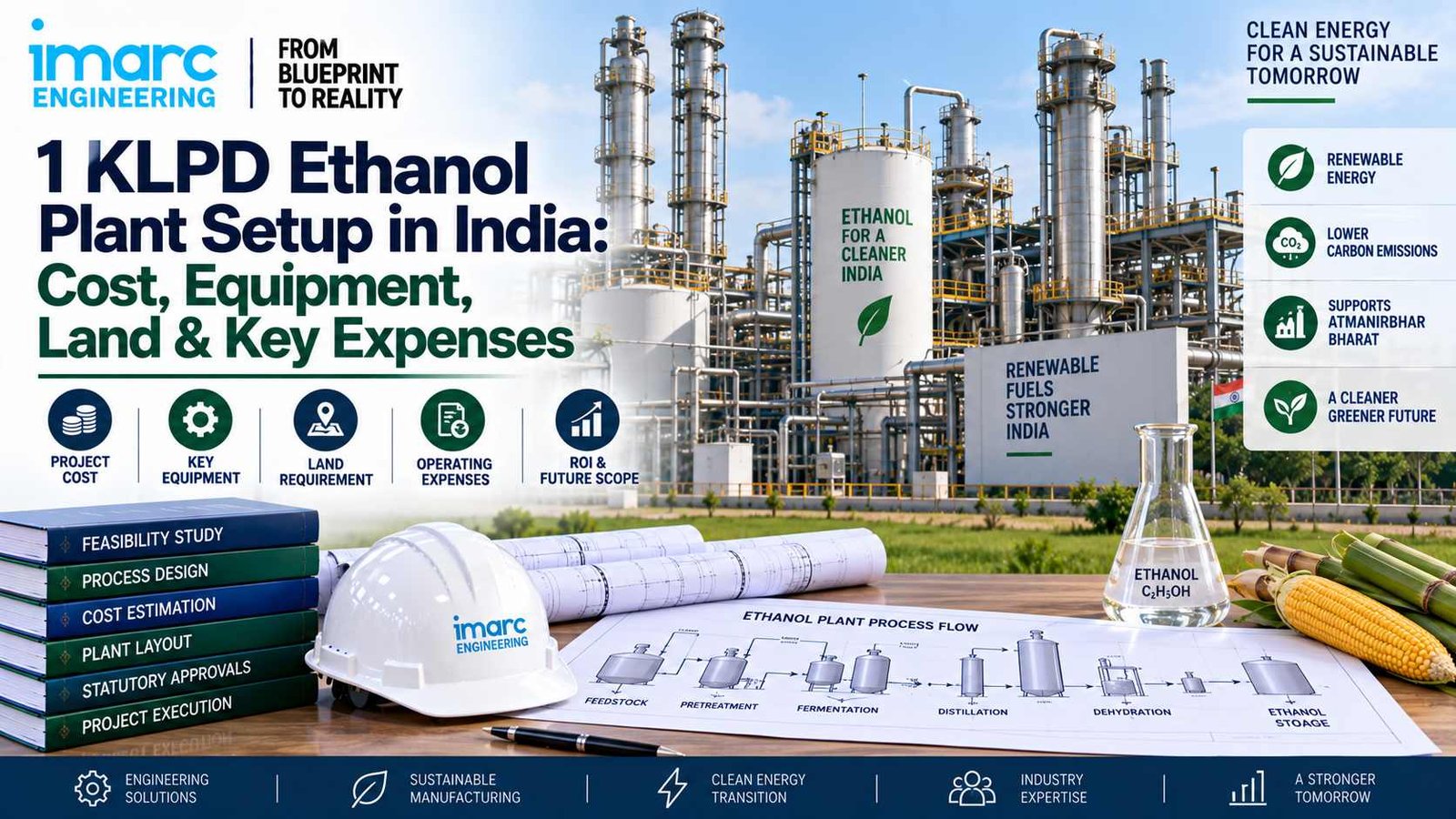
Anyone researching a 1 KLPD ethanol plant cost quickly finds that no two sources agree on a number. That is not because reliable information is missing — cost genuinely depends on feedstock, process technology, automation level, and site conditions, and few projects share the same combination. A grain-based unit will not cost the same as one built around molasses or sugarcane juice, and a plant on an existing distillery site will not cost the same as one on raw agricultural land.
A practical ethanol plant setup and project advisory approach starts with understanding process configuration, feedstock, utilities, equipment, land and regulatory requirements before capital is committed. For a 1 KLPD facility, these factors can materially affect the overall project cost and operating feasibility.
What Does 1 KLPD Ethanol Plant Capacity Mean?
KLPD stands for kilolitres per day. A 1 KLPD ethanol plant is designed to produce 1,000 litres of ethanol per day at its nameplate, or rated, capacity.
This suggests a simple annual figure — 1,000 litres/day multiplied by operating days. In practice, distilleries do not run 365 days a year: maintenance shutdowns, feedstock availability, seasonal crushing windows, and downtime all reduce actual operating days. Annual output depends on uptime, fermentation efficiency, and feedstock quality, not the nameplate figure. Any annual figure used for projections should be treated as illustrative, not guaranteed.
How Much Does a 1 KLPD Ethanol Plant Cost in India?
There is no single, government-published or industry-wide figure for a 1 KLPD ethanol plant cost in India, and no credible source should be expected to quote one. Small-capacity plants are usually built for captive, cooperative, or niche-feedstock use, and cost is assembled project-by-project from vendor quotations and site conditions, not a price list.
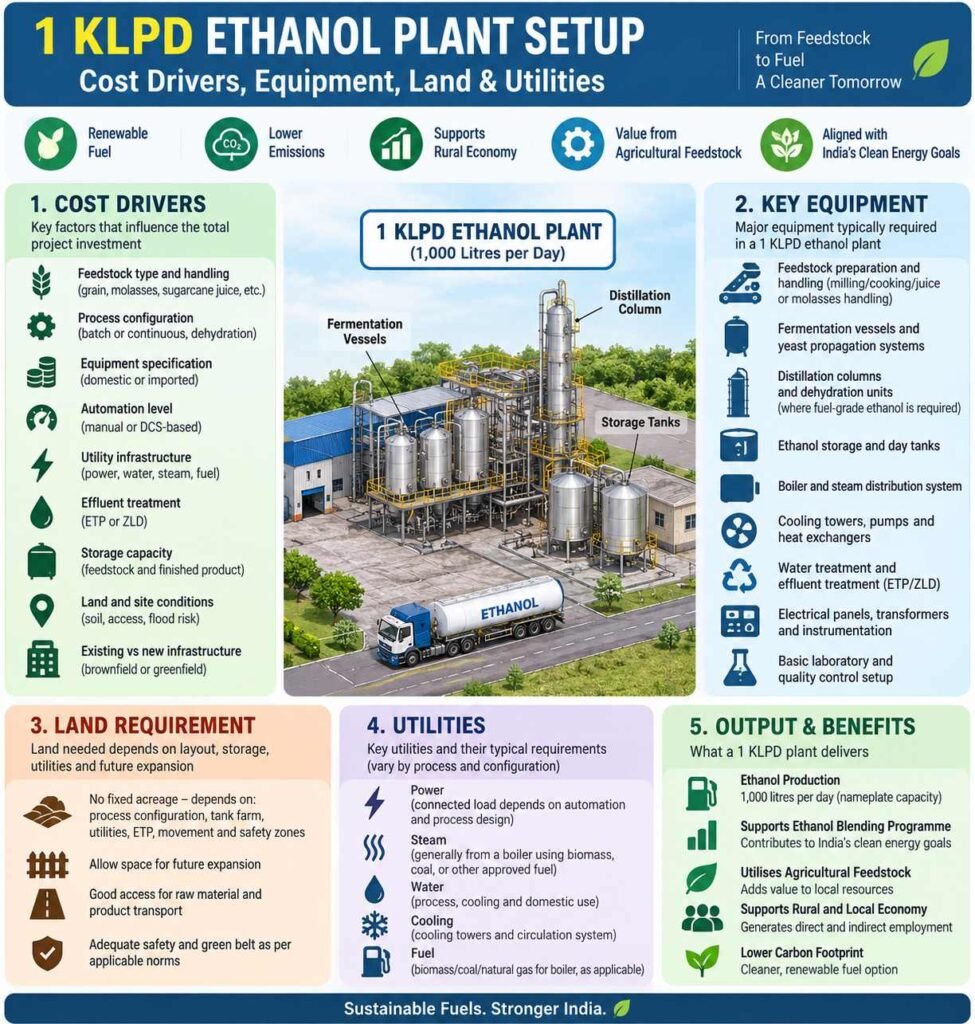
What can be explained reliably is where the investment goes. A 1 KLPD ethanol plant project cost typically builds up across these heads:
- Process equipment — feedstock preparation, fermentation, distillation, and dehydration where fuel-grade ethanol is required
- Feedstock handling, storage tanks, and tank-farm safety systems
- Boiler and steam system, cooling towers, and cooling-water circuit
- Water treatment and effluent treatment (ETP/ZLD where mandated)
- Electrical systems, transformers, and automation/instrumentation
- Civil and structural work, piping, and installation/commissioning
- Engineering, project management, land, site development, and approvals
Costs rise with higher automation, added fuel-grade dehydration, stringent ETP/ZLD needs, or heavy civil development, and fall where an existing site already has usable utilities, storage, or approvals. A realistic estimate follows only once feedstock, process route, and site are finalised — which is why vendor-quotation-based costing, not a benchmark figure, is standard for small ethanol units.
Major Cost Factors That Change 1 KLPD Plant Investment
Beyond the cost-head breakdown above, practical factors decide where a project lands within its possible cost range:
- Feedstock — grain, molasses, sugarcane juice, or damaged food grains need different handling equipment
- Process configuration — batch vs continuous fermentation, and whether fuel-grade dehydration is included
- Equipment specification — steel grade and imported vs domestic fabrication
- Automation level — manual panels cost far less than full DCS-based control
- Utility infrastructure — availability of grid power, water, and steam on site
- Effluent treatment — a basic ETP costs less than a ZLD system with evaporation
- Storage — feedstock buffer and finished-product tankage duration
- Land and site conditions — soil bearing capacity, flood-proofing, access roads
- Existing vs new infrastructure — reusing power, water, or storage cuts capital needs
- Greenfield vs brownfield setup — new sites carry development costs an existing plot does not
Equipment Required for a 1 KLPD Ethanol Plant
The equipment list depends on feedstock and process route, but most 1 KLPD configurations draw from these categories:
- Feedstock preparation and handling (milling/cooking, or juice/molasses handling)
- Fermentation vessels and yeast propagation systems
- Distillation columns, and dehydration units where fuel-grade ethanol is the target
- Ethanol storage/day tanks, boiler and steam distribution system
- Cooling towers, pumps, and heat exchangers
- Water treatment and effluent treatment equipment
- Electrical panels, transformers, and control/instrumentation systems
- Basic laboratory and quality-control setup
A 1 KLPD unit generally needs fewer parallel process lines than a larger distillery, but the categories stay similar — the difference lies in vessel sizing, materials, and automation, finalised against the chosen feedstock and process rather than assumed in advance.
How Much Land Is Required for a 1 KLPD Ethanol Plant?
No fixed, universal land figure applies to every 1 KLPD ethanol plant, since land requirement follows plant layout, not capacity alone. It depends on:
- Process building footprint and equipment spacing norms
- Tank-farm layout and inter-tank safety spacing
- Boiler house and utility block placement, and ETP/ZLD footprint where applicable
- Internal roads, vehicle movement, and fire-safety access norms
- Raw material and finished-product storage areas
- Space reserved for future expansion, and state-specific zoning/setback rules
Land requirement is an output of a site-specific layout exercise, prepared after equipment selection, not assumed beforehand.
Utility Requirements for a 1 KLPD Ethanol Plant
Ethanol production is utility-intensive, and requirements vary by technology and feedstock:
- Water — process use and cooling makeup; quantity depends on feedstock and recirculation
- Steam — for cooking (grain routes) and distillation, sized to the process heat balance
- Electricity — pumps, agitators, automation, and utility equipment
- Cooling — towers to manage fermentation and distillation temperatures
- Compressed/instrument air — for pneumatic valves and instrumentation
- Wastewater treatment — spent wash and process effluent, matched to feedstock and design
Utility sizing should follow a mass and heat balance for the selected process, not a generic per-KLPD assumption.
Approvals and Compliance for Setting Up an Ethanol Plant in India
Ethanol projects typically need approvals across environmental, pollution-control, and factory-related categories, though the exact list depends on location, capacity, and feedstock:
- Environmental clearance, where applicable based on project category and capacity
- Consent to Establish (CTE) and Consent to Operate (CTO) under the Water Act, 1974 and Air Act, 1981
- Compliance with CPCB effluent-discharge norms, including its guidance for molasses-based distilleries
- Fire safety and access-related permissions
- Factory licence under the Factories Act, 1948, or applicable labour codes as they come into force
- Storage-related permissions for flammable materials, and state-specific industrial/land-use approvals
Because requirements genuinely differ by state and category, these should be verified project-by-project with the relevant authorities.
Greenfield vs Existing-Site Setup: Why Cost Can Change
A greenfield 1 KLPD plant, built on undeveloped land, generally needs full investment in land development, roads, power connection, water-source development, and new civil work. An existing sugar mill or grain-processing facility may already have usable power, water access, approvals, storage, or boiler capacity that can be shared or extended.
This can meaningfully reduce certain capital heads. But integrating a new line into an existing facility adds its own costs — modifying utilities for new load, upgrading shared effluent capacity, or reworking layout around existing operations. The right comparison is project-specific: what the site genuinely offers versus what adapting it will cost.
Key Operating Expenses After Plant Commissioning
CAPEX decisions should not be evaluated in isolation from ongoing operating costs, which typically include:
- Feedstock procurement, usually the largest recurring cost
- Power, and steam/fuel for boiler operation
- Water intake and treatment, process chemicals and consumables
- Labour, operating manpower, and routine maintenance
- Effluent/waste treatment operating costs
- Logistics for feedstock and ethanol movement, and quality testing
A plant with lower CAPEX but weaker automation or an inefficient utility design can carry higher OPEX over its life, so operating economics deserve the same scrutiny as CAPEX.
Pre-Investment Checklist for a 1 KLPD Ethanol Plant
Before committing capital, project promoters should typically confirm:
- Feedstock availability, long-term supply arrangement, and an offtake plan
- Site suitability, layout feasibility, and water/power/fuel availability
- Finalised process technology and firm equipment quotations, not budgetary estimates
- Applicable ETP/ZLD and environmental requirements
- Storage adequacy, fire/safety compliance, and utility capacity matched to peak load
- Operating manpower and maintenance planning
- Finalised CAPEX estimate, realistic OPEX projection, and working capital requirement
- Design allowance for future expansion
| Project Cost Area | What Needs to Be Assessed | Why It Affects Investment |
| Process equipment | Feedstock-specific machinery, vessel sizing, materials of construction | Drives the largest share of CAPEX |
| Utilities | Power, water, steam and cooling capacity vs site availability | Gaps require new infrastructure investment |
| ETP/environmental systems | Effluent volume, discharge norms, ZLD applicability | Treatment complexity varies by feedstock |
| Storage | Feedstock buffer and finished-product tankage duration | Tank sizing and spacing affect land and cost |
| Civil/site development | Soil conditions, site development, internal infrastructure | Greenfield sites need substantially more civil work |
| Electrical/automation | Control philosophy, instrumentation depth | Automation level is a major cost lever |
How IMARC Engineering Supports Ethanol Plant Projects
IMARC Engineering supports industrial project developers, including ethanol promoters, through project-stage advisory — feasibility inputs, plant layout planning, utility planning, equipment/vendor evaluation, CAPEX/OPEX assessment, and regulatory readiness ahead of execution.
As a scale/reference example only, not a cost figure for a 1 KLPD plant — IOCL’s 100 KLPD second-generation ethanol bio-refinery at Panipat, Haryana, was built at an estimated cost of around ₹900 crore and commissioned in August 2022, using paddy straw as feedstock, per the Press Information Bureau. It shows how cost, land (roughly 35 acres), and engineering scope scale up sharply with capacity; it is not an indication of a 1 KLPD plant’s cost.
Planning a new ethanol project or evaluating the feasibility of a small-capacity plant? Contact IMARC Engineering to discuss your project requirements, site conditions and engineering needs: https://www.imarcengineering.com/contact-us
Conclusion
There is no universal, fixed 1 KLPD ethanol plant cost in India. Actual investment is decided by the interaction of feedstock, process technology, equipment specification, automation, utility infrastructure, effluent treatment, land and site conditions, storage, and civil work — assessed against the specific project, not a generic benchmark. A dependable estimate comes only from a proper feasibility study and vendor-quotation-based costing exercise before final investment decisions.
About the Author