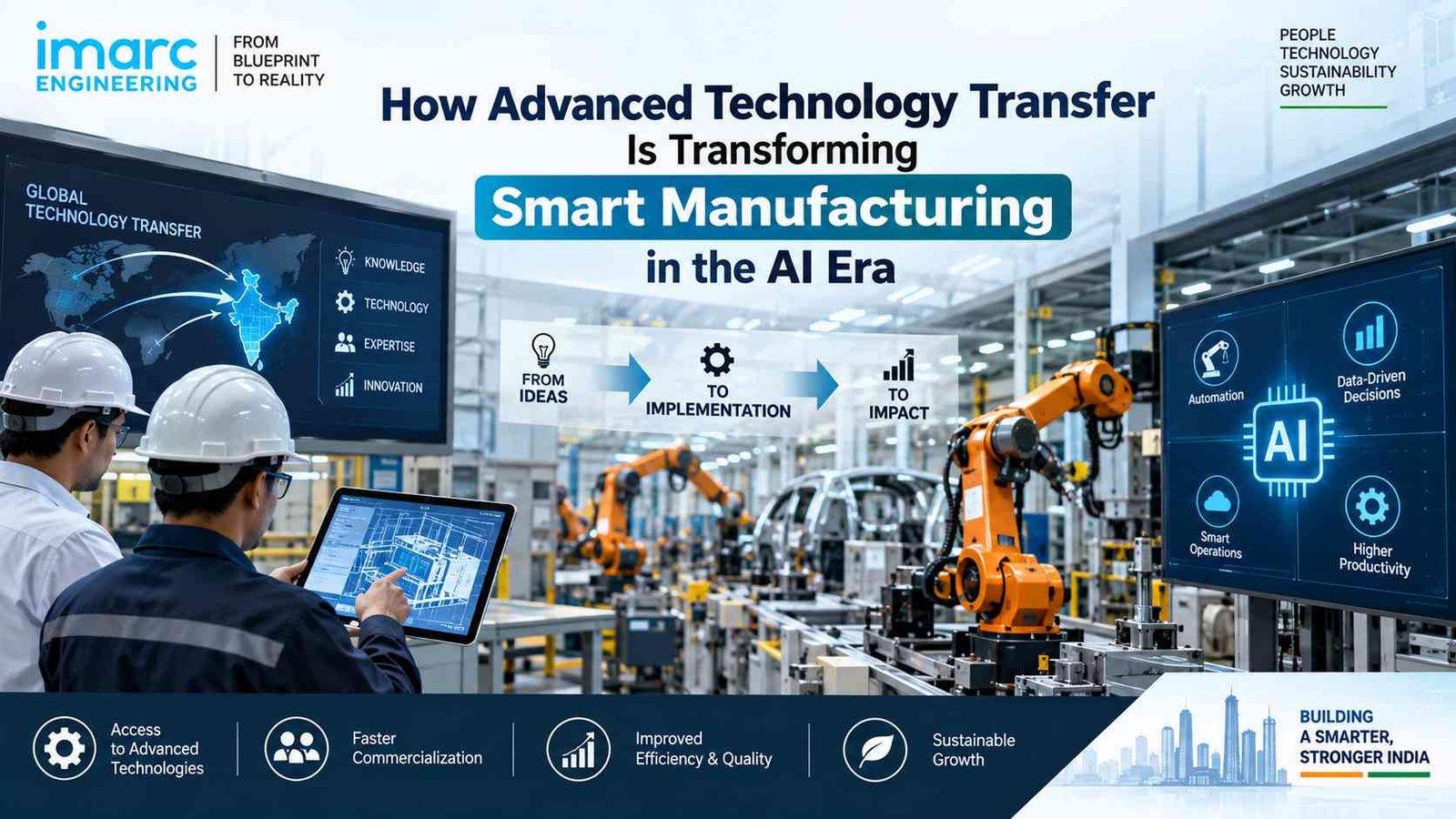
Manufacturing technology transfer used to mean handing over drawings, specifications, and a validated process. That definition no longer covers what actually moves between a sending site and an Indian receiving plant today.
Modern transfers increasingly carry a digital layer alongside the physical one, sensor architectures, predictive-maintenance models, digital twins, and AI-driven process controls that must be replicated with the same rigour as equipment and materials. Getting this layer wrong is now as costly as a failed validation batch.
This shift is exactly why structured advanced technology transfer has moved from a compliance checkbox to a board-level capability question. Manufacturers licensing global processes, or expanding domestic capacity with connected equipment, are discovering that the AI and data architecture embedded in modern production lines needs its own transfer protocol, separate from but integrated with the traditional process-transfer workflow.
The Numbers Behind India’s Smart Manufacturing Shift
The scale of investment flowing into AI-enabled manufacturing in India makes the case on its own.
- India’s Industry 4.0 market was valued at USD 14.20 billion in 2026, up from USD 12.80 billion in 2025, and is projected to reach USD 44.80 billion by 2034 at a 15.5% CAGR
- 54% of Indian manufacturing companies have already implemented AI and analytics technologies on the shop floor
- Indian manufacturers in the high-spending technology-investment bracket are spending 1.6 times more than the global average on smart manufacturing initiatives, according to a 2026 Rockwell Automation study
- The 14 active Production Linked Incentive (PLI) schemes had attracted ₹1.76 lakh crore in committed investment and created more than 12 lakh jobs as of March 2025
- Electronics production under PLI rose 146% between FY2021 and FY2025
- The Electronics Components Manufacturing Scheme (ECMS) outlay was raised from ₹22,919 crore to ₹40,000 crore in the Union Budget 2026-27
Each of these programmes assumes that the underlying technology, much of it AI-dependent, actually reaches the receiving plant intact and functioning. That assumption is where technology transfer discipline becomes decisive.
What Advanced Technology Transfer Now Moves
Traditional transfer protocols were built around product, process, analytical, and quality knowledge. AI-era transfers add a fifth domain: the data and algorithmic layer that increasingly runs the plant.
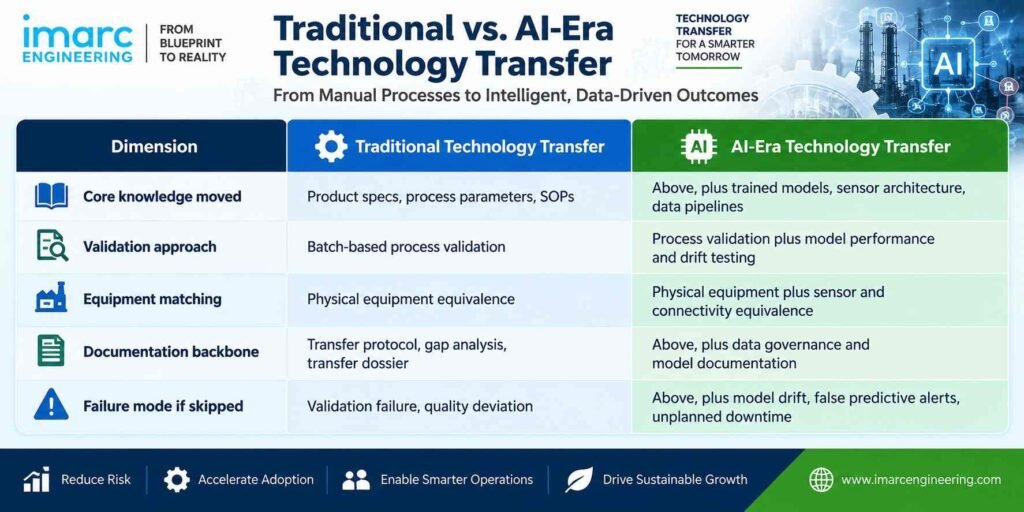
Recognising this fifth domain early prevents the most common new failure pattern: a receiving plant that reproduces the physical process correctly but cannot reproduce the predictive-maintenance or quality-inspection models that made the source plant efficient.
Where AI Is Changing the Transfer Calculus
AI adoption is reshaping specific stages of the classic seven-stage transfer process, not replacing it.
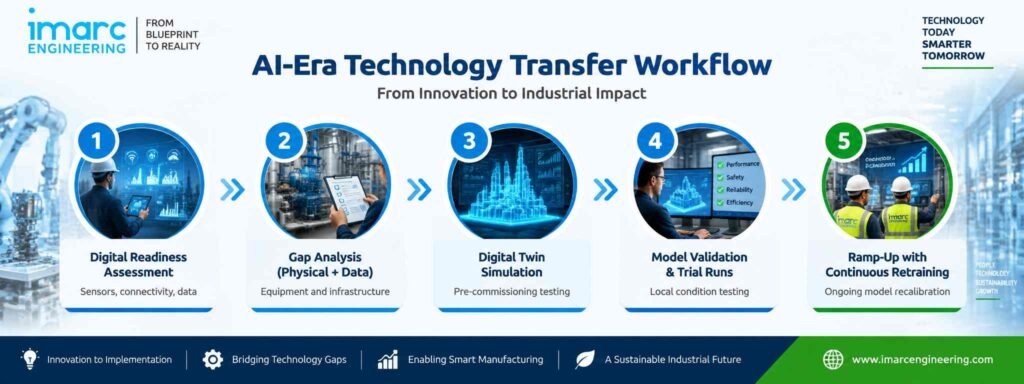
- Gap analysis now needs to cover data infrastructure, sensor density, and edge-computing capability alongside equipment and utilities
- Trial batches must validate model outputs against local operating conditions, not just physical process parameters, since a predictive-maintenance model trained on one plant’s vibration signatures does not automatically generalise to another
- Digital twins are increasingly used during the engineering stage to simulate the receiving plant’s process behaviour before physical commissioning, shortening the trial-and-error cycle
- Workforce training now spans both traditional process skills and the data-literacy needed to interpret AI-driven quality and maintenance alerts
- Post-transfer support periods are extending to cover model retraining cycles, since AI models degrade in accuracy over time and require periodic recalibration with local production data
A Structured AI-Era Transfer Workflow
Facilities pursuing smart manufacturing capability through technology transfer are converging on a common sequence that layers digital readiness on top of the conventional transfer stages.
Governance and Risk Considerations Specific to AI-Era Transfer
Transferring AI-dependent technology introduces risk categories that a purely mechanical transfer protocol does not anticipate.
- Model performance can degrade quickly when the receiving plant’s raw materials, ambient conditions, or equipment wear patterns differ from the source site, even when the physical process transfer was successful
- Intellectual property agreements need explicit clauses covering trained models, training data ownership, and algorithm licensing terms, not just patents and process know-how
- Cybersecurity requirements expand significantly once a plant runs connected sensors and cloud-linked analytics, since the attack surface grows with every additional data pipeline
- Vendor lock-in risk rises when proprietary AI platforms are transferred without adequate documentation of the underlying model logic and retraining procedures
- Workforce readiness gaps are frequently underestimated, operators need to trust and correctly interpret AI-generated alerts rather than override them out of habit
How IMARC Engineering’s Expertise Can Help in Advanced Technology Transfer
- Technology transfer protocol development and gap analysis that explicitly covers data infrastructure, sensor architecture, and connectivity readiness alongside physical equipment
- Plant layout and process flow design that integrates digital twin simulation and AI-driven monitoring points into the engineering package from the outset
- Equipment selection and technical specification drafting that matches both physical process equivalence and the sensor density needed for predictive-maintenance and quality-inspection models
- Regulatory and IP structuring support covering FEMA, FDI, and licensing agreements that explicitly address trained models and data ownership
- Workforce planning and technical staffing support that builds the combined process and data-literacy skills AI-era plants require
Consult With Our Team: https://www.imarcengineering.com/contact?service=technology-transfer
Conclusion
Technology transfer in India’s AI era is no longer a purely mechanical exercise of matching equipment and validating batches. Manufacturers that extend their transfer discipline to cover data architecture, model validation, and continuous retraining will capture the productivity gains driving India’s smart manufacturing investment, while those that treat AI as an add-on will keep discovering its gaps after commissioning, not before.
Contact Us:
IMARC Engineering
Phone: +91-120-433-0800
Email: sales@imarcengineering.com
India: C-130, Sector 2, Noida, Uttar Pradesh 201301
LinkedIn: https://www.linkedin.com/showcase/imarc-engineering/
About the Author