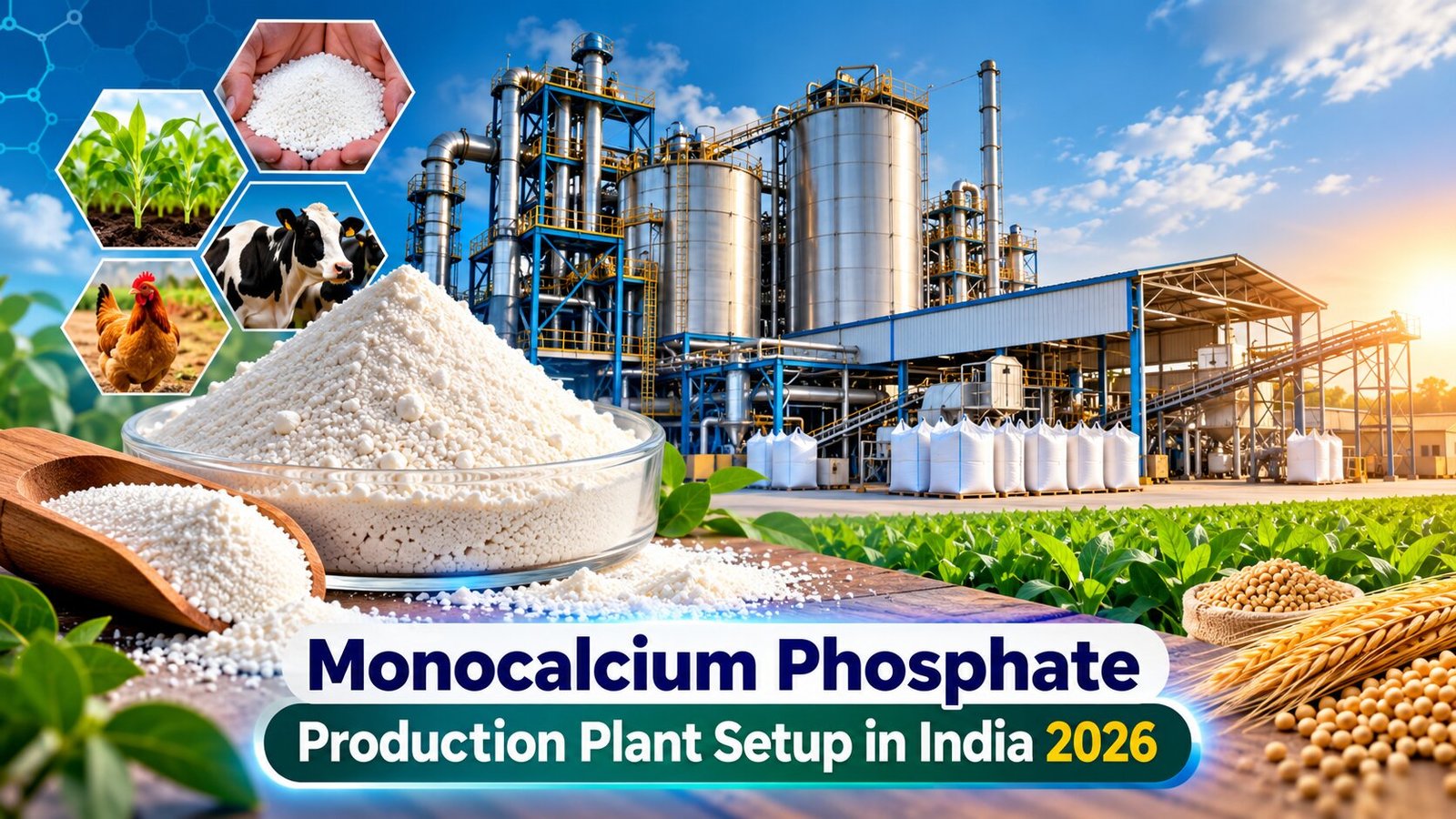
Setting up a monocalcium phosphate production plant in India presents a compelling investment case for investors targeting the animal nutrition and fertilizer value chains. Demand is driven by the animal feed, fertilizer, pharmaceutical, and food industries, with the rising need for phosphorus-based nutritional supplements in livestock and poultry adding momentum. Monocalcium phosphate (MCP) delivers essential phosphorus and calcium, which makes it critical to India’s agricultural and food economy.
India offers clear advantages for this type of investment. Rising urbanisation, expanding infrastructure, and the Make in India initiative support domestic chemical manufacturing, while a large livestock, poultry, and farming base sustains steady consumption. India is a strategically sound base for supplying feed and fertilizer producers with a reliable domestic source of MCP.
The investment case rests on policy support, cost-competitive production, and steady demand from animal feed and fertilizer sectors. Gross margins of 30–40% and net margins of 15–22% indicate healthy profitability, and break-even viability improves at higher capacity utilisation.
What is Monocalcium Phosphate?
Monocalcium phosphate (MCP) is a white crystalline powder that serves two main functions: it is a vital nutritional component for animal feed and a fundamental component of fertilizers. It delivers essential phosphorus and calcium, which animals need to support growth, bone development, and overall health. Its constant chemical composition, high solubility, and bioavailability make it suitable for industrial and agricultural purposes.
The production process begins with a chemical reaction between phosphate rock and sulfuric acid, followed by purification and drying stages. The ingredient enhances digestion and bone development in chickens, pigs, and cattle. The end-use industries served include animal feed, fertilizer, pharmaceutical, and food, where MCP is also used as a mineral supplement.
Cost of Setting Up a Monocalcium Phosphate Production Plant in India
The total cost of a monocalcium phosphate production plant depends on capacity, technology, location, automation, and regulatory compliance.
1. Capital Expenditure (CapEx)
Land and site development covers land registration, boundary development, and related charges, and investors can compare SEZ and industrial estate options for infrastructure access. Civil works include the production shed, laboratory, storage areas, and administrative block. Machinery accounts for the largest share of CapEx, and the scale of production and level of automation determine its total cost. Key machinery required includes:
- High-quality reactors
- Filtration units
- Dryers
- Grinders
- Sieves
- Packaging machines
Other capital costs include effluent treatment, pre-operative expenses, commissioning, and import duties where equipment is sourced abroad.
Request a Sample Report for In-Depth Market Insights: https://www.imarcgroup.com/monocalcium-phosphate-manufacturing-plant-project-report/requestsample
2. Operational Expenditure (OpEx)
Raw materials, particularly phosphate rock, account for 55–65% of total operating expenses. The requirement covers phosphate rock, phosphoric acid, calcium carbonate, and sulfuric acid, and long-term supplier contracts help stabilise pricing and secure steady supply. Utilities such as electricity, water, and steam account for 20–25% of OpEx. Other operating costs include transportation, packaging, salaries and wages, repairs and maintenance, depreciation, and taxes. By the fifth year, total operating costs are expected to rise substantially because of inflation, market fluctuations, supply chain disruptions, and higher material costs.
3. Plant Capacity
The proposed facility is designed for an annual production capacity of 20,000–50,000 tons, balancing economies of scale with operational flexibility. Capacity can be customised to investor requirements, and profitability improves with higher capacity utilisation. Starting at the lower end of the range allows investors to limit the initial outlay and expand output as demand and cash flows build.
4. Profit Margins and Financial Projections
Financial projections are built on realistic assumptions for capital investment, operating costs, capacity utilisation, pricing trends, and demand outlook. The project shows gross profit margins of 30–40% and net profit margins of 15–22%. Investors can assess viability through ROI, NPV, IRR, payback period, and the profit and loss account, which together show long-term sustainability.
Why Set Up a Monocalcium Phosphate Production Plant in India?
Rising Demand from Animal Nutrition. Growing livestock and poultry sectors require high-quality feed additives. Consumer awareness of the nutritional benefits of protein-rich animal products has also lifted demand for feed quality, which supports MCP production.
Expanding Fertilizer Market. Growing agricultural activity and soil fertility management efforts create new opportunities for MCP-based fertilizers. MCP delivers phosphorus and calcium in usable forms that enhance soil quality and agricultural yield.
Policy and Regulatory Tailwinds. The Make in India initiative encourages domestic manufacturing. IMARC’s report also reviews the regulatory landscape, financial assistance, and certifications, helping investors plan approvals.
Cost-Competitive Manufacturing. Production technology allows businesses to start at affordable costs and scale output as demand grows. Site selection near phosphate rock, phosphoric acid, calcium carbonate, and sulfuric acid supply keeps input and distribution costs low.
Active Industry Momentum. In 2025–2026, Punjab produced about 16.24 kg of foodgrain per kg of fertilizer, well above the national average of 11.05 kg. This efficient nutrient use supports agricultural productivity and is expected to drive demand for MCP in balanced fertilization strategies.
Local Supply Chain Preference. Feed and fertilizer producers benefit from nearby sources of phosphorus and calcium inputs, which reduces transportation costs and supply chain risk. A domestic plant also shortens delivery to local buyers.
Production Process – Step by Step
The MCP production process uses the reaction of phosphate rock with sulfuric acid as the primary production method:
- Reaction: Phosphate rock reacts with sulfuric acid in reactors.
- Filtration: Filtration units purify the reaction mixture.
- Neutralization: The mixture is neutralized to reach the required composition.
- Crystallization: MCP crystallizes from the purified solution.
- Drying: Dryers remove moisture from the crystals.
- Grinding: Grinders reduce the dried product to powder.
- Sieving: Sieves separate the powder to a uniform particle size.
- Packaging: Packaging machines prepare the product for dispatch to animal feed, fertilizer, food, and pharmaceutical customers.
Key Applications
Monocalcium phosphate serves four major industries:
- Animal Feed Industry: Supplies essential nutrients that support bone growth and phosphorus absorption in poultry, pigs, and cattle.
- Fertilizer Industry: Delivers phosphorus and calcium in usable forms, enhancing soil quality and agricultural yield.
- Food Industry: Functions as a leavening agent and a mineral strength additive.
- Pharmaceutical Industry: Provides dietary calcium and phosphorus in nutritional supplements.
Leading Manufacturers
The global monocalcium phosphate industry includes several multinational producers with extensive production capacities and diverse application portfolios:
- Mosaic Company
- PhosAgro
- Nutrien Ltd.
- Yara International ASA
- EuroChem Group
Timeline to Start the Plant
- Feasibility study and project report preparation
- Land acquisition and site development
- Regulatory approvals and environmental clearances
- Factory licence and fire safety compliance
- Machinery procurement and installation
- Raw material supplier agreements and supply chain setup
- Trial production and quality testing
- Commercial production launch
Licences and Regulatory Requirements
Starting a monocalcium phosphate production plant in India requires several approvals:
- Business registration (Proprietorship, LLP, or Pvt Ltd)
- Factory Licence under the Factories Act
- Environmental Clearance from State Pollution Control Board
- GST Registration
- Fire Safety NOC
- Hazardous/chemical compliance for sulfuric acid handling
- Effluent Treatment Plant (ETP) operational clearance
- Occupational Health and Safety compliance
Key Challenges to Consider
- High Capital Requirements: Machinery, land, and site development demand substantial upfront funding.
- Raw Material Price Volatility: Phosphate rock, phosphoric acid, calcium carbonate, and sulfuric acid drive costs, and long-term contracts help manage price swings.
- Regulatory Compliance: Zoning, environmental, and emission rules must be met, with effluent treatment systems in place.
- Competition: Established players such as Mosaic Company, PhosAgro, Nutrien Ltd., Yara International ASA, and EuroChem Group operate at large scale.
- Skilled Manpower: Safe handling, leak detection, and quality assurance need trained staff.
Frequently Asked Questions
1. How much does it cost to set up a monocalcium phosphate production plant in India?
Cost depends on capacity, technology, and location. Machinery forms the largest share of CapEx, and the detailed breakdown is in the report.
2. Is MCP production profitable in India in 2026?
The project shows gross margins of 30–40% and net margins of 15–22% under normal operating conditions.
3. What machinery is required for an MCP plant in India?
High-quality reactors, filtration units, dryers, grinders, sieves, and packaging machines.
4. What licences and approvals are required to start an MCP plant in India?
Business registration, Factory Licence, environmental clearance, GST registration, Fire Safety NOC, chemical compliance, ETP clearance, and occupational safety compliance.
5. What raw materials are needed for MCP production? Phosphate rock, phosphoric acid, calcium carbonate, and sulfuric acid.
6. What are the environmental compliance requirements for an MCP plant in India?
Effluent treatment systems, adherence to emission standards, and compliance with local zoning and environmental regulations.
7. What is the best location to set up an MCP plant in India?
A site with easy access to phosphate rock, phosphoric acid, calcium carbonate, and sulfuric acid, close to target markets, with reliable transport, utilities, and waste management.
8. What is the break-even period for this type of plant in India?
It depends on capacity utilisation and costs, and the report’s payback analysis covers the timeline in detail.
9. What government incentives are available for manufacturers in India?
Incentives vary by state and project, and the report covers financial assistance and regulatory requirements.
Key Takeaways for Investors
A monocalcium phosphate production plant investment draws on demand from animal feed, fertilizer, pharmaceutical, and food industries. Financial viability holds across capacities of 20,000–50,000 tons per year, with 30–40% gross margins and 15–22% net margins, and scalable production lets investors enter at affordable cost and expand over time. The global monocalcium phosphate market was valued at USD 1.10 Billion in 2025 and is expected to reach USD 1.57 Billion by 2034, growing at a CAGR of 4.0% from 2026 to 2034. With livestock, poultry, and sustainable farming needs continuing to grow, demand for MCP looks set to remain durable.
About the Author