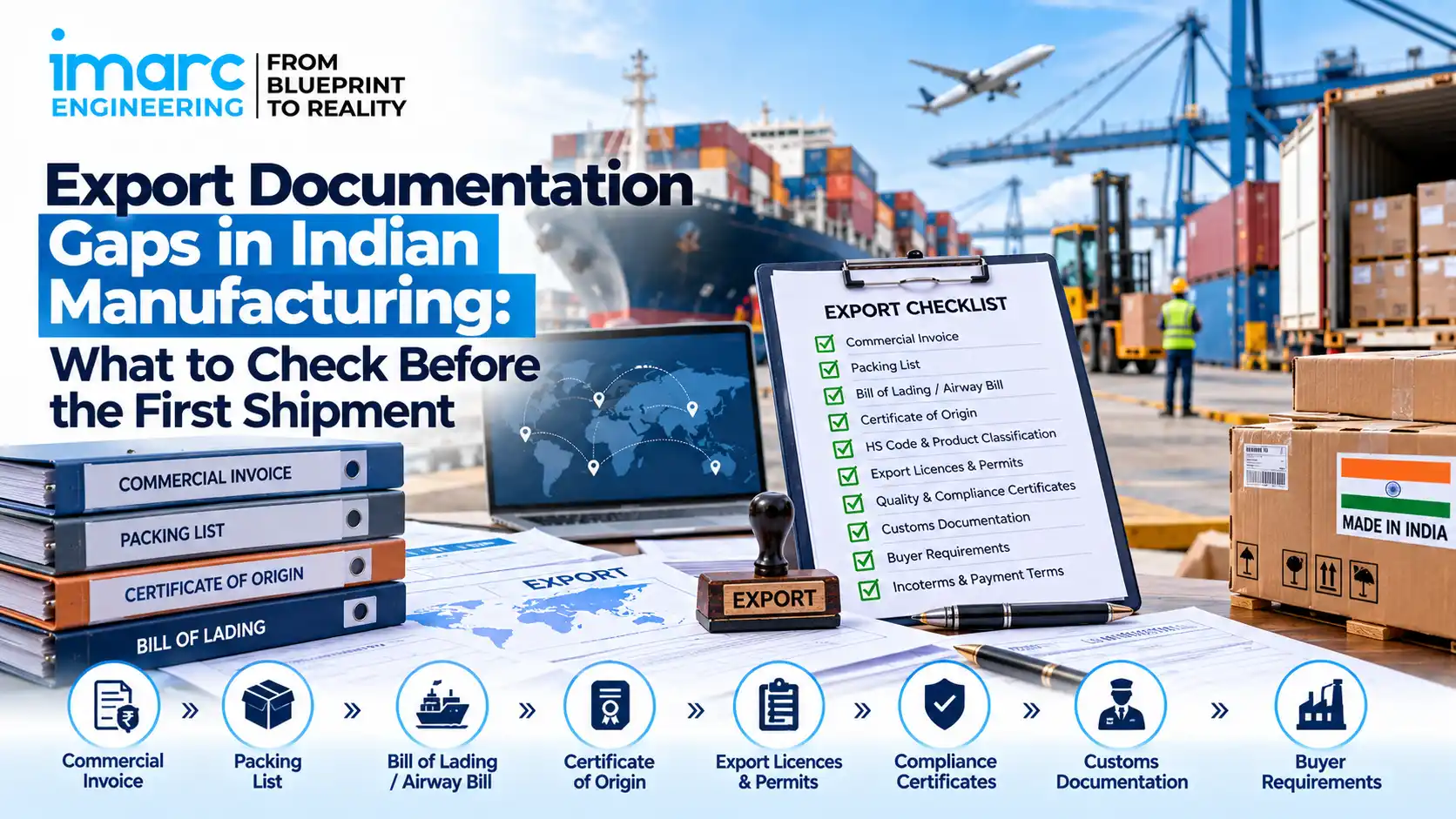
Documentation problems rarely announce themselves early. They surface days before dispatch, when a buyer queries a description, a declaration disagrees with an invoice, or a certificate has lapsed. A manufacturer can hold every major document and still have gaps: details differ between documents, certificates are outdated, product requirements were never mapped, destination rules were missed, technical files no longer match the product, or buyer-specific papers were not prepared.
An export documentation gap assessment solves this systematically. It compares what a shipment needs with what the company holds, then tests those documents for consistency and currency. Manufacturers wanting structured support can explore Compliance & Documentation Strategy Development as part of a wider export-readiness programme. This guide shows how to run the checks.
What Are Export Documentation Gaps?
| Quick answer: Export documentation gaps are differences between the documents a shipment requires and those the manufacturer holds, or between documents that should agree but do not. They include missing, outdated, inconsistent or inapplicable paperwork, best found before cargo is booked. |
Typical examples:
- Invoice and packing-list mismatch in quantity or weight
- Incorrect product description compared with the datasheet
- Outdated certification
- Missing test report
- Destination-specific documentation never identified
- Technical specification differing from the product shipped
- Buyer-required documents not prepared
Why Export Documentation Readiness Matters Before the First Shipment
A gap does not automatically stop a shipment, but it adds friction:
- Customs processing: inconsistent declarations can trigger queries.
- Buyer acceptance: papers differing from the order or specification can delay acceptance.
- Regulatory compliance: missing approvals create exposure.
- Timelines and rework: late corrections cost time.
- Market-entry readiness: a first shipment shapes buyer confidence.
Mandatory vs Product-Specific Export Documents
| Quick answer: Chapter 2 of the Foreign Trade Policy (para 2.06), published by DGFT, lists three mandatory export documents: Bill of Lading/Airway Bill (or equivalent transport receipt), Commercial Invoice cum Packing List, and Shipping Bill/Bill of Export. Separate invoice and packing list are also accepted. Other documents apply only where product, destination or regulation requires. |
Verify the current text on dgft.gov.in. Think in five layers:
- Core export documentation: the three documents above. Exporters also generally need a valid IEC, unless specifically exempted.
- Product-specific documentation: regulators may notify additional documents for regulated goods, so certificates and inspection documents apply where applicable.
- Destination-country requirements: importing-market rules, labelling and registrations.
- Buyer-specific documentation: purchase-order, letter-of-credit or quality conditions.
- Technical and quality support: datasheets, test reports and calibration records.
A Certificate of Origin is required only where applicable. Since 1 January 2025, non-preferential certificates must be applied for online through DGFT’s eCoO platform; preferential certificates support tariff concessions under trade agreements.
10 Common Export Documentation Gaps in Indian Manufacturing
1. Incorrect or outdated exporter details
What it means: Name, address, IEC, GSTIN or bank details differ between documents. Why it happens: Changes reach some records only. Check: Match IEC, GST and bank records against every export template.
2. Product description mismatch
What it means: Invoice, shipping bill, certificates and datasheet describe the product differently. Why it happens: Teams use their own naming. Check: Approve one description per product, with model and grade, and reuse it everywhere.
3. HS classification issues
What it means: The tariff code is inconsistent or unsupported. Why it happens: Codes are copied from earlier shipments or similar variants. Check: Record the classification basis, compare with the destination tariff, and confirm uncertain cases with your customs broker.
4. Invoice and packing-list inconsistencies
What it means: Quantities, package counts, weights or values do not reconcile. Why it happens: Different teams prepare them separately. Check: Reconcile both against production and actual packing, including units and net/gross weights.
5. Shipping-document inconsistencies
What it means: Transport document or shipping bill details deviate from the invoice. Why it happens: Consignee or booking details change late. Check: Review the draft transport document against invoice and shipping bill.
6. Missing or incorrect origin documentation
What it means: Origin evidence is absent or unsupported where required. Why it happens: One certificate is assumed to suit every market. Check: Confirm whether a certificate is needed, which type, and retain supporting manufacturing records.
7. Missing product-specific certification
What it means: Required approvals are not held. Why it happens: Domestic compliance is assumed to be enough. Check: Map the product to applicable standards and regulators; confirm certificate scope covers the exact model.
8. Destination-country compliance gaps
What it means: Labelling, packaging, testing or registration rules were not addressed. Why it happens: A checklist from another market was reused. Check: Verify with the buyer and destination authority rules.
9. Expired or outdated supporting documents
What it means: Test reports, certificates or specifications have lapsed or been superseded. Why it happens: Validity dates are not tracked. Check: Log expiry dates and revision numbers against the current product.
10. Poor document control and ownership
What it means: Nobody is accountable for the final document set. Why it happens: Documents sit across several departments. Check: Assign a named owner, controlled templates and sign-off.
How to Conduct an Export Documentation Gap Assessment
| Quick answer: A manufacturer can run an export documentation gap assessment by defining the target market and product requirements, building a required-document matrix, comparing it with documents held, checking consistency and validity, closing critical gaps, and completing a final review before shipment. |
Step 1: Identify the target export market. Confirm country, buyer, delivery terms and any relevant trade agreement.
Step 2: Identify product-specific requirements. Establish classification, regulators, standards, testing and labelling.
Step 3: Build a required-document matrix. List each document, its requirement source, whether mandatory or conditional, and owner.
Step 4: Compare required against available documents. Mark each as available, outdated, missing or not applicable.
Step 5: Check consistency across documents. Cross-check names, descriptions, codes, quantities, weights and values.
Step 6: Verify validity, versions and supporting evidence. Confirm expiry dates, certificate scope and supporting test records.
Step 7: Close critical documentation gaps. Prioritise by shipment impact, then correct, reissue or obtain documents.
Step 8: Conduct a final pre-shipment review. Have an independent reviewer re-check the final set before filing.
Export Documentation Gap Assessment Table
| Documentation Area | What to Check | Common Gap |
|---|---|---|
| Exporter Details | Entity and exporter information | Outdated/inconsistent details |
| Commercial Invoice | Product, quantity, value and buyer information | Data mismatch |
| Packing List | Packages, quantity and weight | Shipment inconsistency |
| Shipping Bill | Declaration and classification | Incorrect information |
| Transport Document | Consignment details | Mismatch with commercial documents |
| Certificate of Origin | Applicability and origin details | Missing/incorrect evidence |
| Product Compliance | Applicable certifications | Missing certification |
| Testing/Inspection | Buyer or regulatory requirements | Missing reports |
| Labelling | Destination requirements | Non-compliant information |
| Technical Documents | Current specifications and evidence | Outdated documentation |
Why Destination-Country Requirements Matter
| Quick answer: Requirements vary because each importing country sets its own regulations, standards, labelling, testing and customs rules, and buyers add contractual conditions. A checklist built for one market can miss mandatory items in another, so each new destination needs its own requirement check. |
Check regulations, product standards, certification, labelling, packaging, testing, buyer requirements and, where applicable, preferential origin rules. Examples only, not universal requirements: electrical or machinery products may need conformity marking or technical files in some markets; food products may need sanitary documentation; textiles may face fibre-content labelling rules; goods claiming concessions under a trade agreement need origin evidence in the prescribed form.
8-Point Pre-Shipment Export Documentation Checklist
- Exporter details verified, so every document carries the same legal identity.
- Product and HS classification reviewed, to keep declarations consistent.
- Invoice and packing list cross-checked, because they feed customs and transport filings.
- Shipping documentation reviewed, to catch consignee or weight deviations.
- Required certificates and testing verified, for validity and scope.
- Destination-country requirements checked, since rules differ by market.
- Buyer-specific documents completed, to avoid acceptance delays.
- Final pre-shipment document review completed, as the last control point.
Common Mistakes Manufacturers Make
- Preparing documents only at the last moment
- Using an old document template
- Assuming domestic compliance equals export compliance
- Copying documentation from another market
- Ignoring buyer-specific requirements
- Failing to cross-check information across documents
- Not assigning documentation ownership
- Failing to review changes in product or destination requirements
How IMARC Engineering Can Support Export Readiness
IMARC Engineering’s Export Readiness Consulting supports manufacturers with export capability assessment, documentation gap identification, compliance mapping, product certification requirements, export documentation systems, an implementation roadmap and international market-entry readiness. Its methodology evaluates compliance, documentation systems, product certifications, operational capabilities and market-entry requirements. IMARC Engineering does not issue government certificates or replace statutory authorities or certification bodies.
Preparing your manufacturing business for export? Talk to IMARC Engineering for export readiness assessment, compliance gap identification and documentation strategy support: https://www.imarcengineering.com/contact?service=export-readiness-consulting
Conclusion
Export documentation readiness is not simply collecting documents. A shipment is better prepared when documents are applicable, current, consistent, supported by evidence, and aligned with the actual product and destination requirements.Infographic Concept.
Contact Us:
IMARC Engineering
Phone: +91-120-433-0800
Email: sales@imarcengineering.com
India: C-130, Sector 2, Noida, Uttar Pradesh 201301
LinkedIn: https://www.linkedin.com/showcase/imarc-engineering/
About the Author