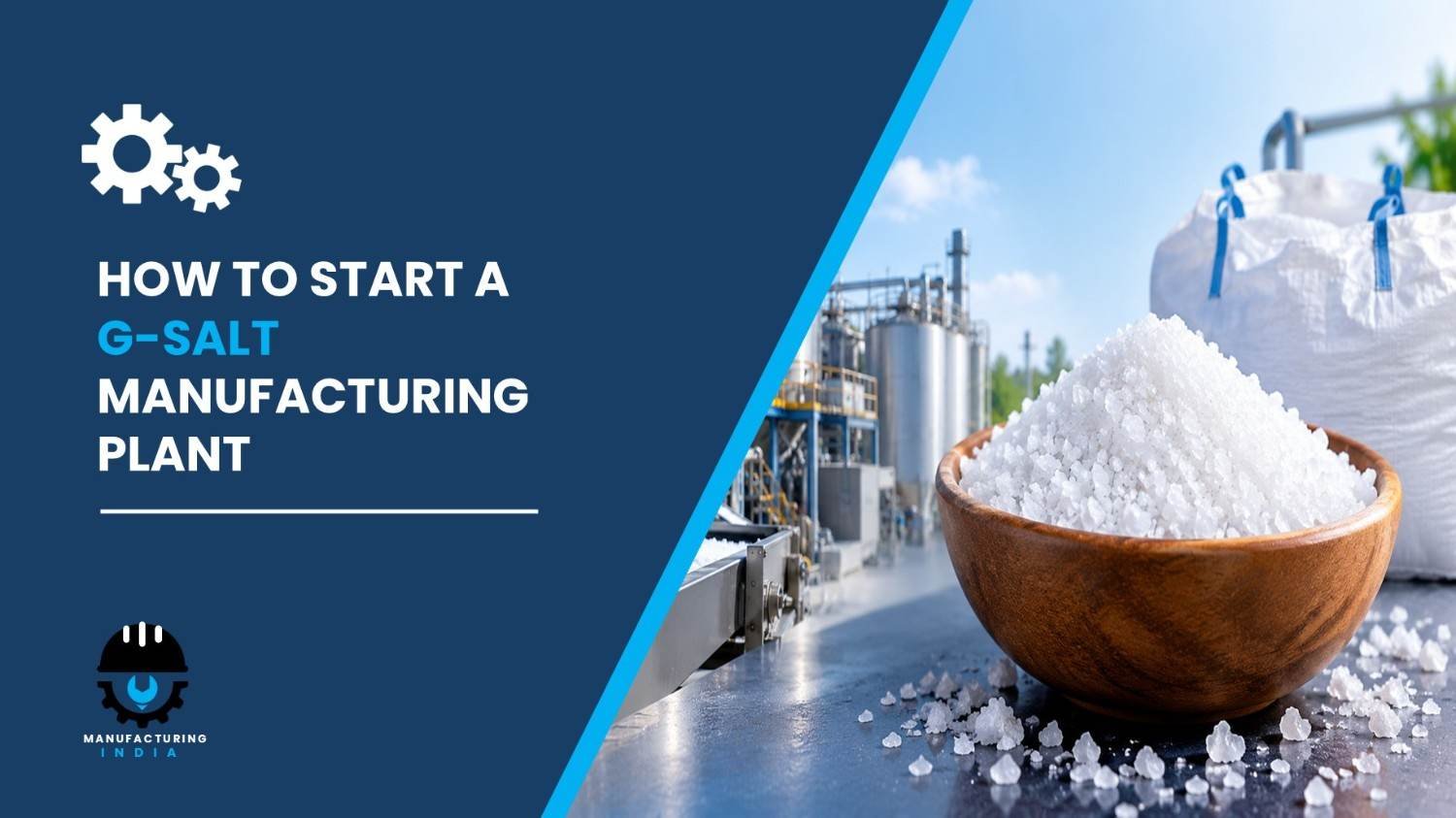
A g-salt manufacturing plant setup in India presents a compelling investment case for entrepreneurs seeking exposure to an essential industrial input. Demand is driven by industrial water treatment, chemical processing, pharmaceuticals, food preservation and agriculture. G-salt is a high-purity inorganic salt, and these sectors rely on it as a chemical intermediate, a buffering and stabilizing agent, a preservation and formulation aid and a water conditioning compound, which explains its importance to India’s industrial economy.
The Indian demand backdrop is encouraging. The International Trade Administration (ITA) places the growth of India’s water and wastewater treatment market at a 9.7% CAGR in 2025, pointing to rising use of chemical salts for water conditioning, buffering and treatment across municipal and industrial applications. Pharmaceutical expansion adds further pull. Local production also cuts transportation costs and gives industrial customers quick access to supply, which makes India a strategically sound base for g-salt production.
The case for g-salt in India rests on a stable, multi-sector demand base, with gross profit margins of 25-35% and net profit margins of 10-15% under normal operating conditions. A 50,000 metric tons per year design supports economies of scale, while local supply gives a freight advantage. Detailed payback and NPV analysis then confirms whether break-even is viable for a given plant configuration.
What is G-Salt?
G-Salt is a high-purity inorganic salt manufactured through controlled chemical synthesis or refined extraction processes to meet industrial and specialty-grade specifications. It is characterized by a stable crystalline structure, high solubility in water, consistent particle size distribution and low impurity levels. Depending on grade, it can be produced with controlled moisture content and tailored granulation.
The g-salt manufacturing process combines purification and filtration, controlled crystallization, centrifugation and drying. The product serves chemical manufacturing, pharmaceuticals, food processing, water treatment and agriculture, where precision-driven applications demand consistent purity and particle size.
Cost of Setting Up a G-Salt Manufacturing Plant in India
The g-salt manufacturing plant cost depends on capacity, technology, location, automation level and regulatory compliance.
1. Capital Expenditure (CapEx)
Land and site development covers land registration, boundary development and related charges, and investors can evaluate industrial estate or special economic zone options based on raw material access and infrastructure. Civil works cover the production shed, quality control laboratory, storage areas and administrative block. Machinery accounts for the largest share of total capital expenditure for a g-salt manufacturing plant, and the scale of production and level of automation determine the final machinery cost.
Key machinery required includes:
- Dissolution tanks
- Filtration units
- Crystallizers
- Centrifuges
- Fluidized bed or rotary dryers
- Sieving and packing machines
All equipment should be corrosion-resistant. Other capital costs include effluent treatment systems, pre-operative expenses and commissioning.
Request a Sample Report for In-Depth Market Insights: https://www.imarcgroup.com/g-salt-manufacturing-plant-project-report/requestsample
2. Operational Expenditure (OpEx)
Raw materials are the largest operating cost, accounting for approximately 65-75% of total OpEx. The inputs are 2-naphthol, sulfuric acid / oleum, potassium chloride and brine solution. Long-term contracts with reliable, nearby suppliers help stabilize pricing and secure steady supply. Utilities such as electricity, water and steam account for 5-10% of OpEx. Other operating costs include transportation, packaging, salaries and wages, repairs and maintenance, depreciation and taxes. By the fifth year, total operating cost is expected to increase substantially because of inflation, market fluctuations, higher key material costs and supply chain disruptions.
3. Plant Capacity
The proposed g-salt manufacturing plant is designed for an annual production capacity of 50,000 metric tons per year, which enables economies of scale while preserving operational flexibility. Capacity can be customized to investor requirements, and profitability improves with higher capacity utilisation.
4. Profit Margins and Financial Projections
A g-salt manufacturing plant typically earns gross profit margins ranging between 25-35%, supported by stable demand and value-added applications, while net profit margins range between 10-15%. The financial analysis covers NPV, IRR, payback period, ROI, profitability, liquidity, sensitivity and uncertainty analysis.
Why Set Up a G-Salt Plant in India?
Water and wastewater treatment growth: ITA places India’s water and wastewater treatment market at a 9.7% CAGR in 2025. This expansion raises demand for chemical salts used in water conditioning, buffering and treatment across municipal and industrial applications.
Pharmaceutical expansion: Growth in pharmaceutical manufacturing, especially drug formulation and API production, supports consumption of g-salt as an excipient and laboratory reagent input.
Quality-driven supply contracts: Producers that prioritize purity uniformity and particle size control are often granted long-term supply contracts with the most demanding industries.
Broad end-use diversity: Chemical, pharmaceutical, food processing, water treatment and agricultural customers reduce dependence on any single sector.
Active industry investment: In June 2025, DuPont announced its FilmTec membrane innovations, used in the Foshan Jialida Dyeing Minimal Liquid Discharge project in China, which was named industrial water project of the year at the 2025 global water awards. The plant uses RO, NF and UF systems to reclaim wastewater and recover sodium chloride brine and Glauber’s salt (G-salt).
Local supply chain preference: Local production cuts transportation costs and ensures industrial customers receive supply quickly.
Manufacturing Process: Step by Step
The g-salt manufacturing process uses purification and filtration, controlled crystallization, centrifugation and drying as the primary production method.
- Raw material preparation: 2-naphthol, sulfuric acid / oleum, potassium chloride and brine solution are received, stored and dissolved in dissolution tanks.
- Purification and filtration: Filtration units remove impurities to achieve low impurity levels.
- Controlled crystallization: Crystallizers produce the stable crystalline structure and consistent particle size distribution.
- Centrifugation: Centrifuges separate the crystals from the liquor.
- Drying: Fluidized bed or rotary dryers bring the product to the required moisture content.
- Sieving and packing: Sieving and packing machines grade the product and prepare it for dispatch.
- Quality testing: Analytical instruments monitor concentration, purity and stability, with documentation for traceability.
- Dispatch: Packed g-salt is dispatched to chemical, pharmaceutical, food processing, water treatment and agricultural customers.
Key Applications
G-salt serves five major industries.
- Chemical Industry: Process intermediary, reaction stabilizer and pH-adjusting agent.
- Pharmaceutical Industry: Drug formulations, excipients and laboratory reagents.
- Food Processing Industry: Preservation, flavour balancing and processing stabilization.
- Water Treatment Industry: Hardness control, ion exchange processes and making water fit for industrial uses.
- Agriculture: Micronutrient formulations and soil treatment solutions under government-prescribed controls.
Leading Manufacturers
The global g-salt industry includes several multinational companies with extensive production capacities and diverse application portfolios. Key players include:
- XinLi Chemical
- Alkim Alkali Kimya
- MINERA DE SANTA MARTA
- LENZING
- Jiangsu Jingshen Salt & Chemical Industry Co.
- Sichuan Xinxing Chemical
- JSC Kuchuksulphate
- Sichuan Meishan Tianhe Chemical Co
Timeline to Start the Plant
- Feasibility study and project report preparation
- Land acquisition and site development
- Regulatory approvals and environmental clearances
- Factory licence and fire safety compliance
- Machinery procurement and installation
- Raw material supplier agreements and supply chain setup
- Trial production and quality testing
- Commercial production launch
Licences and Regulatory Requirements
Starting a g-salt manufacturing unit in India requires several approvals:
- Business registration (Proprietorship, LLP, or Pvt Ltd)
- Factory Licence under the Factories Act
- Environmental Clearance from State Pollution Control Board
- GST Registration
- Fire Safety NOC
- Hazardous/Chemical compliance, relevant given the use of sulfuric acid / oleum
- Effluent Treatment Plant (ETP) operational clearance
- Occupational Health and Safety compliance
Key Challenges to Consider
- High Capital Requirements: A g-salt manufacturing plant needs heavy upfront funding, and machinery takes the largest share of CapEx, and land, civil works and corrosion-resistant equipment add to the upfront commitment.
- Raw Material Price Volatility: 2-naphthol, sulfuric acid / oleum, potassium chloride and brine solution make up 65-75% of OpEx, so price swings directly affect margins.
- Regulatory Compliance: Safety protocols, leak-detection monitoring, effluent treatment and emission standards must be met throughout the g-salt manufacturing process.
- Quality and Traceability Pressure: Regulators require quality consistency and traceability, so purity, concentration and stability must be monitored and documented.
- Competition: Established players such as XinLi Chemical, Alkim Alkali Kimya, LENZING and Sichuan Xinxing Chemical compete across the same end-use sectors.
- Skilled Manpower: Crystallization, filtration and drying operations need trained staff.
Frequently Asked Questions
How much does it cost to set up a g-salt manufacturing plant in India?
The cost depends on capacity, technology and location, covering land and site development, civil works, machinery and other capital costs. Detailed CapEx figures are available in the IMARC Group report through the sample request.
Is g-salt manufacturing profitable in India in 2026?
Under normal operating conditions, gross profit margins typically range between 25-35% and net profit margins between 10-15%, supported by stable demand and value-added applications.
What machinery is required for a g-salt plant in India?
Dissolution tanks, filtration units, crystallizers, centrifuges, fluidized bed or rotary dryers, and sieving and packing machines.
What licences and approvals are required to start a g-salt manufacturing plant in India?
Business registration, Factory Licence, Environmental Clearance from the State Pollution Control Board, GST Registration, Fire Safety NOC, chemical compliance, ETP clearance and occupational health and safety compliance.
What raw materials are needed for g-salt manufacturing?
2-naphthol, sulfuric acid / oleum, potassium chloride and brine solution, which together account for 65-75% of OpEx.
What are the environmental compliance requirements for a g-salt plant in India?
Effluent treatment systems are necessary to minimize environmental impact, and the unit must meet emission standards, local zoning laws and environmental regulations, with monitoring systems to detect leaks or deviations.
What is the best location to set up a g-salt plant in India?
The site should offer easy access to raw materials, proximity to target markets, reliable transportation, utilities and waste management, and compliance with zoning and environmental rules.
What is the break-even period for this type of plant in India?
The report covers payback period, NPV and IRR through its financial analysis. Specific break-even figures are part of the detailed report.
What government incentives are available for manufacturers in India?
The IMARC Group feasibility study addresses regulatory procedures, financial assistance and necessary certifications. Specific schemes should be confirmed through the detailed report.
Key Takeaways for Investors
The g-salt opportunity is anchored in water treatment, chemical processing, pharmaceuticals, food processing and agriculture, which together offer broad and resilient demand. The financial viability of a g-salt manufacturing plant is supported by gross profit margins of 25-35% and net profit margins of 10-15% for a facility designed around 50,000 metric tons per year, with higher utilisation improving returns. India’s water and wastewater treatment market at a 9.7% CAGR in 2025 signals strong sector momentum. With purity-driven contracts and continuing expansion in pharmaceuticals and treatment infrastructure, demand for g-salt should remain sustainable.
About the Author