Lithium-ion battery recycling in India is moving from policy promise to operating reality. Electric vehicles reached 8.5% of total vehicle sales in FY2025-26, so the batteries that will feed recyclers are already on the road.
Yet three problems stall most projects: unreliable feedstock, fire and chemical safety, and a tightening compliance regime. Any one of them can sink returns even when the recovery technology performs well.
A realistic lithium-ion battery recycling plant setup treats all three as design inputs, not afterthoughts. This article explains how businesses can overcome each one using the latest 2026 data.
“Short answer: Businesses overcome feedstock, safety and compliance challenges by contracting feedstock before sizing the plant, designing zoned and fire-protected layouts for discharge and shredding, and securing hazardous waste authorisation and EPR registration ahead of civil construction.”
Why Is Feedstock the Biggest Constraint for Battery Recyclers?
Feedstock security, more than processing capacity, decides whether a plant reaches stable operation. Collection networks are still dispersed, and several structural gaps compound the problem:
- Volumes are still building: EV batteries typically serve 5 to 8 years before replacement, so end-of-life supply lags today’s sales.
- Chemistry is shifting: LFP batteries are over 40% cheaper than NMC, so more feedstock carries less valuable metal content.
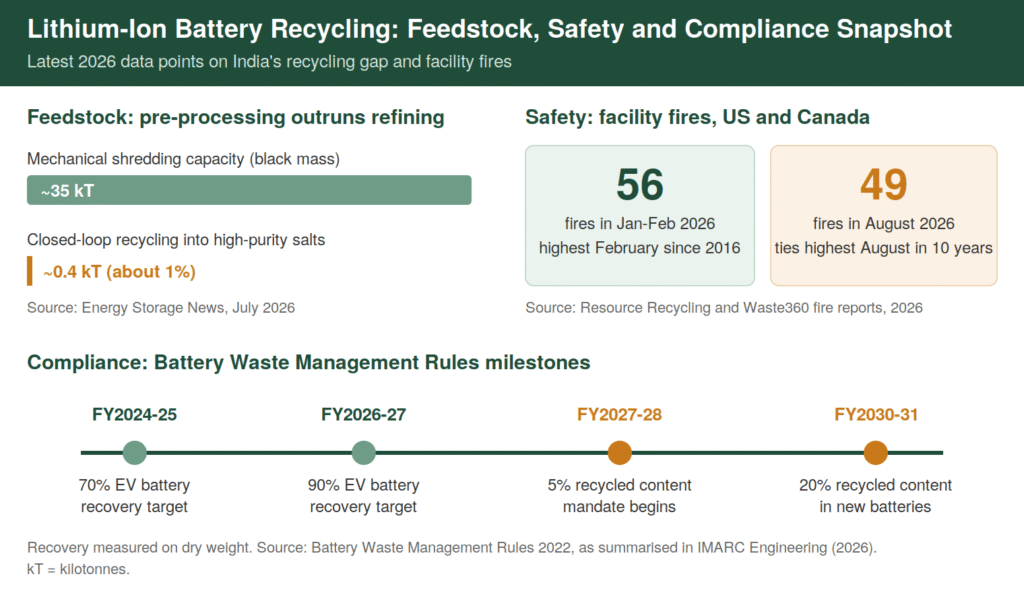
- Processing stops early: as the infographic shows, pre-processing capacity far exceeds domestic refining into battery-grade salts.
- Export is restricted: black mass is hazardous waste, so shipments face transboundary movement controls.
- Cash is tied up: damaged or swollen cells need extended quarantine and controlled discharge before processing.
How Can Businesses Secure Reliable Feedstock?
- Sign structured offtake agreements: contract with EV OEMs, battery makers and Producer Responsibility Organisations, specifying chemistry, format, minimum volumes and pricing linked to critical mineral reference prices.
- Start with manufacturing scrap: cell and pack assembly rejects are the most predictable near-term input because they bypass dispersed end-user collection.
- Triage before recycling: test state of health so batteries with usable capacity move to second-life storage and only spent cells enter the line.
- Build safe reverse logistics: use damage-resistant, fire-retardant packaging, hazardous-goods trained drivers and documented chain of custody.
- Confirm chemistry before machinery: a line tuned for one chemistry can underperform materially when the actual mix changes.
- Phase capacity: commission a first line sized to contracted volume, with civil and utility headroom for expansion.
How Can Recyclers Control Fire and Thermal Runaway Risk?
Fire is the most significant hazard in any battery plant. Fire trackers in the US and Canada logged peak monthly counts at waste and recycling facilities in 2026, and lithium-ion batteries are the leading cause. Indian recyclers can design these risks out from day one:
- Zone the plant: separate receipt and discharge, dismantling and shredding, and hydrometallurgical processing, each with independent ventilation, suppression and containment.
- Shred under inert atmosphere: a nitrogen supply prevents thermal runaway during mechanical processing.
- Monitor and quarantine: use thermal imaging at storage and process areas, and keep damaged or swollen cells in physically segregated storage.
- Specify the right suppression: choose systems suited to lithium battery fires and coordinate an emergency plan with the local fire department.
- Protect workers: provide acid-resistant gloves and aprons, respiratory protection and arc-flash rated equipment, backed by documented training.
- Use a reference standard: AIS-156 safety principles strengthen handling protocols and audit readiness.
Watch the video to understand the key steps involved for a recycling plant: https://www.youtube.com/watch?v=AYtu4ibsC4w&t=187s
Which Compliance Requirements Shape a Recycler’s Plan?
The Battery Waste Management Rules, notified on 22 August 2022, place collection and recycling duties on producers, who buy EPR certificates from registered recyclers. That creates demand, but it also sets conditions a plant must meet:
- Recovery targets: the process and reporting systems must prove recovery performance, measured on dry weight, against the rising thresholds shown in the infographic.
- Collection pressure: producers must reach 70% collection of EV batteries placed in the market by FY2027-28, which increases demand for compliant capacity.
- Hazardous waste authorisation: the State Pollution Control Board must grant it within 120 days of a complete application after site inspection, valid for five years.
- Environmental Clearance: it applies only above scale and site-sensitivity thresholds, and common hazardous waste facilities fall under Category A.
- Quarterly reporting: returns on processed volumes and recovery outcomes are filed through the centralised EPR portal.
- Penalties: serious violations can attract imprisonment of up to five years, a fine of up to INR 100,000, or both under Section 15 of the Environment (Protection) Act, 1986.
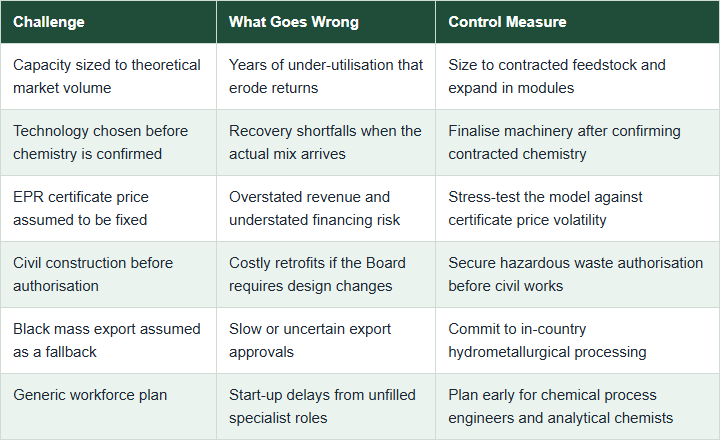
Common Recycling Plant Challenges and How to Control Them
How IMARC Engineering’s Expertise Can Help in Lithium-Ion Battery Recycling Plant Setup
- Feasibility studies and detailed project reports covering feedstock, mass balance and financial projections.
- Technology and machinery selection matched to the contracted battery chemistry mix.
- Plant layout, utility and fire safety system design with zoned risk control.
- Coordination of EPR registration, hazardous waste authorisation and Environmental Clearance.
- End-to-end project management from site selection through commissioning.
Get in Touch With Our Team: https://www.imarcengineering.com/contact-us
Conclusion
Feedstock, safety and compliance are connected risks, not separate workstreams. A plant sized to contracted supply, laid out for fire containment and sequenced behind its approvals is far less likely to stall. As recovery targets and recycled-content mandates tighten, recyclers that deliver reliable battery-grade output will command stronger offtake terms, and those that plan these three risks early will lead that market.
Frequently Asked Questions
What is the biggest challenge in lithium-ion battery recycling?
Feedstock security is usually the binding constraint, since collection is dispersed and end-of-life volumes are still building.
How can a recycler reduce fire risk?
Use zoned layouts, inert-atmosphere shredding, thermal imaging, segregated quarantine for damaged cells and suppression systems designed for lithium battery fires.
Which approvals does a battery recycling plant need?
CPCB EPR registration, State Pollution Control Board consents, hazardous waste authorisation, a factory licence and a fire safety NOC, with Environmental Clearance where thresholds apply.
Why is hydrometallurgical processing preferred in India?
It recovers lithium, cobalt, nickel and manganese as usable salts, while smelting loses most lithium to slag.
Contact Us:
IMARC Engineering
Phone: +91-120-433-0800
Email: sales@imarcengineering.com
India: C-130, Sector 2, Noida, Uttar Pradesh 201301
LinkedIn: https://www.linkedin.com/showcase/imarc-engineering/
About the Author