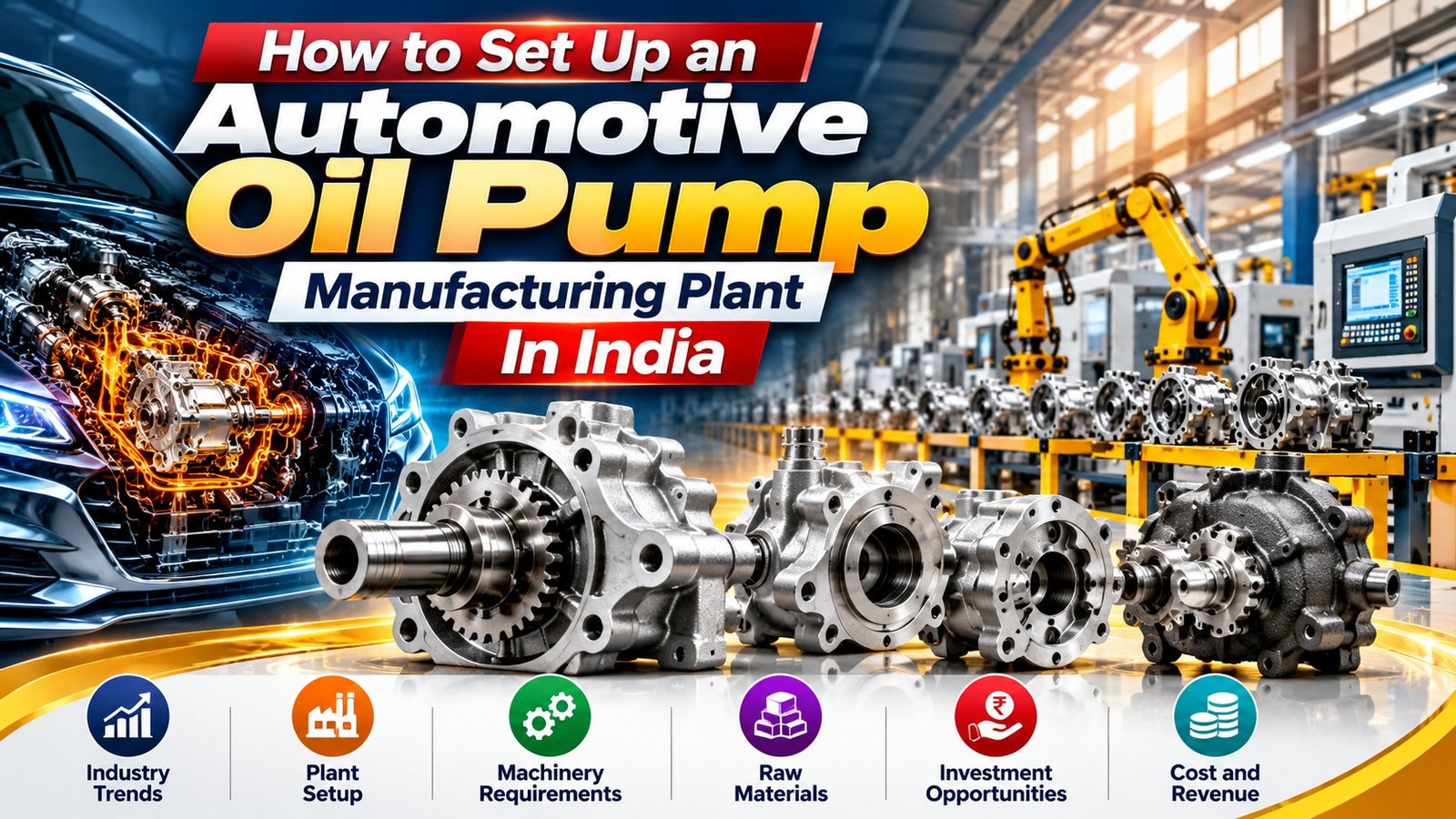
Setting up an automotive oil pump manufacturing plant in India presents a compelling investment case, driven by demand from the automotive, commercial vehicles, off-highway equipment, marine, industrial engines, and aftermarket automotive components sectors. Sitting at the heart of an engine’s lubrication system, the pump circulates pressurised oil to bearings, pistons, and the camshaft, making it indispensable to vehicle reliability and India’s automotive economy.
India’s urbanisation, expanding transport infrastructure, and the Make in India initiative have strengthened the country’s automotive component ecosystem, with Gujarat and Maharashtra among the key manufacturing states. Government initiatives promoting domestic automotive manufacturing, localisation of auto components, and production-linked incentive (PLI) schemes for the automotive sector further support demand for locally made, precision-engineered components, making India a strategically sound base for this type of production.
The investment case rests on policy support for localised auto component production, cost-competitive local sourcing, and steady replacement demand. With gross margins of 22–30%, net margins of 8–14%, and a break-even outlook of 3 to 6 years, the project remains viable across scales of 5–20 million units annually.
What is an Automotive Oil Pump?
An automotive oil pump is the critical heart of a car’s engine lubrication system. It pulls engine oil from the oil pan and pushes it under high pressure through filters and narrow channels to vital moving parts such as bearings, pistons, and the camshaft. This constant pressurised flow stops metal parts from rubbing together, reduces friction, cleans away tiny debris, and cools hot areas to prevent total engine failure.
The product is evolving through variable displacement and electrically driven designs that supply lubrication only when required, including in hybrid vehicles. Production relies on casting, machining, gear and shaft fabrication, heat treatment, assembly, testing, and quality inspection, serving automotive, commercial vehicles, off-highway equipment, marine, industrial engines, and aftermarket components.
Cost of Setting Up an Automotive Oil Pump Manufacturing Plant in India
The cost depends on capacity, technology, location, automation, and regulatory compliance.
1. Capital Expenditure (CapEx)
Land and site development form a foundational part of the investment for an automotive oil pump manufacturing plant, with industrial estates and SEZs offering ready infrastructure. Costs cover land registration, boundary development, and site preparation. Civil works include the production shed, quality control lab, raw material and finished goods storage, and the administrative block. Machinery accounts for the largest share of capital expenditure, and key machinery required includes:
- CNC machining centers
- Lathes
- Milling machines
- Grinding machines
- Heat treatment furnaces
- Gear hobbing machines
- Assembly lines
- Leak testing systems
- Performance testing benches
- Cleaning units
- Packaging machines
Other capital costs include pre-operative expenses, commissioning, installation, an effluent treatment plant (ETP), and import duties where equipment is sourced from overseas.
Request a Sample Report for In-Depth Market Insights: https://www.imarcgroup.com/automotive-oil-pump-manufacturing-plant-project-report/requestsample
2. Operational Expenditure (OpEx)
Raw material cost is the largest component of OpEx for an automotive oil pump manufacturing plant, accounting for approximately 50–60% of total operating expenses. Core raw materials include grey cast iron or aluminum alloy castings, steel gears, shaft/bearing steel, and sealing components, and long-term supplier contracts help stabilise pricing. Utility costs, covering electricity, water, and steam, account for 14–18% of OpEx. Other operating costs include transportation, packaging, salaries, maintenance, depreciation, and taxes, and total operational costs are projected to increase substantially by the fifth year due to inflation and rising material costs.
3. Plant Capacity
The proposed facility is designed for an annual capacity ranging between 5–20 million units, enabling economies of scale while maintaining operational flexibility. The capacity of an automotive oil pump plant can be customised to investor requirements, and profitability improves with higher capacity utilisation.
4. Profit Margins and Financial Projections
Financial projections rest on realistic assumptions covering capital investment, operating costs, capacity utilisation, pricing trends, and demand outlook, and include ROI, net present value (NPV), internal rate of return (IRR), and payback period analysis. Gross profit margins typically range between 22–30%, while net profit margins range between 8–14%.
Why Set Up an Automotive Oil Pump Plant in India?
Expanding Aftermarket Demand: The automotive aftermarket, propelled by aging vehicle fleets and regular maintenance requirements, supports sustained replacement demand for oil pumps.
Strong Global Market Growth: The global market was valued at USD 19.00 Billion in 2025 and, according to IMARC Group estimates, is expected to reach USD 29.48 Billion by 2034, exhibiting a CAGR of 5.0% from 2026 to 2034.
Policy and Regulatory Tailwinds: Government initiatives promoting domestic automotive manufacturing, localisation of auto components, fuel-efficiency regulations, and PLI schemes for the automotive sector indirectly support demand for locally manufactured oil pumps.
Cost-Competitive Manufacturing: Access to nearby suppliers of castings and bearing steel and proximity to target markets help minimise transportation and distribution costs, while long-term supplier contracts stabilise input pricing for a well-located automotive oil pump plant.
Active Industry Development: In April 2026, a study in the International Journal of Engineering Research & Technology presented an advanced test setup combining a Programmable Logic Controller (PLC), LabVIEW-based data acquisition, and precision sensors to measure flow, pressure, torque, temperature, and speed.
Local Supply Chain Preference: Automotive OEMs and Tier-1 suppliers increasingly prioritise reliable local sourcing to reduce supply chain risks, shorten lead times, and improve cost competitiveness, creating opportunities for regional producers with consistent quality standards.
Manufacturing Process – Step by Step
The automotive oil pump manufacturing process uses casting, machining, gear and shaft fabrication, heat treatment, assembly, testing, and quality inspection as the primary production method.
- Design and Specification: Pump geometry and performance requirements are defined.
- Raw Material Procurement: Castings, steel gears, shaft/bearing steel, and sealing components are sourced.
- Casting and Machining: Housings and gears are cast and machined on CNC machining centers, lathes, milling machines, and grinding machines.
- Gear and Shaft Fabrication: Gear hobbing machines produce gears, and shafts are fabricated to tight tolerances.
- Heat Treatment: Heat treatment furnaces harden components for durability.
- Deburring, Finishing, and Cleaning: Parts are finished and passed through cleaning units.
- Assembly: Gears, shafts, and housings are assembled on assembly lines.
- Testing and Quality Inspection: Leak testing systems and performance testing benches verify pressure, flow, and durability.
- Packaging and Dispatch: Packaging machines prepare finished units for dispatch to end-use customers.
Key Applications
Oil pumps serve lubrication needs across a wide range of vehicles and equipment.
- Passenger Vehicles: Engine lubrication systems in gasoline, diesel, and hybrid passenger cars.
- Commercial Vehicles: Oil circulation systems in trucks, buses, and heavy-duty transport vehicles.
- Off-Highway Equipment: Lubrication systems in agricultural machinery, construction equipment, and mining vehicles.
- High-Performance & Motorsport Vehicles: High-pressure oil delivery for enhanced engine performance and durability.
Leading Manufacturers
Leading manufacturers in the global automotive oil pump industry include several multinational companies with diverse application portfolios.
- GDST Auto Parts
- FRECCIA
- MAPCO
- Aisin
- Denso
- Robert Bosch
- Continental AG
- BorgWarner
Timeline to Start the Plant
- Feasibility study and project report preparation
- Land acquisition and site development
- Regulatory approvals and environmental clearances
- Factory licence and fire safety compliance
- Machinery procurement and installation
- Raw material supplier agreements and supply chain setup
- Trial production and quality testing
- Commercial production launch
Licences and Regulatory Requirements
Starting an automotive oil pump manufacturing unit in India requires several approvals:
- Business registration (Proprietorship, LLP, or Pvt Ltd)
- Factory Licence under the Factories Act
- Environmental Clearance from State Pollution Control Board
- GST Registration
- Fire Safety NOC
- Effluent Treatment Plant (ETP) operational clearance
- Occupational Health and Safety compliance
Key Challenges to Consider
High Capital Requirements: Land acquisition, construction, precision equipment, installation, and initial working capital together demand significant upfront investment.
Raw Material Price Volatility: Grey cast iron or aluminum alloy castings, steel gears, shaft/bearing steel, and sealing components are exposed to price fluctuations, making long-term supplier contracts important.
Regulatory Compliance: Securing environmental clearances, factory licences, and fire safety certifications requires careful coordination.
Technology or Innovation Pressure: Electrically driven designs, lightweight materials, and smart controls mean the automotive oil pump manufacturing process must keep pace with evolving engines and OEM qualification requirements.
Competition: Established players such as GDST Auto Parts, FRECCIA, MAPCO, Aisin, Denso, Robert Bosch, Continental AG, and BorgWarner compete on precision and quality.
Skilled Manpower: Precision machining and advanced testing demand skilled engineers and operators, so recruiting and training talent is essential for any automotive oil pump plant.
Frequently Asked Questions
1. How much does it cost to set up an automotive oil pump manufacturing plant in India?
Costs depend on capacity, technology, location, and automation, covering land, civil works, machinery, and working capital.
2. Is automotive oil pump manufacturing profitable in India in 2026?
Gross margins of 22–30% and net margins of 8–14% are typical, improving with higher capacity utilisation.
3. What machinery is required for an automotive oil pump plant in India?
Key machinery includes CNC machining centers, lathes, milling and grinding machines, heat treatment furnaces, gear hobbing machines, assembly lines, and leak and performance testing systems.
4. What licences and approvals are required to start an automotive oil pump plant in India?
Requirements include business registration, factory licence, environmental clearance, GST registration, and fire safety NOC.
5. What raw materials are needed for automotive oil pump manufacturing?
Grey cast iron or aluminum alloy castings, steel gears, shaft/bearing steel, and sealing components are the core inputs.
6. What are the environmental compliance requirements for an automotive oil pump plant in India?
Environmental Clearance from the State Pollution Control Board and an operational effluent treatment system are required.
7. What is the best location to set up an automotive oil pump plant in India?
Sites with easy access to castings and steel, proximity to markets, and robust infrastructure, such as in Gujarat and Maharashtra, suit best.
8. What is the break-even period for this type of plant in India?
Break-even typically ranges from 3 to 6 years, depending on scale, compliance costs, raw material pricing, and market demand.
9. What government incentives are available for manufacturers in India?
Incentives may include capital subsidies, tax exemptions, reduced utility tariffs, export benefits, and PLI schemes for the automotive sector.
Key Takeaways for Investors
An automotive oil pump manufacturing plant in India offers a strong investment opportunity backed by demand from passenger vehicles, commercial vehicles, off-highway equipment, and motorsport applications. Financial viability holds across capacities of 5–20 million units, with gross margins of 22–30% and net margins of 8–14%. The global market is projected to grow from USD 19.00 Billion in 2025 to USD 29.48 Billion by 2034 at a CAGR of 5.0%. With rising vehicle production, hybrid vehicles, and replacement demand sustaining requirements, demand for locally produced oil pumps is set to remain strong.
About the Author