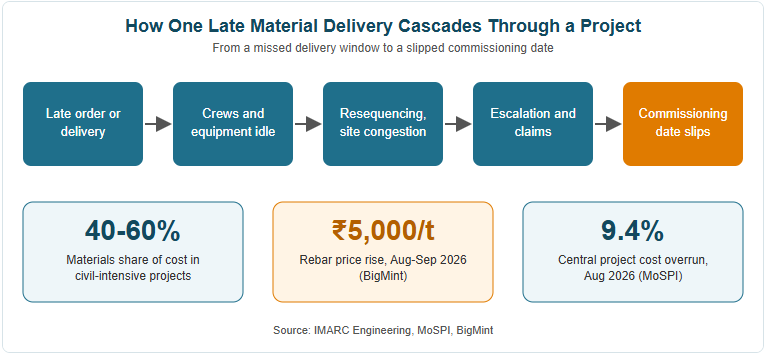
Material availability decides whether an industrial site keeps moving or goes quiet. As of August 2026, MoSPI monitored 1,731 central sector projects costing ₹150 crore or more, with a combined revised cost of ₹33,60,069 crore against an original ₹30,71,947 crore. That is a cumulative overrun of ₹2,88,122 crore, or about 9.4%. Overruns have many causes, but material supply and pricing are among the most manageable.
“Quick answer: Material procurement delays disrupt industrial construction in India because materials make up about 40-60% of cost in civil-intensive projects, every major activity depends on a specific delivery, and a late item idles crews, forces resequencing and exposes the project to price escalation.”
The pressure is rising in 2026. Industrial output grew 8.0% in August 2026, capital goods grew 16.9% and infrastructure and construction goods grew 6.4%, so industrial sponsors compete with public capex for the same steel, cement and equipment. Owners that work with experienced construction management services in India can lock procurement plans, vendors and delivery windows before the site mobilises, instead of reacting after a delivery slips.
1. Why Are Materials So Critical to the Construction Schedule?
Industrial construction is a chain of dependent activities. Foundations need reinforcement and cement, steel erection needs fabricated sections, and equipment installation needs completed civil works and utilities. When one delivery misses its window, the activities behind it cannot start. Typical dependencies include:
- Reinforcement steel and cement for foundations and slabs
- Structural steel (IS 2062 sections) for fabricated frames and sheds
- Cables, switchgear and transformers for energisation
- Process equipment and piping for installation and testing
Because materials account for about 40-60% of cost in civil-intensive projects, a delayed or repriced order hurts both the schedule and the budget.
2. How Is the 2026 Market Making Delays More Likely?
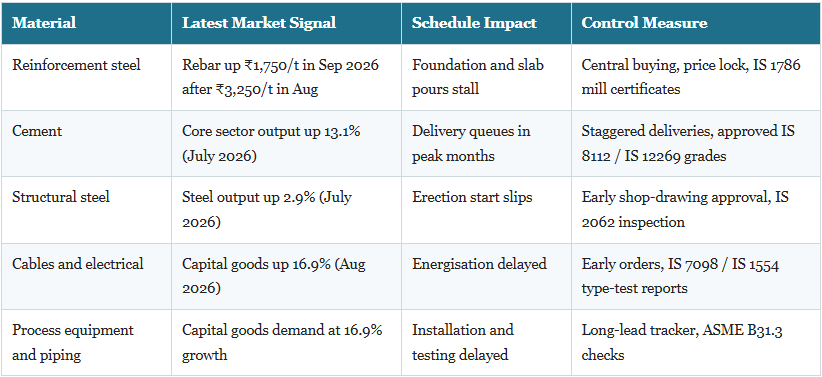
Steel is the clearest example. In early September 2026, a leading Indian steelmaker raised rebar list prices by ₹1,750 per tonne, after a ₹3,250 per tonne increase in August. That is a cumulative rise of ₹5,000 per tonne month on month, which BigMint linked to tight primary supply and maintenance shutdowns at integrated mills.
Demand is strong as well. In July 2026, core sector cement production grew 13.1% and steel production grew 2.9%, driven by government capex. Contractors who have not locked rates face either escalation claims or longer delivery queues.
3. What Causes Procurement Delays Inside the Project?
Most delays are created before the first truck arrives. Common internal causes include:
- Incomplete engineering: Orders placed before specifications are frozen get revised, and the revisions restart lead times. Best practice is 60-80% detailed engineering before construction begins.
- Fragmented buying: Contractor-by-contractor procurement of bulk items such as steel, cement and cables weakens negotiating power and supply security.
- Weak vendor pre-qualification: Suppliers selected on price alone often miss delivery or test-certificate requirements.
- No long-lead tracker: Items with fabrication or import lead times are ordered too late.
- Poor material tracking: Without tracking from receipt to installation, shortages and losses surface only when crews need the material.
- Escalation clauses not linked to indices: Price disputes, slow orders and deliveries.
4. How Do Material Delays Disrupt Cost, Quality and Safety?
The damage rarely stays limited to time. A single delayed material typically triggers several linked problems:
- Cost: Idle labour and equipment continue to be paid, and repriced orders add escalation, as the September 2026 rebar increases show.
- Quality: Pressure to substitute materials can bypass mill test certificates and approved grades such as IS 1786 reinforcement and IS 8112 or IS 12269 cement.
- Safety: Compressed schedules after a late delivery increase rushed work, overcrowded work fronts and permit shortcuts.
- Commercial exposure: Delays feed contractor claims, lender covenant concerns and postponed commissioning.
5. How Do Construction Managers Prevent Procurement Delays?
Procurement control works best when it is built into the construction plan, not added after problems appear:
- Freeze specifications and bills of quantities before placing major orders
- Buy bulk items such as reinforcement steel, cement and cables centrally at project level
- Pre-qualify vendors on capacity, delivery record and test-certificate discipline
- Maintain a long-lead tracker for fabricated, imported and electrical items
- Use six-week rolling look-ahead plans to flag upcoming material needs
- Track every item from receipt to installation
- Link escalation clauses to commodity indices to avoid price disputes
- Verify mill test certificates and type-test reports on receipt
Read our detailed analysis here: https://www.imarcengineering.com/blog/how-construction-management-improves-project-delivery-india
Material Procurement Risks at a Glance
How IMARC Engineering’s Expertise Can Help in Construction Management
- Procurement planning: Material packages, long-lead trackers and delivery windows aligned to the construction schedule
- Contractor and vendor evaluation: Qualification-based selection on capacity, safety and delivery record
- Schedule and cost control: Earned value tracking, look-ahead planning and change control
- Quality assurance: Inspection and test plans, mill certificate verification and non-conformance tracking
- Handover support: Documentation, punch-list closure and commissioning readiness
Consult With Our Team: https://www.imarcengineering.com/contact?service=construction-management-services
Conclusion
Material procurement delays rarely begin on site. They begin with incomplete specifications, late orders and unmanaged price exposure. With industrial demand and steel prices rising in 2026, owners cannot treat procurement as a contractor-side detail. Early long-lead planning, central purchasing for bulk items and disciplined tracking from order to installation keep crews productive and budgets intact. Projects that treat materials as critical-path activities are better placed to meet commissioning dates.
Frequently Asked Questions
Why do material delays affect industrial construction schedules?
Construction activities depend on one another, so a late delivery of steel, cement, cables or equipment blocks every activity that follows it and idles crews in the meantime.
Which materials cause the most procurement delays?
Long-lead items such as structural steel fabrication, electrical equipment and process equipment cause the longest delays, while reinforcement steel creates the most price volatility.
How much of the project cost do materials represent?
Materials typically account for about 40-60% of total cost in civil-intensive industrial projects, though the share varies with project type and equipment intensity.
How can owners reduce procurement delays?
Freeze specifications early, buy bulk materials centrally, pre-qualify vendors, maintain a long-lead tracker and link escalation clauses to commodity indices.
When should a construction management consultant be engaged?
Ideally during feasibility or basic engineering, typically 12-24 months before construction starts, so procurement planning can influence engineering completeness and contractor selection.
Contact Us:
IMARC Engineering
Phone: +91-120-433-0800
Email: sales@imarcengineering.com
India: C-130, Sector 2, Noida, Uttar Pradesh 201301
LinkedIn: https://www.linkedin.com/showcase/imarc-engineering/
About the Author