Introduction
A new machine can meet every line of its own specification and still fail to run properly in your plant. The cause is often not the machine. It is the existing utility system behind it: a transformer that is already heavily loaded, a compressed-air header that cannot hold pressure at peak, a steam line sized for an older layout.
Installed capacity does not automatically equal usable capacity. This article explains why utilities look adequate on paper, how to check them properly, and how a utility capacity assessment can help determine whether you need new capacity or better distribution and control.
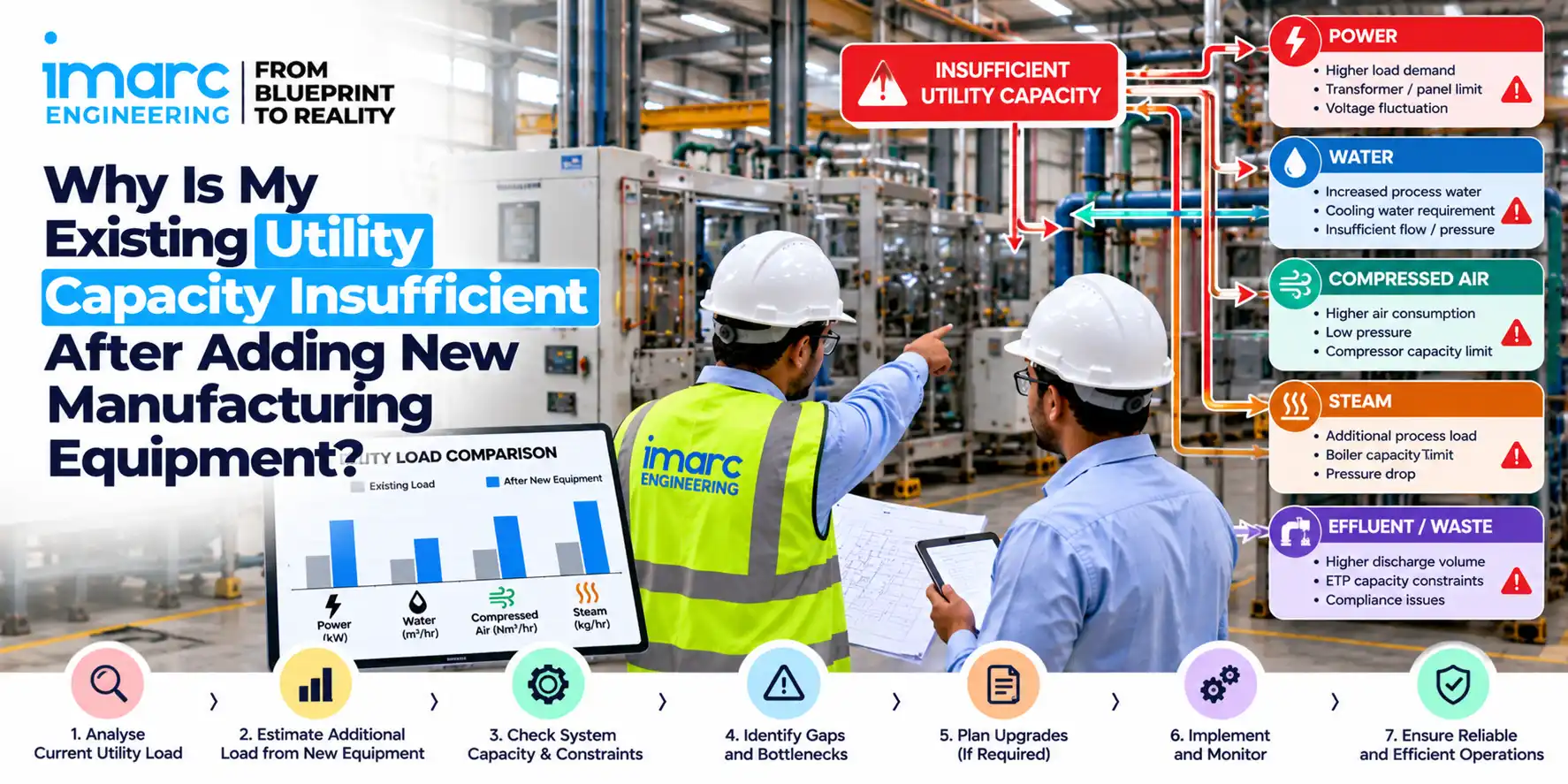
What Does “Insufficient Utility Capacity” Actually Mean?
The phrase hides four different problems. Treating them as one is how plants end up buying the wrong upgrade.
- Generation capacity: what the source can produce, such as a transformer, boiler, compressor set, chiller or pump station.
- Distribution capacity: what the network can carry to the area of use, such as feeders, cables, headers, pipes and valves.
- Point-of-use capacity: what actually arrives at the machine, in the right pressure, voltage, temperature and quality.
- Operating/peak capacity: what the system must supply when many loads run together, not what each load draws on average.
Example: a boiler may be adequate, yet a packaging line at the far end of a long steam header starves during peak draw. Generation is fine. Distribution and point-of-use capacity are not.
The path from source to machine gives the sequence this article follows: Installed Capacity → Available Capacity → Usable Capacity → Point-of-Use Capacity. Each stage introduces another constraint that can reduce the capacity actually available to the equipment.
Why Does Existing Utility Capacity Look Adequate on Paper?
Most paper checks compare a nameplate rating with a new machine’s rating. That misses several things.
- Nameplate is not spare capacity. A rating tells you what the equipment can deliver, not how much of it existing loads already use.
- Demand creeps. Added machines, small modifications and process changes over the years consume headroom that nobody recorded.
- Records age. Drawings and load lists often describe the plant as commissioned, not as it runs today.
- One machine, several utilities. A new line may draw power, compressed air, cooling water, steam and HVAC at the same time. Each may look manageable alone, while the combined effect is what stresses the plant.
- Simultaneity changes the profile. The new equipment may peak exactly when existing equipment peaks.
Build a Utility Requirement Matrix for the New Equipment
Before any tie-in, collect the real requirements from the equipment supplier and confirm them in writing. Ask for operating values, not only connected values.
- Power: voltage, phase, connected load, operating demand, and starting or inrush current where motors, drives or heaters are involved.
- Compressed air: required pressure, flow, air quality (dryness, oil content, particulates) and peak demand.
- Water: flow, pressure, temperature and quality.
- Steam: pressure, temperature and peak consumption.
- Cooling: heat duty, flow, and supply and return temperatures.
- HVAC: heat load, airflow, temperature and humidity.
- Drainage and exhaust: discharge volume, temperature, contaminants and exhaust flow, where applicable.
Also ask for the duty profile: how long the equipment runs, when it peaks, and what happens during start-up or cleaning.
How Do You Calculate Whether Existing Utility Capacity Is Enough?
The starting logic is simple:
Indicative available headroom = Verified existing capacity − Actual existing peak demand
Two words matter here: verified and actual. Use tested or measured capacity, not just the nameplate, and metered peak demand, not the sum of connected loads.
This is only a first-level check. A realistic assessment also looks at:
- simultaneous demand across old and new equipment
- distribution losses
- pressure or voltage drop to the point of use
- operating conditions such as ambient temperature or water supply temperature
- standby equipment, which may be needed for reliability
- maintenance scenarios, when one unit is out of service
- planned future expansion
- critical loads that cannot tolerate disturbance
So installed capacity ≠ available capacity ≠ usable capacity. A 1,000 kVA transformer is not 1,000 kVA of spare headroom, and a boiler’s rated output is not what reaches your reactor jacket.
Why Should You Check Utility Conditions at the Point of Use?
A healthy main header does not automatically mean the machine receives the required utility condition. This is where many commissioning problems originate.
Electrical
Check the transformer loading, feeder and cable ratings, panel capacity, protection settings and the voltage measured at the equipment terminals. A transformer can have spare capacity while a long cable run or an overloaded panel creates voltage drop. Large motor starts can also disturb voltage for neighbouring equipment.
Compressed Air
Check compressor capacity, receiver sizing, header pressure, flow, pressure drop across filters, dryers and regulators, and the pressure at the machine inlet. Pressure falling at the machine while the header gauge looks normal can indicate restrictions, pressure losses in the distribution path, inadequate receiver buffering or a short-duration peak demand.
Water and Cooling
Check the source, pump duty, flow, pressure, temperature, pipe sizing and simultaneous demand. Water may be available in the tank but not at the required flow at the process point. Cooling water that arrives warmer than design reduces the cooling a machine can actually deliver.
Steam
Check boiler capacity, peak demand, header pressure, distribution losses and condensate return. Poor condensate removal or undersized lines can starve equipment even when the boiler is not fully loaded.
What Happens When New and Existing Equipment Run Together?
Testing the new machine alone can be misleading. In isolation it may perform well because the plant is quiet and utilities are lightly loaded.
The real test is combined operation across the situations your plant actually experiences:
- normal production
- peak production
- start-up, when many loads ramp together
- cleaning or CIP cycles, which draw water, steam and heat on demand
- product changeovers
- maximum simultaneous demand
- standby or maintenance scenarios, with one chiller, compressor or boiler offline
Example: a new filling machine may run well alone. When it starts during an existing line’s cleaning cycle, air pressure dips, and an older machine on the same header begins to reject product. The new machine did not fail. It changed the shared demand profile.
Is the Problem Utility Capacity or Utility Distribution?
This diagnosis prevents the assumption that the answer is always a bigger utility system.
Steam: Boiler capacity is adequate, but pressure at the equipment is not. Possible causes include distribution restriction, pressure loss in undersized piping, faulty valves or controls, and condensate problems.
Electrical: Transformer capacity is adequate, but the machine trips or drives fault. Possible causes include feeder voltage drop, starting current, a loaded panel, protection coordination or power-quality disturbance.
Compressed air: Compressor capacity is adequate, but machines starve. Possible causes include blocked filters, undersized branch piping, leakage, regulator problems, or short peaks that the receiver volume cannot absorb.
If the source is fine and the point of use is not, the fix is usually in the network or controls, not in new generation.
Are the Existing Utility Drawings Still Accurate?
In brownfield plants, drawings are a starting point, not proof. Verify these against the actual site:
- P&IDs and single-line diagrams
- utility layouts and equipment lists
- pipe sizes and cable routes
- existing tie-ins and isolation valves
- meters and their calibration status
- the actual connections, not the intended ones
Undocumented modifications and earlier expansions can quietly change what a line feeds. A header assumed to serve three machines may now serve six.
How Do You Decide What Needs to Be Upgraded?
There are three possible situations.
- Generation capacity is insufficient. Verified headroom, including standby needs, cannot cover the new load. The source needs to grow.
- Distribution capacity is insufficient. The source has headroom but the network cannot deliver it. Pipes, cables, panels, headers or receivers need attention.
- Capacity is technically sufficient, but demand, control or operating conditions cause the problem. Staggered start-ups, control tuning, leak reduction, load scheduling or metering may solve it.
Where appropriate, measure and verify before committing capital. For power in India, confirm sanctioned load and contract demand terms with your distribution utility and check applicable requirements against current official sources before assuming a new connection or load is permitted.
Utility Capacity Check: What Looks Adequate vs What Actually Needs Verification
| Utility | What May Look Adequate | What Should Actually Be Checked |
|---|---|---|
| Power | Transformer rating exceeds the new machine’s load | Actual peak demand, motor starting effects, feeder and panel loading, voltage at the machine |
| Compressed air | Compressor capacity exceeds new demand | Peak flow, receiver buffering, pressure drop through filters and piping, pressure at inlet |
| Water | Tank or source has enough volume | Flow and pressure at the process point, pump duty, simultaneous draw, water quality |
| Steam | Boiler rating exceeds the new load | Header pressure at peak, line sizing, trap and condensate performance, losses |
| Cooling | Chiller or tower tonnage looks sufficient | Delivered flow, supply temperature under peak load, heat rejection in summer conditions |
| HVAC | Existing air handling units cover the area | Added heat load, airflow balance, humidity control, effect on neighbouring zones |
| Drainage | Drain line exists near the machine | Discharge rate and temperature, contaminant load, pipe slope and capacity, treatment limits |
How to Find the Real Utility Capacity Gap Before Equipment Installation
The goal is to move from rated numbers to measured, point-of-use evidence. Follow a sequence so that each step narrows the question.
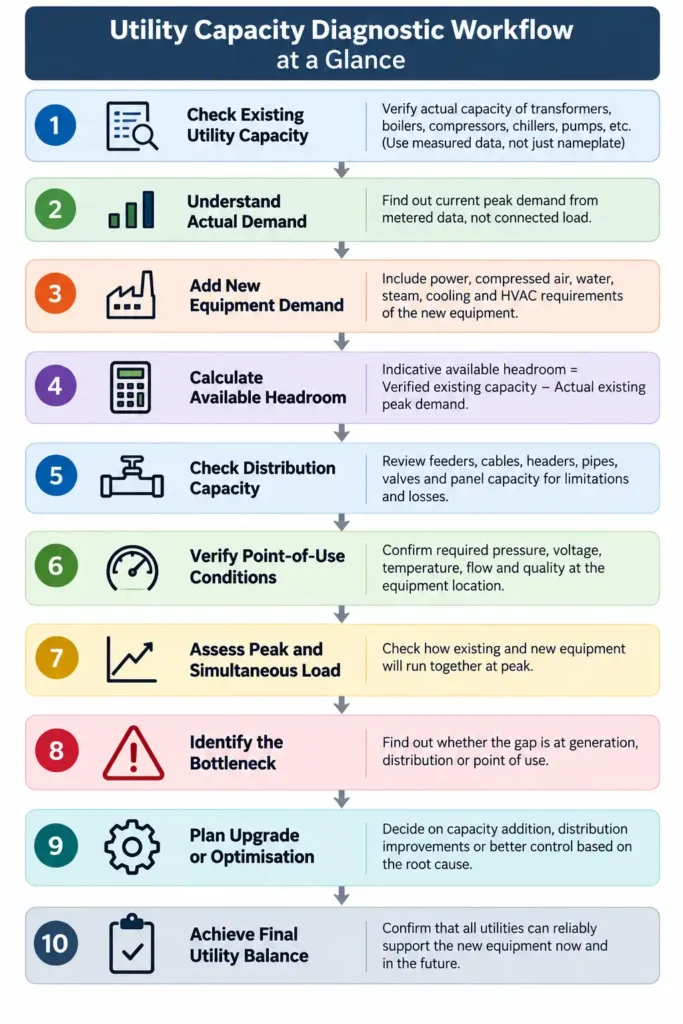
- Verify existing condition: confirm equipment ratings, drawings and connections on site.
- Measure actual demand: log real peak and average demand for each utility.
- Add new equipment demand: use operating values from the requirement matrix.
- Check distribution: calculate losses and drops from source to area.
- Check point-of-use conditions: confirm pressure, voltage, flow and temperature at the machine.
- Test peak and simultaneous demand: include start-up, cleaning and standby cases.
- Identify the actual bottleneck: source, network or operation.
- Select upgrade or optimisation: choose the least costly fix that solves the verified gap.
- Recheck the complete utility balance: confirm the fix did not shift the problem elsewhere.
When Should a Utility Capacity Assessment Be Done?
Assess before the commitments that are hardest to reverse:
- equipment purchase
- layout freeze
- electrical and piping procurement
- civil and foundation work
- utility tie-ins
- shutdown planning
- commissioning
Each later stage makes a utility gap more expensive to correct, and shutdown windows are often short.
Utility Capacity Diagnostic Workflow at a Glance
Core question: “Is the utility capacity really sufficient where and when the new equipment needs it?”
How IMARC Engineering Can Help
IMARC Engineering supports brownfield plants that need to know whether existing utilities can support new production equipment. This typically includes assessing existing utility systems, preparing load calculations and utility balances, and identifying where a capacity gap sits: generation, distribution or point of use.
Our work covers power, water, HVAC and steam planning, compressed-air assessment, utility distribution planning and equipment-to-utility integration, followed by upgrade planning where the evidence supports it. You can read more about our utilities planning services for water, power, HVAC and steam.
Need help assessing your plant’s utility capacity and upgrade requirements? Talk to IMARC Engineering for expert utility planning and engineering support: https://www.imarcengineering.com/contact?service=utilities-planning-water-power-hvac-steam-services
Conclusion
Adding a new machine does not simply add one more load. It changes the demand profile of the shared utility system.
A plant can have apparently sufficient installed capacity and still face problems because of peak demand, distribution limitations, point-of-use losses, simultaneous operation or outdated utility information.
The right time to discover a utility capacity gap is before the machine arrives—not during commissioning.
Explore Our Related Blog: How to Conduct a Utility Cost and Energy Efficiency Audit for Manufacturing Plants in India
Contact Us:
IMARC Engineering
Phone: +91-120-433-0800
Email: sales@imarcengineering.com
India: C-130, Sector 2, Noida, Uttar Pradesh 201301
LinkedIn: https://www.linkedin.com/showcase/imarc-engineering/
About the Author