Environmental Clearance is one of the longest-lead approvals on any industrial project. A delay of even one quarter pushes back construction, financial close and revenue start, which is why approval timing often decides project economics.
The approval landscape changed in 2026. On 13 July 2026, the Ministry of Environment, Forest and Climate Change notified amendments to stop lapsed state appraisal bodies from stalling clearances. Even so, many delays still begin with the developer: late studies, thin baseline data and weak consultation records.
Industries that plan the approval pathway at pre-feasibility stage, supported by environmental impact and sustainability studies services, protect both schedule and capital. This article explains why delays occur, what the 2026 reforms change, how long each stage takes and how to avoid avoidable setbacks.
Why Do Environmental Approvals Get Delayed in India?
Approvals get delayed when applications are incomplete, studies are weak, or the appraisal bodies cannot function on time. The most common drivers are:
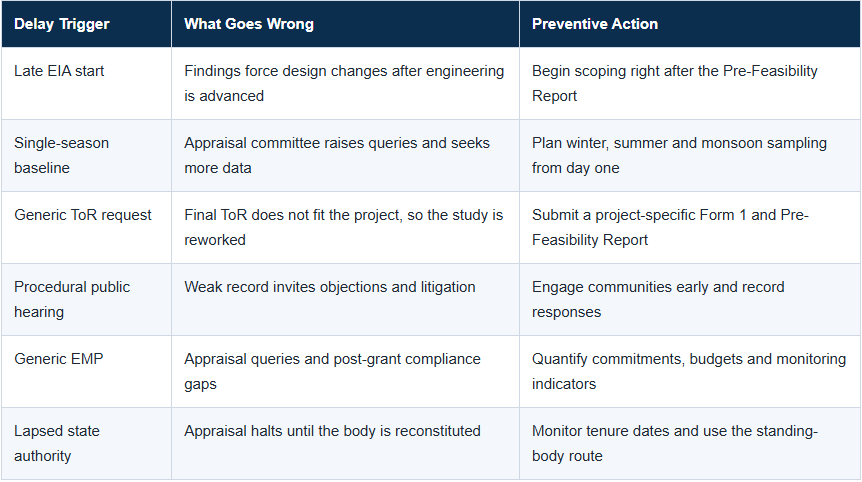
- Late start: EIA begun after detailed design forces redesign and pushes engineering back.
- Thin baseline data: single-season data routinely draws appraisal queries, while three seasons (winter, summer and monsoon) is the stronger standard.
- Weak scoping: a poorly framed Form 1 or Pre-Feasibility Report leads to a Terms of Reference that does not match the project.
- Box-tick public consultation: a hearing plus a 6 to 10 week comment cycle produces a weak record and raises litigation risk.
- Lapsed state bodies: when a SEIAA or SEAC term ends without timely reconstitution, appraisal halts and proposals are redirected to the Centre.
- Parallel clearances: forest clearance under the Forest (Conservation) Amendment Act 2023, wildlife clearance and CRZ 2019 often decide the overall timeline.
What Changed in 2026 to Reduce State-Level Delays?
The 2026 reforms target institutional gaps at state level. The Ministry published a draft on 5 March 2026 and notified the final amendments on 13 July 2026 through S.O. 3862(E) and S.O. 3863(E). Key changes include:
- A Standing Authority on Environment Impact Assessment (SAEIA) and a Standing Committee on Environment Impact Appraisal (SCEIA) in every state and Union Territory.
- These bodies can take over SEIAA and SEAC functions for up to 1 year when the state bodies are non-functional or causing delay.
- Tenure of SEIAA and SEAC members extended from 3 years to 4 years.
- Reconstitution of state bodies must begin 6 months before the term ends.
- Members can be removed for processing delays beyond prescribed timelines.
The March draft had also proposed that a proposal not appraised by the SEAC within 120 days moves automatically to the SCEIA, so developers should confirm the final operative text for their state. These reforms fix institutional continuity. They do not fix a weak application.
How Long Does Each Clearance Stage Take?
Typical stage durations, based on practical project experience, add up to 40 to 76 weeks for a project requiring a full EIA. The infographic below shows where the time goes.
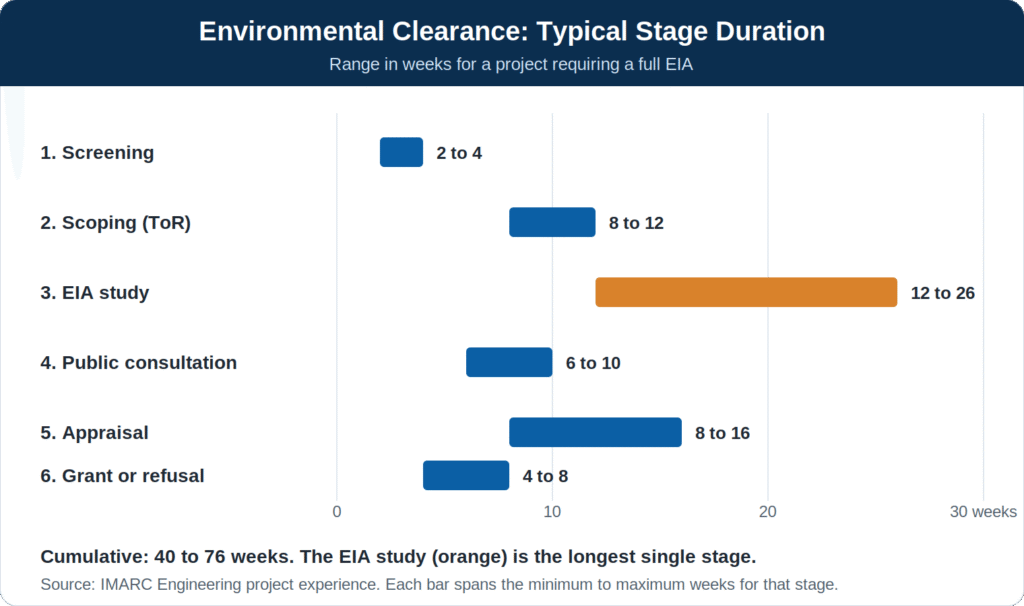
The formal timelines under the EIA Notification are tighter than practical experience. The framework allows 60 days for appraisal of a final EIA report and 45 days for the final decision, a total of 105 days from receipt of the final report. Practical timelines run longer: 12 to 24 months for larger Category A projects and 6 to 12 months for Category B projects, because study quality, queries and consultation outcomes drive the clock.
How Can Industries Avoid Environmental Approval Delays?
The most effective steps are planning decisions made before the application is filed:
- Classify early: confirm Category A, B1 or B2 at screening. Category B2 projects are exempt from a full EIA and public consultation, but still need Consent to Establish and Consent to Operate.
- Start scoping at pre-feasibility: begin ToR discussions immediately after the Pre-Feasibility Report, before detailed design is frozen.
- Use accredited consultants: only NABET-accredited organisations can prepare EIA reports for EC submission.
- Collect three-season baseline data: cover air, water, soil, noise, ecology and socio-economic conditions with a structured sampling design.
- Run real public consultation: engage communities before the hearing and document design changes made in response.
- Write a quantified EMP: assign budgets, responsibilities and measurable monitoring indicators for every mitigation commitment.
- Plan parallel clearances together: sequence EC, forest, wildlife and CRZ approvals in one integrated schedule.
- Track the state body: check whether the SEIAA and SEAC term is close to expiry, and know which standing body would step in.
Which Delay Triggers Can Be Prevented?
How Do Sustainability Studies Support Faster Approvals?
Sustainability work shares baseline data with the EIA, so running both together avoids duplicate surveys. It also strengthens the application in three ways:
- Climate risk, water stewardship and biodiversity analysis give appraisal committees structured evidence beyond the minimum.
- Lenders applying IFC Performance Standards and Equator Principles review the same documentation, which speeds financial close.
- SEBI BRSR Core reaches the top 1,000 listed companies by FY 2026-27, so listed sponsors need project-level data from the planning stage.
How IMARC Engineering’s Expertise Can Help in Environmental Approvals
IMARC Engineering supports industrial developers from project planning to post-grant compliance. Relevant support includes:
- Project categorisation, screening and approval pathway planning
- Scoping support, baseline study planning and EIA coordination
- Public consultation preparation and Environmental Management Plan design
- Integrated planning of EC, forest, wildlife and CRZ clearances
- ESG-aligned sustainability studies and climate risk assessment
- Post-grant compliance monitoring and reporting support
Consult With Our Team: https://www.imarcengineering.com/contact?service=environmental-impact-sustainability-studies
Conclusion
Environmental approval delays are rarely caused by one factor. They build up from late studies, thin data, weak consultation and gaps in state appraisal bodies. The 2026 reforms reduce institutional risk, but approval speed still depends on application quality. Developers who plan scoping early, invest in three-season baseline data and integrate sustainability studies can protect timelines, lender confidence and capital, and reach construction start with fewer regulatory surprises along the way.
Contact Us:
IMARC Engineering
Phone: +91-120-433-0800
Email: sales@imarcengineering.com
India: C-130, Sector 2, Noida, Uttar Pradesh 201301
LinkedIn: https://www.linkedin.com/showcase/imarc-engineering/
About the Author