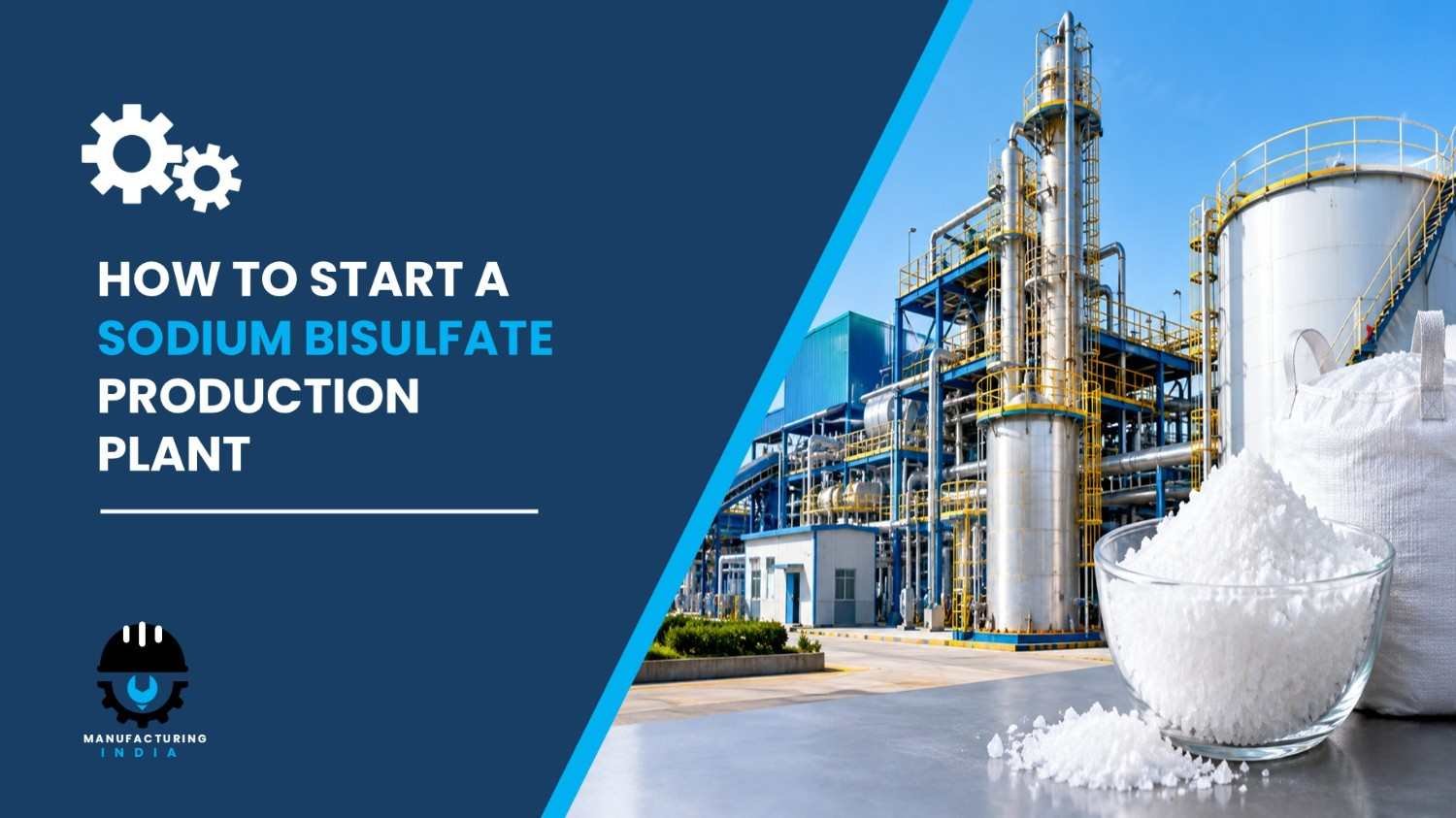
A sodium bisulfate production plant setup in India presents a compelling investment case for chemical entrepreneurs and investors. The product serves pool and spa treatment, food processing, metal finishing, cleaning products, water treatment, and textile manufacturing. As a dry acid, it offers safer and easier handling and storage than liquid acids, which makes it an essential chemical input for sanitation, industrial processing, and infrastructure maintenance.
India offers real advantages for this investment. Rising spending on water treatment, hygiene, industrial cleaning, and food processing supports steady downstream demand, and the food manufacturing market is expected to grow from USD 307 Billion in 2023 to USD 700 Billion in 2030 (IBEF). Government focus on water sanitation, industrial wastewater treatment, food safety, and domestic chemical production, including the Make in India initiative and chemical sector incentives, strengthens the picture. Industrial clusters in states such as Gujarat and Maharashtra add to the strategic case for local production.
The investment case rests on policy support, demand from water treatment, cleaning, and food sectors, and a sodium bisulfate production plant designed at 15,000 MT per year. Gross margins of 20-27% and net margins of 11-17% point to a viable path to recovering capital, with raw materials at 55-65% of OpEx the main cost lever to manage.
What is Sodium Bisulfate?
Sodium bisulfate, also known as sodium hydrogen sulfate, is a dry, granular acid salt formed by the partial neutralization of sulfuric acid. When dissolved in water, it creates a strongly acidic solution capable of quickly lowering pH. Because it acts as a dry acid, it is valued for safer, easier handling and storage compared to liquid acids.
Its most common uses include balancing swimming pool water, formulating heavy-duty household cleaners, adjusting agricultural soil pH, and treating wastewater. It also serves as an additive in pet foods and as a preservative and acidifier in various human food and beverage products.
The production process is crystallization, drying, and granulation. End-use industries include pool and spa treatment, food processing, metal finishing, cleaning products, water treatment, and textile manufacturing.
Cost of Setting Up a Sodium Bisulfate Production Plant in India
The total cost depends on capacity, technology, location, automation, and regulatory compliance. The sections below cover the main cost heads.
1. Capital Expenditure (CapEx)
Land and site development includes land registration, boundary development, and related expenses, which form a substantial part of overall investment. Investors can evaluate SEZ and industrial estate options for infrastructure, utilities, and waste management access. Civil works cover the production shed, laboratory, raw material and finished goods storage, and administrative block, with separate zones for quality control and space reserved for future expansion.
Machinery costs account for the largest portion of CapEx. Key machinery required includes:
- Crystallizers
- Centrifuges
- Drying units
- Screening systems
- Acid-resistant reactors
- Material handling conveyors
- Packaging machines
All equipment should be corrosion-resistant and meet standards for safety, efficiency, and reliability. Other capital costs include effluent treatment, pre-operative expenses, and commissioning.
Request a Sample Report for In-Depth Market Insights: https://www.imarcgroup.com/sodium-bisulfate-manufacturing-plant-project-report/requestsample
2. Operational Expenditure (OpEx)
Raw material cost is the largest item, at approximately 55-65% of total OpEx. The main inputs are sodium chloride/sulfate and sulfuric acid. Long-term contracts with reliable, nearby suppliers help stabilize pricing and secure steady supply.
Utility cost covers electricity, water, and steam, and accounts for 7-11% of OpEx. Other operating costs include transportation, packaging, salaries and wages, repairs and maintenance, depreciation, and taxes. By the fifth year, total operating cost is expected to rise substantially because of inflation, market fluctuations, potential increases in key material costs, and supply chain disruptions.
3. Plant Capacity
The proposed facility is designed for an annual capacity of 15,000 MT, which enables economies of scale while keeping operations flexible. Capacity can be customized to investor requirements, and profitability improves with higher capacity utilization.
4. Profit Margins and Financial Projections
Under normal operating conditions the project shows healthy profitability. Gross profit margins typically range between 20-27%, and net profit margins between 11-17%. Financial projections rest on assumptions about capital investment, operating costs, capacity utilization, pricing trends, and demand outlook, and a full analysis covers NPV, ROI, payback period, and internal rate of return.
Why Set Up a Sodium Bisulfate Plant in India?
Essential industrial chemical input: It is used in water treatment, pH reduction, cleaning formulations, metal finishing, textile processing, poultry feed additives, and swimming pool maintenance. This breadth positions it as important for industrial processing and sanitation.
Megatrend alignment: Rising investment in water treatment, hygiene solutions, industrial cleaning, pharmaceuticals, food processing, and infrastructure is driving sustained demand. Environmental compliance and wastewater management initiatives further support long-term consumption.
Policy and regulatory tailwinds: Government focus on water sanitation, industrial wastewater treatment, food safety, and public hygiene indirectly strengthens demand across downstream industries. Make in India and chemical sector incentives support domestic chemical production.
Cost-competitive production: The industry is less capital-intensive than specialty chemicals, and a sodium bisulfate production plant located close to sodium chloride/sulfate and sulfuric acid suppliers keeps raw material and distribution costs in check.
Active industry investment: In April 2026, a study published by Nature Communications reported a thermochemical method to convert waste sodium sulfate into sodium carbonate and sulfur, offering a sustainable route to reclaim waste salts and close the sodium and sulfur cycles. Global producers such as Clariant, OxyChem, Aditya Birla Chemicals, AkzoNobel, and Hubei Xingfa Chemicals also keep the sector active.
Local supply chain preference: Industrial buyers and distributors increasingly prefer dependable local suppliers to reduce lead times, manage raw material volatility, and ensure uninterrupted supply, which creates openings for regional producers with consistent quality.
Sodium Bisulfate Production Process: Step by Step
The sodium bisulfate production process uses crystallization, drying, and granulation as the primary production method. The main stages in a sodium bisulfate production plant are:
- Raw material handling: sodium chloride/sulfate and sulfuric acid are received, stored, and fed according to mass balance requirements.
- Reaction: acid-resistant reactors carry out the partial neutralization of sulfuric acid.
- Crystallization: crystallizers form crystals from the solution.
- Separation: centrifuges separate the crystals from the liquid.
- Drying: drying units produce the dry, granular salt.
- Screening: screening systems grade the product to the required granule size.
- Quality assurance: testing and monitoring verify purity and consistency at every stage.
- Packaging and dispatch: packaging machines and conveyors prepare the product for dispatch to pool and spa, food, metal finishing, cleaning, water treatment, and textile customers.
Key Applications
The product serves a wide range of industries:
- Chemical manufacturing: pH control agents, cleaning formulations, and industrial processing chemicals.
- Water treatment: swimming pool pH reduction, wastewater treatment, and descaling.
- Food and beverage: food-grade acidulants, processing aids, and sanitation products.
- Textile and leather processing: dyeing operations, bleaching processes, and leather treatment.
Leading Manufacturers
Several multinational companies lead global production. Key players include:
- Clariant
- OxyChem
- Aditya Birla Chemicals
- AkzoNobel
- Hubei Xingfa Chemicals
Timeline to Start the Plant
- Feasibility study and project report preparation
- Land acquisition and site development
- Regulatory approvals and environmental clearances
- Factory licence and fire safety compliance
- Machinery procurement and installation
- Raw material supplier agreements and supply chain setup
- Trial production and quality testing
- Commercial production launch
Licences and Regulatory Requirements
Starting a sodium bisulfate production unit in India requires several approvals:
- Business registration (Proprietorship, LLP, or Pvt Ltd)
- Factory Licence under the Factories Act
- Environmental Clearance from State Pollution Control Board
- GST Registration
- Fire Safety NOC
- Hazardous/Chemical compliance for handling sulfuric acid
- Effluent Treatment Plant (ETP) operational clearance
- Occupational Health and Safety compliance
Key Challenges to Consider
- High capital requirements: a sodium bisulfate production plant needs corrosion-resistant machinery and infrastructure, which represent a significant share of investment, with machinery the largest CapEx item.
- Raw material price volatility: sodium chloride/sulfate and sulfuric acid make up 55-65% of OpEx, so price swings directly affect margins.
- Regulatory compliance: controlled chemical handling, effluent treatment, and emission standards demand disciplined compliance.
- Quality consistency: the industry demands strict purity standards and long-term customer validation, which form moderate but defensible entry barriers.
- Competition: established players such as Clariant, OxyChem, Aditya Birla Chemicals, AkzoNobel, and Hubei Xingfa Chemicals have broad application portfolios.
- Skilled manpower: trained staff are needed to run crystallization, drying, and quality control, and training helps control operating costs.
Frequently Asked Questions
How much does it cost to set up a sodium bisulfate production plant in India?
The cost depends on capacity, technology, and location. Machinery is the largest CapEx item, and detailed figures are available in the sample report.
Is sodium bisulfate production profitable in India in 2026?
Gross margins typically range between 20-27% and net margins between 11-17%, supported by stable demand.
What machinery is required for a sodium bisulfate plant in India?
Crystallizers, centrifuges, drying units, screening systems, acid-resistant reactors, material handling conveyors, and packaging machines.
What licences and approvals are required to start a sodium bisulfate plant in India?
Business registration, a Factory Licence, Environmental Clearance, GST Registration, Fire Safety NOC, chemical compliance, ETP clearance, and occupational health and safety compliance.
What raw materials are needed for sodium bisulfate production?
Sodium chloride/sulfate and sulfuric acid.
What are the environmental compliance requirements for a sodium bisulfate plant in India?
Effluent treatment systems, leak-monitoring systems, and compliance with emission standards and local zoning laws.
What is the best location to set up a sodium bisulfate plant in India?
A site near sodium chloride/sulfate and sulfuric acid suppliers, close to target markets, with reliable transport, utilities, and waste management.
What is the break-even period for this type of plant in India?
Break-even depends on capacity utilization, pricing, and costs, and is assessed through payback period and NPV analysis.
What government incentives are available for manufacturers in India?
Make in India and chemical sector incentives support domestic chemical production.
Key Takeaways for Investors
A sodium bisulfate production plant offers access to demand from pool and spa treatment, food processing, metal finishing, cleaning, water treatment, and textiles. At a 15,000 MT annual capacity, gross margins of 20-27% and net margins of 11-17% indicate sound financial viability. The Indian food manufacturing market is expected to reach USD 700 Billion in 2030 (IBEF), and ongoing investment in sanitation and water treatment should sustain demand for years.
About the Author