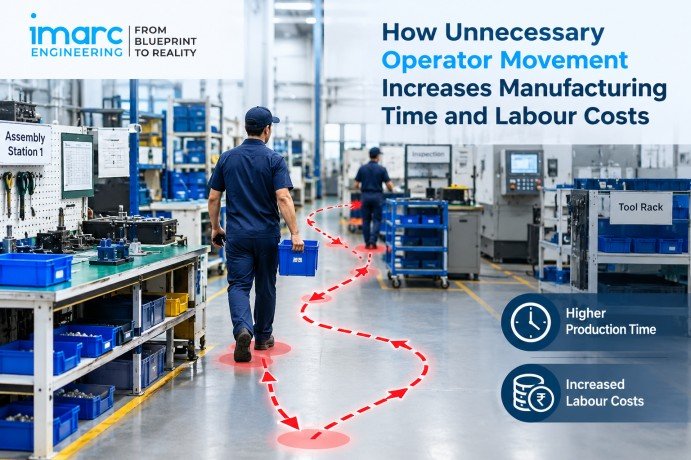
Unnecessary Movement, Rising Manufacturing Costs
Picture a workstation where every operator is busy, every shift is staffed, and the machines are running. Yet the day’s target is missed again, and overtime is approved again. Often the cause is not effort or equipment. It is the small, repeated movements built into the job: a walk to the next rack, a search for the right gauge, a reach across the bench.
This article explains how a motion study in manufacturing helps identify unnecessary operator movements that increase production time and labour costs. It explores practical methods for measuring movement, analysing workflow inefficiencies, and identifying root causes. It also outlines effective ways to optimize workstation layouts, reduce avoidable movements, improve productivity, and maintain essential quality and safety standards.
What Counts as Unnecessary Operator Movement?
Unnecessary movement is physical activity that uses time and effort but adds no value, and that can reasonably be removed, shortened or combined. Lean practice treats it as one of the classic forms of waste, usually listed as “motion.”
Not every movement is waste. It helps to sort what you observe into three groups:
- Value-adding work: activities that transform the product in a way the customer requires, such as machining or assembly.
- Necessary non-value-adding work: required inspection, safety checks, fixture loading and mandatory handovers that cannot currently be eliminated.
- Avoidable movement: walking to fetch frequently used items, searching, double handling and repeated bending that can reasonably be reduced.
The goal is to shrink the third group. It is not to make people move faster, and it is not to strip out checks that protect quality or safety.
Where Operator Time Disappears
Walking and Material Retrieval
When fasteners, tools or sub-assemblies sit away from the workstation, the operator leaves the task to get them. A single trip costs seconds, but the same trip repeats every cycle, every shift, for every operator.
Check: distance to storage, trips per cycle, and whether replenishment arrives before the operator runs out.
Searching for Tools, Parts and Instructions
Searching hides well because it is usually logged as ordinary working time. Unlabelled bins, mixed parts, borrowed tools and hard-to-find work instructions all create it.
Check: how often searching happens, how long it lasts, and what triggers it. A search that recurs every cycle often points to a storage, labelling or replenishment issue—not necessarily an individual performance problem.
Reaching, Bending and Turning
Materials placed too far away, too low or too high force repeated stretching and twisting. This adds seconds to each cycle and adds fatigue over a shift, which can slow work further and raise ergonomic risk.
Check: reach distances, working heights, and how often the operator rotates the body to get something.
Re-handling and Repositioning
Picking a part up, setting it down, turning it and picking it up again is common when fixtures or presentations are poor. Some handling is unavoidable, but repeated repositioning often signals a fixture or sequence problem.
Check: how many times each part is touched between arrival and hand-off.
Interrupted Flow Between Tasks
Leaving the station for an approval, an inspection gauge or a missing document breaks the work rhythm. The delay may look like operator movement, but the root cause can be information flow, supply or an upstream constraint.
What the Evidence Shows (and Does Not Show)
Published studies show that motion waste can be measured and reduced, but results vary by plant.
- A 2021 study by Waseem and colleagues, “Productivity Enhancement at Molding Compound Manufacturing Plant by Applying Time and Motion Analysis”, in the Mehran University Research Journal of Engineering and Technology, reported milling time per operation falling from 36.3 to 22.5 minutes and output rising from 5 to 7.14 bags per worker-hour. The gains came from broader method and process changes, including removing undesired operations, not from cutting movement alone.
- The Lean Enterprise Institute’s Thrustmaster case found technicians walked over seven miles per tunnel thruster, amounting to nearly 10 hours of walking waste per unit. The team then overhauled the layout, flow and standard work, so the results reflect several changes together.
These are individual cases, not benchmarks. No honest source can promise a fixed percentage saving for every factory. The result depends on your starting process, how much movement is truly avoidable, volumes and layout constraints.
How Lost Seconds Become Labour Cost
The maths is simple. Hours exposed per operator = seconds of potentially avoidable movement per cycle × cycles ÷ 3,600.
Worked example (hypothetical, not a client result): an initial review identifies 24 seconds of potentially avoidable movement per cycle. Over 600 cycles that is 14,400 seconds, or 4 hours. If 10 operators each performed 600 comparable cycles with the same 24 seconds, that is a theoretical 40 labour-hours per shift potentially exposed to movement-related losses, before confirming how much can actually be eliminated.
Capacity Versus Payroll Savings
This distinction is often missed. Recovered time initially creates capacity: more output within the same paid hours. It becomes direct payroll savings when overtime or paid hours fall. Avoiding a future hire is cost avoidance; reassigning staff releases capacity for other work, but is not automatically a payroll saving. Be clear on which outcome you are targeting before you build a business case.
Where the Cost Shows Up
- Higher labour cost per good unit, even at unchanged wage rates.
- Overtime used to cover a method problem.
- Extra shifts or headcount added when the real issue is how time is used.
- Missed schedules that trigger expediting costs.
Check movement alongside machine downtime, material shortages, changeovers and quality losses. Movement may be a major cause of a shortfall or a minor one, and only measurement tells you which.
How to Find Unnecessary Movement on Your Shop Floor
- Observe a full cycle. Watch a representative operation from start to finish, across normal variation in product mix and shifts.
- Record activities. Note picking, positioning, walking, searching, waiting and inspecting separately.
- Map the path. Draw a spaghetti diagram of the operator’s route. Crossings, backtracking and long retrieval trips stand out quickly.
- Time it. Use a stopwatch study or video where company policy and privacy rules allow, and tell the team why you are doing it.
- Find the root cause. Do not assume every delay is a layout problem.
- Validate the improvement. Repeat the measurements after the change across representative cycles and, where relevant, different operators, shifts and product variants. Compare average cycle time, movement frequency, output per labour-hour, quality and ergonomic indicators under comparable conditions. Confirm the change improves the whole workflow rather than moving work to another employee or process.
| What you observe | Potential root cause |
| Repeated tool retrieval | Tools are not stored at the point of use |
| Searching for parts | Poor labelling, identification or replenishment |
| Frequent bending or reaching | Workstation height or material positioning |
| Repeatedly turning components | Fixture or work-sequence limitations |
| Walking between process steps | Disconnected layout or workflow |
| Waiting for parts | Supply or replenishment failure |
Treat this table as a starting point. The same symptom can have several explanations, so verify the cause before changing anything.
Speak With An Expert: https://www.imarcengineering.com/contact?service=time-and-motion-studies
How to Reduce Movement Without Compromising Safety or Quality
- Put what is used most closest. Arrange tools and materials in the order of the work sequence, within comfortable reach.
- Use 5S for function, not appearance. The aim is that every item has a marked place, is easy to identify and gets returned there.
- Fix the workstation. Adjust heights, reach distances and fixtures to cut bending and twisting. For lifting tasks, use a formal assessment such as the NIOSH lifting equation rather than judging by eye.
- Standardise the sequence. Write down the best-known method so it does not vary by operator or shift, while leaving room for product differences.
- Fix replenishment. If operators keep leaving to fetch parts, review container size, delivery frequency and refill signals.
Be careful about shifting the burden. Shorter walking for an operator can simply create extra work for a material handler. Judge changes across the whole workflow.
How to Know Whether It Worked
Take a baseline before the change and measure again under comparable conditions. Track:
- Avoidable movement time per cycle
- Walking distance per shift
- Cycle time
- Units per labour-hour
- Overtime hours
- Defects, rework and ergonomic risk indicators
Confirm the gain holds after the first few weeks, not just on the day of the trial.
When Is a Time and Motion Study Worth Doing?
Consider one when:
- Targets are missed despite adequate staffing.
- Overtime stays high while demand is stable.
- Operators doing the same job show very different output.
- A new product or layout change is coming.
- You are about to add shifts, people or equipment.
Scale the effort to the problem. One workstation observation may expose an obvious retrieval issue, while a multi-stage line needs detailed timing and workload analysis.
How IMARC Engineering Can Help
IMARC Engineering’s Time & Motion Studies service shows manufacturers where operator time actually goes. Our engineers observe the work on your shop floor, measure task times and movement, analyse root causes and recommend practical changes you can act on. We then help your team implement them and validate the results, so staffing and capacity decisions rest on measured evidence. Book a consultation to review one problem workstation or line, and we will outline what to measure first. Contact sales@imarcengineering.com or +91-120-433-0800.
Conclusion
Unnecessary operator movement quietly adds minutes to every cycle, and those minutes accumulate into lost capacity, overtime and higher labour cost per unit. Because it rarely shows in output reports, it must be observed and measured directly. The best fixes are not about pushing people harder. They place tools and materials where the work happens, simplify the method, and protect safety and quality, so necessary work takes less avoidable effort.
Contact Us:
IMARC Engineering
Phone: +91-120-433-0800
Email: sales@imarcengineering.com
India: C-130, Sector 2, Noida, Uttar Pradesh 201301
LinkedIn: https://www.linkedin.com/showcase/imarc-engineering/
About the Author