Setting up a porcelain insulator manufacturing plant in India presents a compelling investment case, driven by demand from power transmission and distribution, electrical utilities, renewable energy, railways, industrial equipment, and telecommunications. Porcelain insulators are specialized electrical components made from high-grade ceramic clay, designed to support electrical conductors while safely preventing the unwanted flow of current to the ground, and they are heavily relied upon across high-voltage transmission lines, substations, and industrial equipment for their dielectric strength and heat resistance.
India’s renewable energy build-out gives this investment real momentum: as per the Ministry of New and Renewable Energy, India added a record 44.5 GW of renewable energy capacity in 2025, directly expanding the transmission and substation infrastructure that depends on reliable insulation components. Government investment in electricity transmission, rural electrification, renewable energy integration, railway electrification, smart grids, and substation development indirectly supports demand for porcelain insulators, making the case for this facility strategically sound.
This plant’s investment case is anchored in megatrend-aligned demand from grid modernization and electrification, gross margins of 25–35%, and a capacity range of 5,000–15,000 MT that lets the facility scale to market reach while targeting measurable payback through NPV and IRR analysis.
What is Porcelain Insulator?
A porcelain insulator is a specialized electrical component made from high-grade ceramic clay, designed to support electrical conductors while safely preventing the unwanted flow of current to the ground. These insulators are heavily relied upon in high-voltage power transmission and distribution lines, substations, and industrial equipment due to their exceptional dielectric strength and high heat resistance. Known for their durability, porcelain insulators can withstand extreme mechanical stress from wind and ice, as well as severe environmental degradation from UV exposure and chemical weathering, ensuring long-term reliability and safety across the electrical grid.
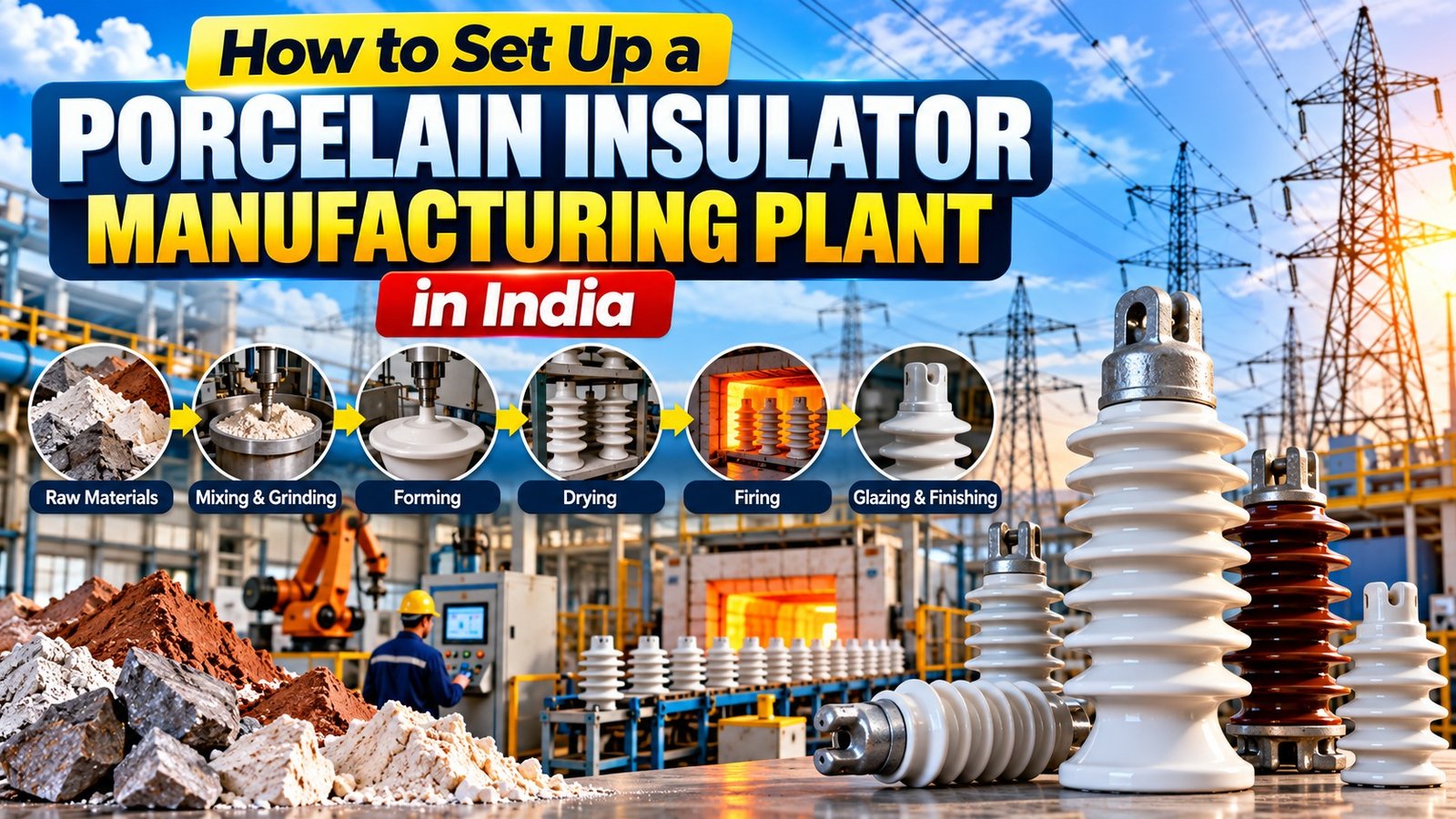
The porcelain insulator manufacturing process involves raw material preparation, batching, wet/dry grinding, mixing, forming, drying, glazing, firing, and finishing. Output serves power transmission and distribution, electrical utilities, renewable energy, railways, industrial equipment, and telecommunications.
Cost of Setting Up a Porcelain Insulator Manufacturing Plant in India
Cost depends on capacity, technology, location, automation, and regulatory compliance.
1. Capital Expenditure (CapEx)
CapEx begins with land acquisition and site preparation, including land registration, boundary development, and necessary infrastructure. Civil works cover raw material storage, the manufacturing area, quality control, and finished goods storage, with space designated for future expansion.
Machinery costs account for the largest portion of total capital expenditure. Key machinery required includes:
- Clay crushers
- Jaw crushers
- Ball mills
- Blungers
- Filter presses
- Pug mills
- Vacuum extruders
- Hydraulic presses
- Drying chambers
- Glazing units
- Kilns
- Inspection and testing equipment
Other capital costs include equipment installation, pre-operative expenses, and initial working capital.
Request a Sample Report for In-Depth Market Insights: https://www.imarcgroup.com/porcelain-insulator-manufacturing-plant-project-report/requestsample
2. Operational Expenditure (OpEx)
OpEx is driven primarily by raw material consumption. Kaolin/clay, feldspar, quartz, and glaze materials together account for approximately 45-55% of total operating expenses, making long-term supplier contracts important for stabilising pricing and ensuring a steady supply. Utility cost — electricity, water, and steam — accounts for 20-28% of OpEx.
Other costs include transportation, packaging, salaries and wages, depreciation, and taxes. First-year operating cost is significant across these categories, and by year five, total operational cost is expected to rise substantially due to inflation, market fluctuations, and potential rises in the cost of key materials.
3. Plant Capacity
The facility is designed for an annual production capacity ranging between 5,000-15,000 MT, enabling economies of scale while maintaining operational flexibility. Capacity can be customised to individual investor requirements, and profitability generally improves with higher capacity utilisation.
4. Profit Margins and Financial Projections
Financial projections are developed based on realistic assumptions related to capital investment, operating costs, manufacturing capacity utilisation, pricing trends, and demand outlook, covering ROI, NPV, and long-term sustainability. Gross profit margins typically range between 25-35%, supported by stable demand and value-added applications, while net profit margins range between 10-16%.
Why Set Up a Porcelain Insulator Manufacturing Plant in India?
Crucial Electrical Infrastructure Role. Porcelain insulators serve as essential components for electrical insulation, mechanical support, and safe current transmission across power transmission and distribution networks, substations, railways, and industrial electrical systems, positioning them as a fundamental product for grid reliability.
India’s Record Renewable Energy Expansion. As per the Ministry of New and Renewable Energy, India added a record 44.5 GW of renewable energy capacity in 2025, directly driving new transmission line and substation construction that requires high-voltage insulation.
Megatrend Alignment with Grid Modernization. The expansion of electricity transmission and distribution networks, renewable power generation, grid modernization, railway electrification, and industrial infrastructure is driving sustained demand for durable, high-performance insulating components.
Policy and Infrastructure Push. Government investment in electricity transmission, rural electrification, renewable energy integration, railway electrification, smart grids, and substation development indirectly supports demand, with initiatives to strengthen local manufacturing creating further opportunities.
Localization and Supply Chain Preference. Utilities, EPC contractors, and electrical equipment manufacturers are increasingly favouring dependable local suppliers to reduce lead times, simplify procurement, and minimize supply-chain disruptions.
Moderate but Justifiable Entry Barriers. Specialized manufacturing equipment, stringent electrical performance standards, precise forming and firing processes, and high-voltage testing requirements create entry hurdles that favour experienced, quality-focused producers.
Manufacturing Process – Step by Step
The porcelain insulator manufacturing process flow uses raw material preparation, forming, and firing as its primary production method.
- Raw Material Preparation: Kaolin/clay, feldspar, quartz, and glaze materials are prepared for processing.
- Batching: Raw materials are precisely batched according to formulation requirements.
- Wet/Dry Grinding: Ball mills and blungers grind materials to the required fineness.
- Mixing: Ground materials are mixed into a consistent ceramic body using filter presses and pug mills.
- Forming: Vacuum extruders and hydraulic presses shape the ceramic body into insulator forms.
- Drying: Drying chambers remove moisture while maintaining dimensional stability.
- Glazing: Glazing units apply a protective glaze layer to the formed insulators.
- Firing: Kilns fire the glazed insulators at high temperature to achieve final strength and finish.
- Finishing: Inspection and testing equipment verify dielectric strength, mechanical performance, and dimensional accuracy.
- Packaging and Dispatch: Finished insulators are packaged and dispatched to power transmission, utility, railway, and industrial customers.
Key Applications
Porcelain insulator output serves a wide range of downstream industries.
- Power Transmission & Distribution: Used in overhead transmission lines, substations, and electrical distribution networks.
- Utilities: Applied in transformers, switchgear, circuit breakers, and other electrical equipment.
- Railways: Used in electrification systems, overhead catenary lines, and railway substations.
- Industrial: Applied in electrical machinery, high-voltage equipment, and power generation facilities.
Leading Manufacturers
Leading manufacturers in the global porcelain insulator industry include several multinational companies with extensive manufacturing capacities and diverse application portfolios, including:
- NGK Insulators
- PPC Insulators
- Hubbell Power Systems
- Aditya Birla Insulators
Timeline to Start the Plant
- Feasibility study and project report preparation
- Land acquisition and site development
- Regulatory approvals and environmental clearances
- Factory licence and fire safety compliance
- Machinery procurement and installation
- Raw material supplier agreements and supply chain setup
- Trial production and quality testing
- Commercial production launch
Licences and Regulatory Requirements
Starting a porcelain insulator manufacturing unit in India requires several approvals:
- Business registration (Proprietorship, LLP, or Pvt Ltd)
- Factory Licence under the Factories Act
- Environmental Clearance from State Pollution Control Board
- GST Registration
- Fire Safety NOC
- High-voltage testing and utility approval certifications
- Effluent Treatment Plant (ETP) operational clearance
- Occupational Health and Safety compliance
Key Challenges to Consider
High Capital Requirements. Specialized kilns, hydraulic presses, and testing equipment account for a significant share of capital expenditure, representing a notable barrier for new entrants.
Raw Material Price Volatility. Kaolin/clay, feldspar, quartz, and glaze materials account for 45-55% of OpEx, so price swings directly affect profitability.
Regulatory Compliance. Stringent electrical performance standards, high-voltage testing requirements, and utility approvals require ongoing attention and resourcing.
Technology and Quality Pressure. Precise forming and firing processes, along with contamination resistance and glazing technology improvements, are needed to meet rising performance expectations.
Competition from Established Players. Global producers such as NGK Insulators, PPC Insulators, Hubbell Power Systems, and Aditya Birla Insulators operate extensive manufacturing capacities, creating a competitive landscape.
Skilled Manpower. Operating specialised equipment such as kilns, glazing units, and inspection systems requires trained technical staff.
Frequently Asked Questions
1. How much does it cost to set up a porcelain insulator manufacturing plant in India?
Capital requirements generally include land acquisition, construction, equipment procurement, installation, pre-operative expenses, and initial working capital, varying by capacity, technology, and location.
2. Is porcelain insulator manufacturing profitable in India in 2026?
Gross profit margins of 25-35% and net profit margins of 10-16% are achievable, supported by stable demand and value-added applications.
3. What machinery is required for a porcelain insulator plant in India?
Clay crushers, jaw crushers, ball mills, blungers, filter presses, pug mills, vacuum extruders, hydraulic presses, drying chambers, glazing units, kilns, and inspection and testing equipment.
4. What licences and approvals are required to start a porcelain insulator plant in India?
Business registration, environmental clearances, factory licenses, fire safety certifications, and high-voltage testing and utility approval certifications, which may vary by local, state, or national regulations.
5. What raw materials are needed for porcelain insulator manufacturing?
Kaolin/clay, feldspar, quartz, and glaze materials, which together account for 45-55% of operating expenses.
6. What are the environmental compliance requirements for a porcelain insulator plant in India?
Environmental clearances, effluent treatment systems, and advanced monitoring systems to detect leaks or deviations in the manufacturing process.
7. What is the best location to set up a porcelain insulator plant in India?
Sites offering easy access to kaolin/clay, feldspar, quartz, and glaze materials, proximity to target markets, and robust transportation, utility, and waste management infrastructure.
8. What is the break-even period for this type of plant in India?
Break-even depends on capacity utilisation and the CapEx-OpEx structure, and is assessed through payback period, NPV, and IRR analysis in the plant’s financial projections.
9. What government incentives are available for manufacturers in India?
Government investment in electricity transmission, rural electrification, renewable energy integration, railway electrification, smart grids, and substation development indirectly supports demand, with initiatives to strengthen local manufacturing creating further opportunities for producers.
Key Takeaways for Investors
This plant taps into consistent demand from power transmission and distribution, electrical utilities, renewable energy, railways, industrial equipment, and telecommunications. Financial viability holds across the 5,000-15,000 MT capacity range, with gross margins of 25-35% and net margins of 10-16% supporting a scalable investment. The global porcelain insulator market, valued at USD 9.50 Billion in 2025 and projected to reach USD 16.32 Billion by 2034 at a CAGR of 6.2%, underscores sustained demand. With India’s record 44.5 GW of renewable energy capacity added in 2025 driving new grid infrastructure, demand for porcelain insulator manufacturing capacity is set to remain durable well beyond the current investment cycle.
About the Author