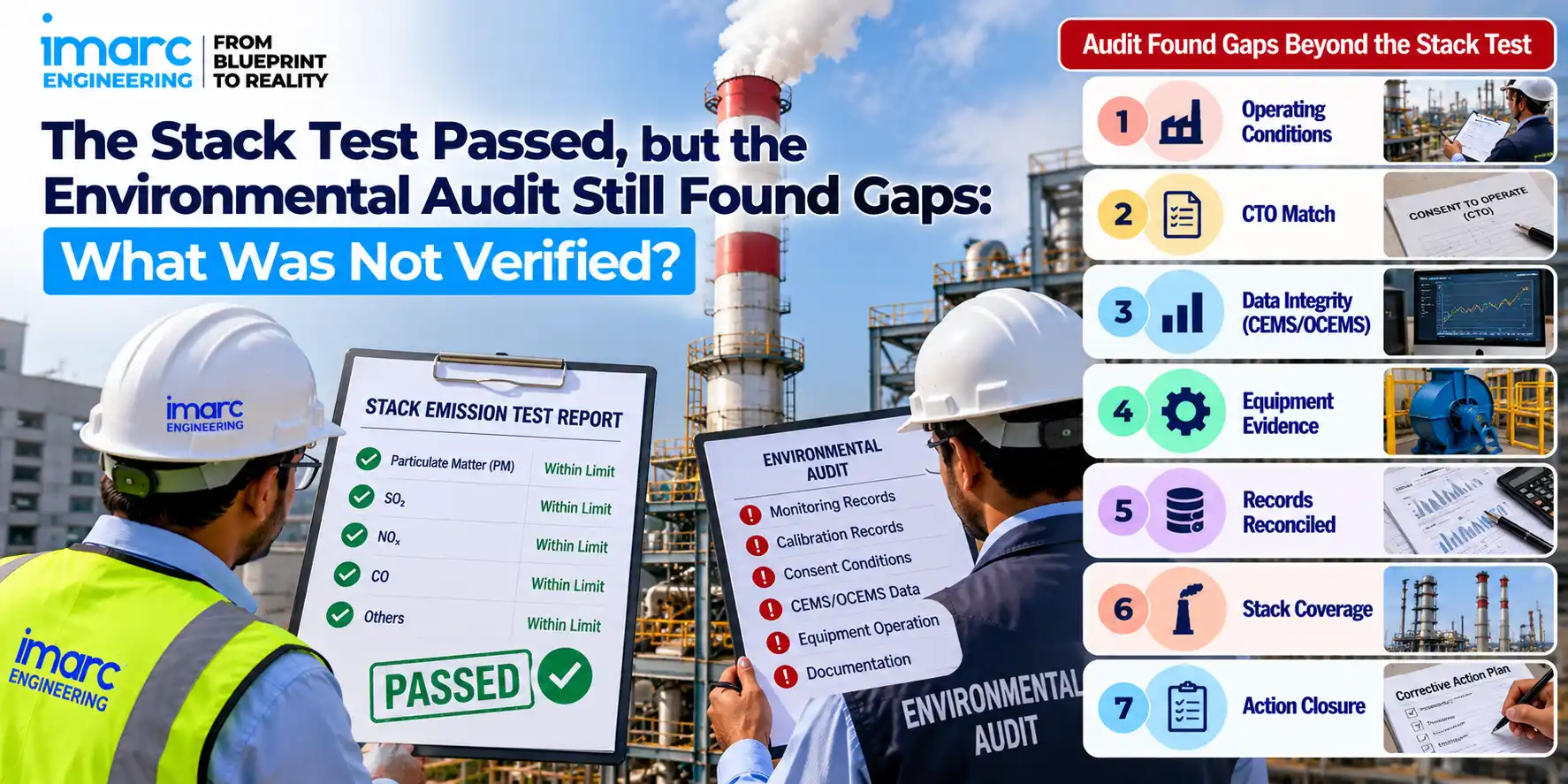
Your stack emission report shows every parameter within limits. Then an environmental compliance audit raises observations about monitoring dates, calibration records or consent conditions. The test may be perfectly valid. It simply answers a narrower question than an audit asks. This article explains what a stack test does and does not verify, where audits commonly find gaps, and how to close them before the next review.
Why a Passing Stack Test Doesn’t Automatically Establish Full Compliance
In simple terms, a passing stack emission test confirms the reported results for the parameters tested during the sampling period. An environmental compliance audit may also examine applicable consent conditions, monitoring frequency, operating records, pollution-control equipment documentation and CEMS/OCEMS data, where required. The exact checks depend on the facility’s applicable regulatory requirements.
An environmental compliance audit looks wider. It asks whether the right parameters were monitored at the right frequency, whether the plant was operating representatively, whether control equipment was running, and whether the records can be traced. A structured review of environmental compliance audit services can help businesses assess these requirements and identify potential documentation or monitoring gaps.
It helps to separate five layers:
- Test result compliance: the measured value against the applicable limit.
- Monitoring-process compliance: sampling method, frequency, stack coverage and laboratory arrangements.
- Consent-condition compliance: whether monitoring matches the plant’s Consent to Operate (CTO) conditions.
- Equipment operation and maintenance evidence: proof that air pollution control equipment was operated and maintained.
- Data integrity and reporting: consistency, traceability and timely submission of records.
These are audit lenses, not legal categories. A plant can satisfy the first and still show gaps in the other four.
What a Stack Test Verifies, and What It May Not
A stack test report generally verifies the concentration of the tested parameters at the sampling location, during the sampling period, using the stated method.
Depending on how the report is written, it may not show:
- whether production load was representative of normal operation
- whether every stack and parameter listed in the CTO was covered
- whether control equipment was operating normally during sampling
- whether fuel or raw material matched typical use
- whether CEMS/OCEMS data, where installed, agrees with manual results
Applicability matters. CEMS/OCEMS requirements depend on the relevant CPCB directions, industry category, applicable standards and conditions imposed by the relevant State Pollution Control Board or Pollution Control Committee. Verify the requirements that apply to your facility rather than assuming that every manufacturing plant has identical online-monitoring obligations.
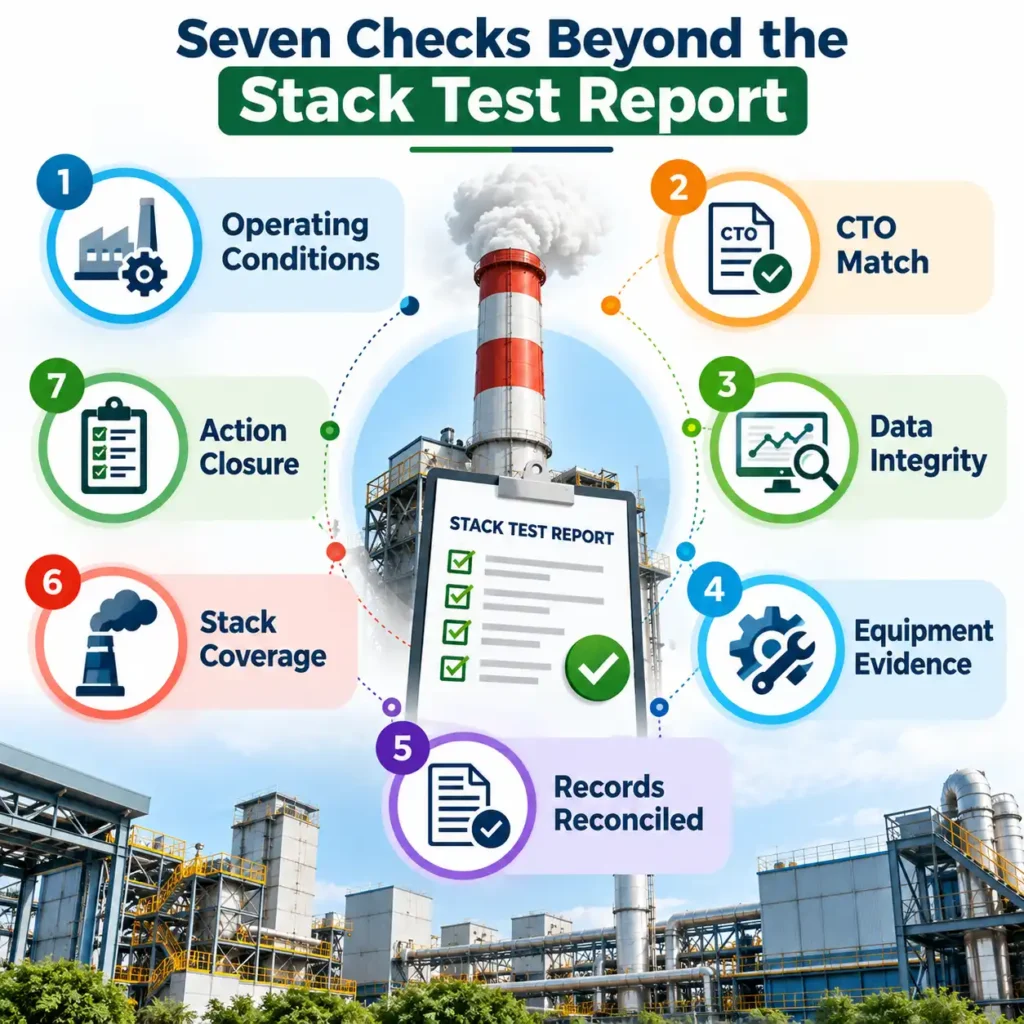
Seven Potential Gaps an Audit May Uncover
These are scenarios to investigate, not universal findings.
1. Operating conditions not demonstrated. The report may not state load, throughput or fuel during sampling. Without this, an auditor cannot judge whether results were representative. Review production logs and the sampling-day schedule, then add an operating-conditions annexure to future reports.
2. Monitoring does not match the CTO. Parameters, frequency or stack coverage in the records may differ from consent conditions. Compare the current CTO line by line with your monitoring calendar and reports.
3. CEMS/OCEMS data gaps, where applicable. Online monitoring systems can experience data gaps, calibration issues or transmission failures. For applicable monitoring systems, CPCB guidelines specify data-capture requirements under the relevant provisions. Verify the requirement applicable to your industry and installation. Review uptime logs, calibration-verification records, flagged readings and transmission logs, and document the reasons for any data gaps.
4. Control-equipment evidence is thin. Equipment may be installed, yet inspection, maintenance and breakdown records are incomplete. A good result achieved while equipment was impaired is hard to defend. Review maintenance logs, pressure-drop or other operating records, and breakdown reports.
5. Records do not reconcile. Production, fuel consumption and emission readings should tell a consistent story. If emissions are low but fuel use is unusually high, an auditor will ask why. Reconcile the three for the same dates.
6. Stack inventory and sampling arrangements. New, modified or standby stacks may be missing from the consent or the monitoring plan. Sampling ports and safe platforms may be inadequate. Walk the plant against the consented stack list.
7. No corrective-action trail. Previous observations may lack owners, dates and closure evidence. Build a register showing assignment, completion and verification.
How to Cross-Check Emission Results Against Plant Operations
Start with the sampling date and time on the report. Then pull production, fuel or process data, and equipment status for exactly that window. Check three things:
- Load or throughput relative to normal operation.
- Fuel or raw-material type matching routine use.
- Control equipment running without alarms or bypass.
If you have CEMS/OCEMS, compare its readings for the same period with the manual result. Material differences deserve an explanation on file.
Hypothetical example (not a real case): A plant’s boiler stack test is within limits. The test report does not record steam load. Production logs show the boiler ran well below its usual load that day. An auditor would reasonably ask whether the result represents routine operation. Keeping load data with each report removes the question.
What to Verify Before the Environmental Audit
Use this as a working checklist:
- Current CTO and its conditions are on file, with the stack list and monitoring requirements extracted.
- Every stack and parameter is mapped to a report and a date.
- Laboratory accreditation and method details are recorded in each report.
- Operating-condition data is filed beside each test report.
- Maintenance and inspection logs cover the equipment tied to each stack.
- CEMS/OCEMS calibration, uptime and transmission records are indexed, where applicable.
- Prior observations have closure evidence.
- Named owners can explain each record.
Stack Test Report vs. Wider Compliance Audit
| Question | Stack test report establishes | Wider audit verifies separately |
|---|---|---|
| Emission value | Measured concentration at the sampled point | Whether it reflects normal operation |
| Scope | Parameters and stacks tested | Whether all consented parameters and stacks are covered |
| Timing | Sampling date | Whether frequency matches the CTO |
| Equipment | May include limited operating details | Reviews relevant operation, inspection and maintenance evidence |
| Online data | May include related readings or references | Reviews applicable calibration, data-capture and transmission requirements |
| Follow-up | May record observations or recommendations | Checks whether corrective actions have been documented and verified |
How to Close Identified Compliance Gaps
- Rank gaps by regulatory exposure and by how easily they can be fixed.
- Assign an owner and a date to each. Unowned findings recur.
- Fix the root cause, such as a missing calendar entry or a report template without operating data, not just the record.
- Verify closure with evidence, not a statement.
- Re-check at the next monitoring cycle.
Keep a single register. It becomes the proof of closure that auditors ask for.
How IMARC Engineering Can Support Environmental Compliance Assessments
IMARC Engineering can support environmental compliance assessments through applicable consent-condition reviews, monitoring-record and documentation checks, CEMS data-integrity review where relevant, and identification and prioritisation of potential compliance gaps. For a stack-test scenario, this may involve mapping applicable CTO conditions to available reports, reviewing supporting operating records and identifying areas that need further verification. The assessment scope and deliverables can be confirmed with the service team.
Explore IMARC Engineering’s environmental compliance audit services to discuss your facility’s requirements: https://www.imarcengineering.com/contact?service=environmental-compliance-audits
Conclusion
A passing stack test is important evidence, but it may not establish that every applicable monitoring, consent and documentation requirement has been met. Reviewing these records together can help plant teams identify potential gaps and prepare a practical corrective-action plan before the next audit.
Need to identify potential gaps before your next environmental audit? Contact IMARC Engineering to discuss an environmental compliance assessment.
FAQs
Can a plant pass a stack test and still receive audit observations? Yes. The test establishes a measured value. Observations can concern frequency, parameters, records, equipment evidence or follow-up actions.
Does every plant need CEMS/OCEMS? No. It depends on CPCB or SPCB directions, industry category, consent conditions and applicable standards. Check your own CTO and any directions addressed to your sector.
Who should perform a CEMS performance audit? CPCB’s guidelines, as summarised by secondary sources, keep performance audits separate from routine calibration and data verification. Confirm the current requirement with your SPCB.
What should accompany a stack test report as audit evidence? Operating-condition data, equipment status, method and laboratory details, and the CTO condition it satisfies.
Contact Us:
IMARC Engineering
Phone: +91-120-433-0800
Email: sales@imarcengineering.com
India: C-130, Sector 2, Noida, Uttar Pradesh 201301
LinkedIn: https://www.linkedin.com/showcase/imarc-engineering/
About the Author