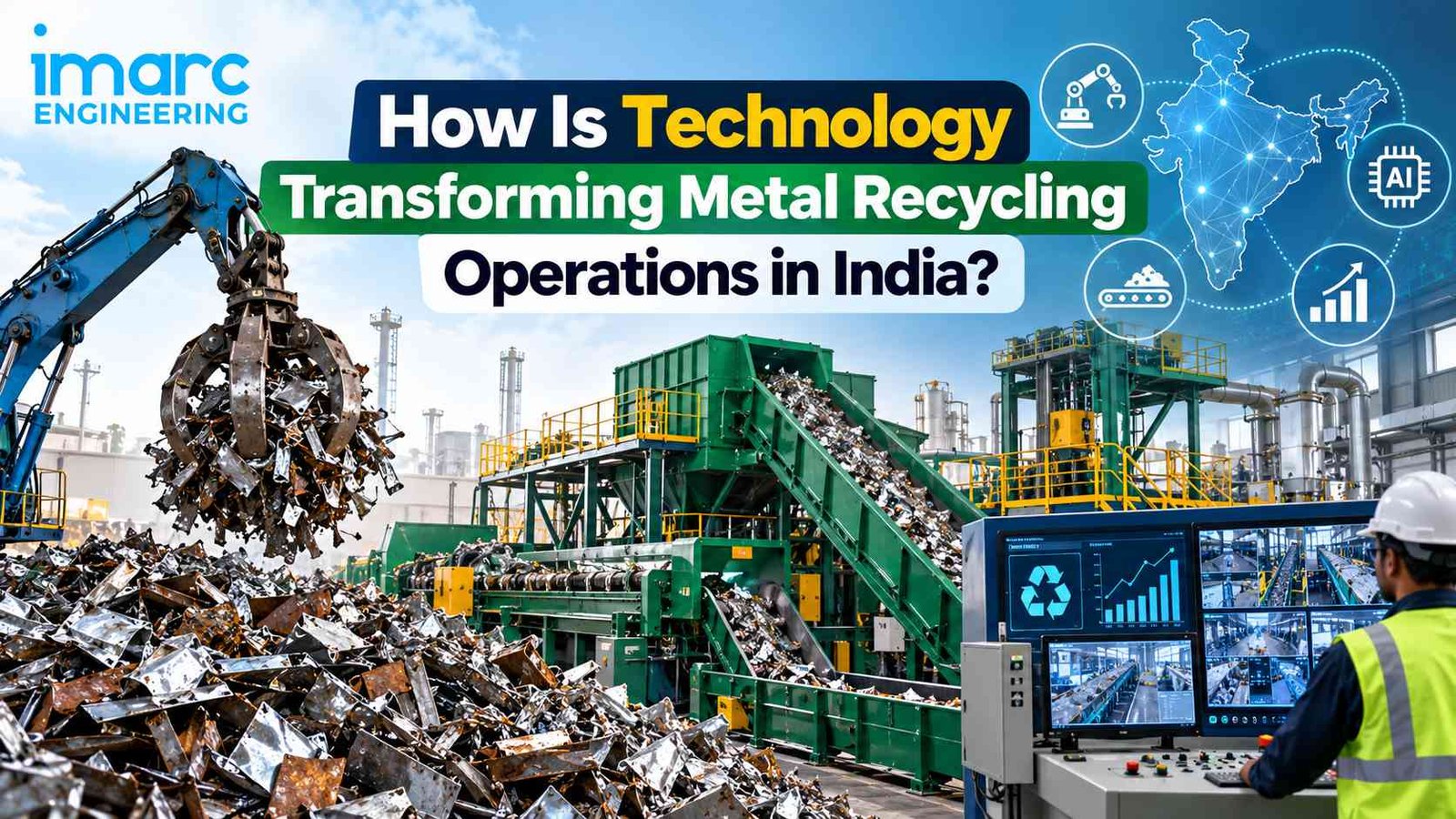
India’s ferrous scrap consumption rose 17% to a record 41 million tonnes in FY26, up from 35 million tonnes in FY25, according to BigMint data. Scrap-based crude steel output grew 16% to 38 million tonnes, outpacing the 11% growth in overall crude steel production.
That growth is raising the standard expected from recyclers. Mills, foundries and OEM customers now want graded, traceable and consistently specified metal, and manual yards cannot deliver it at scale. Sensors, automated separation and digital records are replacing visual grading and handwritten registers.
The shift is visible at every stage of the plant, from the gate to the furnace. This article explains how advanced metal recycling processes work in practice, what each technology delivers in measurable terms, and how investors can adopt them without overbuilding.
How Is Technology Changing Metal Recycling in India?
- Sorting: sensor-based sorters using XRT, XRF and LIBS reach 95-99% purity at 3-15 tonnes per hour per unit.
- Separation: overband magnets recover above 95% of ferrous metal, and eddy current separators recover above 90% of aluminium above 20-30 mm.
- Control: weighbridge-linked records give lot-level traceability and a measurable material recovery rate.
- Safety and emissions: spark detection, thermal imaging, afterburners and bag filters reduce fire and fume risk.
- Economics: feedstock is 65-80% of operating cost, so yield gains from technology move returns more than any other lever.
Why Is Technology Adoption Accelerating in Indian Metal Recycling?
Three FY26 signals explain the momentum.
- Domestic scrap is gaining share: imports fell 19% to an estimated 6.82 million tonnes from 8.45 million tonnes, while domestic scrap generation surged 22%.
- Policy support is building: the Ministry of Steel is finalising a national steel scrap recycling policy to replace the 2019 guidelines and aims to lift scrap’s share in steel production to the global average of 31%.
- Demand is being formalised: the government has proposed raising the steel scrap ratio to 10% under the EPR framework for the auto sector.
Higher volumes with tighter specifications make contamination expensive. Radiation screening of every incoming load is now standard practice, and a single oversized or prohibited item can damage a shredder rotor. Technology is therefore a risk-control tool as much as an efficiency tool.
Which Technologies Are Used in a Modern Metal Recycling Plant?
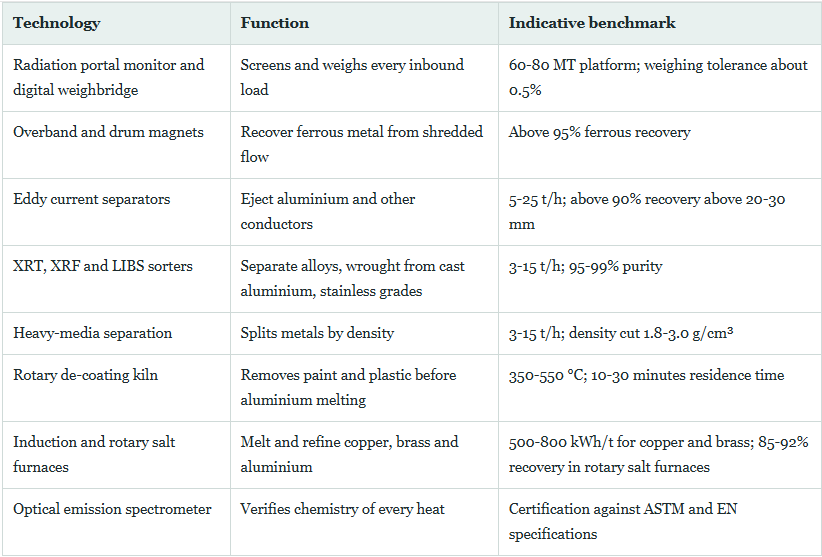
The table below summarises the main technologies, their function and typical performance benchmarks.
How Does Sensor-Based Sorting Improve Metal Recovery?
Magnets and eddy currents handle bulk separation, but the highest value sits in alloy-level sorting. XRT and XRF sorters split wrought from cast aluminium and break Zorba into higher-value fractions. Inductive sorters separate 304 from 316 stainless steel, and LIBS units identify specific alloy families.
Performance depends on preparation. Separation efficiency across all technologies falls below roughly 10-20 mm particle size, so screening into defined cuts before sorting is essential. Jet ejectors also need clean, dry compressed air at 6-8 bar. Plants that skip these basics rarely reach the 95-99% purity that sorters are rated for.
How Are Digital Systems Improving Traceability and Control?
A modern plant is also a documentation plant. Data captured at the weighbridge, shredder feed scale and spectrometer links each lot to a heat or bale number.
- Supplier weight is reconciled against plant weight to within about 0.5%, protecting margin and preventing disputes.
- Programmable logic control and supervisory monitoring track run hours, downtime and faults at modest cost.
- Variable-frequency conveyors match throughput to downstream machines and save energy.
- The same records support statutory returns, hazardous-waste manifests and OEM evidence of recycled content.
Daily reconciliation of input weight against output weight produces a material recovery rate, which is the single most useful operating metric in the plant.
What Technologies Make Metal Recycling Cleaner and Safer?
Fire is the highest-frequency risk in scrap processing, because lithium-ion batteries, aerosols and sealed containers ignite shredder and bale fires. Spark detection with water spray on the shredder infeed, thermal imaging of stored piles and fire walls every 3,000 square metres of storage are now core design features.
- Air: secondary aluminium melting is a recognised source of dioxins and furans, so furnace off-gas needs an afterburner and bag filter, with activated carbon injection for coated or oily scrap. Larger units may need continuous emission monitoring.
- Dust: cyclones and pulse-jet bag filters of 20,000-150,000 m³/h capture shredder particulate.
- Water: 70-90% of process water is recycled, and reverse osmosis at 60-75% recovery supports zero liquid discharge where states require it.
The Technology Chain from Gate to Furnace
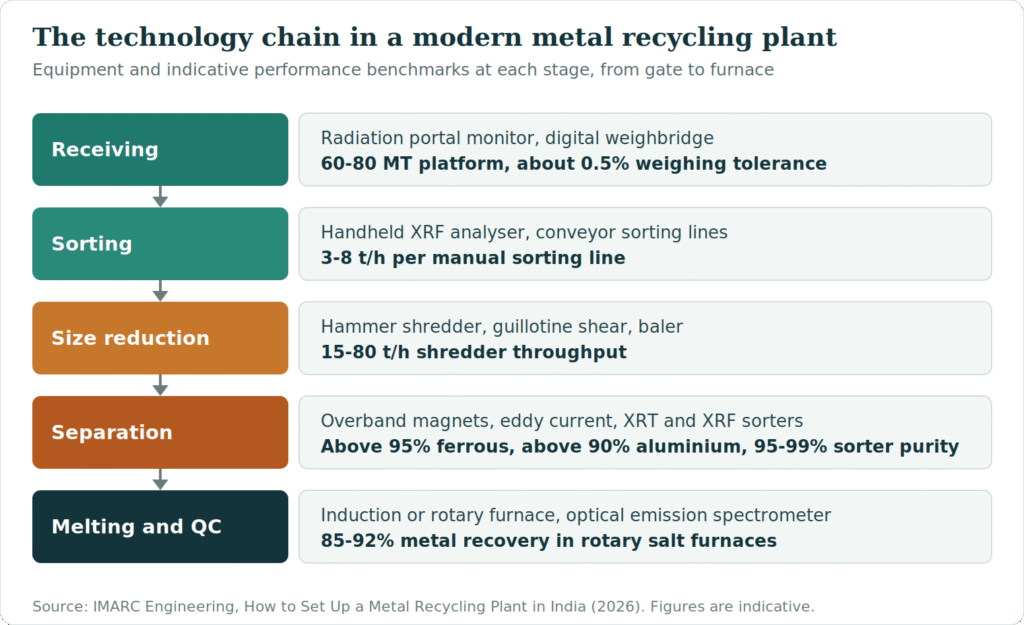
The infographic below shows how these technologies connect, with the indicative performance at each stage.
What Does Technology Adoption Mean for Plant Economics?
- Spread sensitivity: a 2-4% movement in the purchase-to-sale spread can swing returns more than any equipment upgrade, which is why recovery rate matters.
- Utilisation: capacity should be planned around the bottleneck machine at 60-75% utilisation, not nameplate ratings.
- Residue: shredder residue is 10-25% of output, so post-shredder treatment recovers extra non-ferrous metal.
- Retrofit cost: re-engineering layout, utilities or pollution control after commissioning typically adds 10-20% to original CAPEX.
- Investment range: indicative project costs run from INR 1.5-3 crore for a segregation yard and INR 20-40 crore for a ferrous shredding plant to INR 55-95 crore for an integrated plant with melting.
How Can Recyclers Bring New Technology into the Plant?
Many of these systems, including sensor-based sorters, rotary degassers and fume treatment, depend on process know-how held by specialist or overseas suppliers. Structured technology transfer services help recyclers evaluate options, agree licensing and training terms, and move a proven process into operation without costly trial and error.
The practical rule is to define the product specification first and select technology to match it. A sorter bought before the output grade is fixed is often the first machine to sit idle.
How IMARC Engineering’s Expertise Can Help in Metal Recycling Operations
- Feasibility studies covering scrap availability, product mix, capacity and project economics.
- Plant layout and process flow design for single-direction material movement.
- Equipment selection and technical specification drafting for shredders, separators and furnaces.
- Utilities, effluent and pollution-control planning aligned with consent conditions.
- Regulatory approvals and turnkey project management through commissioning.
Get in Touch With Our Team: https://www.imarcengineering.com/contact-us
Conclusion
Technology is turning Indian metal recycling from a grading-and-trading activity into a precise, data-led operation. With ferrous scrap consumption at a record 41 million tonnes in FY26 and specifications tightening, plants that invest in sensor-based sorting, traceable records and cleaner melting will protect yield and margin. Define the product specification first, then match technology to it. Recyclers who plan this way will be best placed as the national scrap policy takes shape.
Frequently Asked Questions
How is technology used in metal recycling in India?
Technology is used for radiation screening, automated weighing, magnetic and eddy current separation, sensor-based alloy sorting, de-coating, melting, spectrometer-based quality control and emission control.
What is sensor-based sorting in metal recycling?
Sensor-based sorting uses XRT, XRF, inductive or LIBS sensors to identify alloys and eject them with compressed air jets, reaching 95-99% purity at 3-15 tonnes per hour per unit.
Why is traceability important for metal recyclers?
Lot-level records support recovery-rate calculation, statutory returns, hazardous-waste manifests and OEM requirements for documented recycled content.
How much does an advanced metal recycling plant cost in India?
Indicative costs range from INR 1.5-3 crore for a segregation yard to INR 55-95 crore for an integrated plant with melting and casting.
Contact Us:
IMARC Engineering
Phone: +91-120-433-0800
Email: sales@imarcengineering.com
India: C-130, Sector 2, Noida, Uttar Pradesh 201301
LinkedIn: https://www.linkedin.com/showcase/imarc-engineering/
About the Author