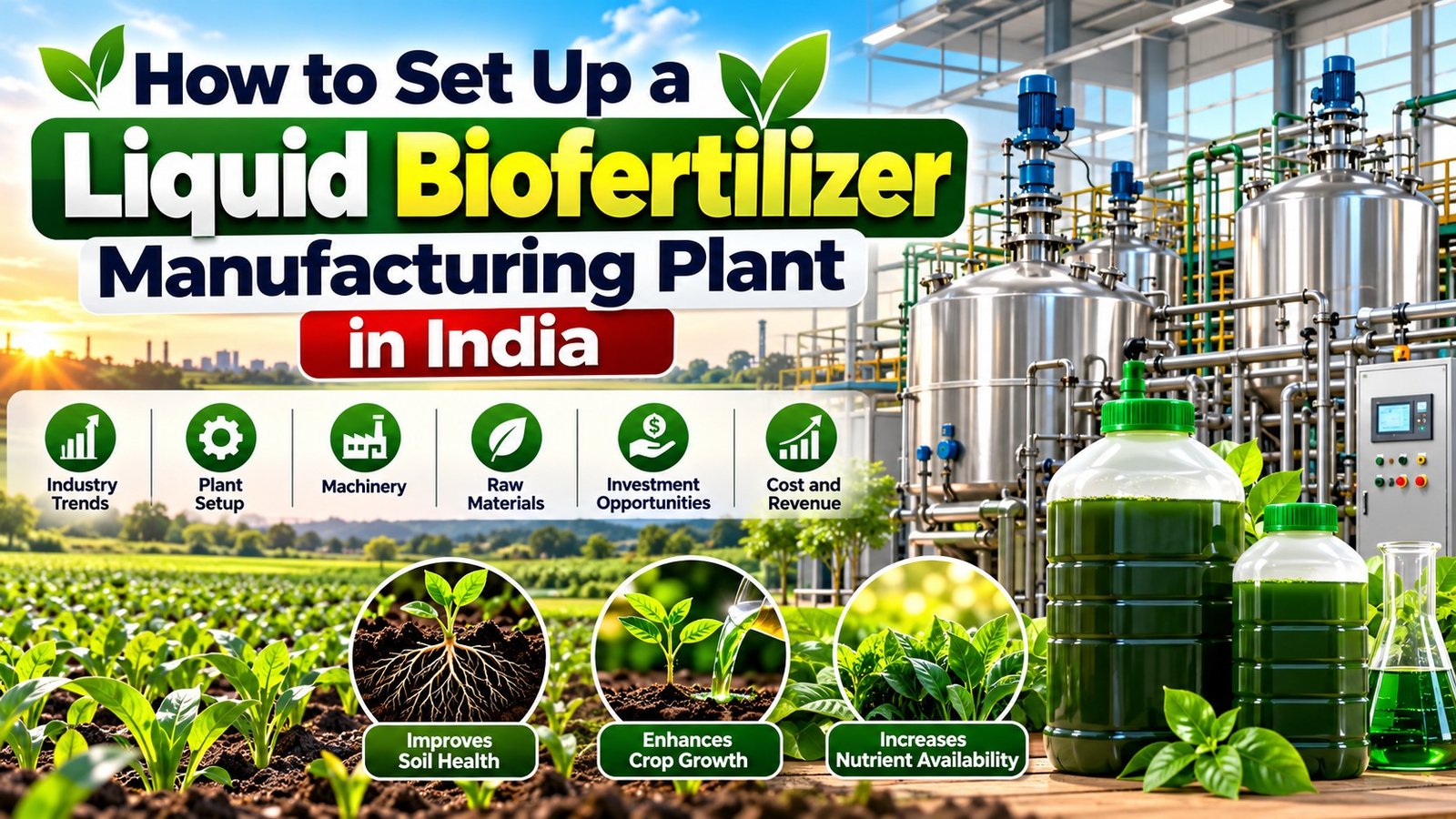
Setting up a liquid biofertilizer manufacturing plant in India presents a compelling investment case as agriculture, horticulture, organic farming, greenhouse cultivation, plantation crops, seed treatment and soil health management move toward biological crop nutrition. Liquid biofertilizers carry beneficial microorganisms that fix atmospheric nitrogen, solubilise phosphorus and mobilise potassium, helping growers lift productivity while reducing dependence on synthetic fertilizers. That makes them central to productive, sustainable farming across cereals, pulses, oilseeds, fruits and vegetables.
India’s case rests on rising demand for organic inputs and continuous innovation in microbial technologies. According to the Indian Council of Agricultural Research (ICAR), the Indian biofertilizer market is projected to grow at a CAGR of approximately 8.7–12% through 2030, while Asia-Pacific already holds 54.8% of the global market. With government initiatives backing integrated nutrient management and soil health, India is a strategically sound base for production.
Government support for bio-based inputs, expanding organic and high-value crop demand, and gross margins of 30–40% build a strong investment case. With raw materials at 40–50% of operating expenses and capacity flexible between 500–2000 KL a year, break-even viability improves as utilisation rises.
What is Liquid Biofertilizer?
Liquid biofertilizer is a biologically active agricultural input containing carefully selected beneficial microorganisms suspended in a nutrient-rich liquid medium. These microorganisms fix atmospheric nitrogen, solubilise phosphorus, mobilise potassium and produce growth-promoting substances that stimulate root development and nutrient uptake. The product offers high microbial viability, uniform field distribution and compatibility with modern irrigation systems. The liquid biofertilizer manufacturing process is fermentation-based, moving from microbial strain selection and inoculum preparation to sterilisation, biomass multiplication, formulation, aseptic filling and packaging. End-use industries include agriculture, horticulture, organic farming, greenhouse cultivation, plantation crops, seed treatment and soil health management.
Cost of Setting Up a Liquid Biofertilizer Manufacturing Plant in India
The cost of a liquid biofertilizer manufacturing plant depends on capacity, technology, location, automation and regulatory compliance.
1. Capital Expenditure (CapEx)
Machinery accounts for the largest share of capital expenditure. Land and site development covers land registration and boundary development, and SEZ or industrial estate sites can be compared. Civil works include the production shed, laboratory, storage and administrative block. The layout should keep raw material storage, production, quality control and finished goods storage in separate areas, with space reserved for future expansion. Other capital costs cover effluent treatment, pre-operative expenses, commissioning and import duties where applicable.
Key machinery required includes:
- Microbial culture vessels
- Media preparation tanks
- Sterilizers
- Seed fermenters
- Industrial bioreactors
- Air compressors
- Filtration systems
- Mixing tanks
- Formulation vessels
- Aseptic filling machines
- Storage tanks
- Quality control laboratory equipment
- CIP/SIP systems
- Cold storage units
- Automated packaging machines
- Material handling equipment
- Process automation systems
Request a Sample Report for In-Depth Market Insights: https://www.imarcgroup.com/liquid-biofertilizer-manufacturing-plant-project-report/requestsample
2. Operational Expenditure (OpEx)
Raw materials account for 40–50% of OpEx and include microbial strains (azospirillum, rhizobium, azotobacter etc.), molasses or yeast extract as the carrier medium, deionized water and pH stabilizers or additives. Long-term supplier contracts help stabilise pricing and supply. Utilities such as electricity, water and steam take 15–20% of OpEx. Other costs include transportation, packaging, salaries and wages, repairs and maintenance, depreciation and taxes. By the fifth year, total operating cost is expected to rise substantially because of inflation, market fluctuations, higher material costs, supply chain disruptions and shifts in the global economy.
3. Plant Capacity
The proposed facility is designed for an annual capacity of 500–2000 KL, balancing economies of scale with operational flexibility. Capacity can be customised to investor requirements, and profitability improves with higher capacity utilisation. Reliable site infrastructure, including transport, utilities and waste management, supports steady output.
4. Profit Margins and Financial Projections
The project shows healthy profitability under normal operating conditions, with gross profit margins of 30–40% and net profit margins of 12–20%. Financial projections cover NPV, IRR, payback period and ROI, built on realistic assumptions for capital investment, operating costs, capacity utilisation, pricing and demand.
Why Set Up a Liquid Biofertilizer Plant in India?
Growing Preference for Sustainable Farming. Soil degradation and excessive chemical fertilizer use are pushing farmers toward biological nutrient management that improves productivity while protecting natural resources.
Expansion of Organic Agriculture. Rising consumer demand for organically produced food and growing certified organic cultivation create commercial openings for manufacturers in domestic and international markets.
Policy and Regulatory Tailwinds. Government initiatives promoting integrated nutrient management, soil health improvement and sustainable agriculture continue to encourage the production and adoption of liquid biofertilizers.
Cost-Competitive Manufacturing. A 500–2000 KL capacity enables economies of scale, while raw materials at 40–50% of OpEx and utilities at 15–20% define a clear cost structure supporting 30–40% gross margins.
Active Industry Investment. In May 2025, a study in the journal Microorganisms found that liquid biofertilizer application enhanced plant growth, improved antioxidant activity and benefited soil bacteria in Chinese cabbage cultivation. Manufacturers are also investing in advanced microbial consortia and formulation technologies.
Local Supply Chain Preference. Sites close to raw material suppliers and target markets reduce transportation and distribution costs, while longer shelf life and easier transportation make liquid formulations increasingly preferred by growers.
Manufacturing Process – Step by Step
The liquid biofertilizer manufacturing process uses microbial fermentation as the primary production method.
- Microbial Strain Selection: Beneficial strains are chosen for nitrogen fixation, phosphate solubilisation and potassium mobilisation.
- Inoculum Preparation: Selected cultures are multiplied in microbial culture vessels.
- Media Sterilization: Culture medium is prepared in media preparation tanks and sterilised, supported by CIP/SIP systems.
- Fermentation: Seed fermenters and industrial bioreactors, with air compressors and filtration systems, grow the culture.
- Biomass Multiplication: Microbial biomass is scaled up under controlled conditions.
- Formulation: Biomass is blended with the liquid carrier and stabilizers in mixing tanks and formulation vessels.
- Quality Testing: Laboratory equipment evaluates the product against quality assurance criteria and technical tests.
- Aseptic Filling and Packaging: Aseptic filling machines and automated packaging machines pack the product, with storage tanks and cold storage units holding stock.
- Dispatch: Finished product moves to agriculture, horticulture, organic farming, greenhouse cultivation, plantation crops, seed treatment and soil health management users.
Key Applications
Liquid biofertilizers serve a wide range of crop and soil management uses:
- Field Crop Production: Improves nutrient availability and root development in cereal, pulse and oilseed cultivation.
- Horticulture & Fruit Cultivation: Supports orchards, vegetable farms, floriculture and nurseries with better blooming, fruit quality and plant vigor.
- Organic Farming: Maintains soil fertility and microbial diversity without synthetic chemical inputs.
- Seed Treatment & Fertigation: Applied through seed coating, drip irrigation and fertigation for uniform microbial distribution.
- Soil Health Restoration: Restores beneficial microbial populations and supports regenerative agriculture.
Leading Manufacturers
Several multinational companies lead the global liquid biofertilizer industry:
- Chema Industries
- Gujarat State Fertilizers & Chemicals
- Rizobacter Argentina SA
- Koppert
- Lallemand
Timeline to Start the Plant
- Feasibility study and project report preparation
- Land acquisition and site development
- Regulatory approvals and environmental clearances
- Factory licence and fire safety compliance
- Machinery procurement and installation
- Raw material supplier agreements and supply chain setup
- Trial production and quality testing
- Commercial production launch
Licences and Regulatory Requirements
Starting a liquid biofertilizer manufacturing unit in India requires several approvals:
- Business registration (Proprietorship, LLP, or Pvt Ltd)
- Factory Licence under the Factories Act
- Environmental Clearance from State Pollution Control Board
- GST Registration
- Fire Safety NOC
- Effluent Treatment Plant (ETP) operational clearance
- Occupational Health and Safety compliance
Key Challenges to Consider
- High Capital Requirements: A liquid biofertilizer manufacturing plant needs heavy machinery investment, with bioreactors, fermenters and sterilizers forming the largest cost.
- Raw Material Price Volatility: Microbial strains, molasses or yeast extract, deionized water and pH stabilizers can fluctuate in price; long-term contracts help.
- Regulatory Compliance: Safety protocols, effluent treatment and emission standards must be met throughout production, supported by documented SOPs, traceability, regular audits and corrective action frameworks.
- Technology or Innovation Pressure: Manufacturers keep investing in advanced microbial consortia and formulation technologies.
- Competition: Established players include Chema Industries, Gujarat State Fertilizers & Chemicals, Rizobacter Argentina SA, Koppert and Lallemand.
- Skilled Manpower: Fermentation, aseptic filling and quality control need trained staff; training also helps control operating costs.
Frequently Asked Questions
1. How much does it cost to set up a liquid biofertilizer manufacturing plant in India?
The total depends on capacity, technology and location, with machinery as the largest CapEx component.
2. Is liquid biofertilizer manufacturing profitable in India in 2026?
The project shows gross margins of 30–40% and net margins of 12–20% under normal operating conditions.
3. What machinery is required for a liquid biofertilizer plant in India?
Core equipment includes culture vessels, seed fermenters, industrial bioreactors, sterilizers, formulation vessels, aseptic filling machines and CIP/SIP systems.
4. What licences and approvals are required to start a liquid biofertilizer plant in India?
Business registration, factory licence, environmental clearance, GST registration, fire safety NOC and ETP clearance are needed.
5. What raw materials are needed for liquid biofertilizer manufacturing?
Microbial strains, molasses or yeast extract, deionized water and pH stabilizers, together 40–50% of OpEx.
6. What are the environmental compliance requirements for a liquid biofertilizer plant in India?
Effluent treatment systems and process monitoring must meet emission standards, alongside State Pollution Control Board clearance.
7. What is the best location to set up a liquid biofertilizer plant in India?
Choose a site near raw materials and target markets, with reliable transport, utilities, waste management and compliant zoning.
8. What is the break-even period for this type of plant in India?
It depends on capacity utilisation, capital investment and operating costs; payback period is modelled in the financial analysis.
9. What government incentives are available for manufacturers in India?
Initiatives promote integrated nutrient management, soil health and sustainable agriculture; verify scheme eligibility and current terms with the relevant authorities before committing capital.
Key Takeaways for Investors
A liquid biofertilizer manufacturing plant in India taps demand from agriculture, horticulture, organic farming, greenhouse cultivation, plantation crops, seed treatment and soil health management. Financial viability holds across the 500–2000 KL capacity range, with 30–40% gross and 12–20% net margins. Asia-Pacific holds 54.8% of the global market, and ICAR projects Indian biofertilizer growth of 8.7–12% CAGR through 2030. As sustainable farming expands, demand for microbial crop nutrition should stay resilient.
About the Author