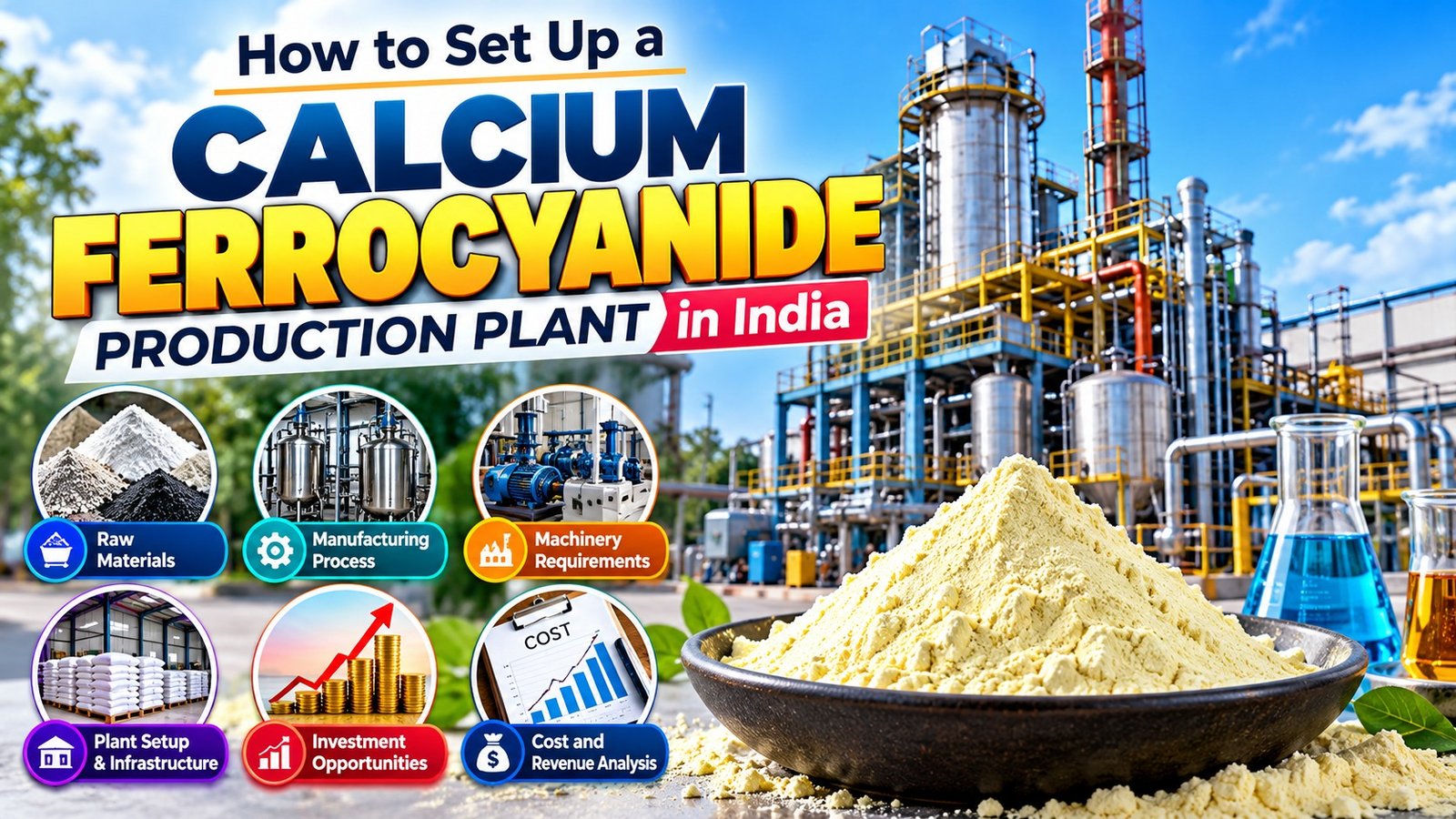
Setting up a calcium ferrocyanide production plant in India presents a compelling investment case, driven by demand from chemical production, pigments and dyes, metal treatment, water treatment, and specialty chemicals. Calcium ferrocyanide is an odorless, yellow crystalline compound used primarily as an anti-caking agent, and it also serves as a precursor for Prussian blue pigment, making it an essential specialty chemical for industrial uses.
India’s food sector adds a strong demand pull. The Indian food processing market reached Rs. 30,49,800 crore (USD 354.5 Billion) in 2024 and is expected to grow to Rs. 4,584,415 crore (USD 535 Billion) by the end of FY26, according to IBEF. Because the compound is added to table salt to keep it free-flowing, and is also used in seasoning blends and powdered foods, a growing processed-food base supports steady offtake, while government support for domestic production and import substitution strengthens the case for local capacity.
This plant’s investment case is anchored in processed-food and industrial chemical demand, gross margins of 26–34%, and a capacity range of 500–2,000 MT that lets the facility scale to market reach while working toward measurable payback through NPV and ROI analysis.
What is Calcium Ferrocyanide?
Calcium ferrocyanide is an odorless, yellow crystalline compound, also known as yellow prussiate of lime. It is primarily used as an anti-caking agent (INS No. E538) added to table salt to keep it free-flowing. The iron and cyanide groups in the compound are strongly bonded, making it practically non-toxic to humans, and it is also a precursor for Prussian blue pigment.
The calcium ferrocyanide production process involves reacting hydrogen cyanide with ferrous chloride, neutralizing with calcium hydroxide, then crystallizing, filtering, drying, and packaging. Output serves chemical production, pigments and dyes, metal treatment, water treatment, and specialty chemicals.
Cost of Setting Up a Calcium Ferrocyanide Production Plant in India
Cost depends on capacity, technology, location, automation, and regulatory compliance.
1. Capital Expenditure (CapEx)
CapEx begins with land and site development, including land registration, boundary development, and related expenses, with options such as industrial estates or SEZ-linked plots. Civil works cover raw material storage, the production area, quality control, and finished goods storage, with space designated for future expansion.
Machinery costs account for the largest portion of total capital expenditure. Key machinery required includes:
- Reaction vessels
- Raw material storage tanks
- Dosing systems
- Agitators
- Crystallizers
- Filtration units
- Centrifuges
- Drying systems
- Storage silos
- Packaging machines
Other capital costs include effluent treatment, pre-operative expenses, and commissioning costs.
Request a Sample Report for In-Depth Market Insights: https://www.imarcgroup.com/calcium-ferrocyanide-manufacturing-plant-project-report/requestsample
2. Operational Expenditure (OpEx)
OpEx is driven primarily by raw material consumption. Hydrogen cyanide, ferrous chloride, and calcium hydroxide together account for approximately 52-60% of total operating expenses, making long-term supplier contracts important for stable pricing and supply. Utility cost — electricity, water, and steam — accounts for 10-14% of OpEx.
Other costs include transportation, packaging, salaries and wages, depreciation, and taxes. Total operational cost is expected to rise from year one to year five due to inflation, market fluctuations, and potential rises in the cost of key materials.
3. Plant Capacity
The facility is designed for an annual production capacity ranging between 500-2,000 MT, enabling economies of scale while maintaining operational flexibility. Capacity can be customised to individual investor requirements, and profitability generally improves with higher capacity utilisation.
4. Profit Margins and Financial Projections
Financial projections cover capital investment, operating costs, capacity utilisation, pricing trends, and demand outlook, including ROI, NPV, and payback analysis. Gross profit margins typically range between 26-34%, while net profit margins range between 9-15%, giving a realistic basis for assessing viability.
Why Set Up a Calcium Ferrocyanide Production Plant in India?
Essential Specialty Chemical. Calcium ferrocyanide is an essential specialty chemical for industrial uses, spanning anti-caking, pigment intermediate, metal treatment, laboratory reagent, and specialty ferrocyanide precursor applications.
Processed Salt and Food Additive Demand. Demand is linked to processed salt, specialty food additives, water treatment, and chemical intermediates, with anti-caking use in table salt, seasoning blends, and powdered foods.
India’s Expanding Food Processing Market. The Indian food processing market reached Rs. 30,49,800 crore (USD 354.5 Billion) in 2024 and is expected to reach Rs. 4,584,415 crore (USD 535 Billion) by the end of FY26, according to IBEF, supporting a growing domestic base for anti-caking agents.
Policy and Import Substitution Support. Government support for domestic production and import substitution creates opportunities for local manufacturers of specialty chemicals.
Moderate but Justifiable Entry Barriers. Purity specifications, controlled reactions, and cyanide handling and compliance requirements create entry hurdles that favour experienced, quality-focused producers.
Local Supply Chain Preference. Buyers prefer reliable regional suppliers with consistent quality, opening opportunities for domestic producers with efficient sourcing and production.
Production Process – Step by Step
The calcium ferrocyanide production process uses reaction, crystallization, and filtration as its primary production method.
- Raw Material Storage: Hydrogen cyanide, ferrous chloride, and calcium hydroxide are held in raw material storage tanks.
- Reaction: Hydrogen cyanide is reacted with ferrous chloride in reaction vessels, with dosing systems and agitators controlling the reaction.
- Neutralization: The reaction mixture is neutralized with calcium hydroxide.
- Crystallization: Crystallizers form calcium ferrocyanide crystals from the neutralized solution.
- Filtration: Filtration units and centrifuges separate the crystals from the liquid.
- Drying: Drying systems remove residual moisture from the crystals.
- Quality Testing: Output is checked against quality assurance criteria and technical tests for purity.
- Storage and Packaging: Storage silos and packaging machines prepare the product for dispatch to chemical, pigment, metal treatment, and water treatment customers.
Key Applications
Calcium ferrocyanide output serves a wide range of downstream industries.
- Anti-Caking Agent: Keeps table salt, seasoning blends, and powdered foods free-flowing.
- Pigment Intermediate: Acts as a precursor for Prussian blue pigment.
- Metal Treatment Chemical: Used in metal treatment processes.
- Laboratory Reagent: Used as a reagent in laboratory work.
- Specialty Chemical Precursor: Serves as a precursor for specialty ferrocyanide compounds.
- Water Treatment: Removes heavy metal and radioactive contaminants through precipitation.
Leading Manufacturers
Leading manufacturers in the global calcium ferrocyanide industry include several multinational companies with extensive production capacities, including:
- BASF
- Lanxess
- Solvay
Timeline to Start the Plant
- Feasibility study and project report preparation
- Land acquisition and site development
- Regulatory approvals and environmental clearances
- Factory licence and fire safety compliance
- Machinery procurement and installation
- Raw material supplier agreements and supply chain setup
- Trial production and quality testing
- Commercial production launch
Licences and Regulatory Requirements
Starting a calcium ferrocyanide production unit in India requires several approvals:
- Business registration (Proprietorship, LLP, or Pvt Ltd)
- Factory Licence under the Factories Act
- Environmental Clearance from State Pollution Control Board
- GST Registration
- Fire Safety NOC
- Hazardous/Chemical compliance for cyanide handling
- Effluent Treatment Plant (ETP) operational clearance
- Occupational Health and Safety compliance
Key Challenges to Consider
High Capital Requirements. Reaction vessels, crystallizers, centrifuges, and drying systems represent significant upfront investment for new entrants.
Raw Material Price Volatility. Hydrogen cyanide, ferrous chloride, and calcium hydroxide account for 52-60% of OpEx, so price swings directly affect profitability.
Regulatory Compliance. Cyanide handling and compliance requirements, along with environmental clearances, demand ongoing attention and resourcing.
Purity and Process Control Pressure. Purity specifications and controlled reactions require consistent process control, and technological advances that improve purity and efficiency while reducing environmental impact are raising expectations.
Competition from Established Players. Global producers such as BASF, Lanxess, and Solvay operate extensive production capacities, creating a competitive landscape.
Skilled Manpower. Operating specialised equipment and managing controlled chemical reactions requires trained technical staff.
Frequently Asked Questions
1. How much does it cost to set up a calcium ferrocyanide production plant in India?
Cost depends on capacity, machinery, automation, and site development, covering land, civil works, machinery, and other capital costs.
2. Is calcium ferrocyanide production profitable in India in 2026?
Gross profit margins of 26-34% and net profit margins of 9-15% are typical, supported by demand from salt, food, and industrial applications.
3. What machinery is required for a calcium ferrocyanide plant in India?
Reaction vessels, raw material storage tanks, dosing systems, agitators, crystallizers, filtration units, centrifuges, drying systems, storage silos, and packaging machines.
4. What licences and approvals are required to start a calcium ferrocyanide plant in India?
Business registration, a Factory Licence, Environmental Clearance, GST Registration, Fire Safety NOC, hazardous/chemical compliance, ETP clearance, and occupational health and safety compliance.
5. What raw materials are needed for calcium ferrocyanide production?
Hydrogen cyanide, ferrous chloride, and calcium hydroxide.
6. What are the environmental compliance requirements for a calcium ferrocyanide plant in India?
Environmental Clearance from the State Pollution Control Board, an operational ETP, and compliance covering cyanide handling and occupational safety.
7. What is the best location to set up a calcium ferrocyanide plant in India?
Sites offering proximity to raw materials, infrastructure and transportation access, and labour availability, subject to local zoning and environmental regulations.
8. What is the break-even period for this type of plant in India?
Break-even depends on capacity utilisation and the CapEx-OpEx structure, and is assessed through payback period, NPV, and ROI analysis.
9. What government incentives are available for manufacturers in India?
Government support for domestic production and import substitution benefits local specialty chemical manufacturers; specific schemes should be verified against current policy for the chosen site.
Key Takeaways for Investors
This plant taps into consistent demand from chemical production, pigments and dyes, metal treatment, water treatment, and specialty chemicals. Financial viability holds across the 500-2,000 MT capacity range, with gross margins of 26-34% and net margins of 9-15%. The global calcium ferrocyanide market, valued at USD 158.00 Million in 2025 and projected to reach USD 292.93 Million by 2034 at a CAGR of 7.1%, underscores sustained demand. With India’s food processing market projected to reach USD 535 Billion by the end of FY26, demand for calcium ferrocyanide production capacity is set to remain durable beyond the current investment cycle.
About the Author