When a manufacturer develops a new product, one question arrives before any other compliance decision: which Indian Standard applies, and is BIS certification in India even mandatory for this product? A product can sit close to two or three Indian Standards at once, a Quality Control Order (QCO) may or may not cover the exact category, and standards get revised or replaced over time. Getting this wrong is not a minor inconvenience — testing against the wrong standard, applying under an outdated revision, or missing an applicable QCO can lead to rejected applications, repeated testing, documentation rework and weeks of avoidable delay.
This article helps manufacturers work through that uncertainty in a structured way, before any testing or application activity begins — covering how to define a new product accurately, identify the applicable Indian Standard, check that standard’s scope, verify whether a QCO applies, understand testing and documentation requirements, and assess factory readiness ahead of certification.
Why Identifying the Correct Indian Standard Comes First
Before asking how to get BIS certification, first determine which Indian Standard and regulatory requirement applies to the exact product. Standard identification has to happen before testing, documentation and certification activity — not alongside it — because every downstream step depends on it. The test lab needs the correct standard and test methods. The documentation team needs the correct clauses to prepare against. The factory needs to know which process controls the scheme expects. If the standard identified at the start turns out to be wrong or outdated, all of this work has to be revisited.
A product name alone rarely settles the question. Two products with the same commercial name can fall under different standards depending on intended use, specifications, classification, materials and sometimes the manufacturing process itself. Manufacturers need to check the standard’s current revision, its scope clause, and whether a QCO has brought that category under compulsory certification — BIS standards are largely voluntary unless a specific government order makes them mandatory for a defined product category.
Takeaway: Before asking how to get BIS certification, first determine which Indian Standard and regulatory requirement applies to the exact product.
Step 1 — Define the Product Before Searching for a Standard
A precise product definition is the foundation of correct standard identification. Before searching for an Indian Standard, a manufacturer should document:
- Product name and technical (not just commercial) description
- Intended application and end use
- Product category or type within its broader class
- Raw materials, components and technical specifications
- Dimensions, capacity or rating, where relevant
- Performance characteristics and manufacturing process
- End-use sector and packaging/marking information
Searching by commercial product name alone is a common source of error. Brand names and trade terminology don’t map cleanly to Indian Standard titles or scope clauses. A “smart plug” or a “premium steel pipe” is not a technical classification — BIS standards are written around material, construction, rating and application, so it’s the underlying technical definition that needs to be matched, not the label used to sell the product.
Step 2 — Check Whether a BIS Standard Exists for the Product
Once the product is clearly defined, the next step is to check whether an Indian Standard exists for it, using official BIS resources such as the BIS standards catalogue and product certification information published on bis.gov.in. For each candidate standard, verify:
- Standard number and full title
- Scope clause and the products it is intended to cover
- Product variants included or excluded
- Current version or revision year
- Applicable amendments issued after the original publication
Finding a similar-looking standard does not prove applicability. Verify its scope, current revision and product coverage against the technical definition established in Step 1.
Step 3 — Check Whether BIS Certification Is Mandatory
Is BIS certification mandatory for a given product? It depends on whether the product falls under a current Quality Control Order. BIS product certification is, by design, largely voluntary — manufacturers can choose to obtain the ISI mark to demonstrate conformity to an Indian Standard. However, the Central Government can issue a QCO under the BIS Act, 2016, making conformity to a specified Indian Standard compulsory for a defined product category. Once a product is brought under a mandatory regulatory requirement, the manufacturer must follow the applicable BIS conformity-assessment scheme and Standard Mark or registration requirement specified for that product. The exact scheme should be verified against the current product-specific notification.
Manufacturers should verify, from current official sources, the following before assuming either way:
- The exact product or category as defined in the relevant QCO
- Whether a QCO currently applies, and its effective/enforcement date
- The Indian Standard referenced by that QCO
- Any scope carve-outs or exemptions specified in the order
- The current regulatory status, since QCOs are periodically issued, amended or replaced
Do not assume that a manufactured product is either automatically subject to BIS requirements or exempt. Verify its status against the current, product-specific QCO or applicable notification.
Step 4 — Match Your Product With the Standard’s Scope
Once a candidate standard and QCO status are identified, the practical task is matching. A useful way to think about this sequence is:
Product definition → Applicable standard → Scope verification → Technical requirements → QCO verification → Testing requirements → Certification route
At this stage, manufacturers should compare their product against the standard on specific points, including:
- Product characteristics against the standard’s defined scope
- Material composition, construction and dimensional requirements
- Performance, safety and testing parameters specified in the standard
- Marking requirements once certified
- Whether each product variant is individually covered by the scope
BIS Applicability Check: 6 Questions Manufacturers Should Answer
Before starting testing or applying for certification, a manufacturer should be able to answer these six questions clearly:
1. What exactly is the product? A precise technical definition, not a commercial name — including materials, construction and intended function.
2. What is its intended use? Industrial, household, commercial or export use can change which standard and scheme applies.
3. Which Indian Standard covers it? Identified by number, title and current revision, using official BIS sources.
4. Does the standard’s scope cover the exact product? Scope clauses, not titles, determine whether the standard genuinely applies.
5. Is the product covered by a mandatory QCO? Checked against the current, product-specific Quality Control Order — not assumed either way.
6. What testing, documentation and factory-control requirements apply? These flow directly from the confirmed standard and certification scheme, so they should only be finalised after Questions 1–5 are answered.
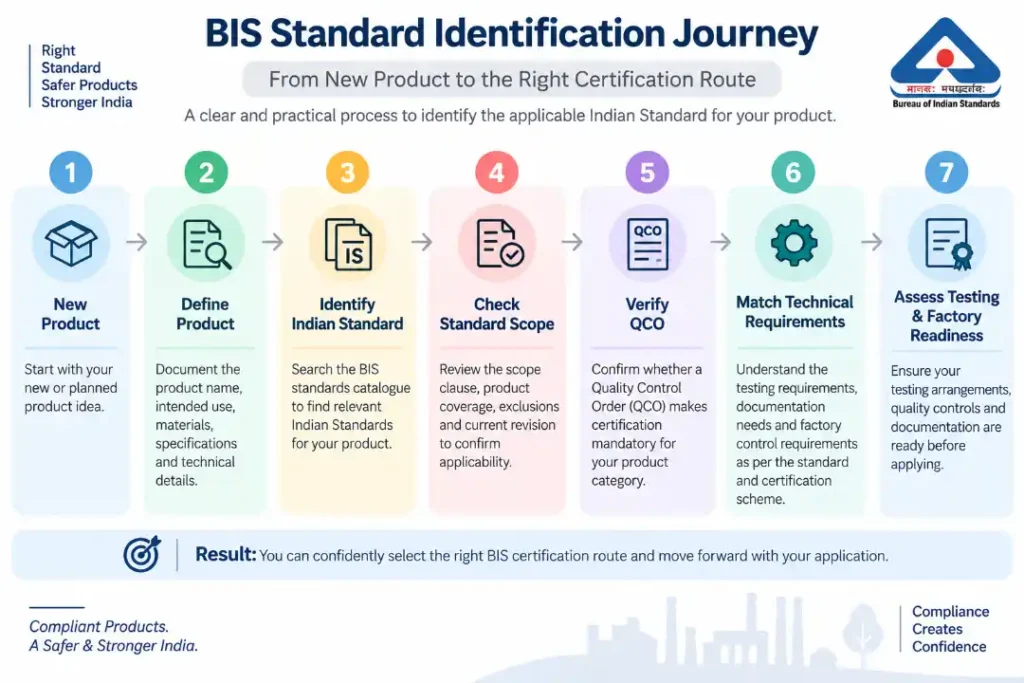
Confirm the applicable standard and regulatory requirement before starting testing or certification activities.
Documents & Technical Information to Prepare Before BIS Application
Exact documentation requirements depend on the applicable product standard and certification scheme, but manufacturers typically need to prepare:
- Product technical specifications and drawings, where applicable
- Manufacturing process and raw material details
- Existing test reports, where available
- In-house quality-control procedures and calibration records
- Testing arrangements and in-house testing capability
- Factory details, layout, equipment and production capacity
- Applicable Indian Standard details, including revision and amendments
- QCO-related information, where the product falls under compulsory certification
BIS Certification Readiness: What Manufacturers Should Check
Before initiating certification, confirm that the product definition, applicable standard, QCO status, testing requirements, technical documentation and factory controls have been reviewed.
BIS Applicability and Readiness Checkpoints
| Checkpoint | What Manufacturer Should Verify | Common Gap |
| Product classification | Exact product type, category and intended use — not just the commercial/brand name. | Product classified only by brand name or generic description. |
| Indian Standard | Correct IS number, title and current revision/amendment status. | Using an outdated or withdrawn version of the standard. |
| Standard scope | Whether the standard’s stated scope actually covers this exact product and its variants. | Assuming a ‘similar’ standard applies without checking scope clauses. |
| QCO applicability | Whether a Quality Control Order currently covers this product category and its effective date. | Not checking QCO status because certification was earlier voluntary. |
| Testing | Test parameters, applicable test methods and whether in-house or third-party testing is required. | Starting tests before confirming the standard and test methods. |
| Technical documents | Specifications, drawings, raw material and process details matching the standard’s requirements. | Documentation that doesn’t align with the specific clauses being assessed. |
| Factory controls | In-house quality control, calibration and process-control requirements under the scheme. | No documented quality-control system at the manufacturing stage. |
| Marking requirements | Mandatory marking, labelling and Standard Mark usage rules under the applicable scheme. | Incorrect or incomplete marking once certification is granted. |
Common Mistakes When Identifying a BIS Standard
- Selecting a standard based only on the product’s commercial or brand name
- Choosing a similar-sounding but technically incorrect standard
- Working from an outdated or superseded standard revision
- Ignoring QCO applicability because certification was earlier voluntary
- Not checking every product variant individually against the scope clause
- Identifying testing requirements too late, after samples are already with a lab
- Technical documentation that is inconsistent with the clauses being assessed
- Starting certification activity before applicability has actually been confirmed
The most expensive BIS mistake is not always a failed test; it can be preparing for the wrong compliance route from the beginning.
What If No Exact Indian Standard Is Found?
Sometimes a manufacturer searches and cannot find a standard that appears to match the product precisely. The instinct to pick the closest-looking standard and proceed should be resisted. Instead:
- Recheck the product classification — the category chosen at the start may not be the correct one
- Search related or adjacent product categories, since standards are sometimes grouped differently than expected
- Review the scope clause of nearby standards carefully, rather than relying on the title alone
- Check applicable QCOs and government notifications, since a QCO may define coverage more specifically than the standard’s own scope note suggests
- Determine whether a different compliance route or scheme genuinely applies to the product
If applicability remains unclear, seek appropriate technical clarification rather than assuming that an alternative standard or compliance route applies.
BIS Certification vs QCO: What Manufacturers Need to Understand
BIS certification and QCOs are related but distinct. BIS provides the applicable conformity-assessment framework, while a QCO determines whether compliance becomes mandatory for a specified product category. Because QCOs can be amended or extended, manufacturers should verify the current product-specific notification.
A QCO changes that status for a specific product category. Issued under Section 16 of the BIS Act, 2016, it makes conformity to a named Indian Standard, and the corresponding BIS certification, legally mandatory for that category from its notified effective date. This is why the same certification process can be voluntary for one product and compulsory for another that looks similar — the difference lies in whether a current QCO names that specific product. Because QCOs are issued, amended and extended over time, the current, product-specific notification is what should be checked, not general assumptions about an industry.
When Manufacturers Should Take BIS Compliance Support
Not every manufacturer needs external support to identify an applicable standard, but it becomes genuinely useful in certain situations, including when:
- The product is newly developed and doesn’t map cleanly to an existing category
- More than one Indian Standard appears potentially relevant
- QCO applicability is unclear or the product sits close to a notified category
- Testing requirements, documentation or product variants raise open questions
- Factory inspection readiness has not yet been assessed
- Internal teams have limited prior experience with BIS compliance
How IMARC Engineering Can Help With BIS Readiness
IMARC Engineering works with manufacturers at the stage where these questions are still open — before testing or application has started. Support typically covers:
- Product and requirement assessment based on technical specifications
- Support in identifying the applicable Indian Standard and its current revision
- Review of BIS and QCO applicability against current official notifications
- Technical documentation review and testing-requirement mapping
- Factory-readiness assessment and gap identification ahead of application
- Coordination support for compliance documentation
This is intended as technical and compliance readiness support — it does not substitute for BIS’s own assessment, and it does not offer or imply guaranteed certification outcomes.
Not sure which Indian Standard applies to your new product? IMARC Engineering can help assess the product, applicable requirements and pre-application readiness before you commit to testing or certification activities.
Talk to IMARC Engineering About BIS Readiness: https://www.imarcengineering.com/contact-us
Conclusion: Identify First, Build Evidence Second, Certify Third
Getting BIS certification right for a new manufacturing product is less about the paperwork at the end and more about the decisions made at the start. The practical path looks like this:
Define the product → Identify the Indian Standard → Verify the scope → Check QCO applicability → Assess testing → Prepare documentation → Check factory readiness → Proceed with the appropriate certification/compliance route
Working through this sequence before testing or application can help manufacturers reduce common compliance mistakes, including testing against the wrong requirements, discovering a QCO late, or preparing documentation that does not match the applicable standard.
Contact Us:
IMARC Engineering
Phone: +91-120-433-0800
Email: sales@imarcengineering.com
India: C-130, Sector 2, Noida, Uttar Pradesh 201301
LinkedIn: https://www.linkedin.com/showcase/imarc-engineering/
About the Author