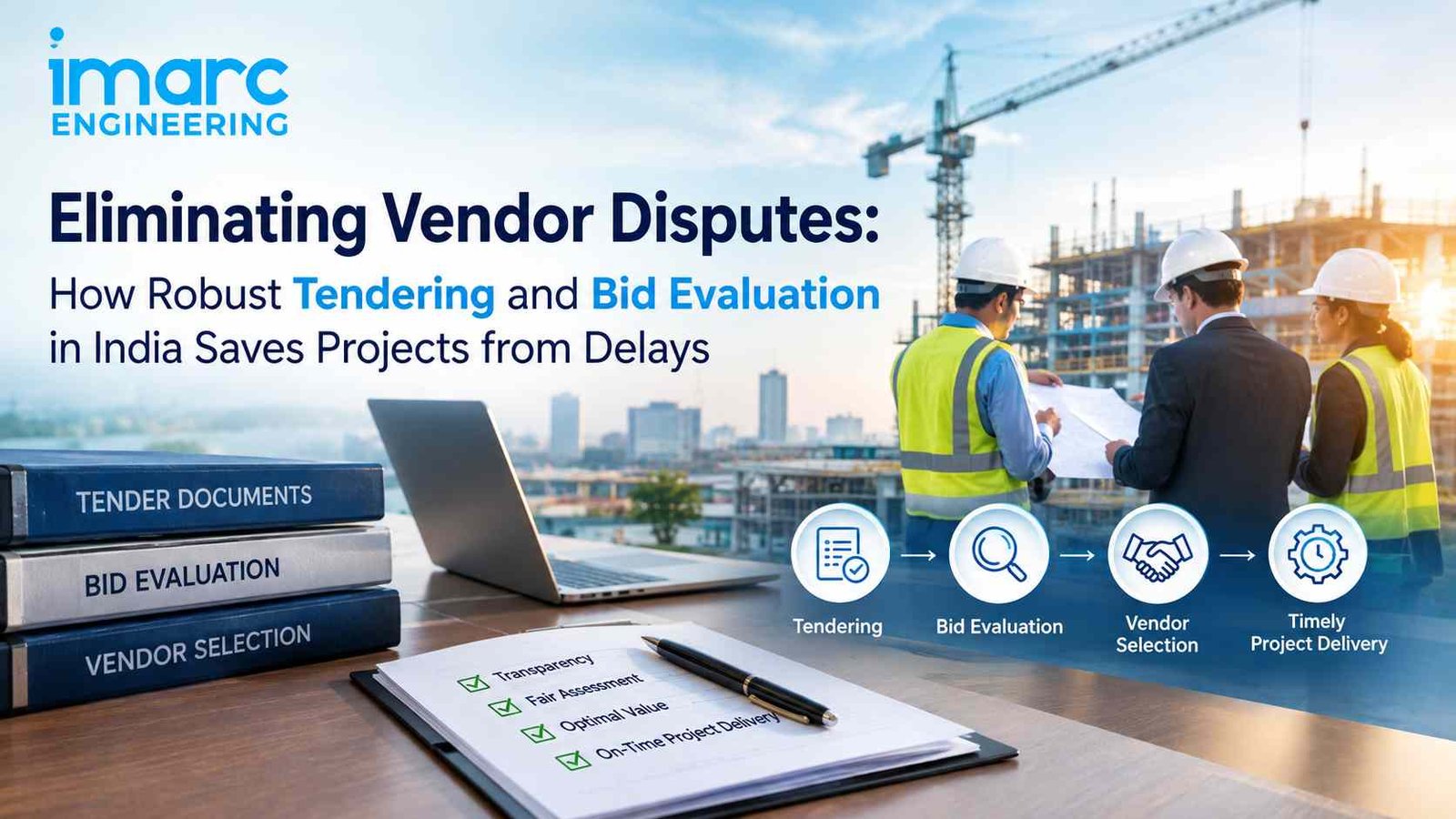
India’s infrastructure and industrial project pipeline is carrying a heavier dispute burden than most promoters realise. As of March 2026, the Ministry of Statistics and Programme Implementation (MoSPI) reported 458 monitored projects facing cost overruns of over INR 5.61 lakh crore, with 831 projects delayed by an average of 36.4 months. A large share of that slippage traces back to one decision made months before the first invoice: which vendor won the bid, and on what terms.
Vendor disputes rarely start as legal battles. They start as ambiguous scope clauses, unverified technical claims, and payment terms nobody stress-tested before signing. Structured tender bid consultancy services in India exist precisely to catch these gaps before they turn into a stalled site and an arbitration notice.
This article breaks down where vendor disputes actually originate, what they cost in 2025-26 numbers, and how a disciplined evaluation process prevents most of them from ever reaching a courtroom or an arbitration tribunal.
Where Vendor Disputes Actually Come From
Most disputes are not caused by dishonest vendors. They are caused by ambiguity that both sides interpret in their own favour once money and schedule pressure builds:
- Scope ambiguity: Vague specifications that leave inclusions and exclusions open to interpretation
- Unverified capability claims: Bidders whose experience and manpower claims were never checked against actual references
- Unnormalised commercial comparison: Awards made on raw quoted price without adjusting for differing scope, tax treatment, or payment terms
- Payment term mismatch: Milestone structures that do not match the vendor’s actual cash flow needs, triggering early payment demands
- Undocumented negotiation: Verbal understandings at award stage that never made it into the signed contract
- No dispute escalation path: Contracts silent on mediation and arbitration timelines until a disagreement is already underway
What Vendor Disputes Cost: The 2025-26 Numbers
The scale of dispute-driven delay and locked-up capital in India is measurable, and the latest figures make the case for prevention on their own:
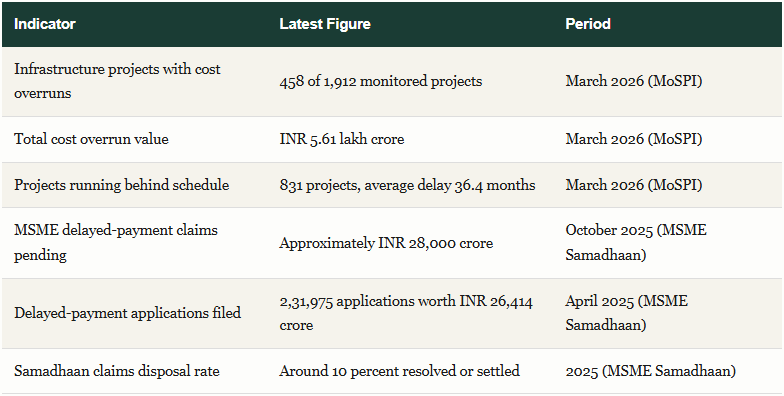
These are not abstract statistics. Every rupee sitting in an unresolved claim is capital that a vendor cannot redeploy, and every month of delay compounds financing cost on both sides of the contract.
How Bid Evaluation Design Prevents Disputes Before They Start
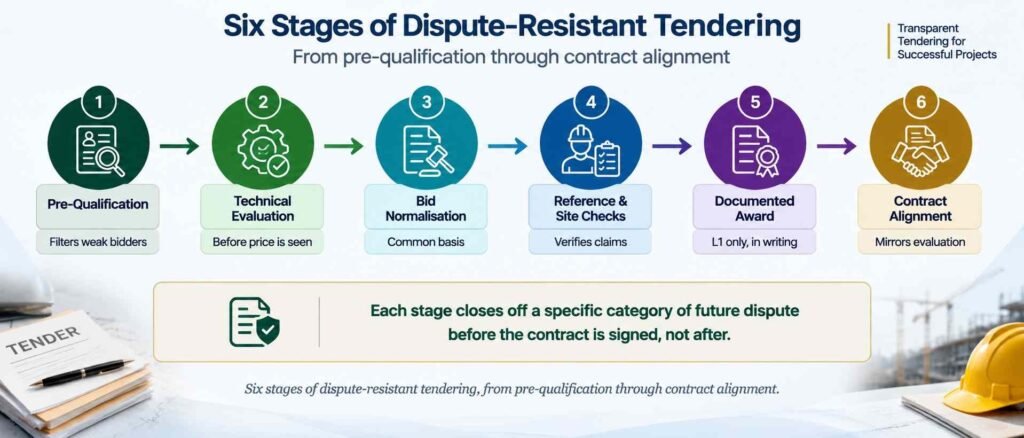
A structured evaluation process is a dispute-prevention tool as much as a procurement tool. Each stage closes off a specific category of future disagreement:
- Pre-qualification filters out bidders lacking the financial capacity or manpower to execute, before a contract is signed with someone who cannot deliver
- Technical evaluation before price is opened stops a low price from masking a weak execution methodology
- Bid normalisation puts every bid on a common scope, tax, and payment basis so the award reflects real value, not the vendor who quietly excluded the most scope
- Reference and site verification confirms claimed experience actually matches what the vendor will be asked to deliver
- Documented clarification and negotiation restricted to the lowest evaluated bidder, with reasons recorded in writing, removes the ambiguity that fuels post-award grievances
- Contract-evaluation alignment ensures the signed contract mirrors exactly what was scored, so there is no gap for either party to exploit later
Need expert tendering support? Get professional assistance with bid evaluation, tendering, and contract alignment: https://www.imarcengineering.com/contact?service=tendering-and-bid-evaluation
A Dispute-Resistant Tendering Process, Step by Step
Contract Documentation That Prevents Disputes Later
- A complete award file: evaluation criteria, scores, clarification correspondence, and the award recommendation, retained as the record that protects the decision under challenge
- Escalation clauses specifying negotiation and mediation before arbitration, so a disagreement has a defined path instead of going straight to a tribunal
- Explicit justification for any difference between the evaluated bid and the final signed contract
- A named point of contact and response-time commitment for both parties on scope or payment queries during execution
- Enhanced performance security specified upfront for any bid accepted after an abnormally-low-price clarification
2025 Regulatory Shift: Government Discourages High-Value Arbitration
Two developments in 2025 are reshaping how disputes should be handled at the contract-drafting stage, not just at the dispute stage:
- A Ministry of Finance directive discourages arbitration for disputes with a claim value above INR 10 crore, favouring structured negotiation and mediation first
- A Ministry of Law directive from April 2025 reinforced this position, calling for more efficient management of government litigation and reduced reliance on prolonged arbitration
- Under Section 29A of the Arbitration and Conciliation Act 1996, a domestic arbitral award must generally be made within 12 months of completion of pleadings, extendable by 6 months only with party consent
For project owners, this means contracts signed in 2026 should build stronger pre-arbitration escalation steps into the agreement itself, since arbitration is increasingly treated as a last resort rather than the default remedy.
Navigating Vendor Risk: How IMARC Engineering Strengthens Tendering and Bid Evaluation in India
Most disputes IMARC Engineering reviews trace back to a gap that existed at tender stage and simply surfaced later. Our procurement team works with project owners to close that gap before award:
- Pre-qualification design with proportionate, defensible eligibility criteria
- Technical evaluation frameworks that score methodology and resourcing, not just proposal quality
- Bid normalisation across scope, tax, and payment terms for a genuinely comparable commercial evaluation
- Reference checks and site visits to verify claimed vendor capability before award
- Award documentation and negotiation support restricted to the lowest evaluated bidder, recorded in writing
- Contract clause review to align escalation, mediation, and arbitration terms with 2025-26 regulatory direction
Read our detailed guide here: https://imarcengineering.com/blog/how-tendering-and-bid-evaluation-improve-contractor-selection-india
Conclusion
Vendor disputes in India are rarely sudden. They are the delayed consequence of ambiguity left unresolved at tender stage, and the 2025-26 numbers, INR 5.61 lakh crore in cost overruns and INR 28,000 crore in pending MSME payment claims, show the scale of what that ambiguity costs. Structured pre-qualification, normalised commercial comparison, and documented award decisions remain the cheapest dispute-prevention investment a project owner can make.
Frequently Asked Questions
What is the biggest cause of vendor disputes in Indian projects?
Scope ambiguity and unverified capability claims are the two most common causes, since both leave room for each party to interpret obligations differently once execution pressure builds.
How does bid normalisation help prevent disputes?
It adjusts competing bids to a common scope, tax, and payment basis before comparison, so the award reflects genuine value rather than the vendor who excluded the most scope from their quote.
Can project owners still use arbitration for high-value disputes in 2026?
Yes, but 2025 government directives discourage arbitration for claims above INR 10 crore in favour of negotiation and mediation first, making strong pre-arbitration escalation clauses more important at contract-drafting stage.
How long does domestic arbitration take in India?
Under Section 29A of the Arbitration and Conciliation Act 1996, a domestic arbitral award must generally be made within 12 months of completion of pleadings, extendable by 6 months only with both parties’ consent.
Contact Us:
IMARC Engineering
Phone: +91-120-433-0800
Email: sales@imarcengineering.com
India: C-130, Sector 2, Noida, Uttar Pradesh 201301
LinkedIn: https://www.linkedin.com/showcase/imarc-engineering/
About the Author