India’s green building movement now operates at scale. As of 1 September 2026, the Indian Green Building Council (IGBC) reported more than 20,164 registered projects covering over 16.42 billion sq ft, with more than 8,100 projects certified and operational.
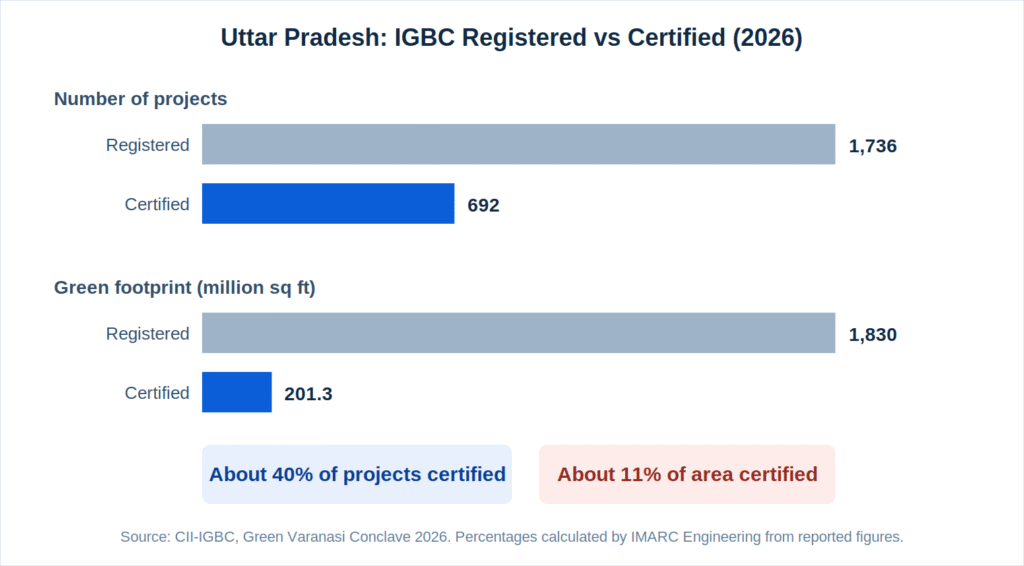
Uttar Pradesh shows the difference. It has 1,736 IGBC-registered projects covering 1.83 billion sq ft, but only 692 projects covering 201.3 million sq ft are certified. That is about 40% of projects and about 11% of the registered area. Projects may remain between registration and certification for several reasons, including incomplete construction, pending documentation, unmet credit requirements or outstanding commissioning evidence. Identifying compliance gaps early can help reduce avoidable redesign and submission delays
Structured green building certification support helps sponsors find these gaps while they are still cheap to fix. This article explains where compliance gaps appear, how to audit for them and how to close them before submission.
“How do you identify and close compliance gaps before green building certification approval? Run a pre-submission gap audit against the chosen rating system’s prerequisites and credit points, review energy, water, materials and commissioning records, fix shortfalls in design or procurement, and register early. Gaps closed during design cost materially less than gaps found after construction.”
1. Why the Registration-to-Certification Gap Matters
The scale of the ecosystem makes certification a mainstream compliance expectation:
- About 41 lakh residential dwelling units and more than 11,770 commercial projects are registered with IGBC.
- More than 985 industrial buildings, over 1,320 transit infrastructure projects and 271 net-zero projects are registered.
- Nearly 90% of India’s green building projects follow IGBC rating systems.
The rating level achieved also carries financial value. Greater Noida Industrial Development Authority offers an additional 5% FAR free of charge for projects achieving IGBC Gold or above. Andhra Pradesh offers Development Charge discounts of 5%, 10% and 15% for Silver, Gold and Platinum ratings. Missing a level by a few points can mean losing the incentive.
2. Where Compliance Gaps Usually Appear
- Sequential design: sustainability added after architecture is complete routinely misses certification thresholds.
- Deferred registration: registering after construction is well underway produces documentation gaps.
- Weak commissioning: buildings that are designed sustainably but poorly commissioned underperform design intent.
- Late materials selection: items sourced late often fail recycled content, regional sourcing or low-VOC requirements.
- No operational verification: certification without post-occupancy checks creates a credibility gap.
3. How to Run a Pre-Approval Gap Audit
- Confirm the rating system and target level. Selection typically takes 4 to 6 weeks and should match occupier expectations.
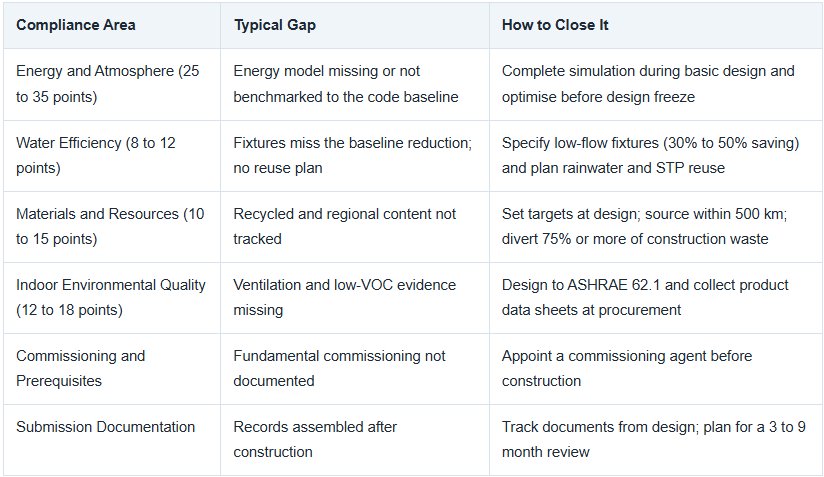
- Map mandatory prerequisites. These include minimum energy performance, indoor air quality, recyclables storage and fundamental commissioning.
- Score credits with a buffer. Compare planned points to the level threshold and keep headroom for credits that may fail review.
- Audit documentation. Check energy simulation, water calculations, materials tracking and construction waste records.
- Verify commissioning readiness. Confirm an appointed commissioning agent and documented test procedures.
4. Where Most Certification Points Are Won
Energy carries the heaviest weight, so energy gaps are the costliest to leave open:
- The building envelope drives 40% to 60% of energy use in tropical climates, and optimising it can deliver 15% to 25% savings without an HVAC upgrade.
- LED lighting with daylight and occupancy controls cuts lighting energy by 40% to 60%.
- Rooftop solar typically offsets 10% to 30% of building demand.
- Passive design can reduce cooling load by 20% to 40%.
5. Compliance Gap Checklist
6. How to Close Gaps Stage by Stage
- Concept (4 to 6 weeks): fix rating system and target level, then register.
- Basic design (8 to 12 weeks): complete passive design, energy modelling and water strategy.
- Detailed engineering (16 to 24 weeks): lock MEP design, envelope specifications and materials.
- Construction (12 to 24 months): enforce quality assurance, waste tracking and substitution checks.
- Submission (3 to 9 months): submit complete documentation and respond to review comments.
Thresholds leave little room. IGBC Gold starts at 60 points and Platinum at 75, while LEED Gold starts at 60 and Platinum at 80. A gap of a few points can decide the outcome.
7. Cost of Certification vs Cost of Gaps
- IGBC registration and certification: INR 50,000 to 5 lakh.
- LEED registration and certification: USD 1,200 to 27,500.
- Consulting engagements: INR 5 to 50 lakh depending on scale.
- Design and construction premium: 1% to 5% of project capex, with payback in 3 to 7 years.
- Operating benefit: 20% to 40% energy savings and 30% to 50% water savings against conventional buildings.
Fees are small compared with the cost of redesign or delayed approval, so early auditing is usually the cheaper route.
How IMARC Engineering’s Expertise Can Help in Green Building Certification
- Rating system selection across LEED, IGBC and GRIHA.
- Pre-submission gap audits against prerequisites and credits.
- Energy modelling, passive design and MEP coordination.
- Water, waste and sustainable materials strategy.
- Certification documentation, submission and review support.
- Commissioning coordination and post-occupancy verification.
Consult With Our Expert: https://www.imarcengineering.com/contact?service=green-building-certification-support
Conclusion
Green building certification rewards projects that plan for compliance early. With registrations rising faster than certifications, the competitive edge lies in closing gaps during design, not after construction. Sponsors that audit prerequisites, score credits with a buffer and document continuously are better placed to secure the target rating, unlock state incentives and avoid costly delays at approval, while also protecting the energy and water savings that justified certification in the first place.
Contact Us:
IMARC Engineering
Phone: +91-120-433-0800
Email: sales@imarcengineering.com
India: C-130, Sector 2, Noida, Uttar Pradesh 201301
LinkedIn: https://www.linkedin.com/showcase/imarc-engineering/
About the Author