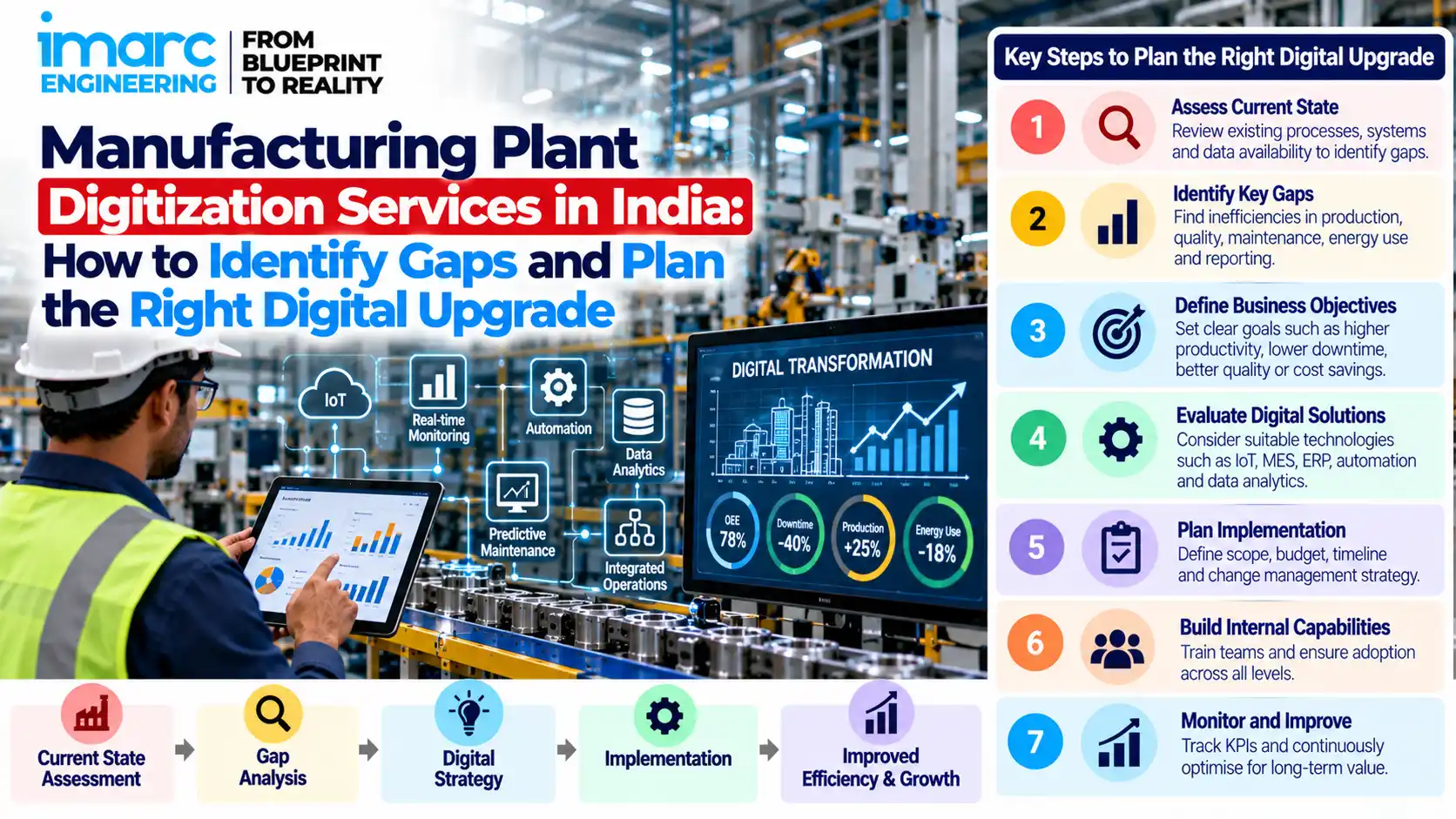
A plant can run an ERP system, a few PLC-controlled machines and a reporting spreadsheet, and still struggle to explain why last night’s output fell short. The numbers exist somewhere, but they arrive late, in different formats, or only after someone compiles them by hand.
Indian manufacturers can improve production visibility by identifying gaps in data collection, machine connectivity, software integration and operational reporting. Manufacturing plant digitization services help assess these gaps before investing in new technology. This article explains how manufacturers can evaluate their current systems, prioritise upgrades and plan implementation without disrupting production.
Why Manufacturing Plants Have Digitization Gaps
Most plants digitize in pieces: an ERP for billing and stock, controllers on newer machines, quality software on one line. Over time, these pieces do not add up to one connected picture. Common gaps include:
- Manual shift reports and spreadsheets. Output, rejections and stoppages are noted on paper or in Excel at shift end, so entries are often rounded, late or incomplete.
- Data separated across departments. Production, quality, maintenance and stores keep their own records, and matching them for one batch can take hours.
- Machines that cannot talk to central systems. Older presses, furnaces or CNC machines may lack communication ports or use proprietary formats.
- Delayed visibility. A breakdown or quality drift is often found at the next review meeting, not when it begins.
- ERP without shop-floor detail. An ERP usually tracks orders, stock and costs well, but not why a line stopped for forty minutes.
Illustrative example: in a hypothetical auto-component plant, the ERP shows a work order running late. Only after the production manager compares three spreadsheets does it emerge that one machine lost two shifts to unrecorded tool changes.
Digitization does not have to mean replacing every system. Often it means connecting what already works, standardising how data is captured and adding tools only where a real gap exists.
How to Identify Gaps Before Choosing Manufacturing Plant Digitization Services
A structured assessment keeps the conversation about problems rather than products. Review six areas, ideally by walking the shop floor with the people who do the work:
- Workflows and reporting. Trace one shift’s data from machine to management report, noting every manual step and delay.
- Data availability, accuracy and ownership. Check that downtime, rejection and output mean the same thing on every shift, and who is accountable for each.
- Machine connectivity. List machines by age and controller type. Separate those that can share data directly, those needing sensors or gateways, and those that will stay manual.
- Software integration. Map what ERP, MES, quality and maintenance tools each hold, and where people re-key data between them.
- Workforce skills. Judge whether operators and supervisors can use tablets or terminals, and who will support the system after go-live.
- Priorities, budget and constraints. Rank problems by business cost, then note budget limits, shutdown windows and compliance needs.
Questions to ask before choosing a technology:
- Which decision can we not make today because data is missing, late or disputed?
- Which single problem, if solved first, would matter most?
- Will the solution work with our current machines and ERP, or does it require replacing them?
- Who will own data quality after installation?
- What result would tell us the pilot worked?
Key Areas to Consider for Plant Digitization
Not every plant needs every capability. These are the areas that most often come up:
- Production and downtime monitoring: capturing output, cycle times and stoppage reasons as they happen, not at shift end.
- Quality data and defect tracking: recording inspections, rejection reasons and rework digitally so patterns by machine, shift or material become visible.
- Inventory and material movement: knowing where raw material, work-in-progress and finished goods are, to reduce searching and mismatches.
- Maintenance records and equipment performance: linking breakdown history and condition data to specific assets.
- Shop-floor and business software integration: feeding verified shop-floor data into ERP and other systems so records agree.
- Dashboards and operational reporting: giving each role a view it actually uses, from line supervisors to plant heads.
The right mix depends on your processes, existing infrastructure and business requirements. A plant with sound ERP data but unrecorded downtime needs a different starting point from one with modern machines but no shared reporting. For plants with mixed-age machinery, IMARC Engineering’s automation and digital monitoring setup services can be explored for relevant integration and monitoring requirements.
A Practical Manufacturing Plant Digitization Roadmap
The sequence below keeps assessment ahead of spending and evidence ahead of scale.
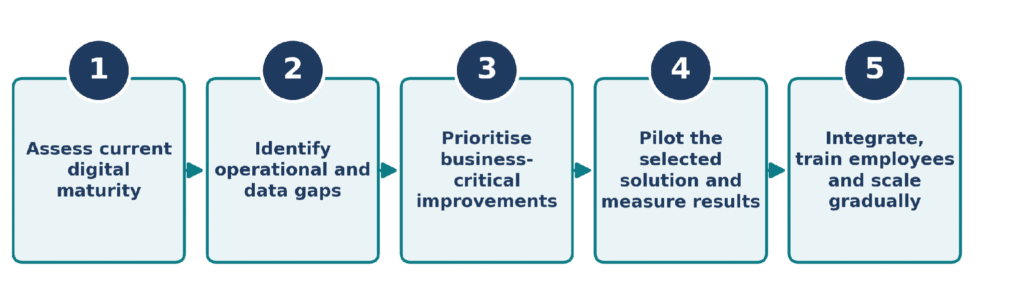
Infographic: A five-stage roadmap for manufacturing plant digitization
What Official Indian Sources Tell Manufacturers
The Government of India’s Bharat 4.0 Digital Readiness Assessment Tool, developed by the Centre of Excellence on Industry 4.0 at the National Productivity Council (NPC), shows why assessment comes first. It places an organisation on one of five maturity levels (Starter, Managed, Adaptive, Realizer and Top-Notch) and indicates the strategies needed to reach the next level. NPC states that the tool applies to companies regardless of industry, size or Industry 4.0 maturity. Users complete a digital questionnaire and receive an evaluation report by email.
The Telecommunication Engineering Centre’s report, Industry 4.0: The Future of Smart Manufacturing (TEC 31238:2025), is equally practical about adoption. It states that success depends far more on people and top management than on technology, and it names resistance to change and lack of digital skills as issues to be handled through involvement and training. It advises starting with the KPIs that matter most and treating Industry 4.0 as a phase-by-phase effort, not a one-time delivery by a supplier.
The report also warns that greater connectivity widens the cyber-attack surface, and points to measures such as multi-factor authentication, role-based access control and regular access-log audits. It has dedicated sections on challenges faced by manufacturing MSMEs and barriers to digital adoption, a useful prompt to test affordability before committing to scale.
Table 1: Manufacturing Plant Digitization Gap Assessment Checklist
| Area to assess | Questions to ask | Potential gap to investigate | Priority |
|---|---|---|---|
| Production data | How soon does a manager see output and stoppages? Are stoppage reasons coded consistently? | Manual or end-of-shift entry; different definitions of downtime across shifts | High |
| Machine connectivity | Which machines have usable controllers or ports? Which would need sensors or gateways? | Legacy equipment with no data output | High |
| Quality tracking | Are inspection results and defect reasons stored digitally and linked to batch, machine and shift? | Paper records; slow defect tracing | High |
| Maintenance | Are breakdowns, repairs and spares logged against each asset? | Reactive repairs; history kept in registers or memory | Medium |
| Inventory | Can we see where material and work-in-progress are at any time? | Stock mismatches; time lost searching | Medium |
| System integration | Where is data re-entered between ERP, MES, quality and maintenance tools? | Duplicate entry; conflicting figures | High |
| Employee readiness | Who will capture data and use dashboards? Is training planned? | Low digital confidence; no internal owner | Medium |
Priority ratings are illustrative. A plant facing serious customer quality complaints might rank quality tracking first; rank each area against your own plant’s losses.
Table 2: How to Prioritise Digitization Investments
| Operational problem | Possible digital intervention | Expected operational benefit | What to measure during a pilot |
|---|---|---|---|
| Downtime reported only at the next review | Automatic or operator-tagged downtime capture with reason codes | Faster response to stoppages; clearer view of recurring causes | Time from stoppage to recorded reason; share of downtime with a valid reason |
| Manual quality records | Digital inspection forms with defect categories | Quicker defect tracing; fewer transcription errors | Time to retrieve a batch’s quality history; entry errors found in audit |
| Disconnected production data | Integration of shop-floor data capture with ERP | More consistent figures across departments | Gap between shop-floor and ERP output; hours spent compiling reports |
| Poor inventory visibility | Barcode or RFID-based material tracking | Fewer stock mismatches; less searching time | Stock-count variance; time to locate material |
| Reactive maintenance | Asset-wise maintenance logging; condition monitoring where justified | Better repair planning; clearer equipment history | Unplanned stoppages per machine; repair turnaround time |
Benefits are potential outcomes, not guaranteed results. Set targets from your own baseline rather than from generic claims.
How to Plan Implementation Without Disrupting Production
A digitization project should fit around production, not interrupt it. A workable sequence:
- Set a baseline. Record current figures for the metrics you want to improve, so results can be judged fairly.
- Select a defined pilot area. One line, cell or department with a clear problem works better than a plant-wide launch.
- Check compatibility. Confirm with machine vendors and IT that the solution works with existing controllers, networks and ERP.
- Assign internal owners. Name people responsible for operations, IT and data accuracy.
- Train employees. Involve operators and supervisors early, since the TEC report ties success to their involvement and training.
- Test data accuracy and reliability. Compare system records with manual checks and observe behaviour during network or power interruptions.
- Measure before scaling. Compare pilot results with the baseline and expand only what has shown value.
- Plan for security and ownership. Define access controls, and who owns and can export plant data, including when outside vendors are involved.
Pre-approval checklist:
- Problem and target KPIs written down
- Baseline measured
- Pilot area and duration agreed
- Compatibility with machines and software confirmed
- Internal owners and training plan in place
- Access controls and data ownership terms agreed
- Criteria for scaling up, adjusting or stopping decided
How IMARC Engineering Can Help
Many plants have a clear sense of the pain but not of the order in which to fix it. IMARC Engineering describes its smart factory and Industry 4.0 integration service as covering assessment of digital maturity, creation of a roadmap and implementation of technology upgrades. Its automation and digital monitoring setup page covers system design, integration and performance optimisation.
In practice, consulting support of this kind can help a manufacturer review current processes and reporting, shortlist digitization priorities, evaluate how new tools would connect with existing machines and ERP, and plan a phased rollout. The scope for any plant would be agreed after discussing its processes and constraints. A wider overview is available on the IMARC Engineering services page.
Planning a digital upgrade for your plant? [Discuss your plant digitization requirements with IMARC Engineering: https://www.imarcengineering.com/contact?service=smart-factory-industry-4-integration
Conclusion
Digital tools help only when they solve a problem the plant has actually defined. Identifying gaps first, in workflows, data, machines, systems and skills, keeps spending tied to operational needs rather than to technology trends.
A phased, business-led approach, with a baseline, a focused pilot and honest measurement, lets a plant build on what already works. That is how manufacturing plant digitization services deliver value without disrupting production.
Contact Us:
IMARC Engineering
Phone: +91-120-433-0800
Email: sales@imarcengineering.com
India: C-130, Sector 2, Noida, Uttar Pradesh 201301
LinkedIn: https://www.linkedin.com/showcase/imarc-engineering/
About the Author