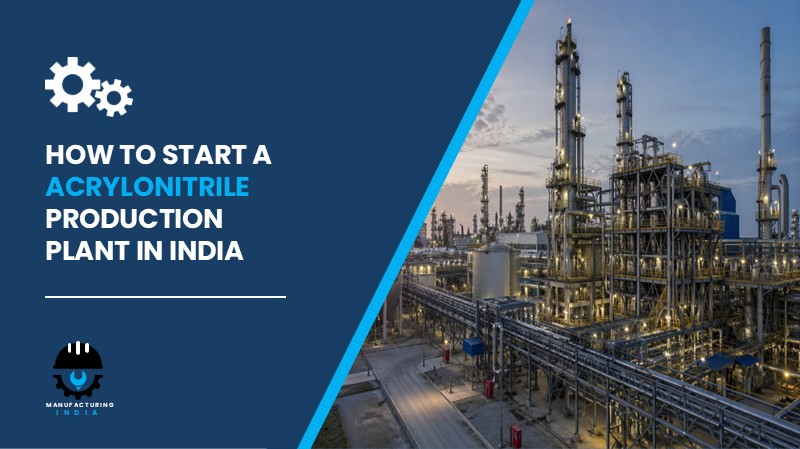
Setting up an acrylonitrile production plant in India presents a compelling investment case at a time when the country’s textile industry, rapidly expanding automotive and plastics sector, growing electronics manufacturing ecosystem, and surging consumption of engineering polymers are collectively generating sustained demand for one of the world’s most strategically important petrochemical intermediates. Acrylonitrile — a colourless, volatile, and highly reactive organic compound produced industrially through the ammoxidation of propylene — serves as the fundamental building block for acrylic fibres, acrylonitrile butadiene styrene (ABS) resins, styrene acrylonitrile (SAN) resins, nitrile rubber (NBR), and numerous specialty chemical intermediates. Without a reliable domestic supply of acrylonitrile, India’s downstream polymer and fibre industries remain dependent on imports at a time when the country’s urbanisation, industrialisation, and rising consumption are creating exactly the conditions for large-scale growth across every end-use sector that acrylonitrile serves.
India’s structural case for acrylonitrile production is grounded in directly observable demand growth. According to UN DESA, India’s urban population is projected to reach nearly 50% by 2050, reflecting rapid urbanisation and rising consumption levels — a demographic shift expected to support stronger demand for construction materials, textiles, and plastics, thereby acting as a key growth driver for acrylonitrile consumption across industrial applications. The automotive sector’s continuing adoption of lightweight and durable ABS resin components, the textile industry’s sustained consumption of acrylic fibre, and the electronics manufacturing expansion under the PLI scheme are all creating converging demand streams for a domestic acrylonitrile supply chain. Petrochemical industrial estates in Gujarat (Dahej, Hazira), Maharashtra (Raigad, Nagpur), and Andhra Pradesh offer the propylene supply chain access, petrochemical handling infrastructure, port connectivity, and regulatory frameworks that a large-scale acrylonitrile production facility requires to operate at full commercial scale.
Investing in an acrylonitrile production plant in India today aligns the country’s growing downstream polymer, textile, automotive, and electronics demand with continuous processing technology that allows efficient large-volume production with optimised cost structures. With gross profit margins of 20–30% and net profit margins of 10–15%, the unit economics are commercially sound across annual production capacities of 200,000 to 500,000 tons, and the investment also offers favourable export potential across Asia-Pacific and European markets seeking supply chain diversification.
What is Acrylonitrile?
Acrylonitrile is a colourless, volatile, and highly reactive organic compound primarily used as a key intermediate in the production of synthetic fibres, plastics, and elastomers. It is produced industrially through the ammoxidation of propylene — the SOHIO process — resulting in a nitrile compound with excellent chemical resistance and thermal stability. Acrylonitrile serves as a fundamental building block for acrylic fibres, acrylonitrile butadiene styrene (ABS) resins, styrene acrylonitrile (SAN) resins, and nitrile rubber (NBR). Its properties — including high tensile strength, resistance to solvents, and durability — make it suitable for demanding industrial and consumer applications across multiple sectors. Due to its toxic and flammable nature, acrylonitrile requires careful handling, storage, and transportation under strict safety and environmental regulations at every stage of its production, storage, and downstream use.
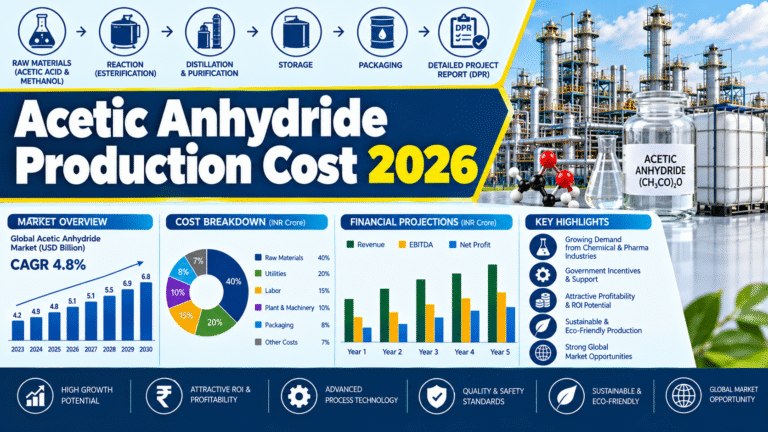
The primary production process covers propylene ammoxidation, catalytic reaction in a fluidised bed reactor, product quenching and absorption, purification and distillation, and storage. End-use industries served include the textile industry, automotive and plastics industry, electronics and electrical sector, and chemical intermediates industry. Applications span acrylic fibre production, ABS and SAN resins manufacturing, nitrile rubber production, and specialty chemical synthesis.
Cost of Setting Up an Acrylonitrile Production Plant in India
The cost of establishing an acrylonitrile production plant in India depends on plant capacity, process technology selection, propylene feedstock access and purity, geographic location — specifically proximity to propylene sources and downstream polymer customers — degree of automation, and the comprehensive environmental, safety, and hazardous chemical compliance requirements applicable to a highly toxic and flammable industrial chemical manufacturing facility.
1. Capital Expenditure (CapEx)
Land and Site Development forms a foundational component of total capital investment, covering land acquisition charges, site registration, boundary development, bund wall and chemical containment infrastructure for acrylonitrile storage, drainage, and site utilities. Given acrylonitrile’s toxic and flammable classification, site safety infrastructure — including blast walls, toxic gas detection systems, and emergency response infrastructure — represents a capital requirement with no equivalent in conventional chemical manufacturing. Investors may explore dedicated petrochemical processing zones in Gujarat’s Dahej and Hazira petrochemical corridors, where propylene pipeline connectivity, established chemical handling infrastructure, port access for raw material imports, and petrochemical safety regulatory expertise create the most commercially advantaged operating environment for an acrylonitrile producer.
Civil Works and Construction cover the main production building housing fluidised bed reactor systems — requiring specialised explosion-proof construction, forced ventilation, and continuous gas monitoring infrastructure — absorption and distillation column structures, product purification systems, acrylonitrile product storage with full secondary containment, ammonia storage infrastructure, utility systems buildings, a quality control laboratory, finished goods loading and distribution facilities, an administrative block, and utilities infrastructure including high-capacity steam and cooling water systems.
Machinery and Equipment represent the largest single component of total CapEx for an acrylonitrile production plant. Key machinery required includes:
- Fluidised bed reactors
- Heat exchangers
- Absorption columns
- Distillation units
- Compressors
- Storage tanks
- Emission control systems
Other Capital Costs include an effluent treatment plant (ETP) for managing hydrogen cyanide and acetonitrile-contaminated process effluents — both toxic by-products of the ammoxidation process — tail gas combustion systems for NOₓ and acrylonitrile emission control, pre-operative expenses, environmental clearance and safety assessment costs, commissioning charges, and import duties on specialised fluidised bed reactor internals or proprietary catalyst systems not available domestically.
Request a Sample Report for In-Depth Market Insights: https://www.imarcgroup.com/acrylonitrile-manufacturing-plant-project-report/requestsample
2. Operational Expenditure (OpEx)
Raw Material Cost is the dominant operational expense, accounting for approximately 70–80% of total OpEx. The primary raw materials are propylene, ammonia, and oxygen — the three reactants in the SOHIO propylene ammoxidation process. Propylene, as the carbon and nitrogen-free olefin feedstock consumed in the largest volumes, drives the majority of raw material cost and is priced in correlation with global propylene and naphtha markets. Domestic propylene is available from Indian refineries and petrochemical cracker units, with Gujarat and Maharashtra having established propylene supply infrastructure from Reliance Industries, ONGC Petro Additions, and other petrochemical producers. Ammonia is the nitrogen source for the nitrile group formation and is commercially available from domestic fertiliser producers. Long-term supply contracts for all three reactants are essential for production cost stability.
Utility Cost is the second-largest OpEx component, representing 10–15% of total operating expenses, covering high-pressure steam for distillation column heating and reactor temperature control, electricity for compressors and process pumps, cooling water for reactor and distillation condenser systems, and process water for absorption column operations.
Other Operating Costs include transportation and distribution — which for acrylonitrile requires specialised tank wagons and ISO tanks compliant with dangerous goods transport regulations — specialised hazmat packaging for customer deliveries, salaries and wages for chemical engineers and safety officers, routine machinery maintenance including catalyst replacement cycles and distillation column internals servicing, depreciation on high-value reactor and distillation systems, and applicable taxes. By the fifth year of operations, total operational costs are projected to increase substantially due to inflation, propylene price movements, ammonia cost changes, supply chain disruptions, and shifts in the global petrochemical and polymer markets.
3. Plant Capacity
The proposed production facility for acrylonitrile is designed with an annual production capacity ranging between 200,000 and 500,000 tons — reflecting the minimum efficient scale required for continuous processing technology to achieve competitive economics. The economies of scale in acrylonitrile production — where continuous processing technology allows efficient large-volume production with optimised cost structures — make the 200,000 to 500,000 ton range the commercially rational investment scale. Plant capacity can be customised per investor requirements and phased in line with secured off-take agreements with domestic acrylic fibre producers, ABS resin manufacturers, or nitrile rubber producers. Profitability improves with higher capacity utilisation, making long-term supply agreements with downstream polymer customers a commercial foundation that should be developed in parallel with plant commissioning activities.
4. Profit Margins and Financial Projections
The financial projections for an acrylonitrile production plant demonstrate commercially sound profitability potential under normal operating conditions. Gross profit margins typically range between 20–30%, supported by stable multi-sector demand from textile, automotive, electronics, and chemical intermediates customers. Net profit margins are projected at 10–15%. A comprehensive financial analysis covering NPV (net present value), IRR (internal rate of return), payback period, gross margin progression, and net margin development across a five-year horizon is essential before committing capital, particularly given the capital intensity and long lead times associated with petrochemical-scale plant construction. The project’s ROI profile and long-term sustainability are assessed against realistic assumptions on capital investment, production capacity utilisation, propylene pricing trends, and demand outlook from the textile, automotive, electronics, and chemical intermediates sectors.
Why Set Up an Acrylonitrile Production Plant in India?
Rising Demand for Engineering Plastics Across Automotive and Electronics. Increasing use of ABS and related acrylonitrile-derived polymers in automotive components — valued for their strength, impact resistance, and lightweight characteristics — and consumer electronics housings is driving global acrylonitrile demand. India’s automotive manufacturing sector, expanding EV production, and rapid electronics manufacturing growth under the PLI scheme are each independently creating growing domestic demand for ABS resin, which requires acrylonitrile as its primary monomer input.
Strong Textile Industry Integration. The textile industry’s widespread use of acrylic fibres — derived from acrylonitrile and valued for their wool-like properties, durability, and resistance to environmental degradation — provides a large, stable, and recurring domestic demand base for acrylonitrile. India is one of the world’s largest textile producers, with acrylic fibre manufacturers across Gujarat, Maharashtra, and Andhra Pradesh constituting an established and immediately accessible customer segment for domestic acrylonitrile supply.
India’s Urbanisation Driving Multi-Sector Polymer Demand. According to UN DESA, India’s urban population is projected to reach nearly 50% by 2050, reflecting rapid urbanisation and rising consumption levels. This demographic shift is expected to support stronger demand for construction materials, textiles, and plastics — all sectors that consume acrylonitrile-derived polymers in significant volumes — thereby acting as a key growth driver for acrylonitrile consumption across industrial applications throughout the investment horizon.
Export Potential Across Asia-Pacific and Europe. High demand across Asia-Pacific and Europe creates favourable export opportunities for large-scale acrylonitrile producers. Supply chain diversification priorities among European and Japanese polymer manufacturers — seeking to reduce import concentration from Chinese producers — make an India-based large-scale acrylonitrile plant well-positioned to capture export market share with cost-competitive production supported by India’s propylene and ammonia supply chain advantages.
Expanding Industrial Applications and Sustainable Production Momentum. Acrylonitrile’s role as a chemical intermediate supports growth across coatings, adhesives, and specialty chemical sectors. In June 2024, Trillium Renewable Chemicals selected INEOS Green Lake for the world’s first demonstration plant for sustainable acrylonitrile production using renewable feedstocks — a development that signals both the industry’s direction toward bio-based acrylonitrile and the continued strategic importance of the compound even as production technology evolves. In May 2025, Ascend Materials initiated production of high-purity acrylonitrile at its expanded site in China, targeting rising demand in carbon fibre and electronics sectors — further evidence of active global capacity investment in response to growing demand.
Economies of Scale in Continuous Processing Technology. Continuous processing technology in acrylonitrile production allows efficient large-volume production with optimised cost structures that significantly reduce per-unit production costs at scale. A 200,000 to 500,000 ton per year plant in India — operating as a continuous 24/7 petrochemical facility — captures the full benefit of these scale economies while serving a domestic market that currently relies on imports for a significant portion of its acrylonitrile consumption.
Production Process — Step by Step
The acrylonitrile production process uses propylene ammoxidation, catalytic reaction in a fluidised bed reactor, product quenching and absorption, purification and distillation, and storage as the primary production method. Each stage requires precisely controlled temperature, pressure, gas composition, catalyst activity, and separation efficiency parameters to maximise acrylonitrile yield while managing the formation and safe handling of toxic by-products including hydrogen cyanide and acetonitrile.
- Propylene, Ammonia, and Air Feed Preparation: Propylene, ammonia, and oxygen (supplied as air) are metered in controlled molar ratios — typically around 1:1.2:10 propylene to ammonia to air — through feed compressors and flow control systems into the fluidised bed reactor inlet, with feed composition monitored continuously to maintain safe operation within explosion limits.
- Catalytic Ammoxidation in Fluidised Bed Reactor: The propylene-ammonia-air feed mixture contacts the bismuth molybdate or similar proprietary catalyst in fluidised bed reactors operating at approximately 400–500°C and elevated pressure. The exothermic ammoxidation reaction converts propylene, ammonia, and oxygen to acrylonitrile, with heat exchangers embedded in the reactor maintaining temperature control and recovering reaction heat for process steam generation.
- Product Quenching: Hot reactor effluent gas — containing acrylonitrile, hydrogen cyanide, acetonitrile, unreacted ammonia, carbon dioxide, water vapour, and nitrogen — is rapidly quenched in quench columns with cooled water, absorbing unreacted ammonia and cooling the gas stream to prevent acrylonitrile degradation.
- Absorption: Cooled quenched gas is contacted with chilled water in absorption columns, where acrylonitrile, hydrogen cyanide, and acetonitrile are selectively absorbed from the gas phase into the absorption water, while nitrogen and carbon dioxide pass through as tail gas for emission treatment.
- Distillation and Purification: Acrylonitrile-containing absorption water is processed through a series of distillation units — including a recovery column, a heads column for hydrogen cyanide and acetonitrile separation, and a product column for final acrylonitrile purification — to deliver specification-grade acrylonitrile with a purity of 99%+ suitable for acrylic fibre, ABS resin, and nitrile rubber applications.
- By-product Recovery: Hydrogen cyanide separated during distillation is recovered as a co-product for sale to mining (gold extraction), pharmaceutical, or specialty chemical markets, and acetonitrile is recovered as a solvent co-product — both by-product streams improving the overall economics of the acrylonitrile production process.
- Emission Control: Tail gas from the absorption columns, containing trace acrylonitrile, hydrogen cyanide, and ammonia, is processed through emission control systems including catalytic oxidation or thermal incinerators to destroy toxic compounds before atmospheric discharge, ensuring compliance with state pollution control board air quality standards.
- Product Storage: Purified acrylonitrile is transferred to storage tanks designed with full containment, inert atmosphere blanketing, refrigeration if required, and continuous toxic gas monitoring, with product stability maintained through inhibitor addition to prevent polymerisation during storage.
- Quality Testing and Dispatch: Finished acrylonitrile is tested for purity, water content, inhibitor level, acidity, and colour before release for loading into dedicated tank wagons, ISO tank containers, or tanker trucks compliant with dangerous goods transport regulations, then dispatched to textile industry, automotive and plastics, electronics, and chemical intermediates customers.
Key Applications
Acrylonitrile produced in India serves commercially dominant and structurally growing downstream polymer and fibre manufacturing industries:
- Textile Industry: Acrylonitrile is widely used in the production of acrylic fibres, offering wool-like properties, durability, and resistance to environmental degradation across apparel, home furnishing, and industrial textile applications.
- Automotive and Plastics Industry: It serves as a key raw material for ABS resins used in automotive components, valued for their strength, impact resistance, and lightweight characteristics that contribute to vehicle weight reduction and fuel efficiency.
- Electronics and Electrical Sector: Acrylonitrile-based polymers are utilised in manufacturing durable housings and electronic components with excellent insulating properties across consumer electronics, industrial electronics, and telecommunications equipment.
- Chemical Intermediates Industry: Acrylonitrile is employed as a precursor for nitrile rubber (NBR), specialty chemicals, coatings, and adhesives, supporting diverse industrial applications across the broader specialty chemicals value chain.
Leading Producers
The global acrylonitrile industry is served by a group of large integrated petrochemical companies with significant production scale, proprietary catalyst technology, and diversified downstream customer portfolios. Key players in the global market include:
- INEOS
- China Petroleum Development Corp.
- Asahi Kasei Advance Corp.
- Ascend Performance Materials
- Chemelot
- Formosa Plastics Corp.
Timeline to Start the Plant
Establishing an acrylonitrile production plant in India involves a structured multi-phase development sequence. Investors should plan for the following phases:
- Feasibility study and project report preparation
- Land acquisition and site development
- Regulatory approvals and environmental clearances
- Factory licence and fire safety compliance
- Machinery procurement and installation
- Raw material supplier agreements and supply chain setup
- Trial production and quality testing
- Commercial production launch
Licences and Regulatory Requirements
Starting an acrylonitrile production unit in India requires comprehensive approvals spanning business registration, hazardous chemical safety, environmental impact assessment, industrial safety, and toxic substance management domains:
- Business registration (Proprietorship, LLP, or Pvt Ltd)
- Factory Licence under the Factories Act
- Environmental Clearance under the Environment Protection Act — mandatory for Schedule A hazardous chemical facilities — with a detailed Environment Impact Assessment (EIA) and public hearing process
- GST Registration
- Fire Safety NOC
- Authorisation under the Manufacture, Storage and Import of Hazardous Chemical (MSIHC) Rules for acrylonitrile as a Schedule 1 highly toxic substance
- Consent to Establish and Consent to Operate from the State Pollution Control Board covering air, water, and hazardous waste compliance
- Effluent Treatment Plant (ETP) operational clearance with capability to manage hydrogen cyanide and acetonitrile-containing process effluents
- Occupational Health and Safety compliance including On-Site Emergency Plan and Off-Site Emergency Plan mandatory for major hazard installations
Key Challenges to Consider
Propylene Feedstock Availability and Price Volatility. Propylene accounts for approximately 70–80% of total OpEx, with pricing tied directly to global propylene, naphtha, and crude oil markets. India’s domestic propylene supply — from refinery FCC units and steam crackers — is growing but may not be sufficient to supply a 200,000–500,000 ton per year acrylonitrile plant entirely, creating a potential import dependency that adds currency exposure and supply chain risk. Securing long-term propylene supply agreements with domestic refineries and petrochemical producers, complemented by import route optionality, is the most critical commercial prerequisite for the investment.
Hazardous Chemical Safety Management Complexity. Acrylonitrile is a Schedule 1 substance under India’s MSIHC Rules — acutely toxic by inhalation with a threshold limit value of 2 ppm — requiring the highest level of on-site hazard management infrastructure, emergency response capability, and workforce safety training of any chemical manufacturing investment. Hydrogen cyanide produced as a by-product adds an additional acute toxic hazard that must be managed throughout the separation, storage, and dispatch process. These safety requirements add both capital cost and ongoing operational complexity that demand dedicated safety engineering expertise.
Comprehensive Environmental Compliance Obligations. The production of acrylonitrile generates multiple environmentally regulated waste streams — hydrogen cyanide, acetonitrile, and acrylonitrile-contaminated process water, NOₓ tail gas emissions, and catalyst waste — that require comprehensive environmental management systems including sophisticated ETP capability, tail gas incineration, and hazardous waste disposal arrangements. The EIA process for a major hazardous chemical facility is complex and time-consuming, requiring experienced environmental consultancy support from the earliest stages of project planning.
Capital Intensity and Long Construction Timelines. A 200,000–500,000 ton per year acrylonitrile plant represents a major capital investment requiring specialised reactor systems, proprietary catalyst licensing, complex distillation train engineering, and extensive safety infrastructure. Equipment procurement lead times for fluidised bed reactors and distillation systems, combined with the complexity of construction under major hazard installation safety requirements, typically result in 36–48 month construction-to-commissioning timelines that must be planned into the pre-revenue investment period.
Competition from Established Global Scale Players. The competitive landscape is dominated by large integrated producers including INEOS, Ascend Performance Materials, Asahi Kasei, and Chemelot with significant scale, proprietary catalyst technology, and long-standing customer relationships with major acrylic fibre and ABS resin manufacturers. New producers must secure downstream customer off-take commitments before plant commissioning and compete on delivered cost, supply reliability, and product quality consistency to establish commercial positions in a market where customers have established qualifying standards.
Sustainable Production Technology Transition. In June 2024, Trillium Renewable Chemicals selected INEOS Green Lake for the world’s first demonstration plant for sustainable acrylonitrile production using renewable feedstocks. While this technology is at demonstration scale, the long-term trajectory toward bio-based acrylonitrile requires investors in conventional propylene-based plants to consider the technology transition risk and plan for potential process adaptation over the investment horizon.
Frequently Asked Questions
1. How much does it cost to set up an acrylonitrile production plant in India?
The total setup cost depends on plant capacity, process technology and catalyst licensing, propylene supply configuration, location, and safety infrastructure scale. CapEx covers land and site development with major hazard installation safety infrastructure, process-grade civil construction, core equipment including fluidised bed reactors, heat exchangers, absorption columns, distillation units, compressors, storage tanks, and emission control systems, along with ETP, tail gas incineration, and other capital costs. A detailed project report with full CapEx and OpEx breakdowns is available on request.
2. Is acrylonitrile production profitable in India in 2026?
Yes. The project demonstrates gross profit margins of 20–30% and net profit margins of 10–15% under normal operating conditions, supported by stable and growing demand from the textile, automotive, electronics, and chemical intermediates sectors. India’s urbanisation trajectory, expanding ABS resin consumption, and sustained acrylic fibre demand provide a multi-sector demand foundation for a domestic acrylonitrile production facility.
3. What machinery is required for an acrylonitrile production plant in India?
Key machinery includes fluidised bed reactors, heat exchangers, absorption columns, distillation units, compressors, storage tanks, and emission control systems. Fluidised bed reactors with proprietary bismuth molybdate catalyst systems are the most technically critical and capital-intensive equipment items, as they determine conversion efficiency, acrylonitrile yield, and by-product selectivity across the entire production economics.
4. What licences and approvals are required to start an acrylonitrile production plant in India?
Required approvals include business registration, a Factory Licence under the Factories Act, Environmental Clearance with full EIA and public hearing, GST registration, a Fire Safety NOC, MSIHC Rules authorisation for Schedule 1 hazardous substance handling, Consent to Establish and Consent to Operate from the State Pollution Control Board, ETP operational clearance, and On-Site and Off-Site Emergency Plan compliance under major hazard installation regulations.
5. What raw materials are needed for acrylonitrile production?
The primary raw materials are propylene, ammonia, and oxygen supplied as air. Propylene accounts for approximately 70–80% of total operating expenses, making propylene procurement strategy, supply contracts with domestic refineries and petrochemical producers, and feedstock price risk management the most critical cost management levers for the investment.
6. What are the environmental compliance requirements for an acrylonitrile production plant in India?
The unit must obtain Environmental Clearance under the EIA process, hold Consent to Operate from the State Pollution Control Board with comprehensive air and water quality compliance, operate a certified ETP capable of treating hydrogen cyanide and acetonitrile-contaminated process effluents, install tail gas emission control systems for NOₓ and residual acrylonitrile destruction, and implement continuous ambient air quality monitoring around the plant boundary.
7. What is the best location to set up an acrylonitrile production plant in India?
Optimal locations offer propylene pipeline connectivity or cost-effective propylene supply from domestic refineries, ammonia supply proximity, industrial port access for raw material imports and product exports, established petrochemical safety and regulatory infrastructure, and logistics connectivity to acrylic fibre, ABS resin, and nitrile rubber customer clusters. The Dahej and Hazira petrochemical corridors in Gujarat are the most strategically advantageous options currently available in India for this type of investment.
8. What is the break-even period for this type of plant in India?
The break-even period depends on plant capacity, capacity utilisation rate, propylene pricing trends, and demand conditions across textile, automotive, and electronics polymer markets. Given the capital intensity and long construction timelines of petrochemical-scale facilities, a detailed financial analysis including payback period, NPV, and IRR projections across a 10–15 year horizon is included in the full project report, available via the sample request link.
9. What government incentives are available for manufacturers in India?
The Make in India initiative, the Petroleum, Chemicals and Petrochemicals Investment Region (PCPIR) scheme, and state-level petrochemical investment incentives in Gujarat — including capital subsidies, land cost benefits, and industrial electricity tariff concessions available within PCPIR zones — provide financial and regulatory support for large-scale acrylonitrile production investments. Export promotion benefits under the specialty chemicals category may also be applicable.
Key Takeaways for Investors
An acrylonitrile production plant in India represents a large-scale petrochemical investment with strong strategic rationale — positioned at the upstream of polymer value chains that supply India’s textile, automotive, electronics, and specialty chemical industries with a critical monomer that the country currently imports almost entirely. The project demonstrates commercial viability across annual production capacities of 200,000 to 500,000 tons, with gross profit margins of 20–30% and net profit margins of 10–15% confirming sound unit economics at the scale at which continuous processing technology delivers its full efficiency and cost advantages. The global acrylonitrile market, valued at USD 12.00 Billion in 2025, is expected to reach USD 13.80 Billion by 2034 at a CAGR of 1.6% — a steady growth trajectory supported by structural demand from acrylic fibre, ABS resin, and nitrile rubber sectors that benefit from India’s urbanisation, automotive expansion, and electronics manufacturing growth. With Ascend Performance Materials expanding high-purity acrylonitrile production for carbon fibre and electronics demand in May 2025, and Trillium Renewable Chemicals advancing sustainable bio-based acrylonitrile with INEOS in June 2024, the investment signals from global industry confirm both the current commercial strength and the long-term strategic importance of this critical industrial chemical across the full investment horizon.
About the Author