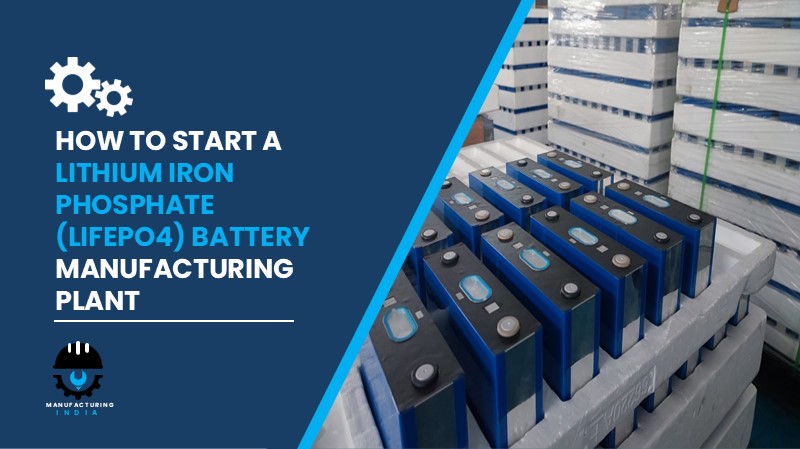
Setting up a lithium iron phosphate battery manufacturing plant in India presents a compelling investment case at the very centre of the global energy transition one that simultaneously addresses the surging demand for electric vehicle batteries, the critical need for grid-scale and residential renewable energy storage, and the strategic imperative of building domestic battery supply chain independence in one of the world’s fastest-growing EV markets. Lithium iron phosphate (LiFePO4) batteries a type of lithium-ion battery that uses lithium iron phosphate as the cathode material have emerged as the preferred battery chemistry for EV and stationary storage applications globally due to their exceptional thermal stability, inherent safety advantages, long cycle life capable of withstanding thousands of charge and discharge cycles, and increasingly competitive energy density. The global lithium iron phosphate battery market was valued at USD 17.99 billion in 2025 and is projected to reach USD 51.68 billion by 2034, exhibiting a CAGR of 12.44% one of the strongest growth trajectories across the entire advanced manufacturing landscape.
India’s strategic positioning for this investment is exceptional and improving rapidly. The government’s PLI scheme for Advanced Chemistry Cell (ACC) battery manufacturing, FAME scheme incentives driving domestic EV adoption, the National Programme on ACC Battery Storage, and active policy support for building an indigenous battery value chain collectively provide the most comprehensive policy and financial infrastructure for LiFePO4 battery manufacturing investment that India has offered to date. Sales of electric cars are near reaching 20 million in 2025, accounting for over a quarter of total cars sold worldwide according to the IEA’s Global EV Outlook directly translating into demand for the battery chemistry that is powering the majority of those vehicles globally. Industrial clusters in Gujarat, Maharashtra, Rajasthan, and Tamil Nadu, combined with India’s growing pool of electrochemical engineers and battery manufacturing technologists, provide investors with the workforce and infrastructure foundation for establishing internationally competitive LiFePO4 battery production capacity.
A lithium iron phosphate battery manufacturing plant in India is positioned within a global market growing at 12.44% CAGR from USD 17.99 billion in 2025 toward USD 51.68 billion by 2034, driven by EV adoption nearing 20 million units globally in 2025, renewable energy storage expansion, and LiFePO4’s unique combination of safety, longevity, and thermal stability that makes it the preferred chemistry across automotive and grid storage applications. With gross margins of 20–35% and net margins of 10–20% at 2 GWh annual production capacity, and supported by India’s ACC PLI scheme, this investment delivers strong clean energy manufacturing returns.
What is a Lithium Iron Phosphate Battery?
Lithium iron phosphate (LiFePO4) batteries are a type of lithium-ion battery that uses lithium iron phosphate as the cathode material. They are known for their high energy density, thermal stability, and outstanding safety characteristics. Unlike traditional lithium-ion batteries, LiFePO4 batteries offer excellent thermal and chemical stability, making them less prone to overheating or combustion and therefore widely used in applications requiring high safety standards, such as electric vehicles, grid energy storage, and medical devices. These batteries also have a longer lifespan, with the ability to withstand thousands of charge and discharge cycles without significant degradation.
The primary production method involves four integrated stages: cathode material preparation, battery assembly, cell formation, and packaging. LiFePO4 batteries serve end-use industries including electric vehicles, renewable energy storage, consumer electronics, and grid energy storage. Key applications include EV battery packs with cell interconnections, busbars, and internal current collectors; battery management systems (BMS) including signal wiring, sensing connections, and control circuitry; energy storage systems (ESS) covering module-to-module connections, grounding, and power distribution; and electric mobility solutions spanning electric vehicles, e-bikes, forklifts, and marine batteries using LiFePO4 chemistry.
Cost of Setting Up a Lithium Iron Phosphate Battery Manufacturing Plant in India
The total investment required to establish a lithium iron phosphate battery manufacturing plant in India depends on plant capacity, cell format selection prismatic, pouch, or cylindrical geographic location, level of automation, and compliance with battery manufacturing safety, environmental, and quality management standards. Investors must account comprehensively for both one-time capital expenditure and recurring operational costs when preparing a feasibility study or detailed project report (DPR).
1. Capital Expenditure (CapEx)
Land and Site Development constitutes a significant foundational investment. Costs for land registration, boundary construction, internal road layout, drainage infrastructure, and site levelling vary based on whether the facility is within a government-notified ACC battery manufacturing zone, a PLI-designated clean energy manufacturing hub, or on privately acquired industrial land. Battery manufacturing clusters in Gujarat, Maharashtra, and Rajasthan offer infrastructure-ready sites with reliable power supply critical for energy-intensive formation and aging processes and proximity to EV OEM and energy storage system integrator customer networks.
Civil Works and Construction encompasses the main dry room electrode fabrication area which requires controlled low-humidity environment for electrode coating and cell assembly operations the cell assembly hall, formation and aging room, quality control and testing laboratory, electrolyte handling and storage facility with chemical containment systems, finished cell and battery pack storage, and administrative block. Dry room construction maintaining dew point temperatures typically below -40°C to prevent moisture contamination of electrolyte and electrode materials represents one of the most technically demanding and cost-intensive civil construction requirements in advanced battery manufacturing, significantly exceeding civil cost benchmarks of conventional manufacturing facilities.
Machinery and Equipment represent the single largest component of capital expenditure. Key machinery required for a lithium iron phosphate battery manufacturing plant includes:
- High-precision mixers
- Coating and calendaring machines
- Vacuum dryers
- Slitters
- Cell assembly lines
- Electrolyte filling systems
- Formation and aging equipment
- Final testing and packaging stations
Other Capital Costs include the effluent treatment plant (ETP) for managing electrolyte and chemical process waste streams, battery waste management and recycling infrastructure, pre-operative expenses covering regulatory filings and ACC PLI application preparation, plant commissioning charges, utility connection fees for high-capacity industrial power required by formation systems, and import duties applicable to precision coating machines, formation equipment, or automated cell assembly lines sourced from international suppliers.
Request a Sample Report for In-Depth Market Insights: https://www.imarcgroup.com/lithium-iron-phosphate-battery-manufacturing-plant-project-report/requestsample
2. Operational Expenditure (OpEx)
Raw Material Cost is the overwhelmingly dominant driver of operating expenditure, accounting for approximately 75–85% of total OpEx the highest raw material cost concentration ratio across all manufacturing categories reviewed in this investment series with the exception of precious metal jewelry. The primary and most cost-significant inputs are LFP cathode powder, graphite anode material, electrolyte (LiPF6), separator, and copper and aluminium foil. LFP cathode powder represents the largest single cost line, with its price linked to lithium carbonate, iron phosphate, and processing cost dynamics on global specialty chemical markets. Graphite anode material primarily sourced from synthetic graphite manufacturers — is the second-largest input. Given this extreme raw material cost concentration, long-term supply contracts with qualified LFP cathode powder manufacturers, graphite anode suppliers, and electrolyte producers are absolutely essential to managing the dominant cost variable and protecting gross margin predictability. Sourcing from domestic suppliers where quality specifications permit reduces import dependency and benefits from PLI localisation incentives under India’s ACC battery manufacturing framework.
Utility Costs – covering electricity for dry room environmental control systems, electrode coating lines, vacuum dryers, formation and aging charging systems, and quality testing equipment account for approximately 5–10% of total OpEx. Formation charging the electrochemical activation of assembled cells through controlled charge-discharge cycles is the most energy-intensive production step, requiring sustained high-capacity electrical power input. Dry room environmental conditioning systems add further continuous utility load to the production facility. Investors in regions with competitive industrial electricity tariffs, reliable high-capacity grid connections, and access to renewable energy are materially better positioned to manage this cost component.
Other Operating Costs include outbound transportation to EV OEMs, battery pack assemblers, energy storage system integrators, and export buyers; packaging for individual cells and completed battery modules; employee salaries for electrochemical engineers, dry room operators, formation technicians, and quality assurance scientists; equipment maintenance; quality assurance testing for BIS battery safety standards and automotive OEM qualification; depreciation on civil and machinery assets; and applicable taxes. By the fifth year of operations, total operational costs are expected to increase substantially due to inflation, market fluctuations, potential rises in LFP cathode powder and graphite anode prices, supply chain disruptions, and rising consumer demand from EV and energy storage markets.
3. Plant Capacity
The proposed lithium iron phosphate battery manufacturing facility is designed with an annual production capacity of 2 GWh, enabling economies of scale while maintaining operational flexibility across different cell formats, capacity ratings, and end-use specifications. This capacity level is well-aligned with the requirements of domestic EV OEMs, battery pack assemblers serving two-wheeler and three-wheeler EV manufacturers, and commercial and residential energy storage system integrators in India’s growing clean energy economy. Capacity can be customised based on investor requirements and offtake contract commitments. Profitability improves substantially with higher capacity utilisation, and LiFePO4 battery plants support phased capacity expansion through additional electrode coating lines and formation capacity with contained incremental CapEx as demand grows and customer qualification is achieved.
4. Profit Margins and Financial Projections
The lithium iron phosphate battery manufacturing plant demonstrates healthy profitability potential under normal operating conditions. Gross profit margins typically range between 20–35%, supported by strong and rapidly growing demand and the high-technology, safety-certified, application-qualified nature of LiFePO4 battery products. Net profit margins range between 10–20%, reflecting the extreme raw material cost intensity of the production model. A comprehensive financial analysis should include income projections, expenditure forecasts, gross and net margin tracking across Years 1 through 5, net present value (NPV), internal rate of return (IRR), payback period, and a full profit and loss account. Sensitivity analysis covering LFP cathode powder and graphite anode price movements, and demand volume variability across EV and energy storage segments, is essential for investment-grade financial planning.
Why Set Up a Lithium Iron Phosphate Battery Manufacturing Plant in India?
EV Adoption Approaching 20 Million Units Globally Creating Enormous Battery Demand. Sales of electric cars are near reaching 20 million in 2025, accounting for over a quarter of total cars sold worldwide according to the IEA’s Global EV Outlook. This historic milestone in global EV adoption directly and powerfully drives demand for LiFePO4 batteries which have become the dominant chemistry choice for mass-market EVs globally due to their safety, longevity, and cost competitiveness. India’s domestic EV adoption particularly accelerating in the two-wheeler, three-wheeler, and commercial vehicle segments is creating a rapidly expanding captive domestic market for LiFePO4 battery cells and modules.
LiFePO4 Chemistry’s Safety and Longevity Advantages Driving Specification Preference. The inherent safety advantages and long cycle life of LiFePO4 batteries make them particularly suitable for applications requiring robust performance and reliability, such as in automotive and grid storage. Unlike high-nickel lithium-ion chemistries, LiFePO4’s iron-phosphate cathode structure does not release oxygen under thermal stress eliminating the primary combustion mechanism that has caused high-profile battery fire incidents in other chemistries. This safety profile is increasingly mandated by EV OEMs and grid storage operators, making LiFePO4 the specification-preferred choice for the most commercially important and fastest-growing battery applications globally.
Renewable Energy Storage Expansion Creating Parallel High-Growth Demand. As more renewable energy sources like solar and wind are integrated into the power grid, the need for reliable and sustainable energy storage solutions is growing, creating additional demand for LiFePO4 batteries. India’s aggressive national solar and wind capacity expansion targets combined with the growing deployment of residential solar-plus-storage systems and commercial grid stabilisation projects are creating a large and parallel energy storage demand stream alongside the automotive application that provides manufacturers with revenue diversification across two independently growing end-use markets.
Government Support Accelerating Adoption and Localisation. Many governments worldwide are incentivising the shift to electric vehicles and renewable energy systems, which is further stimulating the demand for high-quality battery solutions. India’s ACC PLI scheme specifically targets domestic LiFePO4 battery manufacturing capacity creation, with financial incentives, viability gap funding, and manufacturing zone infrastructure that directly reduce the effective CapEx burden for qualifying investors. FAME scheme EV demand subsidies simultaneously grow the domestic buyer market that feeds battery procurement demand.
CATL’s Fifth-Generation LFP Technology Milestone Confirming Chemistry Advancement. In November 2025, CATL officially commenced mass production of its fifth-generation lithium iron phosphate batteries, marking a significant leap forward in battery technology. This new generation spearheaded by the “Shenxing PLUS” model promises substantial improvements in energy density, charging speed, and cycle life. This technology milestone from the world’s largest battery manufacturer confirms that LiFePO4 chemistry continues to advance and improve rather than being supplanted by competing chemistries validating its long-term commercial and technical relevance for investors committing to production capacity today.
LG Energy Solution’s LFP Supply Agreement Validating Global OEM Adoption. In July 2024, LG Energy Solution announced that it would supply LFP pouch-type EV batteries to Ampere, the EV pure player born from Renault Group, its long-time customer. This agreement between a top-tier global battery manufacturer and a major European automotive OEM confirms that LiFePO4 chemistry is gaining traction in the premium automotive segment beyond its original mass-market positioning expanding the addressable customer base for LiFePO4 battery manufacturers globally.
Manufacturing Process – Step by Step
The lithium iron phosphate battery manufacturing process uses cathode material preparation, battery assembly, cell formation, and packaging as the primary production method. Below are the main stages involved in the LiFePO4 battery manufacturing process flow:
- Raw Material Receipt and Inspection: LFP cathode powder, graphite anode material, electrolyte (LiPF6), separator, copper foil (negative electrode current collector), and aluminium foil (positive electrode current collector) are received, inspected against specification, and held in quarantine storage before being released to the production dry room environment following quality verification.
- Electrode Slurry Preparation: High-precision mixers blend LFP cathode powder or graphite anode material with binder (PVDF), conductive additive (carbon black), and solvent (NMP) to produce homogeneous electrode slurries at controlled viscosity, solid content, and particle dispersion specifications the foundation of electrode performance uniformity.
- Electrode Coating: Coating and calendaring machines apply the cathode slurry onto aluminium foil and the anode slurry onto copper foil at precisely controlled coating weights, widths, and speeds. Coating uniformity across the width and length of the electrode directly determines cell capacity consistency and safety across the production batch.
- Drying and Solvent Recovery: Vacuum dryers remove solvent from the coated electrodes under controlled temperature profiles, recovering NMP solvent for reuse and achieving the specified residual moisture content in the dried electrode that is critical for electrolyte compatibility and cell longevity.
- Calendaring: Calendaring machines compress the dried electrodes to the target thickness and porosity specification controlling the electrode density and microstructure that determines ion transport characteristics, energy density, and cycle life of the finished cell.
- Slitting: Slitters precisely cut the calendared electrode sheets into the defined widths required for the target cell format prismatic, pouch, or cylindrical with edge quality and dimensional accuracy verified to minimise metallic particle generation that could cause internal short circuits.
- Cell Assembly: Cell assembly lines stack or wind cathode, separator, and anode layers into the defined cell configuration, insert the electrode stack into the cell housing (aluminium laminate pouch, prismatic aluminium case, or cylindrical steel can), and weld current collector tabs to external terminals — all conducted in the controlled low-humidity dry room environment to prevent moisture contamination.
- Electrolyte Filling: Electrolyte filling systems inject the lithium hexafluorophosphate (LiPF6) electrolyte into each assembled cell under controlled vacuum and atmosphere conditions, achieving the specified electrolyte fill weight and distribution before hermetic sealing.
- Cell Formation: Formation and aging equipment subjects each filled cell to precisely controlled initial charge-discharge cycles that electrochemically activate the electrode interfaces, form the solid electrolyte interface (SEI) layer on the graphite anode, and bring the cell to its operational electrochemical state. Formation is the most energy-intensive and time-critical step, directly determining cell capacity, cycle life, and safety behaviour.
- Aging and Screening: Formed cells are held at elevated temperature for specified aging periods to accelerate early-life degradation and enable identification of cells with manufacturing defects or abnormal self-discharge rates before shipment. Cells failing aging screening are segregated from good cells.
- Final Testing: Final testing and packaging stations subject each cell to comprehensive performance and safety tests including capacity measurement, internal resistance, open circuit voltage, self-discharge rate, dimensional verification, and high-voltage isolation testing with test results recorded for full batch traceability and customer quality documentation.
- Module and Pack Assembly (where applicable): Qualified cells are assembled into battery modules and packs with cell interconnections, busbars, BMS wiring, thermal management components, and structural housing according to customer specifications for EV or energy storage system applications.
- Packaging and Dispatch: Finished LiFePO4 cells and battery packs are packaged according to UN transport regulations for lithium batteries and dispatched to EV OEMs, battery pack assemblers, energy storage system integrators, and consumer electronics manufacturers.
Key Applications
LiFePO4 batteries produced at this type of facility serve four primary end-use sectors with specific cell format, capacity, and performance qualification requirements for each:
- Electric Vehicles: Battery packs for two-wheelers, three-wheelers, passenger cars, commercial vehicles, e-bikes, forklifts, and marine applications using LiFePO4 chemistry the dominant and fastest-growing application segment globally driven by EV adoption nearing 20 million units in 2025.
- Renewable Energy Storage: Grid-scale and residential energy storage systems (ESS) using LiFePO4 batteries for solar and wind energy storage, grid stabilisation, peak shaving, and off-grid backup power applications in India’s rapidly expanding renewable energy infrastructure.
- Consumer Electronics: Batteries for portable electronics, power tools, and backup devices requiring the combination of safety, long cycle life, and consistent discharge performance that LiFePO4 chemistry provides.
- Grid Energy Storage: Large-format stationary energy storage systems for utility-scale grid balancing, frequency regulation, and renewable energy integration requiring the safety profile and multi-thousand-cycle longevity that only LiFePO4 chemistry currently delivers at commercial scale.
Leading LiFePO4 Battery Manufacturers
The global lithium iron phosphate battery industry is served by several large-scale manufacturers with extensive production capacities and strong multi-sector application portfolios. Key players include:
- BYD Company Ltd.
- CATL
- A123 Systems
- LiFeBATT
- Lishen Battery Co.
Timeline to Start the Plant
Investors planning to establish a lithium iron phosphate battery manufacturing plant in India should anticipate the following project development phases, with an overall timeline typically ranging from 24 to 36 months:
- Feasibility study and project report preparation
- Land acquisition and site development
- Regulatory approvals and environmental clearances
- Factory licence and fire safety compliance
- Machinery procurement and installation
- Raw material supplier agreements and supply chain setup
- Trial production and quality testing
- Commercial production launch
Licences and Regulatory Requirements
Starting a lithium iron phosphate battery manufacturing unit in India requires several approvals:
- Business registration (Proprietorship, LLP, or Private Limited Company)
- Factory Licence under the Factories Act
- Bureau of Indian Standards (BIS) certification under applicable lithium battery safety standards including IS/IEC 62619 for secondary lithium cells and batteries for use in industrial applications
- Environmental Clearance from the State Pollution Control Board including EIA for battery manufacturing involving hazardous chemicals and lithium battery waste management
- GST Registration
- Fire Safety NOC including lithium battery thermal runaway and fire suppression compliance
- Effluent Treatment Plant (ETP) operational clearance for electrolyte and NMP solvent waste stream management
- Battery Waste Management Rules, 2022 EPR registration for lithium battery collection, recycling, and disposal obligations
- Occupational Health and Safety compliance covering NMP solvent exposure, electrolyte chemical handling, and dry room safety operations
- ACC PLI scheme registration for eligibility to access Advanced Chemistry Cell battery manufacturing financial incentives
Key Challenges to Consider
Extreme Raw Material Cost Concentration – LFP Cathode Powder. LFP cathode powder and graphite anode material together account for 75–85% of total OpEx — one of the highest raw material cost ratios in all manufacturing. Cathode and anode pricing is linked to lithium carbonate, iron phosphate, and synthetic graphite commodity markets subject to global supply chain volatility. Securing long-term supply contracts with qualified international and domestic suppliers is the most critical operational risk management priority from the investment’s inception.
Dry Room Construction and Operational Complexity. LiFePO4 battery manufacturing requires large-area dry room facilities maintaining dew point temperatures typically below -40°C throughout electrode fabrication and cell assembly operations. Dry room construction and ongoing environmental control costs represent a major CapEx and OpEx item unique to battery manufacturing that significantly exceeds the facility cost benchmarks of conventional manufacturing. Any dry room integrity failure results in moisture contamination, electrode degradation, and batch rejection making dry room maintenance a persistent operational discipline challenge.
Technology Evolution and Energy Density Competition. Battery chemistry and cell design are evolving rapidly, as evidenced by CATL’s November 2025 commencement of mass production of its fifth-generation LFP batteries featuring the “Shenxing PLUS” model with substantial improvements in energy density and charging speed. Manufacturers must track technology advancement and plan for periodic production line upgrades to maintain competitiveness against next-generation cell specifications demanded by evolving EV OEM and energy storage buyer requirements.
OEM Customer Qualification Timelines. Supplying EV OEMs with battery cells requires passing extensive automotive-grade customer qualification programs including performance testing, abuse testing, cycle life validation, and quality system audits (IATF 16949) — that typically require 12 to 24 months from sample submission to production approval. Investors must plan for extended revenue ramp-up timelines and adequate working capital to bridge the qualification period before volume production revenue commences.
Competition from Established Global Battery Manufacturers. The global LiFePO4 battery market is dominated by CATL and BYD which together command the majority of global LFP battery production capacity alongside other large-scale producers including LG Energy Solution, A123 Systems, and Lishen. Indian producers must build competitive positioning through PLI-supported cost structures, domestic OEM relationship development, localisation compliance advantages for FAME and government procurement channels, and focus on application segments where proximity and supply chain reliability offset scale disadvantages.
Skilled Workforce in Electrochemistry and Battery Manufacturing. Operating electrode coating lines, dry rooms, formation charging systems, and cell assembly equipment requires electrochemical engineers and battery manufacturing technologists with specialised training in lithium battery cell design, dry room protocols, formation process management, and battery quality management systems. This talent pool is globally scarce and in high demand as the battery manufacturing industry expands simultaneously across all major economies — making workforce development a critical long-term operational priority for Indian LiFePO4 battery manufacturers.
Frequently Asked Questions
1. How much does it cost to set up a lithium iron phosphate battery manufacturing plant in India?
The total cost depends on plant capacity (2 GWh per annum and above), cell format selection, dry room specification, location, and automation level. CapEx covers land, dry room and battery-grade civil construction, and machinery including high-precision mixers, coating and calendaring machines, vacuum dryers, slitters, cell assembly lines, electrolyte filling systems, formation and aging equipment, and final testing and packaging stations, along with pre-operative and regulatory costs.
2. Is lithium iron phosphate battery manufacturing profitable in India in 2026?
Yes. With gross margins of 20–35% and net margins of 10–20%, supported by EV adoption nearing 20 million units globally in 2025, renewable energy storage expansion, LiFePO4’s dominant safety and longevity advantages, and India’s ACC PLI scheme incentives, the investment presents a strong profitability case at appropriate production scale and with secured OEM offtake agreements.
3. What machinery is required for a lithium iron phosphate battery manufacturing plant in India?
Key equipment includes high-precision mixers, coating and calendaring machines, vacuum dryers, slitters, cell assembly lines, electrolyte filling systems, formation and aging equipment, and final testing and packaging stations.
4. What licences and approvals are required to start a lithium iron phosphate battery manufacturing plant in India?
Required approvals include business registration, Factory Licence, BIS certification under IS/IEC 62619, Environmental Clearance, GST Registration, Fire Safety NOC with lithium battery thermal hazard compliance, ETP operational clearance, EPR registration under Battery Waste Management Rules 2022, Occupational Health and Safety compliance, and ACC PLI scheme registration.
5. What raw materials are needed for lithium iron phosphate battery manufacturing?
The primary raw materials are LFP cathode powder, graphite anode material, electrolyte (LiPF6), separator, copper foil (anode current collector), and aluminium foil (cathode current collector). Additional process materials include PVDF binder, carbon black conductive additive, NMP solvent, and battery housing materials for prismatic or pouch cell formats.
6. What are the environmental compliance requirements for a lithium iron phosphate battery manufacturing plant in India?
Environmental Clearance from the State Pollution Control Board is required, along with ETP for NMP solvent and electrolyte chemical waste management, NMP solvent recovery system compliance, lithium battery waste management under Battery Waste Management Rules 2022, and EPR registration for end-of-life battery collection and recycling obligations.
7. What is the best location to set up a lithium iron phosphate battery manufacturing plant in India?
States with established clean energy and electronics manufacturing infrastructure, reliable high-capacity industrial power supply, ACC PLI zone designation, and proximity to EV OEM assembly clusters — such as Gujarat, Maharashtra, Rajasthan, and Tamil Nadu — offer the best combination of infrastructure readiness, raw material supply chain access, skilled engineering workforce availability, and policy incentive support for LiFePO4 battery manufacturing investment.
8. What is the break-even period for this type of plant in India?
The break-even period depends on plant capacity utilisation, LFP cathode powder and graphite anode procurement pricing, OEM customer qualification timeline, and product selling price to EV and energy storage buyers. A full NPV and IRR analysis incorporating sensitivity testing for cathode material price movements and OEM qualification schedule variability is recommended for investment-grade financial planning.
9. What government incentives are available for lithium iron phosphate battery manufacturers in India?
The ACC PLI scheme provides production-linked financial incentives of up to INR 18,100 crore for domestic advanced battery manufacturers achieving defined production and localisation targets. FAME scheme EV demand incentives grow the domestic buyer market. Make in India manufacturing support, state-level clean energy industrial zone incentives in Gujarat and Maharashtra, and battery recycling infrastructure support under Battery Waste Management Rules all provide meaningful financial and regulatory backing for qualifying LiFePO4 battery manufacturing investments.
Key Takeaways for Investors
A lithium iron phosphate battery manufacturing plant in India represents one of the most strategically critical and financially compelling clean energy manufacturing investments available in 2026 positioned within a global market growing at 12.44% CAGR from USD 17.99 billion in 2025 toward USD 51.68 billion by 2034, driven by EV adoption nearing 20 million units globally in 2025, renewable energy storage deployment expanding at record pace, and LiFePO4 chemistry’s unmatched combination of safety, longevity, and advancing energy density that continues to make it the specification-preferred choice for EV OEMs and grid storage operators worldwide. Financial viability is supported at a plant capacity of 2 GWh per annum and above, with gross margins of 20–35% and net margins of 10–20% achievable as the plant scales toward full capacity utilisation and OEM customer qualification is completed. CATL’s November 2025 commencement of fifth-generation LFP battery mass production featuring the “Shenxing PLUS” model with improvements in energy density, charging speed, and cycle life — and LG Energy Solution’s 2024 LFP supply agreement with Renault Group’s Ampere EV division both confirm the sustained global technology investment and OEM adoption momentum that is anchoring LiFePO4’s long-term commercial dominance. With India’s ACC PLI scheme providing direct manufacturing incentives, FAME scheme demand subsidies expanding the domestic EV market, and India’s renewable energy expansion creating parallel grid storage demand, the long-term investment case for LiFePO4 battery manufacturing in India is comprehensively and compellingly well-supported for the decade ahead.
About the Author