Introduction
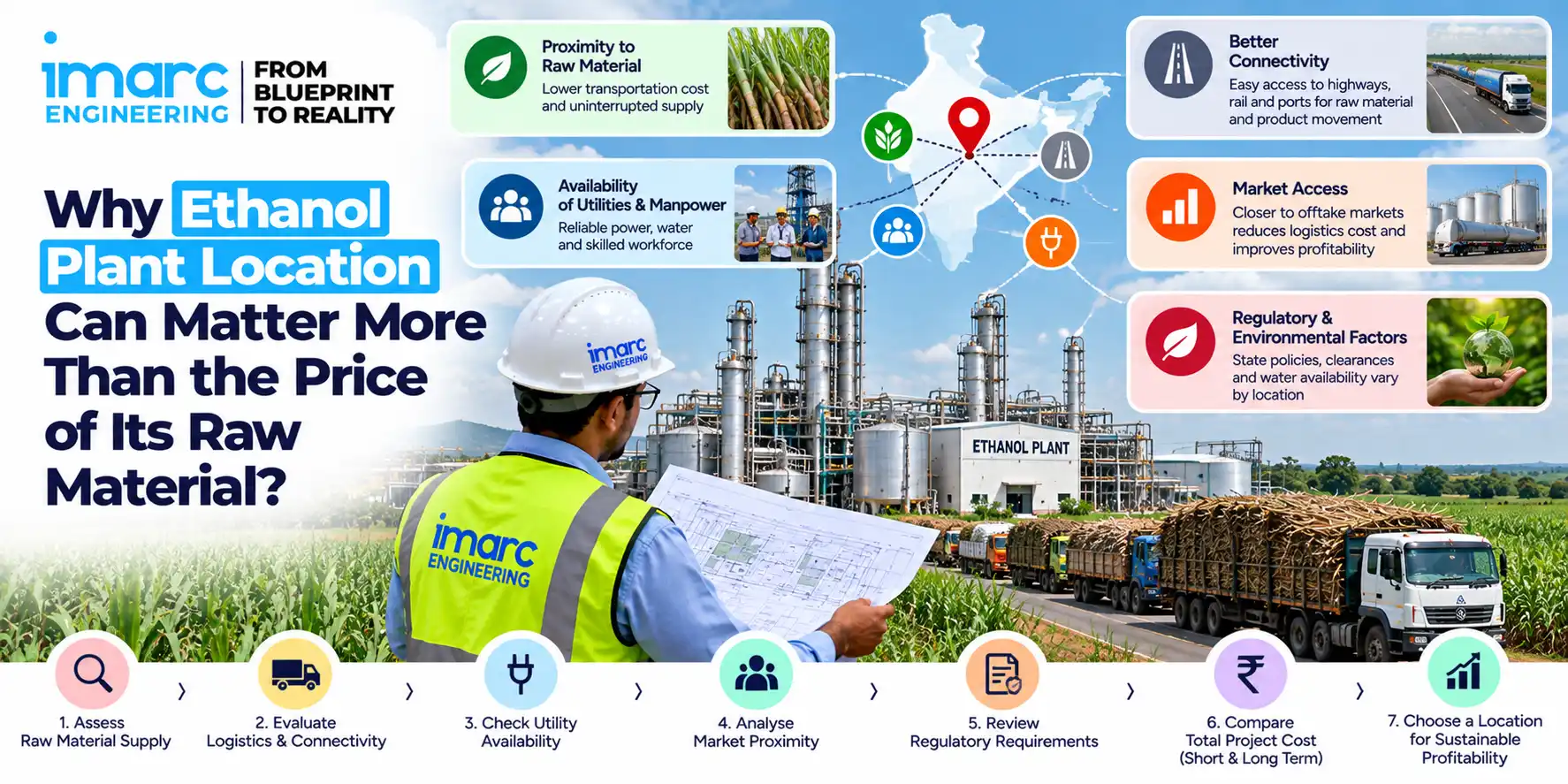
Investors often start by asking what feedstock costs per tonne. For an ethanol manufacturing plant in India, that is only one input. A site with cheap raw material can still carry higher delivered feedstock, water, wastewater, logistics and development costs.
Location decisions are hard to reverse once land is bought and approvals are filed. A structured review of location analysis and site selection services can test these trade-offs before capital is committed. The risks below do not affect every project, but each deserves a check.
Why the Cheapest Raw Material Does Not Always Mean the Lowest Production Cost
The price at the source is not the price at the plant gate. Delivered cost includes loading, freight, handling losses, storage and any intermediaries. A distant supplier with a low rate can cost more than a nearby one with a higher rate.
Ethanol plant project feasibility should therefore be built on delivered cost per tonne of usable feedstock. Compare sites on the full cost to convert that feedstock into ethanol, not on the quoted purchase price.
Feedstock Availability Matters More Than Proximity Alone
A site close to farms or sugar mills is not automatically secure. The questions that matter are:
- Seasonality: Does supply cover the planned operating days, or only a harvest window?
- Supplier concentration: Would the plant depend on a few sellers with pricing power?
- Competing demand: Are other distilleries or industries drawing on the same catchment?
- Flexibility: Can the design handle more than one feedstock if supply shifts?
A feedstock study should map the catchment area, not just the nearest source. Storage cost and working capital also rise when supply is seasonal.
Water Availability Can Change the Site Decision
Water requirements depend on plant capacity, feedstock, process design and the extent of water recycling. Publicly available MPCB project summaries illustrate this variation: a 105 KLPD grain-based distillery in Baramati reports fresh-water use of 788 KLD, while a separate 60 KLPD project reports an initial water demand of 1,125 CMD, including 640 CMD of recycled water. These figures relate to different projects and should not be treated as a direct benchmark. Before selecting a site, estimate the proposed plant’s water balance and confirm the availability, quality, source and permissions for its actual requirements.
If a proposed site may rely on groundwater, confirm the applicable Central Ground Water Authority (CGWA) requirements before finalising the location. NOC requirements and groundwater-abstraction restrictions can depend on the area’s assessment category, the proposed use and the applicable rules or exemptions. Verify the current position for the specific site with the relevant authority. Also assess raw-water quality, because additional treatment may increase both infrastructure and operating costs.
Wastewater Treatment Can Make a Cheap Site Expensive
Distillery wastewater management can influence plant design, land requirements and environmental compliance. Some environmental-clearance documents for ethanol projects refer to Zero Liquid Discharge (ZLD) requirements. However, the applicable conditions should be checked against the proposed plant’s feedstock, project category and the latest relevant notifications and clearance conditions. Before selecting a site, assess whether sufficient space and infrastructure are available for the wastewater-treatment and management system required for that specific project.
A site should be assessed for:
- Space for wastewater treatment, storage and by-product handling, based on the proposed process design and applicable CPCB guidelines and project-specific environmental conditions.
- Nearby water bodies, settlements and sensitive land uses
- Soil and groundwater conditions that affect lining and containment
Cheap land with no room for this infrastructure is not cheap for long.
Transportation Costs Affect Both Inputs and Finished Products
Logistics runs in two directions. Bulky feedstock comes in, while ethanol and by-products such as DDGS go out. Ethanol must reach oil marketing company depots, so the distance and route to those depots affect margins every day the plant runs.
Compare road and rail access, approach-road quality, turnaround time for tankers and trucks, and monsoon accessibility. A short route on poor roads can cost more than a longer route on a good highway.
Cheap Land Can Hide Site Development Costs
A low land rate does not include what the plot needs before construction. Common items include:
- Levelling and filling
- Storm-water drainage and flood protection
- Soil investigation and foundation requirements
- Internal and approach roads
- Boundary works and utility connections
Two plots with the same price per acre can differ widely once these are costed. Ask for a development cost estimate before comparing land rates.
Planning to set up a manufacturing plant in India? Watch this video to understand the key site selection factors to evaluate before purchasing industrial land
Utility Infrastructure Can Affect Commissioning and Operating Costs
An ethanol plant needs reliable power, steam, cooling and treated process water. Clearance documents often show captive cogeneration, with DG sets as standby for grid failures. Whether that works depends on grid capacity and quality, fuel logistics for boilers, and space for utility blocks.
Weak connections can delay commissioning or raise operating cost. Verify capacity, reliability and connection timelines with the utility providers, not only the seller.
Regulatory Suitability Should Be Checked Before Land Purchase
Environmental-clearance requirements depend on the proposed project and the applicable regulatory framework. Before purchasing land, verify the project’s classification, clearance requirements, land-use status and relevant State Pollution Control Board consents with the appropriate authorities. Check the latest official notifications and project-specific conditions before making a site decision.
Check land-use status, zoning, distance from sensitive features and any pending litigation before purchase. Rules and notifications change, so confirm the current position with the authorities and qualified advisers.
Comparison Table: Two Potential Ethanol Plant Locations
This table is illustrative. It does not declare a winner, and actual conclusions need verified costs, resource availability and applicable requirements.
| Parameter | Site A: Lower initial land price | Site B: Higher initial land price |
|---|---|---|
| Land acquisition cost | Lower upfront outlay | Higher upfront outlay |
| Feedstock delivery | May involve longer or less reliable routes | May offer shorter routes or more supplier options |
| Water and utilities | May need new connections or longer pipelines | May have nearer, established access |
| Wastewater management | May need extra infrastructure or land | May have better disposal or treatment options |
| Finished-product logistics | May face longer routes to depots | May have better road or rail connectivity |
| Site-development risks | Possible levelling, drainage or access costs | Possibly lower, but must be verified |
| Overall project economics | Depends on total development and operating cost | Depends on whether connectivity offsets land premium |
Why a Location Screening Process Matters Before Land Purchase
Before purchasing land, compare shortlisted locations using the same technical, commercial and regulatory criteria. A structured screening can help identify site constraints while there is still time to negotiate, redesign the project or reject an unsuitable plot.
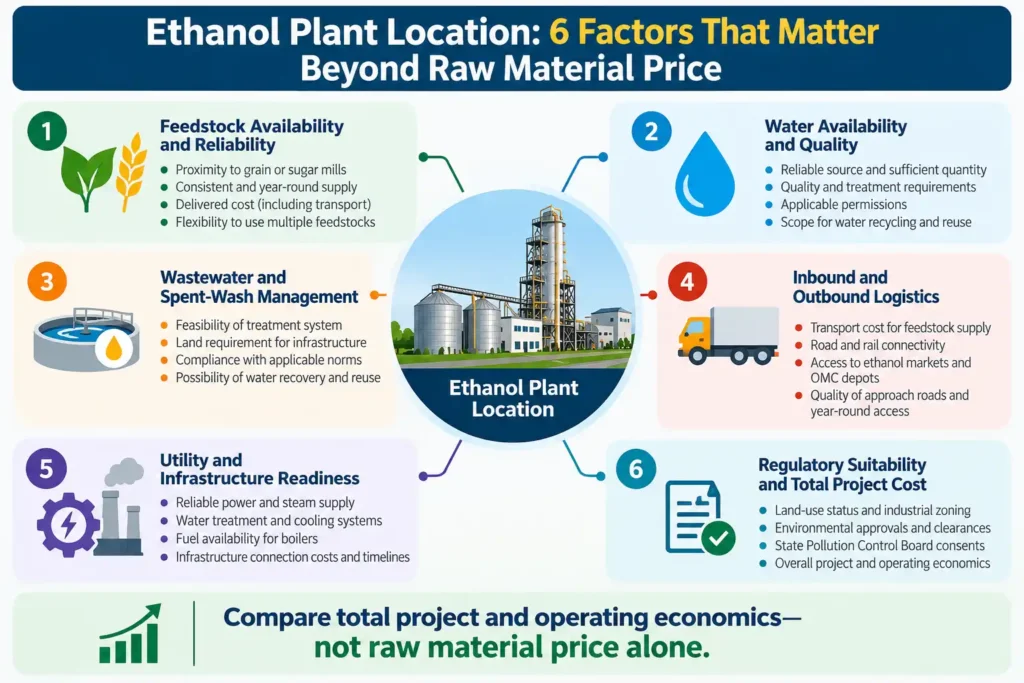
A practical first-stage assessment should cover six areas:
- Feedstock economics: Estimate delivered cost, seasonal availability and dependence on individual suppliers.
- Water feasibility: Confirm the proposed source, expected quantity, quality and applicable permissions.
- Wastewater management: Identify the treatment approach, land requirement and applicable environmental conditions.
- Logistics: Estimate inbound feedstock and outbound ethanol transport requirements using realistic routes.
- Infrastructure: Check power, steam, road access, utility connection costs and expected connection timelines.
- Site and regulatory risks: Review land-use status, site-development needs and the clearances relevant to the proposed project.
Support the comparison with supplier quotations, water-source information, preliminary utility estimates, site-development assessments and relevant regulatory records. Then compare the likely capital and operating costs alongside unresolved risks—not land price alone.
Ethanol Plant Location Checklist for Investors
- Delivered feedstock cost per tonne, not purchase price alone
- Feedstock catchment, seasonality and supplier concentration
- Water source, volume, quality and permission status
- Wastewater pathway and space for ZLD infrastructure
- Inbound and outbound route quality and distance
- Site-development cost: levelling, drainage, soil, roads
- Power, steam and utility connection capacity and timelines
- Land-use status and applicable clearances
- Total project and operating economics across shortlisted sites
How IMARC Engineering Can Help
Selecting an ethanol plant location requires more than comparing land prices and feedstock rates. Project developers need to assess infrastructure access, logistics, water availability, site constraints and applicable planning requirements before committing capital.
IMARC Engineering’s location analysis and site selection services can support project teams in evaluating candidate sites against their operational and development requirements.
Planning an ethanol plant in India? Contact IMARC Engineering to discuss your site-selection requirements before finalising the land: https://www.imarcengineering.com/contact?service=location-analysis-and-site-selection
Conclusion
A low raw material price is a useful starting point for an ethanol manufacturing plant in India, but it is not the deciding factor. Feedstock reliability, water, wastewater, logistics, utilities and regulatory fit shape both capital and running costs. Screen the site on all of them before land purchase.
Contact Us:
IMARC Engineering
Phone: +91-120-433-0800
Email: sales@imarcengineering.com
India: C-130, Sector 2, Noida, Uttar Pradesh 201301
LinkedIn: https://www.linkedin.com/showcase/imarc-engineering/
About the Author