
A jewellery brand can have its designs, a manufacturing partner and a launch date, and still be unsure who must register with the Bureau of Indian Standards (BIS) and who must get the pieces hallmarked.
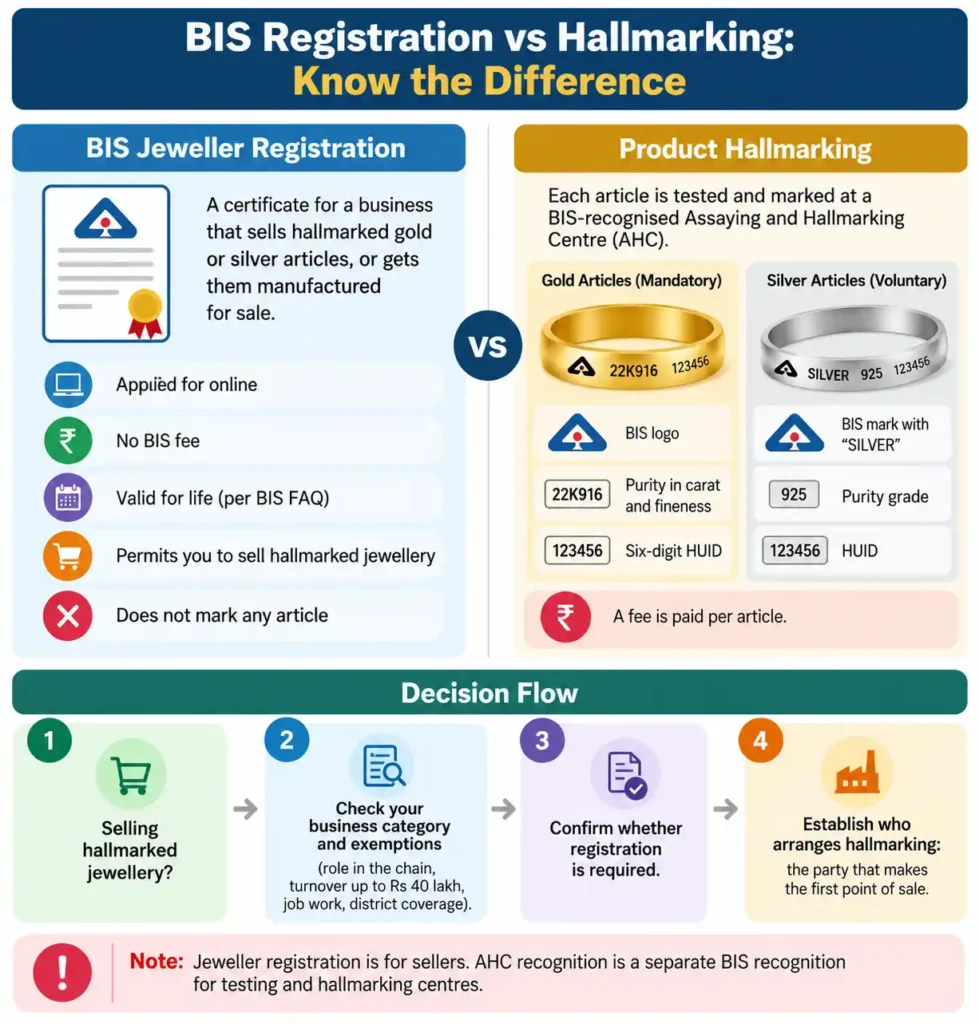
BIS registration for jewellery is a certificate that allows a business to sell hallmarked gold and silver articles. Under BIS guidance, any manufacturer, wholesaler, distributor or retailer selling hallmarked articles must hold it. Registration is not hallmarking: the hallmark is applied by a BIS-recognised testing centre, and in a sales chain the first seller arranges it.
This guide reflects BIS and Gazette documents available on 16 October 2026.
What Is BIS Registration for Jewellery Businesses?
Jeweller registration is a certificate of registration issued by BIS under its Hallmarking Regulations, 2018. BIS’s July 2026 guidelines describe a jeweller as a person who gets precious-metal articles manufactured for sale or sells them. Registration is applied for online and, per the guidelines, is granted instantly.
Hallmarking is a different step. Each article is tested and marked at an Assaying and Hallmarking Centre (AHC), a testing centre recognised by BIS. Per the BIS jewellers FAQ, a gold hallmark carries three marks: the BIS logo, purity in carat and fineness, and a six-digit Hallmark Unique Identification (HUID) number.
AHC recognition is separate again. It is a BIS recognition for testing centres, not something a jewellery brand applies for to sell hallmarked jewellery. A jeweller cannot hallmark its own articles, and BIS treats hallmarking at a non-recognised centre as an unfair practice.
Which Jewellery Businesses Need BIS Registration?
Obligations differ by business model. According to the BIS jewellers FAQ:
- Manufacturers, wholesalers, distributors and retailers that sell hallmarked gold or silver articles must register.
- Private-label brands are not named separately in the FAQ. BIS’s guidelines define a jeweller to include a person who gets articles manufactured for sale, so a brand selling under its own name should assume it is covered and confirm with BIS.
- Job-work artisans who make jewellery for jewellers and are not directly part of the sale chain may be exempt from registration, but must hold documents supporting that status.
- Jewellers with annual turnover up to Rs 40 lakh are outside mandatory hallmarking, though they may register to sell hallmarked jewellery.
The mandatory-hallmarking order also lists article-level exemptions in covered districts, including articles under 2 grams, export articles built to a foreign buyer’s specification, and Kundan, Polki and Jadau jewellery. BIS’s exemption guidelines carry the detail. These exemptions apply only in districts covered by the order.
Why Does BIS Registration Matter Before Selling Jewellery?
In districts covered by the Mandatory Hallmarking Order, gold jewellery must be hallmarked before sale. BIS’s phase-wise list now runs to 392 districts, so a brand’s sales locations decide which rules bite.
Registration also brings ongoing duties. Under the July 2026 guidelines, registered jewellers display their certificate and the BIS logo, and BIS may draw samples from stock and check HUID details. BIS can cancel registration for reasons that include selling articles below their marked purity, as set out in the FAQ, which also summarises penalties under the BIS Act, 2016.
For a new brand, the practical value is clarity. Knowing early who registers, who hallmarks and who keeps the invoices lets you write that into supplier contracts before stock exists.
Gold vs Silver Hallmarking: What Jewellery Brands Should Know
Gold. Hallmarking is mandatory in districts listed in the Mandatory Hallmarking Order, as amended. The latest amendment on BIS’s order page is the Third Amendment Order of 3 August 2026, which substituted the district list. Articles must be hallmarked to the grades in IS 1417. A registered jeweller outside a covered district can still sell hallmarked gold. The order covers jewellery and artefacts, not gold bullion or coins.
Silver. The mandatory order concerns gold only. Silver hallmarking under IS 2112:2025 remains voluntary. Per a Ministry of Consumer Affairs statement, HUID-based silver hallmarking began on 1 September 2025, and any silver article that is hallmarked now carries a HUID. The silver hallmark combines the BIS mark with the word “SILVER”, a purity grade and the HUID. Check BIS before launch, because this position can change.
How to Apply for BIS Jeweller Registration
The steps below follow the BIS jewellers FAQ and the July 2026 guidelines.
- Confirm your role in the sale chain and whether an exemption applies, such as turnover or job work.
- Open the National Single Window System, directly or through BIS’s Manak Online portal, and follow BIS’s application guide.
- Submit the application. A firm with several outlets applies through its registered or head office with a list of outlets, and each outlet receives its own certificate.
- Receive the registration number by email and SMS, then download the certificate. BIS may later scrutinise registrations, and ineligible ones can be cancelled.
- Display the BIS logo with the wording “Hallmarked Jewellery available for sale”, the certificate and the other items the guidelines list.
- Send articles to a recognised AHC through Manak Online. The FAQ says AHC staff can also raise the request on your behalf.
BIS charges no registration fee, and the certificate is valid for life per the FAQ. Hallmarking is paid separately. Under the 14 September 2026 amendment, the fee to an AHC is Rs 75 per gold article with a Rs 200 minimum per consignment, and Rs 35 per silver article with a Rs 150 minimum, plus taxes. BIS registration is its own certificate and does not replace other business registrations or licences.
Who Is Responsible for Hallmarking When Manufacturing Is Outsourced?
The BIS rule is simple: in the chain of manufacturer, wholesaler, distributor and retailer, the party that makes the first point of sale gets the article hallmarked, once. A point of sale needs three things together: ownership transfers, a valid tax invoice is raised, and the goods are physically delivered.
How that plays out depends on your arrangement:
- The manufacturer sells finished jewellery to your brand. That sale is the first point of sale, so the manufacturer registers and arranges hallmarking. Your brand then buys hallmarked stock.
- Your brand supplies the metal and the manufacturer charges labour only. The FAQ explains that job work is not a sale where metal stays with the customer. The same logic may apply here, but this is an inference. Your brand would then make the first sale and arrange hallmarking, and the manufacturer needs documents showing job-work status.
- A wholesaler or retailer buys unhallmarked articles. Whoever sells first hallmarks. A retailer may add its own mark after hallmarking.
Responsibility continues after the sale. The jeweller who got the article hallmarked is responsible for its purity and fineness, and the registered jeweller who sells it pays compensation for any shortfall. BIS also says the AHC that hallmarked the article shares responsibility for penal action when a sample fails. If a jeweller cannot show invoices with proper traceability, the July 2026 guidelines say BIS decides on the available evidence, keeping consumer fairness in view.
Manufacturing and Quality Checks Before Launch
The items below are manufacturing planning, not BIS registration steps.
- Product specifications. Fix the metal, purity grade (IS 1417 for gold, IS 2112 for silver) and weight for each design.
- Declared purity. Each hallmarking request records item category, quantity, weight and declared purity, so production must be able to state these accurately.
- Material traceability. Keep metal purchase invoices, melt or batch records and job-work challans that link finished pieces to their source.
- Pre-submission checks. The guidelines say articles bearing markings such as KDM, or an existing fineness or caratage, must not be sent for hallmarking.
- Testing margin. BIS draws market samples. A shortage in fineness above 40 parts per thousand can start cancellation of registration, so build a safety margin into alloy control.
- Recognised AHCs. Choose from BIS’s AHC list, and confirm the centre tests the metal you use, since not every centre handles silver.
- HUID records. Use Manak Online to update HUID status for sales, returns and melted pieces.
[TABLE PLACEMENT: insert here]
BIS Registration and Hallmarking Requirements by Jewellery Business Type
| Business type | What to check | Important point |
|---|---|---|
| Manufacturer selling hallmarked articles | Registration; whether you make the first point of sale; district coverage | The first seller arranges hallmarking at a recognised AHC. Hallmarking happens once in the chain. |
| Wholesaler or distributor | Registration; whether stock arrived hallmarked | Registration is required to sell hallmarked articles. Unfinished articles meant for further manufacture are exempt, but hallmarking applies at first sale. |
| Retailer | Registration; invoice details; outlet display | A retailer may buy hallmarked stock from a registered jeweller or use an AHC. It may add its own mark after hallmarking. |
| Private-label brand using a contract manufacturer | Who owns the metal; who invoices whom | Depends on the arrangement. A manufacturer sale to the brand makes the manufacturer the first seller. Labour-only job work may make the brand the first seller. |
| Qualifying job-work artisan | Labour-only charges; no sale of articles | May be exempt from registration if supporting documents show job-work status. |
| Silver jewellery business | Voluntary scheme; AHC recognised for silver | Hallmarking is optional, but any hallmarked silver article carries a HUID. Selling hallmarked silver requires registration. |
Common Mistakes Jewellery Brands Should Avoid
- Assuming registration hallmarks products. It only permits sale of hallmarked articles.
- Relying on an outdated district list. BIS has amended the order repeatedly, most recently on 3 August 2026.
- Applying gold rules to silver, or the reverse. Silver hallmarking is voluntary and gold is mandatory in covered districts.
- Assuming outsourced production removes all responsibility. The first seller, not the factory by default, arranges hallmarking.
- Treating exemptions as blanket. Article and turnover exemptions have conditions, and job-work status needs documents.
- Sending pre-marked or already-hallmarked pieces without checking BIS’s rules on markings and re-hallmarking.
How IMARC Engineering Can Help With Jewellery Manufacturing Planning
This guide serves three kinds of reader. If you only need compliance information, the official BIS links in this article are your next step. If you are launching a brand through a contract manufacturer, use the responsibility section above and the contract-manufacturer questions in your supplier talks. If you are planning or expanding a jewellery facility, engineering support becomes relevant.
IMARC Engineering is an EPCM advisory firm. Its listed services relevant to a manufacturing project include feasibility study and business planning, plant layout and process flow design, equipment selection and technical specifications, fire safety and security system design, SOP development and turnkey project management. IMARC Engineering does not issue BIS registrations or provide legal approval.
Planning a jewellery manufacturing facility in India? Contact IMARC Engineering to discuss manufacturing planning, machinery requirements and project feasibility.
Frequently Asked Questions
1. Is BIS registration free for jewellers? Yes. BIS charges no fee for registration, and the certificate is valid for life per the BIS jewellers FAQ. Hallmarking fees are paid separately to the AHC: from 14 September 2026, Rs 75 per gold article (Rs 200 minimum per consignment) and Rs 35 per silver article (Rs 150 minimum), plus taxes.
2. Is BIS registration required when using a third-party manufacturer? It depends on your arrangement. BIS’s guidelines define a jeweller to include a person who gets articles manufactured for sale, so a brand selling hallmarked jewellery should plan to register. The manufacturer registers separately if it sells to you or others. Qualifying job workers may be exempt.
3. Who must arrange hallmarking in the sales chain? The party that makes the first point of sale, whether manufacturer, wholesaler, distributor or retailer. Hallmarking is done once in the chain.
4. Is hallmarking mandatory for silver jewellery? No. The mandatory order covers gold. Silver hallmarking under IS 2112:2025 is voluntary, but any hallmarked silver article carries a HUID, per the Ministry statement. Recheck before launch, as policy may change.
5. Does BIS jeweller registration mean every product is hallmarked? No. Registration permits you to sell hallmarked articles. Each article must still be tested and hallmarked at a recognised AHC, and exemptions and the voluntary silver scheme mean some products legitimately are not.
6. Where can businesses check the latest mandatory-hallmarking requirements? Start with BIS’s Mandatory Hallmarking Order page, which lists each amendment and the phase-wise district list, then the jewellers FAQ and Manak Online.
Conclusion
Registration lets you sell hallmarked jewellery, hallmarking is a per-article test and mark by a recognised centre, and manufacturing is the quality work that makes articles pass. The first seller in the chain arranges hallmarking, so your contract and invoicing decide who that is.
If you are only checking rules, review the BIS sources below. If you are launching through a manufacturer, map who owns the metal and who invoices whom, then confirm with your BIS branch office. If you are building a facility, start with feasibility and layout planning.
About the Author