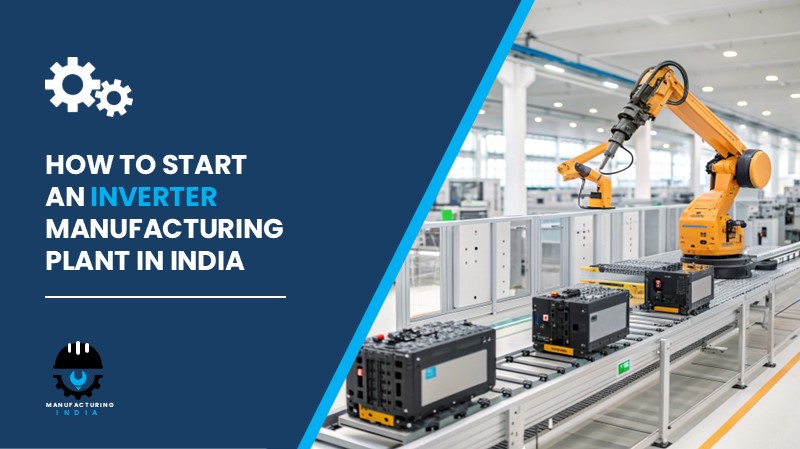
Setting up an inverter manufacturing plant in India presents a compelling investment case as the country rapidly emerges as one of the most cost-competitive and high-demand destinations for power electronics and clean-energy component manufacturing. Driven by accelerating demand from renewable energy, electric vehicles, residential and commercial energy storage, and industrial drives, inverters have become an indispensable part of India’s rapidly expanding clean-energy and electrification infrastructure.
“With over 1.4 billion consumers, a rapidly urbanising population, aggressive renewable energy targets, and a booming EV and solar sector, India offers one of the most financially attractive environments for inverter manufacturing — with gross margins of 30–40% and a break-even window of 3–5 years.”
What is an Inverter?
An inverter is an essential electrical device that converts DC (direct current) to AC (alternating current) for applications where AC power is needed. Inverters are used across a variety of industries, including renewable energy (solar and wind), automotive (electric vehicles), industrial drives, data centres, and backup power systems. High-efficiency inverters ensure maximum energy output while minimising energy losses, making them crucial for applications such as solar power systems, energy storage, and electric vehicle charging infrastructure. Modern inverters incorporate advanced power electronics, firmware-based control algorithms, thermal management systems, and communication interfaces that enable grid synchronisation, demand response, and remote monitoring across utility-scale and distributed energy applications.
Cost of Setting Up an Inverter Manufacturing Plant in India
The inverter manufacturing plant cost in India depends on several parameters including production capacity, technology used, plant location, level of automation, and regulatory compliance requirements. Here is a structured breakdown of all major cost components:
1. Capital Expenditure (CapEx)
The total capital investment in an inverter manufacturing plant typically covers the following:
Land and Site Development
This includes land acquisition, boundary development, land registration charges, and basic site preparation. Cost varies significantly depending on whether the land is in an electronics manufacturing cluster, Special Economic Zone (SEZ), Industrial Development Corporation estate, or a privately purchased plot. Proximity to established power electronics and EV component supply chain hubs such as Pune, Bengaluru, Hyderabad, Chennai, and Noida can significantly reduce component logistics costs.
Civil Works and Construction
Building costs cover the main manufacturing and assembly shed, ESD-controlled production zones, component and raw material storage, quality control and testing laboratory, thermal management testing area, firmware development room, administrative block, and worker amenities. Construction specifications depend on plant scale, ESD compliance requirements, high-voltage testing safety infrastructure, and local regulatory norms.
Machinery and Equipment
This is the single largest component of CapEx. Key machinery required for an inverter manufacturing plant includes:
- Automated PCB Assembly Lines (SMT)
- Pick-and-Place Machines
- Reflow Soldering Ovens
- Wave Soldering Machines
- Automated Optical Inspection (AOI) Systems
- Power Module and IGBT/MOSFET Assembly Stations
- Thermal Management Assembly Equipment
- Environmental Stress Testing (ESS) Chambers
- Electrical Safety and Insulation Testers
- Calibration and Load Bank Testing Systems
- Firmware Programming and Flashing Stations
- Thermal Imaging Cameras for QC
- Enclosure Fabrication and Assembly Equipment
- Advanced Packaging and Labelling Systems
Machinery costs represent the largest share of overall capital expenditure, reflecting the high degree of precision power electronics assembly, thermal management integration, firmware control, and rigorous testing involved in inverter production.
Other Capital Costs
These include pre-operative expenses, commissioning charges, import duties on specialised power electronics manufacturing equipment sourced internationally, ESD flooring and high-voltage safety infrastructure, utilities installation, fire safety systems, and Effluent Treatment Plant (ETP) setup where applicable.
2. Operational Expenditure (OpEx)
Once the plant is commissioned, the ongoing cost structure is dominated by a few key components:
Raw Material Cost (Capacitors, IGBTs/MOSFETs, PCBs, and Components): 70–80% of Total OpEx
Capacitors and power semiconductor devices (IGBTs/MOSFETs) are the primary cost drivers among raw materials and together account for the majority of operating expenses. Additional materials include PCBs, aluminium heat sinks, transformers, inductors, enclosures, terminal blocks, firmware modules, and communication interface components. Long-term supplier contracts and phased domestication of component sourcing help mitigate import dependency and global semiconductor price volatility.
Utility Cost: 5–10% of Total OpEx
Utilities include electricity (consumed by automated assembly lines, soldering ovens, testing chambers, and load bank systems), compressed air supply, and climate control for ESD-compliant assembly areas and component storage. Investing in energy-efficient equipment and rooftop solar integration can materially reduce utility costs over the project lifecycle.
Other Operating Costs
The remaining budget covers transportation and logistics, secondary packaging, salaries and wages for power electronics engineers, firmware developers, and quality technicians, maintenance of precision assembly and testing equipment, depreciation, taxes, certification renewal costs, and miscellaneous overhead.
3. Plant Capacity
The proposed manufacturing facility is designed with an annual production capacity ranging between 500,000 to 1 million units. This range allows the plant to achieve economies of scale while maintaining operational flexibility to serve multiple end-use segments including residential solar systems, commercial rooftop installations, utility-scale solar and wind projects, EV charging infrastructure, industrial variable frequency drives, and backup power systems. Smaller pilot setups with semi-automated assembly may start at lower capacity, but profitability significantly improves with higher capacity utilisation and longer production runs.
4. Profit Margins and Financial Projections
- Gross Profit Margin: 30–40%, supported by stable demand from renewable energy deployment and EV sector growth
- Net Profit Margin: 12–18%, improving with higher capacity utilisation and efficient component sourcing
- Break-Even Period: 3 to 5 years, depending on production scale, order volumes from solar EPC and EV OEM customers, raw material cost management, and sales efficiency
Financial projections must account for capital investment, operating costs, capacity utilisation rates, pricing trends, and demand outlook. A thorough analysis should also include sensitivity analysis, Net Present Value (NPV), Internal Rate of Return (IRR), and Payback Period.
Request a Sample Report for In-Depth Market Insights: https://www.imarcgroup.com/inverter-manufacturing-plant-project-report/requestsample
Why Set Up an Inverter Plant in India?
India presents a uniquely favourable environment for establishing an inverter manufacturing plant:
Surging Domestic Demand from Renewable Energy and EV Expansion
India’s ambitious 500 GW renewable energy target by 2030, aggressive rooftop solar rollout, and rapidly growing EV market are generating unprecedented demand for inverters across all capacity ranges. Solar installations alone require one string or central inverter per installation, creating a direct and high-volume demand pipeline for domestic inverter manufacturers as India accelerates its energy transition.
Policy and Regulatory Tailwinds
The Government of India’s Production Linked Incentive (PLI) schemes for solar PV modules, advanced chemistry cell batteries, and electronics, combined with the Make in India initiative and preferential market access provisions in government procurement for domestically manufactured power electronics, create a strongly policy-favourable environment for Indian inverter manufacturers over importers.
Cost-Competitive Manufacturing
India offers competitive land costs, a large pool of skilled electronics and electrical engineering graduates, and a rapidly expanding domestic electronics component supply chain. Access to cost-effective labour for precision assembly, combined with growing domestic availability of PCBs, enclosures, and passive components, gives Indian manufacturers a meaningful cost advantage over fully imported products across several inverter categories.
Export Opportunities
India-based manufacturers can leverage competitive cost structures to tap into growing export demand from Southeast Asia, Africa, the Middle East, and South Asia, where renewable energy deployment is accelerating rapidly. India’s established electronics export infrastructure, engineering talent pool, and competitive freight rates support international market entry across both solar and industrial inverter segments.
Megatrend Alignment with EV and Energy Storage Growth
The global sales of electric cars are on track to surpass 20 million in 2025, accounting for over a quarter of cars sold worldwide. India’s domestic EV market is growing rapidly across two-wheelers, three-wheelers, and commercial vehicles, all of which require onboard and off-board inverter and power conversion systems — creating a second, high-growth demand channel for domestic inverter manufacturers alongside the renewable energy sector.
Manufacturing Process Overview
The inverter manufacturing process primarily uses power conversion, DC to AC transformation, and energy optimisation technologies. The complete process flow involves:
- Component Procurement and Incoming Quality Inspection — sourcing and IQC of IGBTs/MOSFETs, capacitors, PCBs, heat sinks, transformers, and enclosures
- PCB Assembly (SMT) — automated placement and soldering of surface-mount components using pick-and-place machines and reflow ovens
- Wave Soldering — soldering of through-hole components for power stage and control circuitry
- Automated Optical Inspection (AOI) — automated visual inspection of soldered PCBs for defects and misalignments
- Power Module Sub-Assembly — integration of IGBTs/MOSFETs, busbars, and heat sinks into the power conversion stage
- Firmware Programming — loading and configuring inverter control firmware, grid codes, and communication protocols
- Mechanical Assembly — fitting PCBs, power modules, thermal management components, and terminals into the enclosure
- Electrical Safety Testing — insulation resistance, dielectric withstand, and earthing continuity tests
- Functional and Load Testing — full-power load bank testing, efficiency measurement, and grid synchronisation verification
- Environmental Stress Screening (ESS) — thermal cycling and vibration testing for reliability assurance
- Quality Inspection, Labelling, and Packaging — final QC, certification marking, and dispatch packaging
Key Applications of Inverters
Inverters manufactured in India serve a wide variety of end-use industries and applications:
- Renewable Energy Systems: Solar string, central, and micro-inverters for residential rooftop, commercial, and utility-scale solar PV plants; wind turbine power converters
- Electric Vehicles and EV Charging: Onboard chargers, traction inverters, and DC fast charging power conversion units for two-wheelers, three-wheelers, passenger vehicles, and commercial EVs
- Industrial Drives: Variable frequency drives (VFDs) and motor drive inverters for pumps, compressors, conveyors, and HVAC systems across manufacturing and process industries
- Energy Storage Systems: Battery inverters and bidirectional power conversion units for residential BESS, commercial peak shaving, and grid-scale storage projects
- Backup Power and UPS: Online UPS systems, home inverters, and critical power backup for data centres, hospitals, telecom towers, and commercial establishments
Global Market Outlook
The global inverter market was valued at USD 21.7 Billion in 2025 and is projected to reach USD 72.3 Billion by 2034, growing at a CAGR of 14.3% from 2026 to 2034. This exceptional growth trajectory is driven by worldwide renewable energy deployment, the electric vehicle revolution, expanding energy storage adoption, industrial automation, and data centre power infrastructure expansion.
Leading global players in the inverter industry include:
- SMA Solar Technology AG
- Fronius International GmbH
- Schneider Electric SE
- Huawei Technologies Co. Ltd.
- Enphase Energy Inc.
- ABB Ltd.
- Siemens AG
- Sungrow Power Supply Co. Ltd.
- Delta Electronics Inc.
- GE Vernova
Timeline to Start an Inverter Plant
Setting up an inverter manufacturing plant from ideation to commissioning typically requires 12 to 18 months. This covers:
- Feasibility study and detailed project report (DPR) preparation
- Land acquisition and site development
- Regulatory approvals and environmental clearances
- Factory licence and fire safety compliance
- Machinery procurement, installation, and ESD and high-voltage safety infrastructure setup
- BIS certification testing and product type approval
- Trial production, load testing, and quality verification
- Commercial production launch and customer order fulfilment
Licenses and Regulatory Requirements
Starting an inverter manufacturing unit in India requires several approvals, including:
- Business registration (Proprietorship, LLP, or Private Limited Company)
- Factory Licence under the Factories Act
- Environmental Clearance from the State Pollution Control Board
- GST Registration
- Fire Safety NOC
- BIS Certification under relevant IS standards for inverters, UPS systems, and power electronic converters — mandatory for products sold in India
- CEA (Central Electricity Authority) Grid Connectivity Approval for grid-tied solar inverters
- MNRE empanelment for solar inverters used in government-subsidised rooftop and utility-scale schemes
- IEC 62109 / IEC 61683 Type Testing (for solar inverters)
- Udyam Registration (for MSME benefits and PLI scheme eligibility)
Key Challenges to Consider
Before investing, entrepreneurs should be aware of the common challenges in this business:
- High Capital Requirements: Initial CapEx for automated SMT lines, power module assembly stations, load bank testing systems, and ESS chambers is significant, particularly for mid to large-scale plants targeting solar EPC and EV OEM customers.
- Semiconductor and Component Import Dependency: Key power semiconductor devices including IGBTs, MOSFETs, and specialised capacitors remain heavily import-dependent. Global semiconductor supply chain disruptions and currency fluctuations can significantly impact production costs and margins.
- Certification and Type Approval Complexity: Obtaining BIS, CEA grid connectivity, and MNRE empanelment approvals requires substantial investment in testing infrastructure, type testing at accredited laboratories, and ongoing compliance documentation.
- Rapid Technology Evolution: Fast-evolving inverter topologies, wide-bandgap semiconductor adoption (SiC and GaN), and changing grid code requirements demand continuous R&D investment to remain competitive in specification-driven customer selection processes.
- Competition from Chinese Imports: Low-cost Chinese inverter imports, particularly in the solar segment, exert sustained price pressure on domestic manufacturers, requiring a clear value differentiation strategy based on local service, warranty support, and compliance advantages.
- Skilled Manpower: Operating SMT lines, power module assembly stations, and high-voltage testing equipment requires trained power electronics engineers and technicians, who are in high demand across India’s expanding electronics and clean-energy manufacturing sector.
Frequently Asked Questions
The following questions are answered in the report:
- How much does it cost to set up an inverter manufacturing plant in India?
- Is inverter manufacturing profitable in India in 2026?
- What machinery is required for an inverter plant in India?
- What raw materials and components are required for inverter production?
- What licences and approvals are required to start an inverter plant in India?
- How long does it take to commission an inverter manufacturing plant in India?
- What is the best state or location to set up an inverter plant in India?
- What government incentives are available for inverter manufacturers in India?
- What is the break-even period for an inverter plant in India?
- What are the BIS and CEA compliance requirements for inverter manufacturing in India?
Key Takeaways for Investors
The inverter manufacturing industry in India represents a strong and scalable investment opportunity backed by India’s ambitious renewable energy targets, a booming EV market, and a supportive domestic manufacturing policy environment. With gross margins of 30–40%, a well-planned inverter manufacturing plant cost in India remains competitive and financially viable across plant capacities. Investors who combine BIS-compliant quality systems, efficient power electronics component sourcing, and strong relationships with solar EPC contractors, EV OEMs, and industrial customers stand to benefit significantly from one of India’s fastest-growing segments of clean-energy and power electronics manufacturing.
About the Author