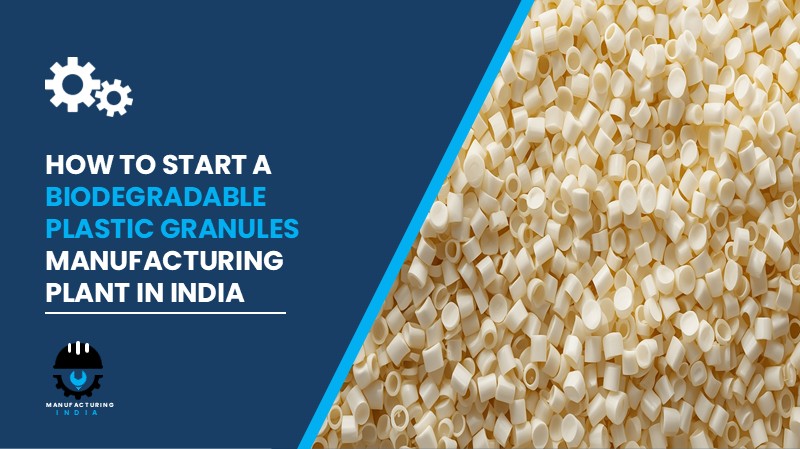
Setting up a biodegradable plastic granules manufacturing plant in India presents a compelling investment case as the country rapidly emerges as one of the most cost-competitive and high-demand destinations for sustainable packaging and eco-friendly polymer manufacturing. Driven by booming demand from the packaging, agriculture, consumer goods, and food service industries, biodegradable plastic granules have become an indispensable part of India’s shift toward sustainable materials and circular economy solutions.
“With over 1.4 billion consumers, a rapidly urbanizing population, Make in India policy support, stringent single-use plastic bans, and a booming sustainable packaging sector, India offers one of the most financially attractive environments for biodegradable plastic granules manufacturing with gross margins of 30-40% and strong long-term growth potential.”
What are Biodegradable Plastic Granules?
Biodegradable plastic granules are a polymer material made to break down into innocuous end-products such as water, carbon dioxide, and biomass under specific environmental conditions. Most of the granules are produced from renewable or bio-based feedstock—corn/potato starch blends, polylactic acid (PLA), and polyhydroxyalkanoates (PHA). Besides their biodegradable nature, they offer similar resistance, flexibility, and processability compared to conventional plastics with a considerably lower environmental impact. Biodegradable plastic granules are designed to be compatible with standard plastic processing equipment.
These granules serve as the core raw material for manufacturing compostable packaging films, agricultural mulch films, disposable cutlery, food service containers, non-woven fabrics, and medical implants. Globally respected regulatory institutions, including EN 13432 (Europe) and ASTM D6400 (USA), have established standards for biodegradability and compostability. In India, the growing push for sustainable packaging, compliance with Extended Producer Responsibility (EPR) frameworks, and eco-conscious consumer preferences are further accelerating biodegradable plastic granules demand across both urban and rural markets.
Request for a Sample Report: https://www.imarcgroup.com/biodegradable-plastic-granules-manufacturing-plant-project-report/requestsample
Cost of Setting Up a Biodegradable Plastic Granules Manufacturing Plant in India
The biodegradable plastic granules manufacturing plant cost in India depends on several parameters including production capacity, technology used, plant location, level of automation, feedstock selection (PLA, PHA, starch-based), and regulatory compliance. Here is a structured breakdown of all major cost components:
- Capital Expenditure (CapEx)
The total capital investment in a biodegradable plastic granules manufacturing plant typically covers the following:
Land and Site Development: This includes land acquisition, boundary development, land registration charges, and basic site preparation. Cost varies significantly depending on whether the land is in an industrial estate, Special Economic Zone (SEZ), or a privately purchased plot. Location must offer easy access to key raw materials such as corn starch/sugarcane (for PLA), bacterial strains/nutrients (for PHA), and solvents.
Civil Works and Construction: Building costs cover the main manufacturing shed, utility area, raw material storage, quality control laboratory, administrative block, and worker amenities. Construction specifications depend on plant scale and local compliance norms. The layout should be optimized with separate areas for raw material storage, production, quality control, and finished goods storage, with space for future expansion.
Machinery and Equipment: This is the single largest component of CapEx. Key machinery required for a biodegradable plastic granules plant includes:
- Industrial mixers and compounders for blending raw materials
- Twin-screw extruders for polymer compounding and processing
- Pelletizing and cutting systems for granule formation
- Cooling baths for solidification and temperature control
- Drying units for moisture removal
- Quality control sieves for particle size classification
- Automated packaging machines for final product handling
- Polymerization reactors (for PLA/PHA production from feedstock)
- Filtration and purification systems
- Laboratory equipment for quality testing and certification
Machinery costs represent the largest share of overall capital expenditure, reflecting the high degree of precision engineering and process control involved in biodegradable polymer production.
Other Capital Costs: These include pre-operative expenses, commissioning charges, import duties (if machinery is sourced internationally), utilities installation, fire safety systems, and Effluent Treatment Plant (ETP) setup to ensure environmental compliance.
- Operational Expenditure (OpEx)
Once the plant is commissioned, the ongoing cost structure is dominated by a few key components:
Raw Material Cost: 50-60% of Total OpEx: Raw materials including corn starch/sugarcane (for PLA), bacterial strains/nutrients (for PHA), and solvents account for the majority of operating expenses. Additional materials may include plasticizers, compatibilizers, and performance additives depending on the final application requirements.
Utility Cost: 20-30% of Total OpEx: Utilities include electricity (heavily consumed by extruders, compounders, and dryers), water (used in cooling and processing), steam (for polymerization reactions), and compressed air supply. Energy efficiency is critical given the significant utility share in operating costs.
Other Operating Costs: The remaining budget covers transportation, secondary packaging, salaries and wages, maintenance, depreciation, taxes, and miscellaneous overhead.
- Plant Capacity
The proposed manufacturing facility is designed with an annual production capacity ranging between 20,000 to 50,000 MT. This range allows the plant to achieve economies of scale while maintaining flexibility to serve multiple end-use segments including packaging, agriculture, consumer goods, and medical applications.
Smaller pilot setups with limited automation may start at a lower capacity, but profitability significantly improves with higher capacity utilization and access to bulk feedstock procurement.
- Profit Margins and Financial Projections
- Gross Profit Margin: 30-40%
- Net Profit Margin: 12-18%
- Break-Even Period: 3 to 5 years, depending on production scale, market demand, raw material cost management, feedstock sourcing efficiency, and sales strategy.
Financial projections must account for capital investment, operating costs, capacity utilization rates, pricing trends, certification costs (EN 13432, ASTM D6400), and demand outlook. A thorough analysis should also include sensitivity analysis, Net Present Value (NPV), Internal Rate of Return (IRR), and Payback Period.
Why Set Up a Biodegradable Plastic Granules Plant in India?
India presents a uniquely favorable environment for establishing a biodegradable plastic granules manufacturing plant:
Surging Domestic Demand: India’s sustainable packaging, food service, agriculture, and consumer goods industries are growing rapidly. According to IBEF, the biodegradable plastic market in India is expected to grow to USD 223 million by 2030, as India escalates efforts under the single-use plastic ban. This creates massive demand for eco-friendly packaging alternatives and compostable materials.
Policy and Regulatory Tailwinds: The Government of India’s emphasis on plastic waste management, single-use plastic bans, Extended Producer Responsibility (EPR) frameworks, Make in India initiatives, and support for bio-based materials is creating a policy-friendly environment for biodegradable plastic granules manufacturers. Regulatory restrictions on petroleum-based plastics directly accelerate market growth.
Cost-Competitive Manufacturing: India offers competitive land costs, a large pool of trained labor, well-established agricultural feedstock supply chains (corn, sugarcane), and growing biotech capabilities for PHA production, making it one of the most cost-effective locations for biodegradable plastic granules production in Asia.
Export Opportunities: India-based manufacturers can tap into growing export demand from Southeast Asia, Europe, the Middle East, and Africa, where local bio-polymer production capacity remains limited and demand for sustainable packaging is surging.
Local Supply Chain Preference: FMCG, food service, packaging converters, and agricultural companies increasingly prefer sourcing biodegradable materials locally to reduce logistics costs, improve responsiveness, ensure EPR compliance, and maintain better quality control—a direct opportunity for domestic biodegradable plastic granules manufacturers.
Alignment with Corporate Sustainability Goals: Brand owners and multinational corporations are committing to sustainability targets, driving demand for certified compostable materials and creating long-term, stable offtake agreements for reliable biodegradable granule suppliers.
Manufacturing Process Overview
The biodegradable plastic granules manufacturing process involves several precision-controlled stages:
Polymerization (for PLA/PHA from feedstock):
- Fermentation of sugars to produce lactic acid (for PLA) or bacterial cultivation (for PHA)
- Polymerization reactions to form polymer chains
- Purification and recovery of bio-polymer
Compounding and Pelletizing:
- Raw material preparation and drying
- Blending of bio-polymers with additives, compatibilizers, and performance enhancers
- Twin-screw extrusion for homogeneous compounding
- Pelletizing through underwater or strand cutting systems
- Cooling and solidification in water baths
- Drying to remove surface moisture
- Sieving and classification for uniform particle size
- Quality inspection for biodegradability, mechanical properties, and certification compliance
- Packaging in moisture-resistant bags for storage and dispatch
The complete process flow involves raw material sourcing and preparation, polymerization (if starting from feedstock), compounding and extrusion, pelletizing and cooling, drying and classification, quality testing, and final packaging.
Key Applications of Biodegradable Plastic Granules
Biodegradable plastic granules manufactured in India serve a wide variety of end-use industries:
- Packaging: Compostable films, flexible packaging products, biodegradable containers, and food service packaging
- Agriculture: Mulch films, seed trays, plant pots, and agricultural protective covers
- Consumer Goods: Disposable cutlery, tableware, household items, and single-use products
- Textiles: Non-woven fabrics for hygiene and medical applications
- Medical & Hygiene: Compostable medical disposables, sanitary products, and pharmaceutical packaging
- Biomedical: Medical implants, sutures, and controlled-release drug delivery systems
Global Market Outlook
According to industrial reports, the biodegradable plastic granules market is experiencing robust growth driven by stringent regulations on single-use plastics, rising environmental concerns, increasing adoption of sustainable packaging, and growing demand from food service and agricultural sectors. Europe accounts for the largest market share of 42.7% of the total market, driven by strict EU regulations and high consumer awareness.
The market is projected to continue growing at a healthy rate from 2026 to 2034, supported by urbanization, increasing packaged food consumption, agricultural expansion, and rising demand for sustainable and compostable packaging formats.
Leading global players in this industry include:
- NatureWorks LLC
- BASF SE
- Novamont S.p.A.
- TotalEnergies Corbion
- Danimer Scientific
- FKuR Kunststoff GmbH
Timeline to Start a Biodegradable Plastic Granules Plant
Setting up a biodegradable plastic granules manufacturing plant from ideation to commissioning typically requires 12 to 18 months. This covers:
- Feasibility study and project report preparation
- Land acquisition and site development
- Regulatory approvals and environmental clearances
- Factory license and fire safety compliance
- Technology selection and feedstock sourcing agreements
- Machinery procurement and installation
- Process validation and quality certification (EN 13432, ASTM D6400)
- Trial production and performance testing
- Commercial production launch
Licenses and Regulatory Requirements
Starting a biodegradable plastic granules manufacturing unit in India requires several approvals, including:
- Business registration (Proprietorship, LLP, or Private Limited Company)
- Factory License under the Factories Act
- Environmental Clearance from the State Pollution Control Board
- GST Registration
- Fire Safety NOC
- BIS Certification (for specific applications)
- FSSAI Approval (for food contact packaging applications)
- Biodegradability and Compostability Certifications (EN 13432, ASTM D6400, BIS standards)
- EPR Registration for plastic waste management compliance
Key Challenges to Consider
Before investing, entrepreneurs should be aware of the common challenges in this business:
- Moderate to High Capital Requirements: Initial CapEx for specialized polymerization, compounding, and extrusion machinery is significant, especially for integrated PLA/PHA production facilities.
- Raw Material Price Volatility: Feedstock costs (corn, sugarcane) are linked to agricultural commodity markets and can fluctuate, directly impacting margins. Bacterial culture costs for PHA can also vary.
- Regulatory Compliance: Meeting biodegradability standards, compostability certifications, and food-contact safety requirements requires continuous investment in quality systems and third-party testing.
- Competition from Conventional Plastics: Despite regulatory support, biodegradable plastics still face price competition from cheaper petroleum-based alternatives, requiring strong value proposition and customer education.
- Skilled Manpower: Operating precision extrusion, polymerization, and compounding equipment requires trained technical staff with expertise in polymer processing and quality control.
- Market Education: Converters and brand owners may require technical support and education on processing parameters, performance characteristics, and end-of-life disposal of biodegradable granules.
Recent Industry Developments
November 2024: Toray Industries, Inc. stated that it had signed a memorandum of understanding with major Thai petrochemicals manufacturer PTT Global Chemical Public Company Limited (GC) to develop mass production technology for adipic acid produced from non-edible biomass, supporting sustainable bio-polymer production.
September 2024: Danimer Scientific, Inc. and Ningbo Homelink Eco-iTech Co. Ltd. announced the commercial introduction of biopolymers for home compostable extrusion coatings created with Nodax, Danimer’s trademark polyhydroxyalkanoate (PHA). With their Nodax PHA-based biopolymer coating, Homelink’s cups will provide their consumers with a fully repulpable, industrially and home compostable substitute for conventional paper cups.
Frequently Asked Questions
The following questions are commonly asked by investors and entrepreneurs:
- How much does it cost to set up a biodegradable plastic granules manufacturing plant in India?
- Is biodegradable plastic granules manufacturing profitable in India in 2026?
- What machinery is required for a biodegradable plastic granules plant in India?
- What licenses and approvals are required to start a biodegradable plastic granules plant in India?
- How long does it take to commission a biodegradable plastic granules manufacturing plant in India?
- What is the best state or location to set up a biodegradable plastic granules plant in India?
- What government incentives are available for biodegradable plastic granules manufacturers in India?
- What is the break-even period for a biodegradable plastic granules plant in India?
- What are the biodegradability and compostability certification requirements for biodegradable plastic granules manufacturing in India?
- What are the key feedstock options (PLA, PHA, starch-based) and their cost implications?
Key Takeaways for Investors
The biodegradable plastic granules manufacturing industry in India represents a strong and scalable investment opportunity backed by growing domestic demand, stringent single-use plastic regulations, and supportive government policy. With gross margins of 30-40% and net margins of 12-18%, a well-planned biodegradable plastic granules manufacturing plant cost in India remains competitive and financially viable across plant capacities.
Essential Sustainability Material: Biodegradable plastic granules are a core input for compostable packaging, agricultural films, consumer goods, and single-use alternatives—making them a critical material in the global transition away from conventional plastics toward sustainable and circular economy solutions.
Policy & Regulatory Push: Government bans on single-use plastics, Extended Producer Responsibility (EPR) frameworks, compostability regulations, and incentives for green materials directly accelerate demand for biodegradable plastic granules.
Megatrend Alignment: Global megatrends such as sustainability mandates, plastic waste reduction, eco-conscious consumer behavior, and corporate ESG commitments are driving strong growth in biodegradable plastics; packaging, agriculture, and food-service segments are expanding at high single- to double-digit rates worldwide.
How IMARC Can Help?
IMARC Group is a global management consulting firm that helps the world’s most ambitious changemakers to create a lasting impact. The company provides a comprehensive suite of market entry and expansion services. IMARC offerings include thorough market assessment, feasibility studies, company incorporation assistance, factory setup support, regulatory approvals and licensing navigation, branding, marketing and sales strategies, competitive landscape and benchmarking analyses, pricing and cost research, and procurement research.
Contact Us:
IMARC Group
134 N 4th St. Brooklyn, NY 11249, USA
Email: sales@imarcgroup.com
Tel No: (D) +91 120 433 0800
United States: +1-201-971-6302
About the Author