Setting up an acetic anhydride production plant in 2026 requires clarity on a few core variables: process route, production capacity, capital investment, operating cost structure, and profitability under prevailing market conditions. This feasibility study covers the acetic anhydride plant setup cost in india, and the machinery and raw materials needed, driven by rising demand from cellulose acetate production, increasing pharmaceutical manufacturing, growth in agrochemical intermediates, and rising chemical synthesis applications.
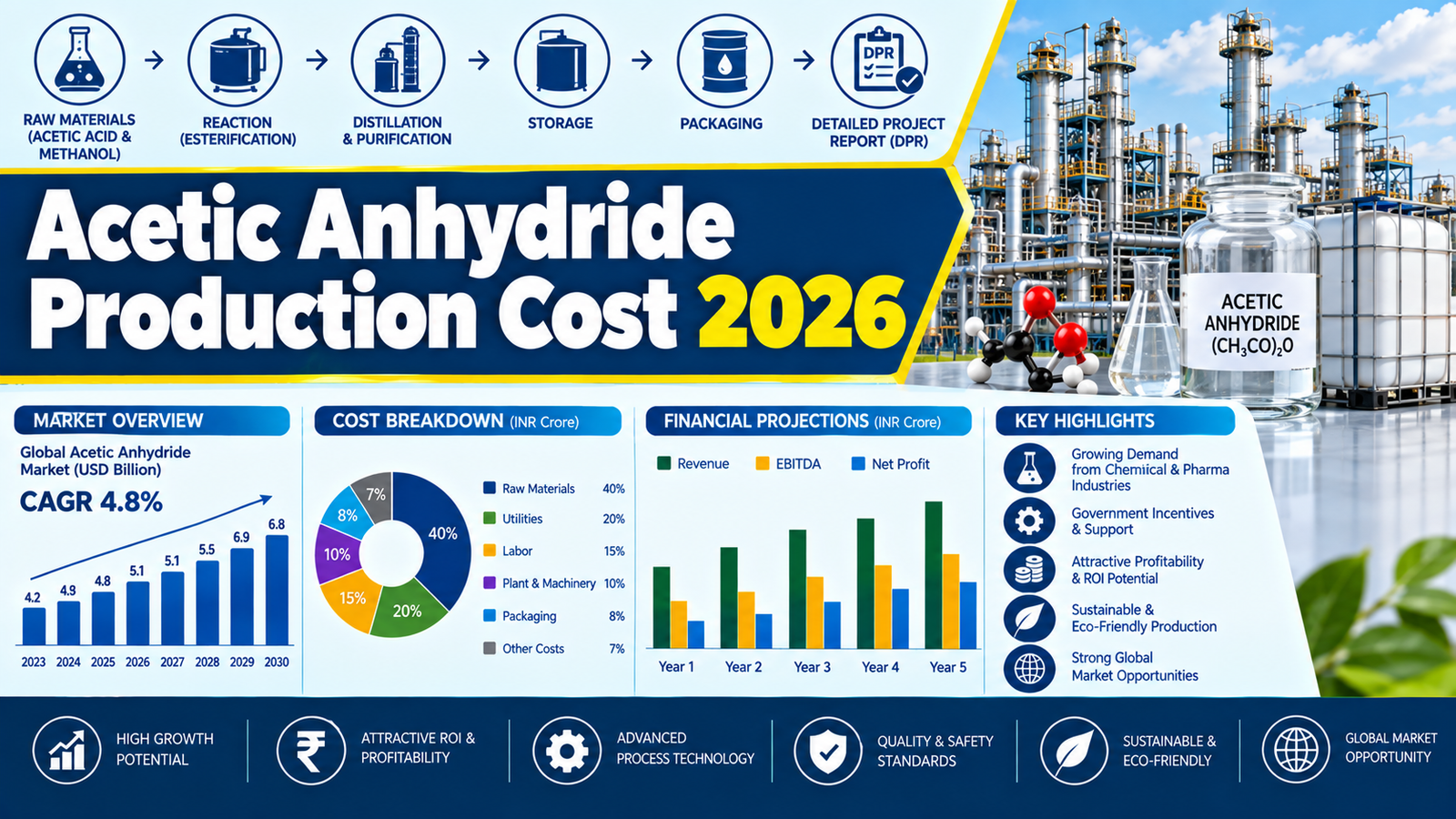
This business plan report covers what capacity to target, which raw materials to secure, what machinery and site conditions are required, how capital and operating costs break down, and what profitability and regulatory factors determine commercial viability for an acetic anhydride production plant. It draws on IMARC Group’s Acetic Anhydride Production Cost Analysis Report 2026, which benchmarks a facility with an annual production capacity of 50,000-200,000 MT. The global acetic anhydride market was valued at USD 4.0 Billion in 2025 and, according to IMARC Group estimates, is expected to reach USD 5.0 Billion by 2034, exhibiting a CAGR of 2.40% during 2026-2034.
What is Acetic Anhydride?
Acetic anhydride (C₄H₆O₃) is a colorless, highly reactive organic compound widely used as an acetylating agent in chemical synthesis. It is produced primarily through the reaction of acetic acid or via carbonylation processes, has a strong odor, and reacts readily with water to form acetic acid. Acetic anhydride is a key intermediate in the production of cellulose acetate, pharmaceuticals, dyes, perfumes, explosives, and agrochemicals. Due to its reactivity, it is handled under controlled industrial conditions with appropriate storage and safety protocols, and its versatility in acetylation reactions makes it an essential chemical in multiple industrial value chains.
Key Investment Highlights
- Process Used: Ketene process, carbonylation of methyl acetate process, raw material purification, reaction under controlled temperature and pressure, distillation and purification, storage, quality testing, and packaging.
- End-use Industries: Pharmaceutical industry, textile and fiber industry, agrochemical manufacturing, chemical intermediates, and cigarette filter production.
- Applications: Production of cellulose acetate, synthesis of aspirin and other pharmaceuticals, manufacture of dyes and perfumes, agrochemical intermediates, plasticizers and specialty chemicals.
Acetic Anhydride Plant Capacity
The proposed production facility is designed with an annual production capacity ranging between 50,000-200,000 MT, enabling economies of scale while maintaining operational flexibility.
Request Sample: https://www.imarcgroup.com/acetic-anhydride-manufacturing-plant-project-report/requestsample
Acetic Anhydride Plant Profit Margins
The project demonstrates healthy profitability potential under normal operating conditions. Gross profit margins typically range between 25-35%, supported by stable demand and value-added applications.
- Gross Profit: 25-35%
- Net Profit: 12-20%
Acetic Anhydride Plant Cost Analysis
The operating cost structure of an acetic anhydride production plant is primarily driven by raw material consumption, particularly acetic acid, which accounts for approximately 70-80% of total operating expenses (OpEx).
- Raw Materials: 70-80% of OpEx
- Utilities: 15-20% of OpEx
Financial Projection
The financial projections for the proposed project have been developed based on realistic assumptions related to capital investment, operating costs, production capacity utilization, pricing trends, and demand outlook. These projections provide a comprehensive view of the project’s financial viability, ROI, profitability, and long-term sustainability.
Major Applications
- Pharmaceutical Industry: Used in acetylation processes for drugs such as aspirin and other active pharmaceutical ingredients.
- Textile and Fiber Industry: Essential for producing cellulose acetate fibers used in fabrics and cigarette filters.
- Agrochemical Industry: Serves as an intermediate in manufacturing pesticides and herbicides.
- Chemical Manufacturing: Applied in synthesizing dyes, fragrances, and specialty chemical compounds.
- Plastics and Polymers Sector: Used in producing acetate-based plastics and coatings.
Regional Insights
Acetic anhydride production plant costs vary across regions, influenced by access to acetic acid and other feedstocks, chemical-processing infrastructure, energy and utility costs, specialised equipment, labour, environmental and safety requirements, and proximity to pharmaceutical, cellulose acetate, agrochemical, and specialty-chemical industries. IMARC’s 2026 analysis covers production capacities of 50,000–200,000 MT annually and identifies raw materials as the dominant operating-cost component.
● Asia Pacific (China, India, Japan, South Korea, Australia, Indonesia, Thailand, Malaysia, Vietnam, Philippines, Singapore) Strong chemical-processing infrastructure, established pharmaceutical and agrochemical industries, and significant cellulose acetate and specialty-chemical manufacturing support acetic anhydride plant development. China and India benefit from extensive chemical supply chains and large downstream markets, while Japan and South Korea provide advanced process technology and sophisticated chemical-manufacturing capabilities. Access to acetic acid, reliable utilities, industrial clusters, and export infrastructure can significantly influence project economics.
● North America (U.S., Canada, Mexico) A mature chemical industry, established pharmaceutical and specialty-chemical manufacturing base, and strong demand from cellulose acetate, agrochemical, and pharmaceutical applications support acetic anhydride production. Advanced infrastructure and process automation can improve operational efficiency, while labour, construction, energy, environmental compliance, and specialised equipment costs can increase overall investment requirements.
● Europe (Germany, U.K., France, Italy, Spain, Netherlands, Belgium, Poland, Sweden, Norway, Denmark, Switzerland) Established pharmaceutical, chemical, fibre, coatings, and specialty-material industries provide a strong downstream base. Advanced manufacturing technologies and well-developed chemical clusters support efficient production, while stringent requirements for process safety, emissions, hazardous-material handling, and environmental protection can add to capital and operating costs.
● Latin America (Brazil, Argentina, Mexico, Colombia, Chile, Peru, Paraguay, Uruguay, Ecuador) Expanding pharmaceutical, agrochemical, chemical, and industrial manufacturing sectors are supporting opportunities for acetic anhydride production. Plant economics are influenced by access to acetic acid, imported machinery and technology, energy availability, transportation infrastructure, and proximity to major industrial consumers. Integrated chemical sites and port access can help manage feedstock and distribution costs.
● Middle East & Africa (Saudi Arabia, UAE, Qatar, Kuwait, Oman, Israel, Egypt, South Africa, Nigeria, Morocco, Algeria, Kenya, Ethiopia, Tanzania, Ghana) Expanding chemical manufacturing and industrial diversification are creating opportunities for specialty and intermediate chemicals such as acetic anhydride. Selected markets benefit from established petrochemical infrastructure and energy availability, while access to acetic acid, specialised technology, skilled labour, hazardous-material handling systems, logistics, and environmental infrastructure remains important for plant economics.
Cost structure: IMARC estimates that raw materials account for approximately 70–80% of operating expenditure, with utilities representing around 15–20%. Acetic acid is identified as a particularly important cost driver. Major capital equipment includes reaction vessels/reactors, distillation columns, heat exchangers, storage tanks, pumps, compressors, and quality-control instrumentation.
Speak to an Analyst: https://www.imarcgroup.com/request?type=report&id=20785&flag=C
Why Acetic Anhydride Production?
- Essential chemical intermediate: Widely used in acetylation reactions across industries.
- Strong pharmaceutical linkage: Supports production of key medications and APIs.
- Growing fiber demand: Increasing consumption of cellulose acetate supports steady demand.
- Versatile chemical applications: Serves multiple industrial sectors, including agrochemicals and plastics.
- Established production technologies: Mature manufacturing processes enable scalable industrial output.
Acetic Anhydride Industry Outlook 2026
The acetic anhydride market is driven by rising pharmaceutical production and expanding demand for cellulose acetate fibers in textiles and cigarette filters. For instance, 3,768 acetic anhydride shipments were exported between July 2024 and June 2025 through 799 exporters and 996 buyers, with strong export activity from India (2,225 shipments), the United States (1,356), and China (1,249), reflecting active global trade flows. With Ukraine, Belgium, and India leading imports, this widespread cross-border demand directly supports sustained production expansion and growth in the acetic anhydride market. Increasing global healthcare expenditure supports acetylation-based drug manufacturing, growth in agrochemical production strengthens intermediate demand, and industrial expansion in specialty chemicals and coatings also contributes to consumption. Growing industrialization in emerging economies further supports long-term demand.
Leading Acetic Anhydride Producers
Leading producers in the global acetic anhydride industry include several multinational companies with extensive production capacities and diverse application portfolios. Key players include:
- Jubilant Life Sciences
- Celanese Corporation
- DuPont
- Sasol Limited
- SABIC
These companies collectively serve end-use sectors including the pharmaceutical industry, textile and fiber industry, agrochemical manufacturing, chemical intermediates, and cigarette filter production.
How to Setup an Acetic Anhydride Production Plant?
Setting up an acetic anhydride production plant requires evaluating several key factors, including technological requirements and quality assurance. Some of the critical considerations include:
Detailed Process Flow: The production process is a multi-step operation involving several unit operations, material handling, and quality checks, covering unit operations involved, mass balance and raw material requirements, quality assurance criteria, and technical tests.
Site Selection: The location must offer easy access to key raw materials such as acetic acid and catalyst (rhodium/iodine). Proximity to target markets helps minimize distribution costs, and the site must have robust infrastructure, including reliable transportation, utilities, and waste management systems, along with compliance with local zoning laws and environmental regulations.
Plant Layout Optimization: The layout should be optimized to enhance workflow efficiency, safety, and minimize material handling, with separate areas designated for raw material storage, production, quality control, and finished goods storage, and space incorporated for future expansion.
Equipment Selection: High-quality, corrosion-resistant machinery tailored for acetic anhydride production must be selected. Key equipment includes reaction vessels and reactors, distillation columns, heat exchangers, storage tanks, pumps and compressors, and quality control instrumentation. All machinery must comply with industry standards for safety, efficiency, and reliability.
Raw Material Sourcing: Reliable suppliers must be secured for raw materials like acetic acid and catalyst (rhodium/iodine) to ensure consistent production quality, while minimizing transportation costs by selecting nearby suppliers. Sustainability and supply chain risks should be assessed, and long-term contracts negotiated to stabilize pricing and ensure a steady supply.
Safety and Environmental Compliance: Safety protocols must be implemented throughout the production process, with advanced monitoring systems installed to detect leaks or process deviations, and effluent treatment systems in place to minimize environmental impact and ensure compliance with emission standards.
Quality Assurance Systems: A comprehensive quality control system should be established throughout production, using analytical instruments to monitor product concentration, purity, and stability, with documentation maintained for traceability and regulatory compliance.
Project Economics
Establishing and operating an acetic anhydride production plant involves various cost components, including:
Capital Investment: The total capital investment depends on plant capacity, technology, and location, and covers land acquisition, site preparation, and necessary infrastructure.
Equipment Costs: Equipment costs, such as those for reaction vessels and reactors, distillation columns, heat exchangers, storage tanks, pumps and compressors, and quality control instrumentation, represent a significant portion of capital expenditure. The scale of production and automation level will determine the total cost of machinery.
Raw Material Expenses: Raw materials, including core ingredients like acetic acid and catalyst (rhodium/iodine), are a major part of operating costs, and long-term contracts with reliable suppliers will help mitigate price volatility.
Infrastructure and Utilities: Costs associated with land acquisition, construction, and utilities (electricity, water, steam) must be considered in the financial plan.
Operational Costs: Ongoing expenses for labor, maintenance, quality control, and environmental compliance must be accounted for, with process optimization and staff training helping control these costs.
Financial Planning: A detailed financial analysis, including income projections, expenditures, and break-even points, aids in securing funding and formulating a clear financial strategy.
Capital Expenditure (CapEx) and Operational Expenditure (OpEx) Analysis
Capital Investment (CapEx): Machinery costs account for the largest portion of total capital expenditure. The cost of land and site development, including charges for land registration, boundary development, and other related expenses, forms a substantial part of the overall investment, ensuring a solid foundation for safe and efficient plant operations.
Operating Expenditure (OpEx): In the first year of operations, the operating cost for the acetic anhydride production plant is projected to be significant, covering raw materials, utilities, depreciation, taxes, packing, transportation, and repairs and maintenance. By the fifth year, total operational cost is expected to increase substantially due to inflation, market fluctuations, and potential rises in the cost of key materials, along with supply chain disruptions, rising consumer demand, and shifts in the global economy.
Frequently Asked Questions
1. How much capital is required to start an acetic anhydride production plant?
Capital requirements generally include land acquisition, construction, equipment procurement, installation, pre-operative expenses, and initial working capital. The total amount varies with capacity, technology, and location.
2. How do I start an acetic anhydride production business?
Starting an acetic anhydride production business requires a market feasibility study, securing required licenses, arranging funding, selecting suitable land, procuring equipment, recruiting skilled labor, and establishing a supply chain and distribution network.
3. What raw materials are required for acetic anhydride production?
Acetic anhydride production requires raw materials such as acetic acid and ketene (produced from acetic acid) or acetyl chloride and the sodium salt of acetic acid. Other common raw materials include methyl acetate and carbon monoxide, or acetaldehyde and acetic acid.
4. What machinery and equipment are required to start an acetic anhydride factory?
An acetic anhydride factory typically requires ketene pyrolysis or oxidation reactors, followed by a fractional distillation column for purification, along with high-pressure feed pumps, heat exchangers, condensers, corrosion-resistant storage tanks, and robust piping.
5. What are the key steps involved in acetic anhydride production?
The main steps generally include acetic acid dehydration and thermal cracking into ketene, gas cooling and scrubbing, acetic acid absorption, crude acetic anhydride separation, product purification by fractional distillation, by-product acetic acid recovery, and packaging, storage, and distribution.
6. How long does it take to start an acetic anhydride production plant?
The timeline usually ranges from 24 to 36 months, depending on factors such as site development, machinery installation, environmental clearances, safety measures, and trial runs.
7. What are the biggest challenges in starting an acetic anhydride production business?
Challenges may include high capital requirements, securing regulatory approvals, ensuring raw material supply, competition, skilled manpower availability, and managing operational risks.
8. What licenses and approvals are needed to start an acetic anhydride factory?
Typical requirements include business registration, environmental clearances, factory licenses, fire safety certifications, and industry-specific permits, which may vary by local, state, or national regulation.
9. Who are the top acetic anhydride producers in the world?
The top producers include Celanese, Eastman Chemical, BASF, Jubilant Ingrevia, Daicel, and SABIC.
10. Is acetic anhydride production a profitable business?
Profitability depends on market demand, production efficiency, pricing strategy, raw material cost management, and operational scale, with margins typically improving as capacity utilization increases.
11. What is the cost breakdown of setting up an acetic anhydride production plant?
Cost components typically include land and infrastructure, machinery and equipment, building and civil construction, utilities and installation, and working capital.
12. How long does it take to break even in an acetic anhydride production business?
Break-even typically ranges from 5 to 8 years, depending on scale, regulatory compliance costs, raw material pricing, and market demand, with efficient production and export opportunities helping accelerate returns.
13. Are there any government subsidies or incentives for acetic anhydride production?
Governments may offer incentives such as capital subsidies, tax exemptions, reduced utility tariffs, export benefits, or interest subsidies to promote manufacturing under various national or regional industrial policies.
14. What financing options are available for setting up a production unit?
Financing can be arranged through term loans, government-backed schemes, private equity, venture capital, equipment leasing, or strategic partnerships, with financial viability assessments helping identify optimal funding routes.
Buy Now: https://www.imarcgroup.com/checkout?id=20785&method=2175
About Us:
IMARC Group is a global management consulting firm that helps the world’s most ambitious changemakers to create a lasting impact. The company excels in understanding its client’s business priorities and delivering tailored solutions that drive meaningful outcomes. We provide a comprehensive suite of market entry and expansion services. Our offerings include thorough market assessment, feasibility studies, company incorporation assistance, factory setup support, regulatory approvals and licensing navigation, branding, marketing and sales strategies, competitive landscape, and benchmarking analyses, pricing and cost research, and procurement research.
Contact Us:
IMARC Group
134 N 4th St. Brooklyn, NY 11249, USA
Email: sales@imarcgroup.com
Tel No: (D) +91 120 433 0800
United States: (+1-201-971-6302)
About the Author