Setting up a control cables manufacturing plant in India presents a highly compelling investment opportunity as global demand for signal transmission and process control systems continues to surge across power generation, industrial automation, oil and gas, infrastructure, and renewable energy industries. Control cables have become indispensable in modern industrial and commercial installations due to their exceptional flexibility, flame retardancy, chemical resistance, and reliable signal transmission properties.
With a rapidly growing global market projected to reach USD 48.74 Billion by 2034 at a CAGR of 8.3%, expanding adoption in industrial automation, renewable energy, and smart infrastructure, and gross margins of 25–35%, control cables manufacturing is among the most financially compelling opportunities in the electrical equipment sector — with a break-even window of 3–6 years.
What are Control Cables?
Control cables are multi-core electrical cables engineered to transmit low-voltage signals for controlling, monitoring, and regulating equipment in industrial and commercial installations. They typically consist of copper or aluminum conductors insulated with PVC, XLPE, or LSZH compounds, and may include shielding to minimize electromagnetic interference. Control cables are designed for flexibility, flame retardancy, and resistance to moisture, chemicals, and mechanical stress.
Available in armored and unarmored variants, they ensure reliable signal transmission in both indoor and outdoor environments. Applications span instrumentation panels, automation systems, power plants, industrial machinery, PLC systems, motor control circuits, HVAC systems, elevator and conveyor systems, and renewable energy plant monitoring.
Globally, regulatory bodies and industry standards organizations recognize control cables for their critical role in industrial safety and operational continuity. The increasing push toward smart manufacturing, infrastructure modernization, and renewable energy deployment is driving accelerating demand for control cables across industrial and commercial markets worldwide.
Cost of Setting Up a Control Cables Manufacturing Plant in India
The control cables manufacturing plant setup cost depends on several parameters including production capacity, technology configuration, plant location, level of automation, raw material sourcing strategy, and regulatory compliance requirements. Here is a structured breakdown of all major cost components.
1. Capital Expenditure (CapEx)
The total capital investment in a control cables manufacturing plant typically covers the following:
Land and Site Development
This includes land acquisition, boundary development, land registration charges, and basic site preparation. Cost varies significantly depending on whether the land is in a designated industrial zone, electronics manufacturing cluster, Special Economic Zone (SEZ), or a privately purchased plot. Proximity to copper wire suppliers and key transportation corridors is a critical factor in site selection.
Civil Works and Construction
Building costs cover the main production facility, raw material warehousing, wire drawing and extrusion halls, quality control laboratory, administrative block, utility area, and worker amenities. Construction must comply with electrical equipment manufacturing safety norms including fire resistance, dust containment, cable testing bays, and environmental management standards.
Machinery and Equipment
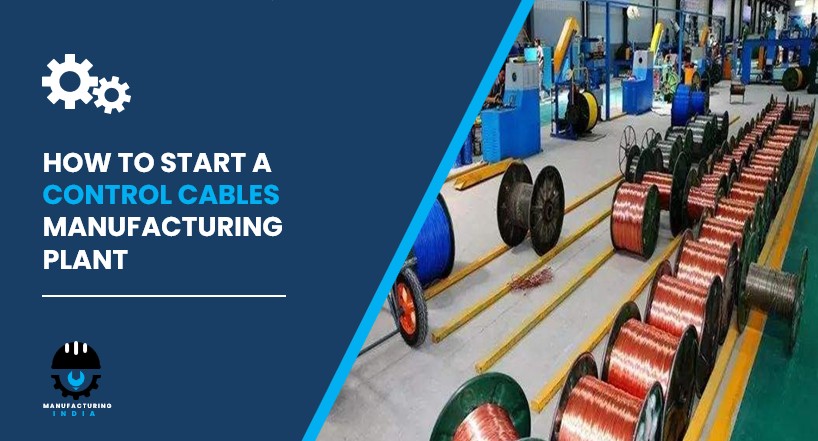
This is the single largest component of CapEx. Key machinery required for a control cables manufacturing plant includes wire drawing machines for copper and aluminum conductor sizing, annealing furnaces for conductor softening, insulation extrusion lines for applying PVC, XLPE, and LSZH compounds, stranding and bunching machines for conductor assembly, inner sheath and bedding extrusion lines, armoring machines for steel wire and steel tape application, outer sheath extrusion lines, high-voltage spark testers and continuity testing equipment, cable coiling and drum winding machines, packaging lines and cable drum handling systems, and process control and quality inspection systems.
Machinery costs represent the largest share of overall capital expenditure, reflecting the high degree of precision engineering, corrosion-resistant materials, and process safety requirements involved in control cables production.
Other Capital Costs
These include pre-operative expenses, commissioning charges, import duties if machinery is sourced internationally, utilities installation, fire safety systems, Effluent Treatment Plant setup, and environmental management infrastructure. The total capital investment amount depends on the plant capacity, chosen technology configuration, degree of automation, and geographic location.
Request a Sample Report for In-Depth Market Insights: https://www.imarcgroup.com/control-cables-manufacturing-plant-project-report/requestsample
2. Operational Expenditure (OpEx)
Once the plant is commissioned, the ongoing cost structure is dominated by a few key components:
Raw Material Cost — 75–85% of Total OpEx
Copper wire is the primary raw material and accounts for the dominant share of operating expenses, typically representing 75 to 85 percent of total operating expenditure. Additional materials include aluminum conductors where applicable, PVC, XLPE, and LSZH insulation compounds, steel wire and tape for armoring, shielding braid, inner bedding compounds, and specialty additives for flame retardancy, oil resistance, and sunlight resistance depending on the product specification and end-use application. Copper price volatility linked to LME commodity markets represents the most significant raw material cost management challenge for plant operators.
Utility Cost — 5–10% of Total OpEx
Utilities include electricity consumed by extrusion lines, wire drawing machines, and annealing furnaces, water used in cooling systems and washing processes, compressed air supply, and steam generation. Energy-efficient extrusion equipment and heat recovery systems can significantly reduce utility costs over time. Utility costs typically account for 5 to 10 percent of total operating expenditure.
Other Operating Costs
The remaining operating budget covers transportation and logistics, packaging including cable drums, reels, and coil packaging materials, salaries and wages for plant personnel, routine maintenance and spares, depreciation on machinery and civil assets, insurance, environmental compliance costs, taxes, and miscellaneous overhead expenses. By the fifth year of operations, total operational costs are expected to increase substantially due to inflation, market fluctuations, and potential rises in the cost of key input materials.
3. Plant Capacity
The proposed manufacturing facility can be designed across a range of production scales to match market demand and investment capacity.
Small-scale operations with annual production of 5,000 to 10,000 KM are suitable for regional markets, specialized formulations, and niche industrial applications with flexible equipment and batch production. Mid-scale plants producing 10,000 to 30,000 KM annually are designed for national markets with semi-continuous production, moderate automation, and a diversified product portfolio. Large-scale plants capable of producing 20,000 to 50,000 KM annually are built for national or export markets with continuous production, high automation, multiple parallel lines, and a comprehensive product portfolio.
Profitability significantly improves with higher capacity utilization. Larger plants benefit from economies of scale in raw material procurement, energy efficiency, and distribution logistics. The proposed manufacturing facility is designed with an annual production capacity ranging between 20,000 and 50,000 KM, enabling economies of scale while maintaining operational flexibility.
4. Profit Margins and Financial Projections
The project demonstrates healthy profitability potential under normal operating conditions. Gross profit margins typically range between 25 and 35 percent, supported by stable demand and value-added applications. Net profit margins range between 12 and 20 percent depending on production scale, market positioning, raw material cost management, product mix, and sales efficiency. The break-even period is estimated at 3 to 6 years.
Financial projections must account for capital investment, operating costs, capacity utilization rates, pricing trends, and demand outlook. A thorough analysis should also include sensitivity analysis, Net Present Value (NPV), Internal Rate of Return (IRR), and Payback Period calculations to ensure a comprehensive understanding of the investment’s financial viability and long-term sustainability.
Why Set Up a Control Cables Manufacturing Plant in India?
The global market environment presents a uniquely favorable opportunity for establishing a control cables production facility. Several converging demand drivers are creating sustained long-term growth across all major end-use sectors.
Growing Industrial Automation Trends
Industry 4.0 and smart manufacturing initiatives are significantly increasing demand for reliable signal transmission systems. The rapid adoption of programmable logic controllers (PLCs), robotics, and process automation equipment across manufacturing facilities worldwide is driving accelerating consumption of control cables. The increasing digitalization of manufacturing facilities and adoption of PLCs are strengthening demand for signal transmission cables at an accelerating pace.
Infrastructure Modernization and Power Sector Expansion
Expansion of energy and transport infrastructure supports steady cable consumption. Notably, 83 percent of power sector investment in 2024 was directed toward clean energy, and India received USD 2.4 billion in development finance funding, significantly accelerating renewable energy infrastructure development and directly boosting demand for control cables used in solar and wind farms, substations, and grid monitoring systems.
Renewable Energy Growth
The rapidly expanding renewable energy sector requires control cables for system monitoring, inverter control operations, wind farm instrumentation, and solar plant management. India’s increasing non-fossil power capacity to 44 percent of installed capacity creates a sustained pipeline of demand for specialized cable solutions. This expansion directly boosts demand for control cables used in renewable energy installations, driving market growth.
Oil and Gas and Petrochemical Sector Demand
Rising oil and gas exploration and petrochemical processing activities support specialized armored control cable consumption. Hazardous area installations in refineries and offshore platforms require high-specification, flame-retardant cables with robust shielding and certified designs. The specialized nature of these applications creates higher margins and sustained replacement demand cycles.
Smart City and Building Automation
Smart city initiatives and commercial building automation systems are accelerating deployment of control cables in data centers, commercial complexes, transportation systems, and public infrastructure. The digitalization of commercial and residential buildings is creating new and growing application segments for both armored and unarmored control cable variants.
Replacement and Upgrade Demand
Aging electrical infrastructure worldwide requires periodic cable replacement and system upgrades. This creates a consistent baseline demand that provides revenue stability independent of new construction cycles, making control cables manufacturing a resilient investment across economic cycles.
Manufacturing Process Overview
The control cables manufacturing process is a multi-stage precision operation involving several unit operations, material handling steps, and quality checks at each stage of production.
Conductor Wire Drawing and Annealing
Copper or aluminum rod is drawn through a series of progressively smaller dies to achieve the target conductor diameter and cross-sectional area. Annealing furnaces are then used to restore conductor flexibility and electrical conductivity after the cold-drawing process, ensuring the final conductor meets the required mechanical and electrical performance specifications.
Conductor Stranding
Individual drawn wires are stranded together using bunching and stranding machines to achieve the required conductor flexibility, mechanical strength, and current-carrying capacity specifications. The stranding pattern is designed to optimize flexibility, minimize diameter, and ensure consistent electrical performance across the conductor length.
Insulation Extrusion
PVC, XLPE, or LSZH insulation compounds are applied over each conductor using extrusion lines operating under precise temperature and pressure controls. Color coding is applied during this stage for core identification purposes. Insulation thickness and compound selection are determined by the voltage rating, environmental conditions, and application requirements of the finished cable.
Core Assembly and Color Identification
Insulated cores are laid up and twisted together according to the cable design specification. Core color coding and numbering ensure correct identification during installation, maintenance, and troubleshooting. The lay length and direction of twist are controlled to optimize the cable’s electrical and mechanical characteristics.
Inner Sheathing or Bedding
An inner sheath or bedding layer is extruded over the assembled core bundle to provide mechanical protection, maintain cable roundness, and improve crush resistance before armoring. This layer also serves as a barrier against moisture ingress and provides a smooth surface for armoring application.
Armoring
Steel wire armoring or steel tape armoring is applied for mechanical protection in direct burial, tray, or underground installations. Galvanized steel wire or tape is wound around the inner sheath at a controlled pitch to provide maximum mechanical protection while maintaining cable flexibility. Armored cables are designed for applications requiring protection against mechanical damage and rodent attack.
Outer Sheath Extrusion and Final Testing
The outer sheath layer in PVC, LSZH, or polyurethane is extruded as the final protective covering. Completed cables undergo comprehensive spark testing, high-voltage testing, continuity testing, insulation resistance measurement, and dimensional verification before dispatch. All cables must pass rigorous quality checks to confirm compliance with applicable IEC, BIS, and customer-specified standards.
Packaging, Storage, and Distribution
Finished cables are coiled, wound onto drums, or spooled according to customer specifications. Packaging includes drum labeling, reel identification, and protective wrapping for transportation and storage. Cables are then dispatched to distributors, project contractors, OEM customers, and export markets.
Key Applications of Control Cables
Control cables serve a wide variety of end-use industries and applications, making them one of the most broadly demanded electrical components in industrial and commercial installations.
Power Generation and Transmission
Control cables are extensively used in power plants and substations for monitoring, signaling, and operational control systems. They connect instrumentation panels, protection relays, switchgear, and control systems in generating stations and transmission infrastructure.
Oil and Gas Industry
Refineries and offshore platforms rely on specialized control cables for instrumentation and process control in hazardous environments. Armored, flame-retardant, and chemically resistant cable variants are required for safe operation in these demanding installations.
Industrial Automation
Control cables are integrated into PLC systems, robotics, assembly lines, and process control equipment across all sectors of manufacturing. They form the backbone of signal transmission infrastructure in automated production environments.
Infrastructure and Construction
Commercial buildings, data centers, hospitals, airports, and smart infrastructure projects use control cables for centralized building management and control systems. The growth of smart buildings and intelligent infrastructure is creating sustained demand for high-specification control cables.
Renewable Energy
Wind and solar farms rely on control cables for system monitoring, inverter control operations, SCADA communications, and grid interface management. The rapid expansion of renewable energy capacity globally is one of the fastest-growing demand drivers for the control cables market.
Railways and Transportation
Signaling systems, platform automation, and train monitoring systems require specialized control cables designed for continuous vibration, temperature cycling, and outdoor exposure conditions. Railway modernization programs worldwide are driving significant cable replacement and upgrade demand.
Global Market Outlook
The global control cables market size was valued at USD 23.78 Billion in 2025. According to IMARC Group estimates, the market is expected to reach USD 48.74 Billion by 2034, exhibiting a CAGR of 8.3% from 2026 to 2034. This sustained growth is driven by expanding industrial automation investments, renewable energy infrastructure development, smart building and smart city deployments, rising oil and gas exploration activity, and the accelerating modernization of aging electrical infrastructure across both developed and emerging economies.
Asia Pacific leads global demand, driven by China, India, South Korea, and Southeast Asian manufacturing hubs. India represents a high-growth opportunity market due to the national manufacturing push, PLI schemes, grid modernization programs, and rapid industrial corridor development.
Leading global players in this industry include:
Leading manufacturers in the global control cables industry include several multinational companies with extensive production capacities and diverse application portfolios. Key players include:
- Prysmian S.P.A
- Thermo Cables Pvt. Ltd
- General Cable Technologies Corporation
- Datafield Industries
- Orient Cables (India) Pvt. Ltd
- Nexans
All of which serve end-use sectors such as power generation and transmission, oil and gas, industrial automation, infrastructure, railways, and renewable energy.
Timeline to Start a Control Cables Manufacturing Plant
Setting up a control cables manufacturing plant from ideation to commissioning typically requires 12 to 24 months. This covers feasibility study and detailed project report preparation, land acquisition and site development, environmental impact assessment and regulatory approvals, plant design and layout and engineering, machinery procurement and import clearance and installation, utility setup and infrastructure commissioning, trial production and cable testing certification, BIS product certification for the Indian domestic market, and commercial production launch and market entry.
The timeline can vary depending on site availability, regulatory clearance timelines, machinery lead times from equipment suppliers, and the complexity of the product range being commissioned. Early engagement with regulatory authorities and machinery vendors is critical to keeping the project on schedule.
Licenses and Regulatory Requirements
Starting a control cables manufacturing unit requires several approvals and certifications, which may vary by country and jurisdiction. These typically include business registration and incorporation, factory license under applicable labor and manufacturing laws, environmental clearance from relevant pollution control authorities, fire safety certification, Bureau of Indian Standards product certification for domestic market compliance, hazardous waste management authorization where applicable, export certifications such as CE, IEC, UL, and ATEX for international markets, ISO 9001 quality management certification, ISO 14001 environmental management certification, and occupational health and safety certifications.
BIS certification is mandatory for the Indian domestic market and requires product testing, factory audit, and ongoing quality surveillance. International export markets may require additional country-specific certifications and product approvals. Early regulatory planning is essential to avoid costly delays in commercial launch.
Key Challenges to Consider
Before investing, entrepreneurs and investors should be aware of the common challenges in this business.
High Capital Requirements
Initial CapEx for precision wire drawing machinery, extrusion lines, testing equipment, and infrastructure is significant, especially for mid to large-scale plants. Investors must carefully plan capital structure, funding mix, and phased capacity expansion to manage financial risk during the ramp-up period.
Raw Material Price Volatility
Copper wire prices are linked to global commodity markets and LME copper pricing. Fluctuations directly impact production costs and profit margins, particularly for smaller-scale manufacturers operating without long-term supply contracts. Hedging strategies, strategic inventory management, and supplier partnerships are essential risk management tools.
Regulatory Compliance
Meeting electrical product safety, environmental, and occupational health standards requires continuous investment in quality systems, testing equipment, and trained personnel. BIS certification is mandatory for domestic Indian market access and requires ongoing factory surveillance audits and product testing.
Competition
The market features established global and Indian cable manufacturers with significant production capacities and strong brand recognition. New entrants must develop a clear differentiation strategy through specialized products, niche market focus, technical service excellence, or competitive pricing in underserved geographic markets.
Technical Expertise
Operating precision extrusion lines, managing conductor stranding processes, and maintaining product quality consistency requires highly trained electrical engineers and process operators. Investment in workforce training programs is essential for consistent product quality and regulatory compliance.
Skilled Manpower Availability
Availability of trained cable manufacturing technicians, quality control personnel, and electrical testing engineers may vary by location. Proximity to technical training institutions and industrial clusters with existing cable manufacturing activity can be an advantage in workforce recruitment and development.
Frequently Asked Questions
The following questions are answered in the IMARC Group Control Cables Manufacturing Plant Project Report:
- How much does it cost to set up a control cables manufacturing plant in India?
- Is control cables manufacturing a profitable business in 2026?
- What machinery and equipment are required for a control cables plant?
- What licenses and approvals are required to start a control cables production facility?
- How long does it take to commission a control cables manufacturing plant?
- What is the best location to set up a control cables manufacturing plant in India?
- What government incentives are available for cable manufacturers?
- What is the break-even period for a control cables manufacturing plant?
- What are the BIS certification requirements for control cables in India?
- What are the key raw materials and their sourcing strategies for control cables manufacturing?
- How does copper price volatility affect the profitability of a control cables plant?
- What are the export opportunities for Indian control cable manufacturers?
Key Takeaways for Investors
The control cables manufacturing industry represents a strong and scalable investment opportunity backed by growing global demand across multiple high-value industrial sectors and supportive policy environments. With gross margins of 25 to 35 percent and a break-even window of 3 to 6 years, a well-planned control cables manufacturing plant remains competitive and financially viable across plant capacities.
The convergence of industrial automation growth, renewable energy infrastructure expansion, power sector modernization, and smart city development creates a robust and diversified revenue base for control cable manufacturers entering or expanding in this market. India’s strong domestic demand, growing export competitiveness in electrical products, and government manufacturing incentives under PLI and Make in India schemes further strengthen the investment case.
About the Author