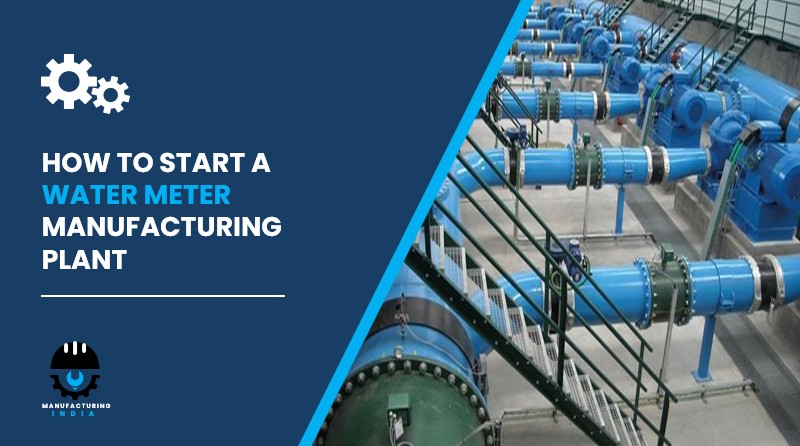
Setting up a water meter manufacturing plant in India presents a highly compelling investment opportunity as global demand for precision flow measurement devices continues to surge across municipal water utilities, commercial infrastructure, industrial facilities, and smart city programmes. Water meters have become indispensable to modern water management ecosystems due to their critical role in billing accuracy, non-revenue water (NRW) reduction, demand management, and data-driven utility operations.
“With a rapidly expanding global market projected to grow at a CAGR of 5.7% through 2034, accelerating adoption of AMR/AMI-enabled smart metering, and gross margins of 40–50%, water meter manufacturing offers one of the most financially attractive opportunities in the precision instrument and utility infrastructure sector — with a break-even window of 3–6 years.”
What is a Water Meter?
A water meter is a precision measuring device used to quantify water flow and total consumption in a pipeline over a defined period. It typically consists of a metering element (mechanical or ultrasonic), a measuring chamber or flow path, a register/display unit, and protective housing engineered for long-term field operation under varying pressure and environmental conditions.
Water meters are manufactured in multiple configurations including single-jet, multi-jet, Woltmann (bulk-type), electromagnetic, and ultrasonic types, with options for pulse output, remote reading modules, or integrated communication capabilities. Key performance requirements include measurement accuracy across low-to-high flow ranges, resistance to tampering, corrosion and scale tolerance, pressure integrity, and stable calibration throughout service life.
Globally, regulatory and metrology bodies require water meters to meet strict accuracy and durability standards before utility procurement. The increasing shift toward smart water management, non-revenue water reduction targets, and digital utility operations is driving sustained demand for meters with remote reading, data-logging, and advanced metering infrastructure (AMI) capabilities across residential, commercial, and industrial applications worldwide.
Cost of Setting Up a Water Meter Manufacturing Plant
The water meter manufacturing plant cost depends on several parameters including production capacity, technology configuration, plant location, level of automation, raw material sourcing strategy, and regulatory compliance requirements. Here is a structured breakdown of all major cost components:
1. Capital Expenditure (CapEx)
The total capital investment in a water meter manufacturing plant typically covers the following:
Land and Site Development
This includes land acquisition, boundary development, land registration charges, and basic site preparation. Cost varies significantly depending on whether the land is in a designated industrial zone, electronics/precision instruments manufacturing park, Special Economic Zone (SEZ), or a privately acquired plot. Proximity to component suppliers, skilled labour pools, and key transportation corridors is a critical factor in site selection.
Request a Sample Report for In-Depth Market Insights: https://www.imarcgroup.com/water-meter-manufacturing-plant-project-report/requestsample
Civil Works and Construction
Building costs cover the main production facility, component storage areas, raw material warehousing, quality control and calibration laboratory, administrative block, utility area, and worker amenities. Construction must comply with precision manufacturing plant norms including cleanroom-ready areas for sensor assembly, electrostatic discharge (ESD) protection zones, environmental control systems, and fire safety infrastructure.
Machinery and Equipment
This is the single largest component of CapEx. Key machinery required for a water meter manufacturing plant includes:
- Precision CNC Lathes and Milling Machines
- Injection Molding Presses (for plastic housings and bodies)
- Die Casting Machines (for brass and alloy components)
- Automated Assembly Lines and Pick-and-Place Systems
- Calibration and Flow Testing Stations
- Ultrasonic Transducer and Sensor Integration Equipment
- Laser Engravers and Marking Systems
- Pressure Testing Chambers and Leak Detection Systems
- Remote Reading Module Integration Rigs (AMR/AMI)
- Automated Packaging and Labelling Systems
- Process Control and Quality Management Systems (SCADA/MES)
Machinery costs represent the largest share of overall capital expenditure, reflecting the high precision engineering, metrology-grade calibration infrastructure, and electronics integration capabilities required in water meter production.
Other Capital Costs
These include pre-operative expenses, commissioning charges, import duties (if machinery is sourced internationally), utilities installation, fire safety systems, Effluent Treatment Plant (ETP) setup, calibration laboratory accreditation, ESD flooring and environmental management infrastructure.
2. Operational Expenditure (OpEx)
Once the plant is commissioned, the ongoing cost structure is dominated by a few key components:
Raw Material Cost (Plastic Housing, Measuring Mechanism, Register Display): 50–60% of Total OpEx
Plastic housing (engineering-grade polymers such as ABS, polyamide, or brass alloy castings) and the internal measuring mechanism (impeller assemblies, ultrasonic transducers, or electromagnetic sensor elements) are the primary raw materials and account for many operating expenses. Additional materials include register display units, communication modules (for AMR/AMI-enabled meters), seals and gaskets, electronic components (PCBs, microcontrollers), and packaging materials.
Utility Cost: 10–15% of Total OpEx
Utilities include electricity (consumed by CNC machines, injection molding presses, calibration stations, and process control systems), compressed air supply, climate control for sensitive assembly areas, and water for testing and washing processes. Energy-efficient equipment selection and optimized production scheduling can meaningfully reduce utility costs over time.
Other Operating Costs
The remaining budget covers transportation and logistics, packaging (individual cartons, bulk palletization for utility tenders), salaries and wages (for engineers, calibration technicians, and assembly operators), maintenance, depreciation, insurance, regulatory compliance costs, quality certification costs, and miscellaneous overhead.
3. Plant Capacity
The proposed manufacturing facility can be designed across a range of production scales:
- Small-Scale Operations: 50,000–200,000 units annually — suitable for regional utilities, niche smart metering applications, and specialized product lines with flexible assembly and batch calibration.
- Mid-Scale Plants: 200,000–1,000,000 units annually — designed for national markets with semi-automated assembly lines, moderate calibration infrastructure, and a diversified product portfolio covering mechanical and smart meter variants.
- Large-Scale Plants: 1,000,000–2,000,000+ units annually — built for national or global supply with fully automated assembly, high-throughput calibration stations, parallel production lines, and comprehensive product portfolios spanning mechanical, electronic, and AMI-enabled smart meters.
Profitability significantly improves with higher capacity utilization. Larger plants benefit from economies of scale in component procurement, calibration efficiency, and logistics consolidation for utility tenders.
4. Profit Margins and Financial Projections
- Gross Profit: 40-50%
- Net Profit: 15-25%
Financial projections must account for capital investment, operating costs, capacity utilization rates, pricing trends, and demand outlook. A thorough analysis should also include sensitivity analysis, Net Present Value (NPV), Internal Rate of Return (IRR), and Payback Period.
Why Set Up a Water Meter Manufacturing Plant?
The global market environment presents a uniquely favorable opportunity for establishing a water meter manufacturing facility:
Surging Municipal and Urban Infrastructure Demand
Water meters are foundational to water billing, demand management, and leakage reduction in urban water distribution systems. As cities expand and utilities seek to improve revenue assurance and operational efficiency, replacement of aging mechanical meters and deployment of smart-ready meters is creating a sustained and predictable demand cycle. The United Nations Population Fund projects that global urban population will reach approximately 5 billion by 2030, driving continued investment in municipal water infrastructure.
Smart Metering and AMR/AMI Upgrade Cycle
The accelerating shift from manual meter reading to Automated Meter Reading (AMR) and Advanced Metering Infrastructure (AMI) systems is driving premiumization across the water meter market. Utilities are increasingly adopting meters with pulse outputs, RF communication modules, and data-ready registers to enable real-time consumption monitoring, automated billing, and predictive leak detection. This technology transition is expanding average selling prices and creating strong demand for locally manufactured, compliance-ready smart meter solutions.
Non-Revenue Water (NRW) Reduction Mandates
Many city utilities globally lose 25–40% of treated water to distribution losses, theft, and billing inaccuracies — collectively classified as non-revenue water (NRW). Government-backed NRW reduction programmes are among the strongest drivers of metering investment, requiring both retrofit deployment of accurate meters in underserved zones and installation of district meters for zonal monitoring. This creates large-scale, government-funded procurement opportunities for domestic water meter manufacturers.
Localization Advantages and Tender Competitiveness
Local manufacturing significantly improves competitiveness in utility procurement tenders by reducing lead times, simplifying post-sale calibration and spare parts logistics, and enabling flexible customization for regional pressure ratings, connection standards, and regulatory requirements. Many national governments and utility regulators are increasingly prioritizing locally manufactured meters in public procurement, creating structural advantages for domestic producers over importers.
Industrial and Commercial Metering Growth
Beyond municipal applications, water meters serve a growing range of industrial and commercial end users including manufacturing plants, commercial complexes, hospitals, data centres, hotels, and agricultural irrigation schemes. The expansion of industrial water accounting, building water management systems, and water-intensive industries in emerging economies is creating a diversified and growing non-municipal revenue stream for water meter manufacturers.
Manufacturing Process Overview
The water meter manufacturing process is a multi-step, precision engineering operation that combines mechanical fabrication, electronics integration, and metrological calibration:
- Component Fabrication — Plastic housings, meter bodies, and covers are manufactured using injection molding presses with engineering-grade polymers (ABS, polyamide) or die-cast from brass alloys. CNC lathes and milling machines are used for precision machining of internal flow chambers, valve seats, and threaded connections.
- Measuring Mechanism Assembly — Impeller assemblies (for single-jet and multi-jet mechanical meters) or ultrasonic transducer pairs (for ultrasonic meters) are assembled in controlled conditions. Electromagnetic and Woltmann-type elements require additional precision alignment and rotor assembly steps.
- Register and Display Integration — Odometer or LCD register displays are calibrated and integrated with the metering element. For smart meters, RF or NB-IoT communication modules, microcontrollers, and batteries are assembled and firmware-programmed.
- Calibration and Flow Testing — Each meter undergoes calibration on automated test benches using traceable flow standards. Meters are tested at minimum, transitional, and maximum flow rates to verify accuracy class compliance (Class B, C, or MID R800 for high-precision applications).
- Pressure and Leak Testing — Completed meters are subjected to hydrostatic pressure testing in sealed chambers to verify housing integrity, seal performance, and leak-free operation under rated pressure conditions.
- Marking, Packaging, and Quality Release — Approved meters are laser-engraved or labelled with serial numbers, accuracy class markings, and regulatory certifications, then individually packaged and palletized for dispatch.
Key Applications of Water Meters
- Residential billing meters (DN15–DN25), district meters (DN50–DN150) for zonal monitoring, and bulk supply meters at treatment plant outlets. Municipal Water Distribution:
- Large-diameter process meters for manufacturing, cooling towers, data centres, hospitals, hotels, and institutional water users. Commercial and Industrial Facilities:
- AMI-enabled smart meters with remote data transmission for real-time consumption analytics, automated billing, and demand management platforms. Smart City Infrastructure:
- Woltmann and electromagnetic meters for canal irrigation schemes, farmer-level allocations, and groundwater extraction monitoring. Agricultural Irrigation:
- District metering area (DMA) meters, pressure reducing valve (PRV) monitors, and leak detection sub-meters deployed in NRW reduction programmes. Non-Revenue Water Management:
- Sub-metering for commercial complexes, apartment buildings, and campuses enabling tenant-level billing and internal consumption management. Building Management Systems:
Global Market Outlook
The global water meter market size was valued at USD 21,945.20 Million in 2025. According to IMARC Group estimates, the market is expected to reach USD 36,142.19 Million by 2034, exhibiting a CAGR of 5.7% from 2026 to 2034. This sustained growth is driven by expanding municipal water infrastructure investment, accelerating smart metering adoption under AMR/AMI programmes, government-mandated NRW reduction initiatives, rapid urbanization in Asia Pacific and Africa, and rising commercial and industrial water accountability requirements.
Asia Pacific is a dominant and rapidly expanding regional market, driven by China, India, and Southeast Asian countries undertaking large-scale smart city infrastructure investment, piped water expansion, and utility modernisation programmes. India specifically presents a compelling manufacturing opportunity, supported by the Jal Jeevan Mission targeting piped water connections to all rural households and AMRUT 2.0 funding urban water infrastructure upgrades.
Leading global players in this industry include:
- Badger Meter
- Sensus (Xylem)
- Itron
- Diehl Metering
- Kamstrup
Timeline to Start a Water Meter Manufacturing Plant
Setting up a water meter manufacturing plant from ideation to commissioning typically requires 12 to 24 months. This covers:
- Feasibility study and Detailed Project Report (DPR) preparation
- Land acquisition and site development
- Environmental impact assessment and regulatory approvals
- Plant design and engineering
- Machinery procurement, installation, and commissioning
- Calibration laboratory setup and accreditation
- Utility setup and infrastructure commissioning
- Trial production and flow calibration testing
- Legal Metrology type approval and product certification
- Commercial production launch and utility tender registration
Licenses and Regulatory Requirements
Starting a water meter manufacturing unit requires several approvals, which may vary by country and jurisdiction, including:
- Business registration and incorporation
- Factory License under applicable labour and manufacturing laws
- Environmental Clearance from relevant pollution control authorities
- Legal Metrology Type Approval (mandatory in most jurisdictions for meters used in billing)
- BIS Certification (Bureau of Indian Standards IS 779 / IS 6784 for mechanical meters; IS 15747 for static/ultrasonic meters in India)
- MID (Measuring Instruments Directive) compliance for European export markets
- Fire Safety and NOC from local authorities
- ISO 9001 Quality Management System Certification
- ISO/IEC 17025 Calibration Laboratory Accreditation (for in-house test benches)
- Occupational Health and Safety Certifications
- Export quality approvals (WRAS, NSF/ANSI 61 for markets with water quality contact requirements)
Key Challenges to Consider
Before investing, entrepreneurs and investors should be aware of the common challenges in this business:
Legal Metrology Type Approval Barriers: Water meters used for utility billing must obtain type approval from national weights and measures authorities before sale. The approval process involves rigorous testing across flow ranges, temperature cycles, and pressure conditions, and can take 6–18 months. This creates a meaningful compliance timeline that must be factored into the pre-commercial phase.
Component Sourcing Complexity: High-precision metering elements, ultrasonic transducers, and electronics modules often rely on specialized global suppliers. Disruptions in semiconductor supply chains, import restrictions, or quality inconsistencies from component suppliers can materially impact production schedules and product quality.
Calibration Infrastructure Investment: Maintaining traceable, accredited calibration bench infrastructure is a recurring operational requirement. Flow test benches must themselves be calibrated against national standards, requiring investment in reference meters, controlled flow systems, and laboratory management systems.
Competitive Tendering Environment: Large utility procurement tenders are highly competitive, with established domestic and international manufacturers offering aggressive pricing. New entrants must develop clear differentiation through product quality, smart metering capabilities, service response, and compliance documentation to win and retain utility contracts.
Technical Expertise Requirement: Producing meters that maintain calibration accuracy across service lives of 8–15 years requires highly skilled metrologists, precision assembly technicians, and quality engineers. Attracting and retaining this specialized talent is a consistent challenge, particularly in locations away from major industrial centres.
Frequently Asked Questions
The following questions are answered in the report:
- How much does it cost to set up a water meter manufacturing plant?
- Is water meter manufacturing a profitable business in 2026?
- What machinery and equipment are required for a water meter plant?
- What licenses and approvals are required to start a water meter manufacturing facility?
- How long does it take to commission a water meter manufacturing plant?
- What is the best location to set up a water meter manufacturing plant in India?
- What government incentives are available for water meter manufacturers in India?
- What is the break-even period for a water meter manufacturing plant?
- What are the Legal Metrology and BIS compliance requirements for water meter manufacturing in India?
- What are the key raw materials and their sourcing strategies for water meter manufacturing?
- How does the shift to smart metering (AMR/AMI) affect plant investment requirements?
- What are the export opportunities for Indian water meter manufacturers?
Key Takeaways for Investors
The water meter manufacturing industry represents a strong and scalable investment opportunity backed by growing global demand across multiple high-value end-use segments and supportive government policy environments. With gross margins of 40–50% and a break-even window of 3–6 years, a well-planned water meter manufacturing plant cost remains competitive and financially viable across plant capacities. The convergence of municipal water infrastructure expansion, smart metering upgrade cycles, non-revenue water reduction programmes, and rapidly urbanizing emerging markets creates a robust and diversified revenue base for water meter manufacturers entering or expanding in this market.
India presents a compelling manufacturing destination backed by the Jal Jeevan Mission’s rural piped water expansion programme, AMRUT 2.0 urban water infrastructure investment, and growing utility demand for domestically manufactured, compliance-certified metering solutions that offer reliable supply, localized after-sales support, and competitive tender pricing.
About the Author