Setting up a flooring adhesive manufacturing plant in India presents a compelling investment case as the country rapidly emerges as one of the most cost-competitive and high-demand destinations for specialty construction chemical and adhesive manufacturing. Driven by surging demand from the residential housing, commercial real estate, hospitality, retail infrastructure, and industrial flooring sectors, flooring adhesives have become an indispensable part of India’s booming construction and interior finishing industry.
“With over 1.4 billion consumers, a rapidly urbanizing population, massive government investment in affordable housing and infrastructure, and a booming tile, vinyl, wooden flooring, and carpet industry, India offers one of the most financially attractive environments for flooring adhesive manufacturing — with gross margins of 28–42% and a break-even window of 2–4 years.”
What is a Flooring Adhesive?
A flooring adhesive is a specially formulated bonding compound designed to permanently or semi-permanently fix flooring materials — including ceramic and vitrified tiles, natural stone, vinyl and LVT (luxury vinyl tile), hardwood and engineered wood, laminate, carpet, rubber flooring, and epoxy self-leveling floors — to sub-floor surfaces such as concrete, screed, plywood, and existing floors. Flooring adhesives are engineered to deliver the required bond strength, flexibility, open time, coverage, and compatibility with specific flooring substrate combinations.
The flooring adhesive market encompasses several distinct product categories including polymer-modified tile adhesives (cement-based), pressure-sensitive adhesives (PSA), contact adhesives, polyurethane adhesives, epoxy adhesives, acrylic dispersion adhesives, and MS polymer adhesives — each designed for specific flooring materials, installation conditions, and performance requirements. As India’s construction sector continues its rapid expansion and consumers increasingly demand premium flooring finishes, the domestic market for high-performance flooring adhesives is growing at an accelerated pace.
Cost of Setting Up a Flooring Adhesive Manufacturing Plant in India
The flooring adhesive manufacturing plant cost in India depends on several parameters including production capacity, product type mix (cement-based vs. polymer-based vs. specialty adhesives), raw material sourcing, level of automation, plant location, and regulatory compliance. Here is a structured breakdown of all major cost components:
1. Capital Expenditure (CapEx)
The total capital investment in a flooring adhesive manufacturing plant typically covers the following:
Land and Site Development
This includes land acquisition, boundary development, land registration charges, and basic site preparation. Cost varies significantly depending on whether the land is in an industrial estate, Special Economic Zone (SEZ), or a privately purchased plot. Proximity to raw material suppliers (chemical distributors, cement suppliers, polymer emulsion producers) and to major construction markets is a key site selection criterion to minimize inbound and outbound logistics costs.
Civil Works and Construction
Building costs cover the main manufacturing and blending shed, liquid raw material storage area (with bunding for chemical containment), dry powder material silos and storage, filling and packaging area, quality control laboratory, administrative block, and worker facilities. Adequate chemical storage safety provisions including ventilation, spill containment, and fire suppression systems are essential given the flammable and reactive nature of certain adhesive raw materials.
Machinery and Equipment
This is the single largest component of CapEx. Key machinery required for a flooring adhesive manufacturing plant includes:
- High-Speed Dispersers and Dissolvers (for polymer emulsion and liquid adhesive blending)
- Planetary Mixers and Sigma Blade Mixers (for paste-type and high-viscosity adhesive formulations)
- Ribbon Blenders and Paddle Mixers (for cement-based dry powder adhesive blending)
- Jacketed Reaction Vessels with Temperature Control (for polyurethane and reactive adhesive production)
- Bead Mills and Three-Roll Mills (for pigment and filler dispersion in specialty adhesives)
- Liquid Storage Tanks (stainless steel or HDPE for polymer emulsions, solvents, and additives)
- Dry Powder Silos and Pneumatic Conveying Systems
- Filling and Packing Machines (for bags, buckets, drums, and cartridges)
- Viscosity Testing Equipment (Brookfield Viscometer, Cone and Plate Viscometer)
- Adhesion and Bond Strength Testing Equipment
- Open Time and Pot Life Testing Apparatus
- Laboratory Reactor and Small-Scale Pilot Equipment
- Forklift Trucks and Pallet Handling Equipment
- Effluent Treatment System (for washwater from equipment cleaning)
Machinery costs represent the largest share of overall capital expenditure, reflecting the precision required in adhesive formulation, consistency of blending, and quality control necessary to meet the performance specifications demanded by professional flooring installers and construction chemical standards.
Other Capital Costs
These include pre-operative expenses, commissioning charges, import duties (if specialized reactor or dispersion equipment is sourced internationally), utilities installation (electricity, compressed air, process water), chemical storage bunding infrastructure, fire detection and suppression systems, and any environmental compliance setup required under state pollution control norms for chemical manufacturing operations.
Request a Sample Report for In-Depth Market Insights: https://www.imarcgroup.com/flooring-adhesive-manufacturing-plant-project-report/requestsample
2. Operational Expenditure (OpEx)
Once the plant is commissioned, the ongoing cost structure is dominated by a few key components:
Raw Material Cost (Polymers, Cement, Fillers & Additives): 55–68% of Total OpEx
Polymer emulsions (VAE, SBR, acrylic), Portland cement, calcium carbonate fillers, silica sand, cellulose ethers (HPMC), redispersible polymer powders (RDP), polyurethane prepolymers, epoxy resins, hardeners, solvents, plasticizers, thickeners, defoamers, and preservatives are the primary raw materials. Raw material costs vary significantly by adhesive type — specialty polyurethane and epoxy adhesive formulations carry higher material costs but also command substantially higher selling prices compared to standard cement-based tile adhesives.
Utility Cost: 8–12% of Total OpEx
Utilities include electricity (consumed by mixers, dispersers, filling machines, and air handling systems), compressed air (for pneumatic conveying and packaging equipment), and process water used in emulsion-based adhesive production and equipment cleaning. Solvent recovery systems may be required for certain adhesive types to manage both cost and environmental compliance.
Other Operating Costs
The remaining budget covers transportation of raw materials and finished goods, secondary packaging (bags, pails, drums, pallets), salaries and wages (including R&D chemists and technical sales support), maintenance, quality control consumables, depreciation, regulatory compliance costs, taxes, and miscellaneous overhead.
3. Plant Capacity
The proposed manufacturing facility is designed with an annual production capacity ranging between 5,000 to 50,000 metric tonnes of flooring adhesive products across multiple product lines. This range allows the plant to achieve economies of scale while maintaining flexibility to serve multiple market segments including tile adhesives for the mass construction market, specialty adhesives for premium flooring applications, and private-label manufacturing for large retail and distribution customers. Smaller batch-production setups may start at lower capacity, but profitability significantly improves with higher automation levels, broader product portfolio, and higher capacity utilization.
4. Profit Margins and Financial Projections
- Gross Profit Margin: 28–42%
- Net Profit Margin: 12–22%
- Break-Even Period: 2 to 4 years, depending on production scale, product mix (standard vs. premium specialty adhesives), market demand, raw material cost management, and distribution network development.
Financial projections must account for capital investment, operating costs, capacity utilization rates, raw material price trends (particularly polymer emulsion and specialty chemical inputs), product pricing strategy across grades, and demand outlook from the construction and flooring installation sectors. A thorough analysis should also include sensitivity analysis, Net Present Value (NPV), Internal Rate of Return (IRR), and Payback Period.
Why Set Up a Flooring Adhesive Manufacturing Plant in India?
India presents a uniquely favorable environment for establishing a flooring adhesive manufacturing plant:
Surging Construction and Flooring Market Demand
India’s tile market is the second largest in the world, with an annual production of over 1.3 billion square metres of ceramic, vitrified, and porcelain tiles — virtually all of which require adhesive for installation. The growing preference for larger format tiles (600×1200 mm and above), natural stone, engineered wood, and luxury vinyl tile among India’s expanding middle and upper-middle class is accelerating demand for high-performance specialty flooring adhesives beyond basic cement-based products.
Policy and Regulatory Tailwinds
The Government of India’s affordable housing programs under PM Awas Yojana, Smart Cities Mission infrastructure projects, metro rail expansion, airport modernization, and commercial real estate development are all significant drivers of flooring installation activity and, consequently, flooring adhesive consumption. Construction chemical manufacturers also benefit from the Government’s push for quality standards and BIS certification, which favors organized manufacturers over unbranded products.
Rapidly Growing Specialty Flooring Segment
India is witnessing rapid growth in the installation of luxury vinyl tile (LVT), engineered wood, sports flooring, and epoxy self-leveling floors — all of which require specialty adhesive systems beyond conventional cement-based products. This premiumization trend is creating significant opportunity for manufacturers capable of supplying technically advanced flooring adhesive formulations to premium residential, commercial, and institutional projects.
Cost-Competitive Manufacturing
India offers competitive manufacturing costs through available domestic supplies of key inputs such as Portland cement, calcium carbonate, and basic chemicals, combined with competitive labor costs and a well-established construction chemical distribution infrastructure. India’s large and growing chemical industry also provides a strong domestic supply base for many adhesive raw materials.
Export Opportunities
India-based manufacturers can tap into growing export demand from the Middle East, Southeast Asia, East Africa, and neighboring South Asian countries, where construction activity is expanding rapidly and demand for quality flooring adhesives is increasing. Indian construction chemical exporters have established growing presence in Gulf Cooperation Council (GCC) markets and are increasingly competitive in Asian export markets.
Private Label and Contract Manufacturing Opportunity
Large paint companies, construction material retailers, and tile manufacturers increasingly seek reliable private-label flooring adhesive manufacturers to supply branded products under their own labels. This contract manufacturing model offers flooring adhesive plant operators a stable base-load revenue stream with lower sales and marketing investment requirements.
Manufacturing Process Overview
The flooring adhesive manufacturing process varies by product type. The two primary production routes are:
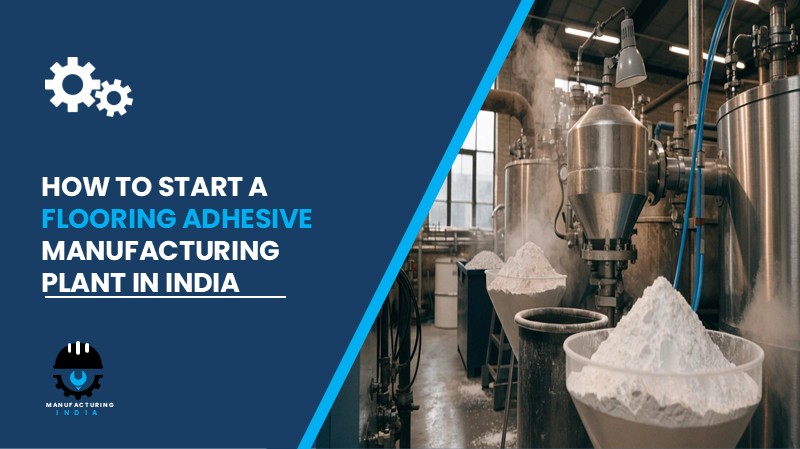
- Dry Blend / Cement-Based Tile Adhesive Production Route — Portland cement, graded silica sand, calcium carbonate fillers, cellulose ether (HPMC), redispersible polymer powder (RDP), and additives are precision-weighed and blended in ribbon or paddle blenders, filled into bags, and dispatched as a dry-mix product requiring only site addition of water prior to application
- Liquid / Polymer Dispersion Adhesive Production Route — polymer emulsions (VAE, SBR, acrylic), water, fillers, thickeners, preservatives, and additives are blended in high-speed dispersers or planetary mixers, filled into buckets or drums, and dispatched as ready-to-use liquid adhesive products
The complete process flow for cement-based adhesive production involves raw material receipt and quality testing, precision weighing and batching, dry blending in ribbon or paddle mixers, sieving for homogeneity, bag filling and sealing, palletizing, and dispatch. For liquid adhesive production, the process involves polymer emulsion receipt and testing, weighing and charging of liquid components into disperser vessels, controlled dispersion and blending, viscosity adjustment, quality testing (viscosity, pH, bond strength, open time), filling into pails or drums, labeling, and dispatch.
Key Applications of Flooring Adhesives
Flooring adhesives manufactured in India serve a wide variety of end-use flooring installation applications:
- Ceramic and Vitrified Tile Installation: Cement-based polymer-modified tile adhesives for wall and floor tile fixing in residential, commercial, and industrial buildings — the largest volume segment in India
- Natural Stone Installation: High-strength, non-staining adhesive systems for marble, granite, slate, and limestone flooring and cladding applications
- Luxury Vinyl Tile (LVT) and Vinyl Sheet Flooring: Pressure-sensitive adhesives (PSA) and acrylic dispersion adhesives for direct-stick LVT, SPC, and vinyl sheet flooring installation
- Engineered Wood and Hardwood Flooring: Polyurethane and MS polymer adhesives for glue-down installation of engineered wood and solid hardwood flooring
- Carpet Installation: Pressure-sensitive and tackifier-based adhesives for broadloom carpet and carpet tile installation
- Epoxy and Self-Leveling Flooring: Two-component epoxy adhesives and primers for industrial epoxy flooring systems in factories, warehouses, and food processing facilities
- Sports and Rubber Flooring: Contact adhesives and polyurethane systems for sports flooring, gymnasium rubber tiles, and running track surfaces
Global Market Outlook
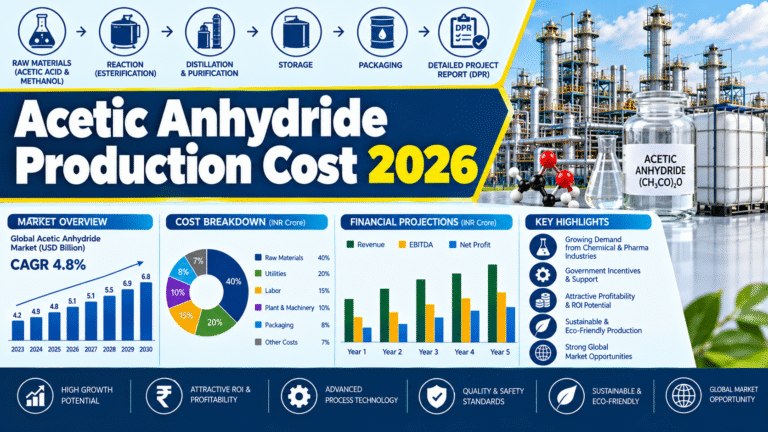
The global flooring adhesive market was valued at approximately USD 4.2 billion in 2025 and is projected to reach USD 6.5–7.5 billion by 2034, growing at a CAGR of 5–7% from 2026 to 2034. This sustained growth is driven by rapid urbanization and construction activity in Asia and Africa, the global shift toward premium flooring materials requiring specialty adhesive systems, increasing renovation activity in mature markets, and tightening VOC and environmental regulations driving innovation in water-based and low-emission adhesive technologies.
Leading global and Indian players in the flooring adhesive market include:
- Bostik S.A. (Arkema Group, France)
- Sika AG (Switzerland)
- Mapei S.p.A. (Italy)
- Henkel AG & Co. KGaA (Germany)
- H.B. Fuller Company (USA)
- Pidilite Industries Ltd. (India)
- LATICRETE International Inc. (USA)
- Saint-Gobain Weber (France)
Timeline to Start a Flooring Adhesive Manufacturing Plant
Setting up a flooring adhesive manufacturing plant from ideation to commissioning typically requires 12 to 18 months. This covers:
- Feasibility study and Detailed Project Report (DPR) preparation
- Land acquisition and site development
- Regulatory approvals and environmental clearances
- Factory license and fire safety compliance
- Machinery procurement and installation (mixers, dispersers, filling equipment)
- Raw material sourcing agreements (polymer emulsions, cement, fillers, additives)
- Product formulation development, testing, and BIS/quality certification
- Distribution network development and commercial production launch
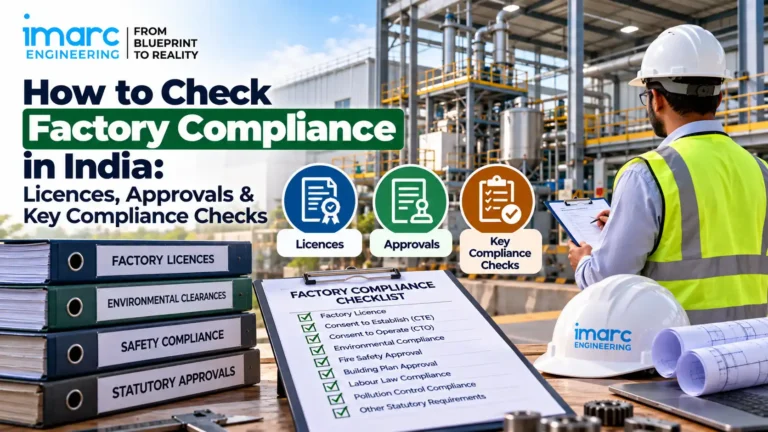
Licenses and Regulatory Requirements
Starting a flooring adhesive manufacturing unit in India requires several approvals, including:
- Business registration (Proprietorship, LLP, or Private Limited Company)
- Factory License under the Factories Act
- Environmental Clearance from the State Pollution Control Board (SPCB)
- Consent to Establish (CTE) and Consent to Operate (CTO) under Air and Water Acts
- GST Registration
- Fire Safety NOC (especially important for solvent-based adhesive manufacturing)
- BIS Certification under IS 15477 (Adhesives for Ceramic Tiles) or relevant Indian Standards for specific adhesive product categories
- Hazardous Chemical License (if manufacturing solvent-based or reactive adhesive systems containing classified hazardous chemicals)
- MSME/Udyam Registration (for eligibility under government incentive schemes)
Key Challenges to Consider
Before investing, entrepreneurs should be aware of the common challenges in this business:
- Raw Material Price Volatility: Key inputs such as polymer emulsions (VAE, acrylic), polyurethane prepolymers, and specialty additives are petroleum-derived and subject to global price fluctuations that directly impact adhesive manufacturing margins.
- Technical Formulation Expertise: Developing and maintaining high-performance adhesive formulations for diverse flooring substrates and installation conditions requires significant investment in R&D capabilities and experienced adhesive chemists.
- Competition from Established Brands: The Indian construction adhesive market is led by strong brands such as Pidilite (Fevicol, Dr. Fixit), Sika, and Mapei with extensive distribution networks, requiring new entrants to invest substantially in brand development or pursue private-label strategies.
- VOC and Environmental Compliance: Increasing regulatory scrutiny on volatile organic compound (VOC) emissions from adhesives, particularly solvent-based products, requires investment in reformulation toward water-based and low-VOC systems.
- Contractor and Installer Education: Professional flooring installers and tile fixers often default to familiar products; technical training and demonstration programs are essential investments for market penetration.
- Working Capital Requirements: Flooring adhesive manufacturing involves significant raw material inventory investment due to the diverse product range and the need to maintain consistent supply to distribution partners.
Frequently Asked Questions
The following questions are answered in the report:
- How much does it cost to set up a flooring adhesive manufacturing plant in India?
- Is flooring adhesive manufacturing profitable in India in 2026?
- What machinery is required for a flooring adhesive plant in India?
- What licences and approvals are required to start a flooring adhesive plant in India?
- How long does it take to commission a flooring adhesive manufacturing plant in India?
- What is the best state or location to set up a flooring adhesive plant in India?
- What government incentives are available for construction chemical manufacturers in India?
- What is the break-even period for a flooring adhesive plant in India?
- What is the difference between cement-based, polymer-based, polyurethane, and epoxy flooring adhesives?
- What are the BIS certification requirements for flooring adhesives in India?
Key Takeaways for Investors
The flooring adhesive manufacturing industry in India represents a strong and scalable investment opportunity backed by the country’s world-class tile industry, rapidly growing premium flooring segment, massive affordable housing and infrastructure construction pipeline, and the long-term structural shift toward high-performance specialty adhesive systems. With gross margins of 28–42% and a break-even window of 2–4 years, a well-planned flooring adhesive manufacturing plant cost in India remains highly competitive and financially attractive — particularly for entrepreneurs who can develop technically differentiated product formulations, secure BIS certification, establish strong distribution reach into the tile retail and flooring contractor network, and capitalize on the high-margin specialty adhesive segments serving LVT, engineered wood, and industrial epoxy flooring applications.
About the Author