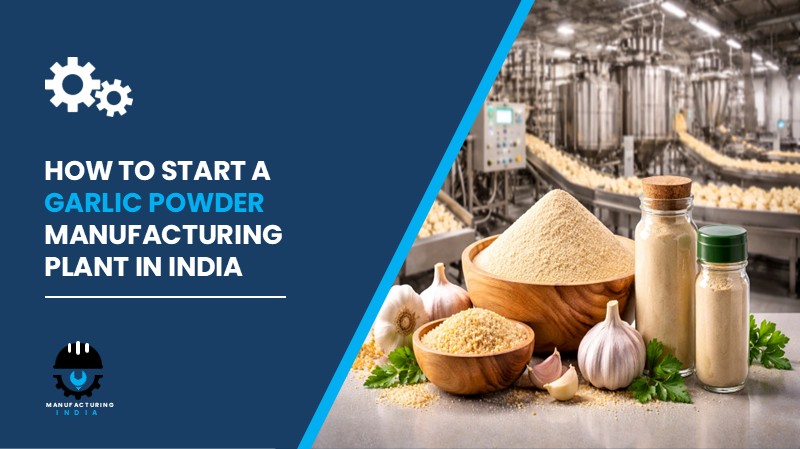
Setting up a garlic powder manufacturing plant in India presents a compelling investment case driven by surging demand from the food processing, nutraceuticals, hospitality, ready-to-eat meals, and animal feed industries. As Indian consumers increasingly shift toward convenience foods and clean-label seasoning ingredients, garlic powder has emerged as a high-value dehydrated product with stable offtake across both domestic and export markets. The product’s antimicrobial, antioxidant, and flavor-enhancing properties make it indispensable for food manufacturers, pharmaceutical formulators, and animal nutrition producers alike.
India’s structural advantages rapid urbanisation, a deep agricultural base producing fresh garlic at competitive prices, growing food processing zones in states such as Gujarat, Maharashtra, and Uttar Pradesh, and strong policy tailwinds under the Make in India initiative make the country strategically sound for this type of production. The combination of low-cost raw material procurement from garlic-growing belts and proximity to large consumer markets positions India as an ideal hub for both domestic supply and export-oriented garlic powder production.
Establishing a garlic powder manufacturing unit in India offers policy-backed cost competitiveness, healthy gross profit margins of 30–40%, and diversified demand across food processing, nutraceuticals, and animal feed sectors. With a net margin range of 15–20% and a production capacity scalable between 1,000–3,000 MT per annum, this plant type presents a financially viable investment with strong break-even prospects.
What is Garlic Powder?
Garlic powder is a dehydrated and finely milled form of garlic derived from fresh garlic bulbs. It retains the characteristic sulfur-containing compounds including allicin, diallyl sulfide, and ajoene that are responsible for its strong aroma, flavor, and medicinal properties. The product appears as an off-white to pale yellow powder with a moisture content of less than 6%, which ensures a prolonged shelf life. It is widely valued for its uniform flavor distribution, ease of handling, and microbial stability.
The manufacturing process involves cleaning, peeling, slicing, dehydration, grinding, sieving, and packaging. Due to its antioxidant, antimicrobial, and flavor-enhancing properties, garlic powder is extensively consumed across food processing, pharmaceuticals, nutraceuticals, and animal nutrition sectors. It is used as a seasoning agent, flavor enhancer, functional food ingredient, and preservative substitute across multiple end-use industries.
Cost of Setting Up a Garlic Powder Manufacturing Plant in India
The total investment required for this type of plant depends on capacity, technology selection, plant location, level of automation, and compliance with applicable regulatory requirements.
1. Capital Expenditure (CapEx)
The land and site development component covers land acquisition, registration charges, boundary development, and related infrastructure preparation. Investors may explore options in Special Economic Zones (SEZs) or state-designated industrial estates to benefit from concessional land rates and faster regulatory approvals. Civil works encompass the construction of the production shed, quality control laboratory, raw material storage area, finished goods warehouse, and administrative block.
Machinery costs represent the largest single portion of total CapEx for a garlic powder manufacturing plant. Key machinery required includes:
- Garlic bulb separator and peeler
- Slicing and washing units
- Dehydrators (hot air or freeze dryers)
- Pulverizers and grinders
- Sieving and blending machines
- Automatic packaging systems
Other capital costs include effluent treatment plant (ETP) setup, pre-operative expenses, plant commissioning charges, and any applicable import duties on specialised dehydration and grinding equipment.
Request a Sample Report for In-Depth Market Insights: https://www.imarcgroup.com/garlic-powder-manufacturing-plant-project-report/requestsample
2. Operational Expenditure (OpEx)
Raw material cost is the dominant operating expense, with fresh garlic and packaging together accounting for approximately 70–80% of total OpEx. Securing long-term supplier contracts with garlic-growing regions in India is essential for mitigating price volatility and ensuring production continuity. Utility costs covering electricity for dehydration and grinding equipment, process water, and steam represent a further 10–15% of annual operating expenditure. Additional ongoing costs include transportation, packaging materials, salaries and wages, routine maintenance, depreciation, and applicable taxes. By the fifth year of operations, total operational costs are projected to increase substantially, driven by inflation, market fluctuations, rising raw material costs, supply chain shifts, and growing consumer demand.
3. Plant Capacity
The proposed manufacturing facility is designed with an annual production capacity ranging between 1,000–3,000 MT of garlic powder, enabling economies of scale while maintaining operational flexibility. Capacity can be customised to match an individual investor’s capital outlay and market access. Profitability improves meaningfully with higher capacity utilisation, as fixed costs are spread across a larger volume of output.
4. Profit Margins and Financial Projections
The financial projections for a garlic powder manufacturing plant cover NPV, IRR, payback period, gross margin, and net margin analysis across a five-year horizon. The project demonstrates healthy profitability potential under normal operating conditions, with gross profit margins typically ranging between 30–40% and net profit margins in the range of 15–20%. The detailed project report provides a complete income and expenditure projection, uncertainty analysis, and sensitivity analysis to support funding decisions and financial strategy formulation.
Why Set Up a Garlic Powder Plant in India?
Rising Demand for Convenience Foods. The worldwide rise in consumption of ready-to-cook and processed foods is a primary driver of demand for stable, easy-to-use seasoning ingredients such as garlic powder. As Indian food manufacturers scale production of sauces, soups, snack seasonings, and ready meals, demand for consistent, high-quality dehydrated ingredients continues to grow.
Strong Agricultural Linkages. India’s large and established garlic cultivation base allows procurement costs to be reduced and value addition to occur close to the source. This agricultural proximity strengthens supply chain reliability and gives Indian producers a structural cost advantage over importers in global markets.
Export-Oriented Growth Potential. Dehydrated garlic products attract strong demand in overseas markets due to their longer shelf life, ease of transportation, and consistently maintained quality standards. An Indian production facility is well-placed to serve both domestic food manufacturers and international buyers.
Health and Clean-Label Trend. Growing consumer preference for natural flavoring agents and clean-label ingredients supports long-term market expansion. Garlic powder retains many of the beneficial compounds found in fresh garlic while offering easier incorporation into formulations and longer usability.
Active Industry Investment. In November 2022, LifeSpice India Pvt. Ltd. launched what it claims to be India’s first science-backed spice mix range, which includes garlic powder among its core ingredients, manufactured in a dedicated facility using research-driven formulations. In March 2025, Khonoma Village in Nagaland hosted its first-ever Chümerie (Garlic) Festival under the MYKI Village Adoption Initiative, promoting garlic as a key cash crop under the “One Village, One Product” approach — signalling growing institutional support for garlic value-chain development across India.
Scalable and Diversifiable Operations. The production facility can be scaled up and operations diversified into related dehydrated vegetable powders, expanding revenue streams and reducing concentration risk for investors.
Manufacturing Process — Step by Step
The garlic powder manufacturing process uses cleaning, peeling, slicing, dehydration, grinding, sieving, and packaging as the primary production method. Each stage involves specific unit operations, quality checks, and material handling protocols.
- Cleaning: Fresh garlic bulbs are received and cleaned to remove field debris, soil, and foreign matter using washing equipment.
- Peeling: Garlic bulb separators and peelers mechanically remove the outer skin, preparing cloves for further processing.
- Slicing: Slicing and washing units cut peeled cloves to uniform thickness to ensure even dehydration and consistent moisture removal.
- Dehydration: Hot air dryers or freeze dryers reduce moisture content to below 6%, preserving the sulfur-containing compounds and extending shelf life.
- Grinding: Pulverizers and grinders reduce the dehydrated garlic to a fine, uniform powder.
- Sieving and Blending: Sieving and blending machines ensure consistent particle size, homogeneity, and compliance with product specification.
- Quality Assurance: Technical tests monitor product concentration, purity, and microbial stability at multiple production stages.
- Packaging and Dispatch: Automatic packaging systems fill and seal the finished product in food-grade containers, ready for dispatch to food processing facilities, hospitality buyers, nutraceutical manufacturers, and animal feed producers.
Key Applications
Garlic powder serves a wide range of end-use industries, reflecting its versatility as both a functional ingredient and a flavor-enhancing compound.
- Food and Beverage Industry: Used in spice mixtures, sauces, soups, ready meals, snack seasonings, and meat products.
- Pharmaceuticals and Nutraceuticals: Included in capsules, tablets, and powders for cardiovascular and immune-support formulations.
- Animal Feed Industry: Incorporated into poultry and livestock feed as a natural growth promoter and antimicrobial agent.
- Cosmetics and Personal Care: Employed in herbal creams and topical applications for its antimicrobial properties.
Leading Manufacturers
The global garlic powder industry is served by several multinational companies with extensive production capacities and diverse application portfolios. Key players include:
- The Spice Hunter
- Knorr (Unilever)
- Badia Spices Inc.
- Naturevibe Botanicals
- Watkins Incorporated
- McCormick and Company
Timeline to Start the Plant
- Feasibility study and project report preparation
- Land acquisition and site development
- Regulatory approvals and environmental clearances
- Factory licence and fire safety compliance
- Machinery procurement and installation
- Raw material supplier agreements and supply chain setup
- Trial production and quality testing
- Commercial production launch
Licences and Regulatory Requirements
Starting a garlic powder manufacturing unit in India requires several approvals:
- Business registration (Proprietorship, LLP, or Pvt Ltd)
- Factory Licence under the Factories Act
- Environmental Clearance from State Pollution Control Board
- GST Registration
- Fire Safety NOC
- Food Business Operator (FBO) licence under FSSAI
- Effluent Treatment Plant (ETP) operational clearance
- Occupational Health and Safety compliance
Key Challenges to Consider
High Capital Requirements. Establishing a garlic powder manufacturing plant with adequate capacity and compliant infrastructure requires substantial upfront investment in land, civil works, dehydration machinery, and effluent treatment systems.
Raw Material Price Volatility. Fresh garlic prices are subject to seasonal fluctuations and supply disruptions. Since raw materials account for 70–80% of OpEx, price volatility can materially affect operating margins without forward supply contracts in place.
Regulatory Compliance. Meeting FSSAI standards, environmental clearances from State Pollution Control Boards, and ongoing ETP compliance requires dedicated quality assurance investment and documentation management.
Technology and Innovation Pressure. Technological advancements in dehydration and grinding techniques are continuously improving product quality, yield, and energy efficiency. Staying current with these developments requires periodic capital reinvestment.
Competition. The market includes established global players such as McCormick and Company, Knorr (Unilever), Badia Spices Inc., The Spice Hunter, Naturevibe Botanicals, and Watkins Incorporated. New entrants must differentiate on quality, price, or niche application focus.
Skilled Manpower. Dehydration processing and quality control operations require trained technical staff. Attracting and retaining qualified personnel in food processing and instrumentation disciplines is an ongoing operational challenge.
Frequently Asked Questions
1. How much does it cost to set up a garlic powder manufacturing plant in India? Total investment depends on plant capacity (1,000–3,000 MT per annum), technology selection, automation level, location, and regulatory compliance. A detailed breakdown of CapEx and OpEx is available in the full project report.
2. Is garlic powder manufacturing profitable in India in 2026? Yes. The project demonstrates gross profit margins of 30–40% and net profit margins of 15–20% under normal operating conditions, supported by stable demand across food processing, nutraceuticals, and animal feed.
3. What machinery is required for a garlic powder plant in India? Essential equipment includes garlic bulb separators and peelers, slicing and washing units, dehydrators (hot air or freeze dryers), pulverizers and grinders, sieving and blending machines, and automatic packaging systems.
4. What licences and approvals are required to start a garlic powder plant in India? Required approvals include business registration, Factory Licence, FSSAI licence, GST registration, Environmental Clearance, Fire Safety NOC, ETP clearance, and Occupational Health and Safety compliance.
5. What raw materials are needed for garlic powder manufacturing? The primary raw material is fresh garlic, along with food-grade packaging materials. Fresh garlic alone drives 70–80% of total operating expenditure.
6. What are the environmental compliance requirements for a garlic powder plant in India? Plants must obtain Environmental Clearance from the State Pollution Control Board, install and operate an effluent treatment plant, and maintain ongoing compliance with emission and waste management standards.
7. What is the best location to set up a garlic powder plant in India? Ideal locations offer proximity to garlic-growing regions to reduce raw material procurement costs, access to reliable utilities and transportation, and availability of industrial land within SEZs or state manufacturing estates.
8. What is the break-even period for this type of plant in India? The break-even period depends on capacity utilisation, product pricing, and cost management. Full financial projections including payback period analysis are covered in the detailed project report.
9. What government incentives are available for manufacturers in India? Food processing manufacturers in India may benefit from schemes under the Make in India initiative, PLI scheme for food processing, state industrial investment subsidies, and concessional finance from institutions such as SIDBI and NABARD.
Key Takeaways for Investors
A garlic powder manufacturing plant in India represents a financially attractive and operationally scalable opportunity driven by strong demand from food processing, nutraceuticals, hospitality, ready-to-eat meals, and animal feed sectors. The project demonstrates financial viability across a production capacity range of 1,000–3,000 MT per annum, with gross margins of 30–40% and net margins of 15–20% achievable under stable market conditions. The dehydrated garlic segment held a dominant market position capturing more than a 28.6% share of the broader dehydrated garlic market, with the industry witnessing steady expansion driven by changing dietary habits, rising urbanisation, and increasing demand for processed and convenience foods. With the expanding plant-based food sector — valued at approximately USD 8.1 billion in the United States alone with 59% of American households purchasing plant-based products in 2024 demand for natural flavor-enhancing ingredients such as garlic powder is expected to remain robust and sustained over the long term.
About the Author