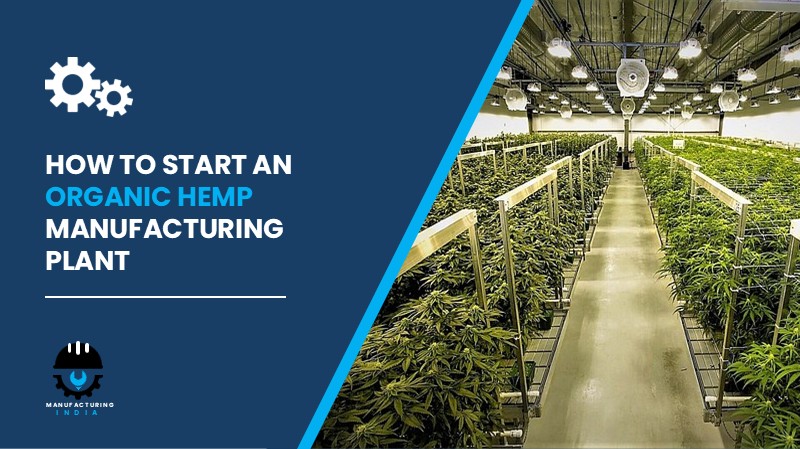
Setting up an organic hemp manufacturing plant in India presents a compelling investment case rooted in the country’s expanding wellness, textile, construction, and sustainable agriculture sectors. Organic hemp, derived from the Cannabis sativa plant, is increasingly recognized as a versatile industrial crop with negligible THC content, making it legally viable for industrial production. Its applications span textiles, food, medicine, construction materials, biofuel, and paper – sectors that are integral to India’s rapidly evolving manufacturing economy. The convergence of global sustainability trends with domestic demand for eco-conscious alternatives makes this facility an exceptional opportunity for forward-looking investors.
India’s structural advantages – a large agricultural base, cost-competitive land and labour, growing urbanisation, and the Government of India’s Make in India initiative – position the country as a strategically sound location for establishing an organic hemp manufacturing unit. States with strong agri-industrial infrastructure offer logistical efficiencies for raw material sourcing and product distribution. As more regions globally legalise hemp farming, Indian manufacturers stand to benefit from both domestic consumption and export diversification, reinforcing the long-term commercial viability of this investment.
Setting up an organic hemp manufacturing plant in India combines policy support, cost-competitive manufacturing, and multi-sector demand from textiles, wellness, construction, and food industries. With favourable break-even dynamics and robust downstream offtake from sustainability-oriented sectors, this investment delivers both margin resilience and long-term demand sustainability.
What is Organic Hemp?
Organic hemp is a crop derived from the Cannabis sativa plant that contains negligible levels of THC, rendering it non-intoxicating and legally suitable for a wide range of industrial and commercial applications. As described in the IMARC Group project report, organic hemp is often referred to as the “miracle crop” due to its eco-friendly attributes and extraordinary versatility. Its rapid growth cycle and low resource requirements make it an environmentally sustainable crop that enriches soil health and reduces dependence on synthetic fertilisers. Hemp fibers are renowned for their durability and find application in textiles, ropes, and construction materials. Hemp seeds are rich in protein and omega-3 fatty acids, serving as a nutritional superfood, while its non-intoxicating cannabinoid CBD is increasingly used across wellness and skincare products.
The production process for organic hemp involves multiple unit operations that are fully documented in the IMARC manufacturing plant project report, including mass balance calculations, quality assurance criteria, and technical tests. End-use industries served by organic hemp include textiles and sustainable fashion, food and nutrition, healthcare and wellness, construction, biofuel, and paper production.
Cost of Setting Up an Organic Hemp Manufacturing Plant in India
The total cost of establishing an organic hemp manufacturing plant in India depends on several interdependent variables including production capacity, selected technology, plant location, degree of automation, and regulatory compliance requirements.
1. Capital Expenditure (CapEx)
Capital expenditure represents the largest upfront financial commitment for any organic hemp plant project in India. Land and site development costs vary considerably depending on whether the investor opts for an SEZ location, an established industrial estate, or a greenfield agricultural-industrial site. Industrial estates in states with strong agri-processing zones tend to offer better infrastructure access at competitive land rates.
Civil works and construction encompass the manufacturing shed, quality control laboratory, raw material storage, packaging area, and administrative block. These must be designed to accommodate the specific unit operations involved in organic hemp processing, with adequate provisions for ventilation, moisture control, and material flow.
Machinery and equipment constitute a significant share of total CapEx. As detailed in the IMARC Group’s Organic Hemp Manufacturing Plant Project Report 2026, the report covers full machinery requirements, machinery costs, and machinery supplier details (provided on request). Key machinery requirements, cost estimates, and equipment specifications are disclosed within the paid report under Section 6.3.
Other capital costs include effluent treatment plant (ETP) installation, pre-operative expenses, commissioning charges, and any import duties applicable to specialised equipment not manufactured domestically.
Request a Sample Report for In-Depth Market Insights: https://www.imarcgroup.com/organic-hemp-manufacturing-plant-project-report/requestsample
2. Operational Expenditure (OpEx)
Recurring operational costs are a critical input for financial modelling in any organic hemp plant feasibility study. Raw material cost forms the largest component of OpEx. The IMARC report covers raw material requirements, procurement details, and cost structure under Section 6.4, including raw material supplier identification provided on request. Investors should plan for long-term supplier contract strategies to mitigate raw material price fluctuations, particularly given the evolving regulatory landscape around hemp cultivation across Indian states.
Utility costs – including electricity, water, and any steam requirements associated with processing – represent a meaningful share of monthly operational expenditure. These vary based on plant location, local utility tariffs, and the extent of automation. Transportation and logistics costs depend on proximity to raw material sources and end-use industry clusters. Other operating costs encompass packaging, employee salaries, plant maintenance, depreciation on fixed assets, and applicable taxes. A five-year cost projection model, covering both fixed and variable cost escalation, is included in the IMARC report under Section 8, providing investors with expenditure projections that reflect realistic operational scenarios.
3. Plant Capacity
The IMARC Group report allows plant capacity to be fully customised based on investor requirements and business scale. Whether the investor is planning a small-scale processing unit or a large-scale integrated organic hemp manufacturing facility, the project economics can be tailored accordingly. As a general principle, profitability improves significantly with higher capacity utilisation, making it important to align installed capacity with secured offtake commitments and market demand forecasts.
4. Profit Margins and Financial Projections
The project report provides a thorough financial analysis covering net present value (NPV), internal rate of return (IRR), payback period, gross margin, net margin, and a detailed profit and loss account. Additional analyses include liquidity analysis, sensitivity analysis, uncertainty analysis, and economic analysis. Product pricing and margin estimates are covered in Section 8.5 of the report. Specific margin ranges and payback period figures are disclosed within the paid project report and vary based on capacity, location, and market pricing at the time of the feasibility study.
Why Set Up an Organic Hemp Plant in India?
Growing Demand from Wellness and Healthcare: The wellness and healthcare sectors are among the most significant contributors to the rise of organic hemp globally. CBD – a non-intoxicating compound derived from hemp – has gained strong traction in skincare, supplements, and alternative medicine. As India’s wellness consumption deepens, this creates robust downstream demand for domestically manufactured organic hemp derivatives.
Sustainable Textile Industry Demand: Innovations in textile technology have led to a resurgence in hemp-based fabrics, aligned with the global sustainable fashion movement. Hemp clothing is valued for its durability, breathability, and reduced environmental impact. India’s textile sector, one of the largest globally, presents a natural and growing market for hemp fibre producers.
Eco-Friendly Agricultural Alternatives: As consumers globally and in India become increasingly conscious of their environmental footprint, organic hemp’s ability to thrive without synthetic pesticides positions it as a preferred eco-friendly crop. This aligns with India’s national priorities around sustainable farming, organic certification, and soil health initiatives under various agricultural development schemes.
Policy and Regulatory Tailwinds: Government regulations and support for hemp cultivation are identified as key drivers by IMARC Group. As more regions legalise hemp farming, there is an increase in supply and product diversity. India’s evolving regulatory framework for industrial hemp — particularly in states that have begun permitting licensed cultivation – creates growing headroom for investment in processing and manufacturing.
Cost-Competitive Manufacturing: India offers compelling cost advantages including relatively lower land acquisition costs in agri-industrial zones, competitive labour rates for both skilled and semi-skilled roles, and an established domestic supply chain for packaging and logistics services. These structural cost efficiencies support stronger operating margins compared to manufacturing in higher-cost geographies.
Multi-Sector End-Use Demand: Organic hemp serves a wide array of industries — textiles, food, medicine, construction, biofuel, and paper. This diversified demand base significantly reduces market concentration risk for investors, ensuring that production output has multiple viable commercial outlets across India’s growing industrial economy.
Manufacturing Process – Step by Step
The organic hemp manufacturing process uses unit operations as the primary production methodology, as documented in Section 5 of the IMARC Group project report. The specific process flow, including each unit operation, mass balance, and quality assurance criteria, is detailed within the full paid report. Based on the report framework, the manufacturing sequence covers:
- Raw material sourcing and intake: Procurement of organically certified hemp biomass and other input materials; inspection and acceptance testing against quality assurance criteria.
- Pre-processing and preparation: Conditioning of input materials for downstream unit operations.
- Core processing unit operations: Primary transformation processes as documented in Section 5.2 of the IMARC report; specific operations vary by product variant.
- Quality control and technical testing: Application of quality assurance criteria and technical tests as outlined in Section 5.3 and 5.4 of the report.
- Packaging: Packaging per requirements documented in Section 6.5; packaging material procurement and cost covered separately.
- Storage and dispatch: Finished product storage and logistics to end-use industries including textiles, food, wellness, construction, biofuel, and paper.
Key Applications
Organic hemp serves a broad range of industries, underpinning its commercial resilience and multi-market demand.
- Textiles and Sustainable Fashion: Hemp fibers are used in durable fabrics, ropes, and sustainable clothing lines aligned with eco-conscious fashion trends.
- Food and Nutrition: Hemp seeds, rich in protein and omega-3 fatty acids, are processed into superfoods, nutritional supplements, and food ingredients.
- Healthcare and Wellness: CBD derived from hemp is used in skincare formulations, wellness supplements, and alternative medicine products.
- Construction Materials: Hemp fibers contribute to sustainable building materials, supporting a more robust and eco-friendly construction industry.
- Biofuel Production: Hemp’s potential as a biofuel feedstock holds promise for green energy applications.
- Paper Production: Hemp biomass serves as a raw material for sustainable paper manufacturing, offering a renewable alternative to wood pulp.
Leading Manufacturers
The global organic hemp market features a competitive landscape of key players whose profiles, market structure, and competitive positioning are documented in Section 4.8 of the IMARC Group Organic Hemp Manufacturing Plant Project Report 2026. The report covers market structure, key players, and detailed profiles of key players as part of the competitive landscape analysis. Specific company names and market share data are disclosed within the paid report. Investors are encouraged to review the full competitive landscape section to understand positioning strategies before entering the market.
Timeline to Start the Plant
- Feasibility study and project report preparation
- Land acquisition and site development
- Regulatory approvals and environmental clearances
- Factory licence and fire safety compliance
- Machinery procurement and installation
- Raw material supplier agreements and supply chain setup
- Trial production and quality testing
- Commercial production launch
Licences and Regulatory Requirements
Starting an organic hemp manufacturing unit in India requires several approvals:
- Business registration (Proprietorship, LLP, or Pvt Ltd) with relevant state and central authorities
- Factory Licence under the Factories Act, 1948
- Environmental Clearance from the State Pollution Control Board
- GST Registration
- Fire Safety NOC from the local fire authority
- Hazardous and Chemical compliance, relevant given the nature of hemp-based chemical extracts including CBD
- Effluent Treatment Plant (ETP) operational clearance
- Occupational Health and Safety compliance under applicable labour and safety laws
The IMARC Group report addresses regulatory procedures and approval requirements in detail under Section 9, along with certification requirements in Section 10.
Key Challenges to Consider
High Capital Requirements: Establishing an organic hemp processing facility involves significant upfront investment in land, civil infrastructure, specialised machinery, and regulatory compliance, which may pose entry barriers for smaller investors without access to structured project finance.
Raw Material Price Volatility: The cost of organically certified hemp biomass and associated input materials can fluctuate based on cultivation seasons, regulatory changes in hemp farming permissions, and organic certification supply dynamics. Long-term supplier contracts are advisable to manage this risk.
Regulatory Compliance: India’s evolving hemp regulatory framework requires investors to maintain close alignment with state-level cultivation laws, import and export regulations, and environmental compliance requirements, which can vary significantly by region.
Technology and Innovation Pressure: As the global organic hemp market matures, innovations in textile technology and extraction processes continue to evolve. Investors must factor in technology refresh cycles and process upgrades to remain competitive.
Competition from Established Players: The global organic hemp market includes established key players whose profiles are detailed in the IMARC report. Indian manufacturers will need to differentiate on quality, cost, and supply reliability to compete effectively with both domestic and international producers.
Skilled Manpower: Organic hemp processing requires technically skilled personnel for quality control, extraction operations, and compliance management — categories where India’s talent pipeline is still developing, particularly outside major industrial centres.
Frequently Asked Questions
How much does it cost to set up an organic hemp manufacturing plant in India?
The total setup cost varies depending on plant capacity, location, technology choice, and level of automation. Detailed CapEx and OpEx estimates are available in the IMARC Group Organic Hemp Manufacturing Plant Project Report 2026.
Is organic hemp manufacturing profitable in India in 2026?
The production of organic hemp serves high-growth sectors including wellness, textiles, construction, and food. With appropriate capacity utilisation, this investment offers viable profitability. NPV, IRR, and margin analysis are covered in the IMARC project report.
What machinery is required for an organic hemp plant in India?
Machinery requirements, costs, and supplier details are fully documented in Section 6.3 of the IMARC report. The report covers all unit operation-specific equipment needed for the manufacturing process.
What licences and approvals are required to start an organic hemp plant in India?
Key requirements include business registration, a Factory Licence, Environmental Clearance, GST registration, Fire Safety NOC, ETP clearance, chemical compliance, and occupational health approvals. Details are in Section 9 of the IMARC report.
What raw materials are needed for organic hemp manufacturing?
Raw material requirements, procurement strategies, costs, and supplier details are documented in Section 6.4 of the IMARC Group project report.
What are the environmental compliance requirements for an organic hemp plant in India?
Investors must obtain clearance from the State Pollution Control Board, operate a compliant ETP, and meet chemical handling norms. The IMARC report covers this under regulatory procedures in Section 9.
What is the best location to set up an organic hemp plant in India?
Location selection should consider proximity to hemp cultivation zones, infrastructure access, utility availability, and skilled labour supply. The IMARC report includes a detailed location analysis and selection criteria in Section 6.1.
What is the break-even period for this type of plant in India?
Payback period analysis, along with NPV and IRR calculations, is included in the financial analysis section (Section 8.8) of the IMARC report and varies with capacity and market pricing.
What government incentives are available for manufacturers in India?
Government support for hemp cultivation and manufacturing is growing as more regions legalise hemp farming. Make in India and related industrial investment schemes may offer capital subsidies, land cost concessions, and export incentives depending on state policy.
Key Takeaways for Investors
An organic hemp manufacturing plant in India represents a multi-sector investment opportunity with demand drawn from textiles, food, wellness, construction, biofuel, and paper industries – all of which are experiencing structural growth within the domestic economy. The investment is financially viable across a range of plant capacities, with profitability improving as capacity utilisation increases, and the full financial picture – including NPV, IRR, payback period, and margin projections – is covered in the IMARC Group project report. The global organic hemp market is being propelled by a confluence of factors including consumer demand for eco-friendly alternatives, regulatory liberalisation of hemp farming, and innovation in textile and extraction technologies, all of which reinforce sustained demand growth. With India’s cost-competitive manufacturing base, expanding regulatory headroom, and the Government of India’s support for sustainable agriculture and industrial investment, the long-term demand outlook for domestically manufactured organic hemp products remains firmly positive.
About the Author