Setting up a rigid PVC pipe manufacturing plant in India presents a compelling investment case anchored by the country’s accelerating construction boom, expanding municipal water infrastructure, large-scale agricultural irrigation modernisation, and growing industrial piping requirements across chemical transport, wastewater disposal, and electrical conduit applications. Rigid PVC (polyvinyl chloride) pipes — valued for their chemical resistance, long service life, low maintenance requirement, and ease of installation — are foundational inputs for residential, commercial, and industrial construction projects at every scale. As India’s urban population expands and demand for reliable water supply, sewage, and drainage networks intensifies across tier-1, tier-2, and tier-3 cities, the country’s requirement for domestically produced, cost-competitive rigid PVC pipes is growing at a pace that presents a clear and durable opportunity for new manufacturing investment.
India’s structural positioning makes it one of the most strategically sound locations globally for establishing this production. The country’s construction and infrastructure sector is among the world’s fastest-growing, driven by government-led urbanisation programmes, the Jal Jeevan Mission for rural water supply, and sustained investment in industrial and commercial real estate. The Make in India initiative provides policy support for plastics and chemical manufacturing, while well-developed industrial estates in Gujarat, Maharashtra, Rajasthan, and Uttar Pradesh offer proximity to PVC resin supply chains, logistics infrastructure, and the large construction market clusters that constitute the primary domestic customer base. The extrusion-based production process carries a moderate capital investment threshold relative to its output scale, making this unit a financially accessible entry point into India’s high-growth pipes and fittings sector.
Investing in a rigid PVC pipe manufacturing plant in India aligns robust construction and infrastructure-driven demand with cost-competitive manufacturing conditions, a well-established domestic PVC resin supply chain, and strong government policy support for piping infrastructure programmes. With gross profit margins of 20–30% and net profit margins of 8–12%, the unit economics are commercially sound, and the facility’s scalable extrusion-based production model supports viable break-even outcomes across annual capacities of 30,000 to 60,000 MT.
What are Rigid PVC Pipes?
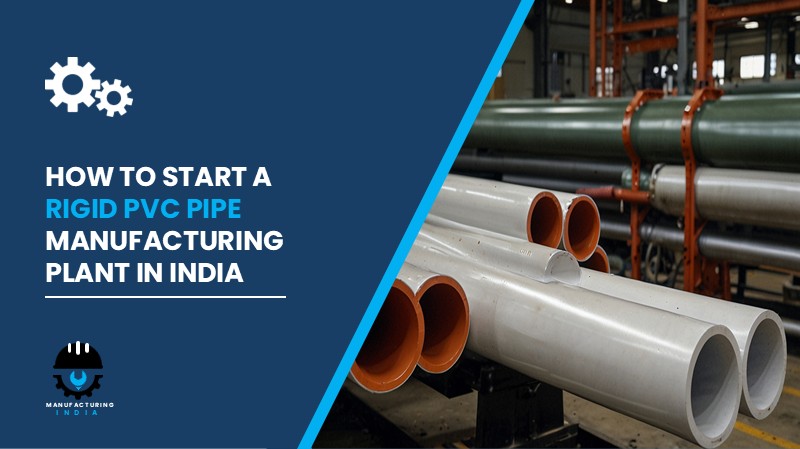
Rigid PVC pipes are strong, lightweight, and rustproof piping solutions that have found extensive application in water supply, sewage systems, industrial fluid transport, and irrigation networks across residential, commercial, and industrial sectors. Their production involves mixing PVC resin with stabilisers, lubricants, and sometimes fillers, after which extrusion is used to create pipes with different diameters and thicknesses suited to a wide range of pressure ratings and application requirements.
The key performance advantages of rigid PVC pipes include resistance to chemicals, a long service life, minimal maintenance requirements, and ease of installation using standard fittings compatible with both manual and automated assembly systems. The product range covers multiple grades — including pressure pipes, sewer pipes, and electrical conduit pipes — each engineered to serve specific performance requirements across their respective applications. This product diversity, combined with the ability to customise diameters and pressure ratings, makes rigid PVC pipes a highly versatile and commercially attractive manufactured product.
The production process spans PVC resin compounding, extrusion, cooling, sizing, cutting, inspection, and packaging. End-use industries served include construction, irrigation, municipal water supply, industrial piping, and electrical conduit systems. Applications cover water distribution systems, sewage and drainage systems, irrigation networks, cable protection conduits, and chemical transport pipelines.
Cost of Setting Up a Rigid PVC Pipe Manufacturing Plant in India
The cost of establishing a rigid PVC pipe manufacturing plant in India depends on plant capacity, technology selection, geographic location, degree of automation, and the regulatory compliance requirements applicable to plastics and chemical processing manufacturing.
1. Capital Expenditure (CapEx)
Land and Site Development forms a foundational component of the total capital investment, covering land registration charges, boundary development, drainage infrastructure, and site utilities. Investors may explore industrial estates and plastics manufacturing clusters or Special Economic Zones (SEZs) in states such as Gujarat and Maharashtra, where plug-and-play infrastructure, streamlined approvals, and proximity to PVC resin suppliers reduce both upfront costs and pre-production timelines significantly.
Civil Works and Construction encompass the main production shed housing extrusion lines, a raw material storage area for bulk PVC resin and additive inputs, a quality control laboratory for dimensional and pressure testing, finished goods warehousing for pipe stock, an administrative block, and utilities infrastructure including power distribution and water supply systems for cooling operations.
Machinery and Equipment represent the largest single component of total CapEx for a rigid PVC pipe manufacturing plant. Key machinery required includes:
- Extruders
- Cooling tanks
- Sizing devices
- Cutting machines
- Packaging systems
Other Capital Costs include an effluent treatment plant (ETP) for process water management, pre-operative expenses, commissioning and trial run charges, and any applicable import duties on specialised extrusion or sizing equipment not manufactured domestically.
Request a Sample Report for In-Depth Market Insights: https://www.imarcgroup.com/rigid-pvc-pipe-manufacturing-plant-project-report/requestsample
2. Operational Expenditure (OpEx)
Raw Material Cost is the overwhelmingly dominant operational expense, accounting for approximately 70–80% of total OpEx. The primary raw materials are PVC resin, plasticisers (for modified rigid grades), stabilisers including lead and calcium-zinc formulations, lubricants, fillers such as calcium carbonate, and colorants. PVC resin, as the base polymer consumed in the largest volumes, drives the majority of this cost. Long-term procurement contracts with reliable PVC resin suppliers are strongly advisable to stabilise input costs and protect margins against petrochemical price cycles. Selecting plant locations with proximity to domestic resin producers or port-accessible import routes reduces the freight burden on the highest-volume input category.
Utility Cost is the second-largest OpEx component, representing 10–15% of total operating expenses, covering electricity for extruder drive systems, cooling tank water circulation, sizing and cutting machinery, and general plant operations. Water consumption for pipe cooling is a continuous process requirement that must be factored into site utility planning.
Other Operating Costs include transportation and distribution to construction, municipal, agricultural, and industrial customers, packaging materials for pipe bundling and protection, salaries and wages for production and quality control personnel, routine machinery maintenance and wear part replacement for extrusion tooling, depreciation on production equipment, and applicable taxes. By the fifth year of operations, total operational costs are projected to increase substantially due to inflation, market fluctuations, potential rises in PVC resin and stabiliser prices, supply chain disruptions, rising consumer demand, and shifts in the global petrochemical economy — all variables that must be incorporated into the multi-year financial model.
3. Plant Capacity
The proposed manufacturing facility for a rigid PVC pipe plant is designed with an annual production capacity ranging between 30,000 and 60,000 metric tonnes, enabling economies of scale while maintaining the operational flexibility needed to serve a diverse customer base across construction, municipal, agricultural, and industrial segments. Plant capacity can be customised per investor requirements and phased in line with demand ramp-up from secured supply agreements or regional market penetration strategies. As with all extrusion-based polymer manufacturing, profitability improves meaningfully with higher capacity utilisation rates, making anchor customer relationships with construction contractors, government infrastructure programmes, or agricultural irrigation project developers a strategic commercial priority.
4. Profit Margins and Financial Projections
The financial projections for a rigid PVC pipe manufacturing plant demonstrate sound profitability potential under normal operating conditions. Gross profit margins typically range between 20–30%, supported by stable demand from construction, municipal water supply, irrigation, and industrial piping customers and the product’s established position as the lowest-cost durable piping solution across most application categories. Net profit margins are projected at 8–12%. A comprehensive financial analysis covering NPV (net present value), IRR (internal rate of return), payback period, gross margin progression, and net margin development across a five-year horizon is essential before committing capital. The project’s ROI profile and long-term financial sustainability are assessed against realistic assumptions on capital investment, production capacity utilisation, PVC resin pricing trends, and demand outlook from key end-use sectors.
Why Set Up a Rigid PVC Pipe Plant in India?
Growing Construction and Infrastructure Demand. Increasing residential, commercial, and industrial construction activities are the primary structural driver of rigid PVC pipe demand in India and globally. The global count of megacities — defined as urban areas with over 10 million residents — rose from 8 in 1975 to 33 in 2025, with this rapid urban expansion fuelling demand for robust water supply, sewage, and drainage infrastructure, and driving significant growth in the rigid PVC pipe market. India, as one of the world’s most rapidly urbanising large economies, is a central beneficiary of this structural trend.
Expanding Agricultural and Irrigation Sector. Growth in irrigation projects and the modernisation of water distribution systems — particularly across India’s large agricultural states — has substantially raised demand for PVC piping solutions. The use of rigid PVC pipes ensures reliable, cost-effective water distribution across both large and small-scale irrigation networks, and government-backed irrigation expansion programmes create consistent public sector demand for domestic pipe producers.
Municipal Water Supply Upgrades. India’s ambitious Jal Jeevan Mission and related urban infrastructure programmes are systematically upgrading municipal water supply and sewage systems across the country. These programmes represent multi-year, large-volume procurement cycles for rigid PVC pipes that domestic manufacturers are well-positioned to serve with shorter lead times and lower logistics costs than import-based supply chains.
Active Industry Investment and Product Innovation. In April 2025, Prayag Polymers launched a complete PVC-O (Oriented PVC) pipe range for high-pressure water distribution, irrigation, and industrial use, highlighting oriented PVC technology that delivers higher mechanical strength and reliability than conventional rigid PVC pipe systems. In February 2025, Malpani Pipes & Fittings Limited introduced a new PVC pipe product line supported by expanded capacity of 1,800 MT per year, targeting plumbing, sewage, drinking water distribution, irrigation, and industrial applications. Both developments signal active product expansion and capacity investment across the Indian market.
Industrial Piping and Electrical Conduit Applications. Industrial applications including chemical transport, wastewater disposal, and electrical conduit systems are also contributing to market growth for rigid PVC pipes. As India’s industrial manufacturing base expands across chemicals, pharmaceuticals, food processing, and infrastructure sectors, demand for reliable, corrosion-resistant industrial piping solutions creates an additional demand layer beyond the construction and agricultural segments.
Scalable and Cost-Efficient Extrusion-Based Production. The extrusion method used for rigid PVC pipe production carries a moderate capital investment relative to output scale and provides easy operational scaling as market demand grows. Diverse product customisation — covering pipes with different diameters, pressure ratings, and grades — allows a single plant to serve multiple end-use segments, distributing fixed cost recovery across a broader revenue base and improving overall unit economics.
Manufacturing Process — Step by Step
The rigid PVC pipe manufacturing process uses PVC resin compounding, extrusion, cooling, sizing, cutting, inspection, and packaging as the primary production method. Each stage requires controlled process parameters and quality assurance to deliver pipes that consistently meet dimensional, pressure, and chemical resistance specifications.
- PVC Resin Compounding: PVC resin is blended with stabilisers (lead or calcium-zinc), lubricants, fillers such as calcium carbonate, plasticisers for modified rigid grades, and colorants in precisely controlled formulations to achieve the compound properties required for the target pipe grade and application.
- Extrusion: The prepared PVC compound is fed into extruders where it is melted, homogenised, and forced through a die to form a continuous pipe profile of the specified diameter and wall thickness.
- Cooling: The extruded pipe passes through cooling tanks where controlled water circulation solidifies the pipe structure, locking in the dimensional geometry and surface quality established at the die exit.
- Sizing: The cooled pipe passes through sizing devices that apply vacuum or pressure to precisely control the external diameter and wall thickness to the required dimensional tolerances.
- Cutting: Sized pipe is cut to specified lengths — typically 3-metre or 6-metre standard sections for the construction and agricultural markets — using automated cutting machines calibrated to the production line speed.
- Inspection: Cut pipes undergo dimensional measurement, visual surface inspection, and pressure testing as required by applicable product standards to verify compliance with specification before release for packaging.
- Packaging: Inspected pipes are bundled and packaged using packaging systems for dispatch to construction, irrigation, municipal water supply, industrial piping, and electrical conduit system customers.
Key Applications
Rigid PVC pipes manufactured in India serve a broad and commercially diverse range of end-use sectors across both public infrastructure and private construction:
- Construction and Infrastructure Sector: Provides durable, lightweight, and corrosion-resistant solutions for water supply, sewage, and drainage networks in residential, commercial, and industrial buildings.
- Agricultural Irrigation Systems: Ensures reliable water distribution for both large-scale and small-scale irrigation projects, supporting the modernisation of agricultural water management across India.
- Industrial Piping Solutions: Used for the safe and reliable transport of chemicals, wastewater, and other industrial liquids in chemical processing, pharmaceutical, and manufacturing facilities.
- Electrical Conduit Systems: Provides a protective shield for electrical wiring against mechanical impact, water ingress, and chemical exposure in building and infrastructure electrical installations.
Leading Manufacturers
The rigid PVC pipe industry in India is served by a group of well-established domestic manufacturers with extensive production capacities and diversified application portfolios across construction, municipal, agricultural, and industrial piping segments. Key players in the market include:
- Finolex Industries
- Astral Poly Technik Ltd
- Supreme Industries Ltd
- Prince Pipes and Fittings Ltd
- Jain Irrigation Systems Ltd
Timeline to Start the Plant
Establishing a rigid PVC pipe manufacturing plant in India involves a structured multi-phase development sequence. Investors should plan for the following phases:
- Feasibility study and project report preparation
- Land acquisition and site development
- Regulatory approvals and environmental clearances
- Factory licence and fire safety compliance
- Machinery procurement and installation
- Raw material supplier agreements and supply chain setup
- Trial production and quality testing
- Commercial production launch
Licences and Regulatory Requirements
Starting a rigid PVC pipe manufacturing unit in India requires several approvals spanning business registration, environmental, industrial, and chemical compliance domains:
- Business registration (Proprietorship, LLP, or Pvt Ltd)
- Factory Licence under the Factories Act
- Environmental Clearance from the State Pollution Control Board
- GST Registration
- Fire Safety NOC
- Hazardous/Chemical compliance (applicable given the use of lead and calcium-zinc stabilisers and other chemical additives in the compounding process)
- Effluent Treatment Plant (ETP) operational clearance
- Occupational Health and Safety compliance
Key Challenges to Consider
High Raw Material Cost Concentration. PVC resin, stabilisers, lubricants, fillers such as calcium carbonate, and colorants together account for 70–80% of total OpEx, with PVC resin alone representing the dominant share. As a petrochemical derivative, PVC resin pricing is directly exposed to global crude oil and ethylene market cycles, making raw material cost management through long-term supplier contracts and dual-source procurement the single most consequential operational risk factor for margin stability.
Competitive Market Landscape. The domestic rigid PVC pipe market is served by large, established players including Finolex Industries, Astral Poly Technik Ltd, Supreme Industries Ltd, Prince Pipes and Fittings Ltd, and Jain Irrigation Systems Ltd — all of which carry significant brand recognition, distribution reach, and scale advantages. New entrants will need to differentiate through price competitiveness, product quality, regional focus, or secured supply relationships with construction or government procurement channels.
Regulatory Compliance Across Chemical and Environmental Domains. The use of lead-based and calcium-zinc stabilisers, lubricants, and other chemical additives places the production process under chemical handling compliance obligations. Environmental clearance management, ETP operation, and monitoring of process water discharge require dedicated compliance resources and ongoing regulatory engagement with state pollution control authorities.
Technology and Product Innovation Pressure. Product-level innovation — as evidenced by Prayag Polymers’ April 2025 launch of PVC-O (Oriented PVC) pipe technology delivering higher mechanical strength than conventional rigid systems — creates competitive pressure on producers to invest in advanced extrusion technology and higher-performance product grades to remain relevant to demanding specification-driven customers in municipal and industrial segments.
Capital Requirements for Meaningful Scale. Achieving the 30,000 to 60,000 MT annual production capacity required for competitive unit economics demands meaningful investment in multiple extrusion lines, cooling systems, sizing and cutting equipment, and quality testing infrastructure. Securing adequate project funding and managing the pre-revenue period through the commissioning and trial production phases requires careful financial planning.
Skilled Manpower for Extrusion Process Management. Maintaining consistent pipe dimensions, wall thickness uniformity, and surface quality across high-speed continuous extrusion operations requires experienced process operators and quality control technicians — a technical workforce segment that demands ongoing investment in training and retention programmes.
Frequently Asked Questions
1. How much does it cost to set up a rigid PVC pipe manufacturing plant in India?
The total setup cost depends on plant capacity, technology selection, location, and automation level. CapEx covers land and site development, industrial civil construction, core machinery including extruders, cooling tanks, sizing devices, cutting machines, and packaging systems, along with other capital costs including ETP and pre-operative expenses. A detailed project report with full CapEx and OpEx breakdowns is available on request.
2. Is rigid PVC pipe manufacturing profitable in India in 2026?
Yes. The project demonstrates gross profit margins of 20–30% and net profit margins of 8–12% under normal operating conditions, supported by stable and growing demand from construction, municipal water supply, agricultural irrigation, and industrial piping sectors across India’s rapidly urbanising economy.
3. What machinery is required for a rigid PVC pipe plant in India?
Key machinery includes extruders, cooling tanks, sizing devices, cutting machines, and packaging systems. The scale of production and automation level determine the number of extrusion lines and total machinery investment required.
4. What licences and approvals are required to start a rigid PVC pipe plant in India? Required approvals include business registration, a Factory Licence under the Factories Act, Environmental Clearance from the State Pollution Control Board, GST registration, a Fire Safety NOC, chemical handling compliance approvals for stabiliser and additive use, ETP operational clearance, and Occupational Health and Safety compliance.
5. What raw materials are needed for rigid PVC pipe manufacturing?
The primary raw materials are PVC resin, plasticisers for modified rigid grades, stabilisers including lead and calcium-zinc formulations, lubricants, fillers such as calcium carbonate, and colorants. PVC resin and related inputs account for approximately 70–80% of total operating expenses, making resin procurement strategy the critical cost management lever.
6. What are the environmental compliance requirements for a rigid PVC pipe plant in India?
The unit must obtain Environmental Clearance from the State Pollution Control Board, operate a certified ETP for process water management, comply with chemical handling regulations applicable to lead-based and calcium-zinc stabilisers, and maintain monitoring systems for emissions and wastewater discharge in line with state pollution control standards.
7. What is the best location to set up a rigid PVC pipe plant in India?
Optimal locations offer proximity to PVC resin supply chains, reliable utilities and transportation infrastructure, and access to large construction, municipal, and agricultural customer markets. Industrial estates and chemicals manufacturing clusters in Gujarat, Maharashtra, Rajasthan, and Uttar Pradesh are among the most strategically relevant options for this investment.
8. What is the break-even period for this type of plant in India?
The break-even period depends on plant capacity, capacity utilisation rate, PVC resin pricing trends, and demand conditions. A detailed financial analysis including payback period, NPV, and IRR projections is included in the full project report, available via the sample request link.
9. What government incentives are available for manufacturers in India?
The Make in India initiative and state-level industrial promotion policies provide financial and regulatory support for plastics and chemical manufacturing investments. State investment promotion boards, capital subsidy schemes, and production-linked incentive frameworks applicable to construction materials may offer additional fiscal benefits depending on the chosen plant location and production scale.
Key Takeaways for Investors
A rigid PVC pipe manufacturing plant in India represents a commercially well-grounded investment opportunity driven by sustained and structurally growing demand from the construction sector, municipal water supply programmes, agricultural irrigation networks, industrial piping systems, and electrical conduit applications that together form one of the country’s broadest and most consistently expanding piping markets. The project demonstrates financial viability across annual production capacities of 30,000 to 60,000 MT, with gross profit margins of 20–30% and net profit margins of 8–12% confirming sound unit economics under normal operating conditions. The global rigid PVC pipe market, valued at USD 15.98 Billion in 2025, is projected to reach USD 25.00 Billion by 2034, growing at a CAGR of 5.1% from 2026 to 2034, with India’s urbanisation trajectory and infrastructure investment cycle placing the country at the high-growth end of this expansion. With construction activity accelerating, irrigation modernisation programmes advancing, and municipal piping upgrade mandates sustaining public sector procurement volumes, demand sustainability for India-based rigid PVC pipe production is structurally robust across the full investment horizon.
About the Author